

In this lesson we’ll be listening to the second recorded conversation that Ava had on her trip to Portugal. This time, she was practising her Portuguese by asking for travel information at the airport. The conversation contained many useful words and phrases, which Rafael and Ava then discussed back in the studio
CBGa 1.31 | Glasgow

We are back after a short break and over the course of the next ten lessons we will be taking our Gaelic to the next level and really putting what we have learned into practice. We will follow Iona and her cousins Cailean and Sìne as they take a virtual island hopping trip. In Lesson 31, we start at the very beginning of the trip – in Glasgow.
CBP 31 | At the airport – Planning a trip to Portugal

Welcome to a new episode… on location in Portugal! It’s time to put everything we’ve learned in our course so far into practice in real-life situations. Over the next 10 episodes, we’re going to be following Ava’s trip to Portugal. Back in the studio, Rafael and her will listen to the conversations recorded while she was there and discuss the interesting language, words and phrases used by all of the speakers we hear in a variety of contexts. Vamos lá!
How to react like a native speaker: Spanish filler words

Knowing how to react in a Spanish conversation can significantly enhance your fluency and make you sound more like a native speaker. Therefore, using Spanish filler words to react in a conversation is key.
That’s why we didn’t want to finish this season of The Coffee Break Spanish Show without bringing you some tips on how to perform better in your speaking in Spanish. In this article, we’ll explore common reactions and filler words in Spanish that will help you sound natural and confident in your conversations. ¡Qué ganas!
The Coffee Break Spanish Show is a series of short, informal podcast episodes, in which we discuss tricky but useful topics for Spanish learners. In the latest episode, Anabel and Concha introduce some of the main Spanish filler words, teaching you how to properly use them in a real conversation and sound more like a native speaker.
Listen along to the audio episode, or watch the video version, while you read this article. Once you reach the end, don’t miss your free worksheet which you can download to put what you’ve learned to the test. ¡Empecemos!
Common Spanish filler words to react in a conversation
Now we are going to look at some of the main Spanish filler words, which will help us navigate any conversation in the language like a native speaker! We have included filler words in Spanish more focused on how to react to news and also some other phrases or Spanish filler words that will show you are engaged in the conversation. ¡Empezamos!
¿En serio?
This phrase is perfect for expressing surprise, whether it’s after hearing good or bad news. It’s similar to the English “really?”. An example of this use in a conversation is:
A: Me voy dos meses a Tailandia.
A: I’m going to Thailand for two months.
B: ¿En serio? ¡Qué bien!
B: Really? That’s great!
¡Qué rollo!
Use this phrase to show that you find something boring or bothersome. It is similar to the English “how boring!” and “what a pain!”. In this phrase, we can find the word rollo, which means “roll” or, in slang, “boring’.
Let’s see how to use this one taking the same example about a trip to Thailand. This time, let’s imagine that speaker A doesn’t like travelling.
A: Me voy dos meses a Tailandia.
A: I’m going to Thailand for two months.
B: ¿En serio? ¡Qué rollo!
B: Really? What a pain!
Now we can also see how ¿en serio? can be used to react to negative news. Listen to the audio episode or watch the video to notice the difference in intonation when using this reaction filler after good and bad news. The difference is subtle, so you may want to listen to it several times.
¡Qué pena!
Another one of our Spanish filler words (another phrase in this case) is ¡qué pena!. Similar to English, this phrase expresses condolences about a situation – it’s like saying “what a shame!”. Also, in the following example you can see it’s possible to use multiple filler words in the same sentence to convey more nuanced reactions.
A: No podemos ir de vacaciones.
A: We can’t go on holiday.
B: ¡Oh, no! ¿En serio? ¡Qué pena!
B: Oh, no! Really? What a shame!
¡Qué me dices!
This phrase is used to show surprise, whether good or bad, and can be interchangeable with ¿en serio?, or you use one after the other to emphasise your surprised reaction.
It’s important to differentiate it from ¿qué me dices? (“what are you telling me?”), which is an actual question where the speaker wants you to repeat what you said. In a conversation, the intonation shows the difference between them. It may be good to listen to or watch the episode to get a better grasp of this.
A: Mis amigos me prepararon un viaje sorpresa y nos fuimos una semana a Francia.
A: My friends organised a surprise trip for me and we went to France for a week.
B: ¡Qué me dices! ¡Qué guay!
B: Really? How cool!
¡No me digas!
Similar to ¡qué me dices! and ¿en serio?, we have ¡no me digas!. It literally means “don’t tell me”, but in some contexts it’s simply used to express surprise. For example:
A: Me voy a casar el mes que viene.
A: I’m going to get married next month.
B: ¡No me digas! ¿En serio? ¡Qué bien!
B: No way! Really? So cool!
¡Qué lío!
Use this to express that a situation is complex or a mess. For instance:
A: Pensaba que tenía que hacer una presentación el lunes, pero me dijo mi jefe que era el martes. Llega el lunes y me dicen que tenía que hacerla ese día. ¡Y no me había preparado nada!
A: I thought I had to do a presentation on Monday, but my boss told me that it was on Tuesday. Monday arrived and I was told that I had to do it that very same day. And I didn’t have anything ready!
B: ¡Qué me dices! ¿En serio?
B: Really? Are you joking?
A: Sí, sí. Y resulta que el tema de la presentación era otro del que me habían dicho.
A: Yes. And it seems that the topic of the presentation was different from what I was told.
B: ¡No me digas! ¡Qué lío!
B: No way! What a mess!
Ya / sí
One of the most versatile filler words in Spanish is ya. It is incredibly useful to show that you are following the conversation. It’s simple but effective. Instead of ya, or along with it, we can also use sí or ajá. These three filler words in Spanish will show you are engaged in the conversation.
A continuación, we have transcribed the conversation between Anabel and Concha from this episode of The Coffee Break Spanish Show, but we’d recommend listening to it in the video or audio episode, too, to hear how it sounds in a real conversation.
Anabel: ¿Qué vas a hacer este fin de semana?
Anabel: What are you going to do this weekend?
Concha: Este fin de semana, Anabel, me voy a París.
Concha: Anabel, this weekend I’m going to Paris.
Anabel: Ah, ¡qué bien!
Anabel: Ah, how cool!
Concha: Sí, voy a París para ver a mi amiga, que vive allí.
Concha: Yes, I’m going to Paris to see my friend, who lives there.
Anabel: Ajá, sí.
Anabel: (simply showing attention to the conversation)
Concha: Y vamos a visitar muchos museos.
Concha: And we are going to visit many museums.
Anabel: Ay, ¡qué bien!
Anabel: Oh, how cool!
Concha: Sí, pero creo que va a llover.
Concha: Yes, but I think it’s going to rain.
Anabel: Ah, ¡qué mal!
Anabel: Oh, no. How bad!
Concha: Sí… no, no. Espero que no llueva.
Concha: Yes, I know… I hope it won’t rain.
Anabel: Oh, lo siento.
Anabel: Aw, I’m sorry.
Summary of some common Spanish filler words to react in a conversation

Learning how to react like a native speaker in a Spanish conversation involves mastering various Spanish filler words. By using expressions like ¿En serio?, ¡Qué rollo!, ¡Qué pena!, ¡Qué me dices!, ¡Qué lío!, and the versatile ya, you’ll not only sound more natural but you will also enhance your conversational skills. So, practise these reactions and see how they transform your Spanish interactions!
If sounding more natural and more like a native speaker is one of your main goals, then make sure you check out another episode of The Coffee Break Spanish Show, which is all about how to sound more natural in Spanish in restaurants and shops. Or, if you’d like to find out how to ask for the bill like a native speaker, you can find a video all about this here. ¡No te lo pierdas!
¡Eso es todo por este episodio! We hope that you have enjoyed this episode about Spanish filler words and how to use them to react in a conversation, and we also hope you enjoyed this season of The Coffee Break Spanish Show. If you found this article useful, why not listen to the full episode with Anabel and Concha on The Coffee Break Spanish Show? For more episodes for Spanish learners, make sure to subscribe to our podcast feed and our channel on YouTube.
As well as this, you can sign up to receive regular, free email lessons to help you improve your Spanish. You will also receive language-learning tips and tricks from Mark, the founder of Coffee Break Languages. Just look out for the sign-up box!
Muchísimo ánimo, and, as always,
Happy Coffee Breaking!
Listen to the podcast
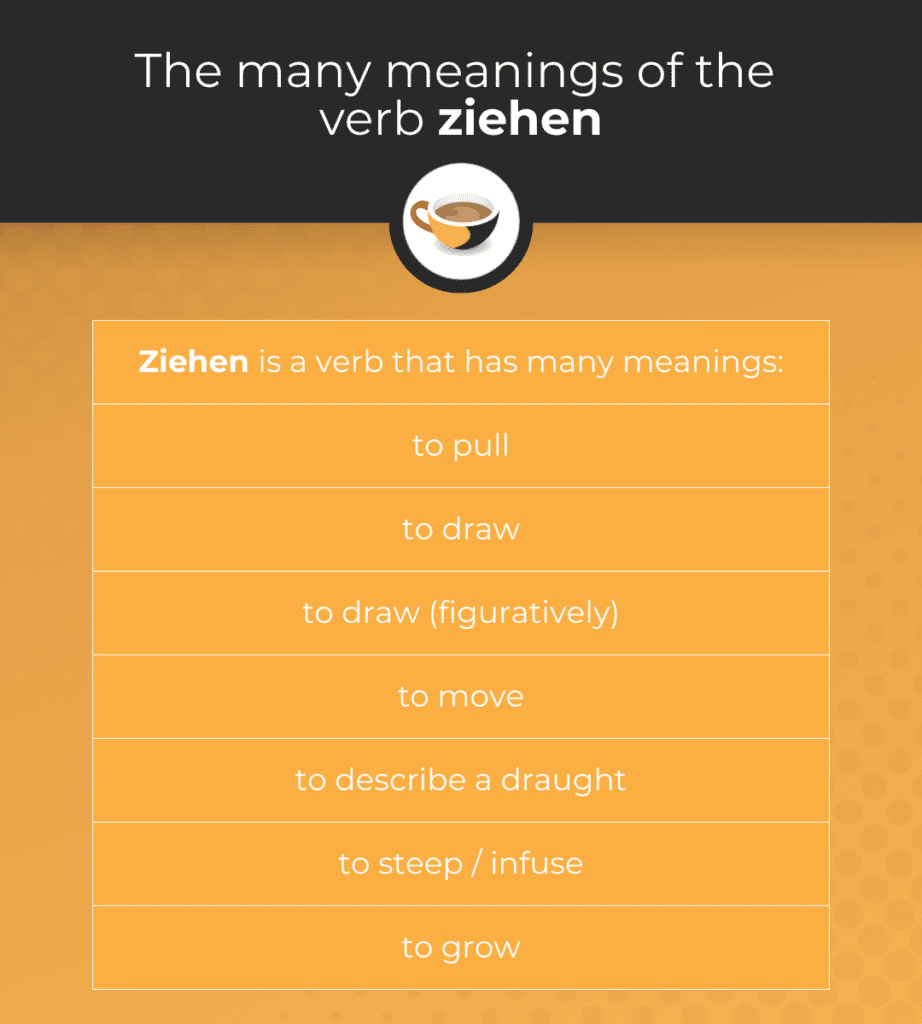
The many uses of the German verb ‘ziehen’

Today, we are looking at a single German word that many learners come across early in their studies: ziehen. You might have seen it on doors, where it means “to pull.”
However, this verb is one of those versatile ones in German and it has multiple meanings depending on the context. Let’s explore some of these diverse uses.
The Coffee Break German Show is a video and audio podcast series of short discussions, in which we explore interesting German language topics. Join Mark and Thomas in our latest episode for a thorough look at this interesting German verb.
Keep reading to find out more, and we’d recommend listening to the podcast episode as you read. Plus, don’t miss our free worksheet at the end to practise what you learn!
What does the verb ‘ziehen’ mean?
We may be familiar with ziehen meaning “to pull”. However, as you’ll see below, it has many different meanings in addition to this.
The core meaning: “to pull”
At its core, it often means “to pull”. This is a straightforward translation that appears in many everyday situations. For example:
Der Hund zieht an der Leine.
The dog pulls on the leash.
Bitte zieh nicht an mir.
Please don’t pull (on) me.
This second example uses the imperative in German and both sentences here show use of the preposition an with the verb ziehen.
Another meaning: “to draw”
A closely-related meaning of this verb is “to draw”, as in drawing a card or drawing conclusions:
Zieh eine Karte.
Draw a card.
Er hat die richtigen Schlüsse gezogen.
He has drawn the right conclusions.
Sometimes, it implies a figurative pull or attraction:
Im Sommer zieht es uns ans Meer.
In summer, we are drawn to the sea.
Es hat keinen Sinn, wir müssen hier einen Schlussstrich ziehen.
It makes no sense, we need to draw a line here.
Further meanings: moving and more
Ziehen also means “to move” in the context of changing residences. For instance:
Wir werden nächstes Jahr nach Japan ziehen.
We will move to Japan next year.
Another common use relates to draughts or wind:
Es zieht, bitte mach das Fenster zu.
There’s a draught, please close the window.
When making tea, the verb also describes the steeping process:
Der Tee muss 5 Minuten ziehen.
The tea needs to steep for 5 minutes.
In a gardening context, it refers to growing plants:
Er zieht die Gurken in seinem Treibhaus.
He grows cucumbers in his greenhouse.
Lastly, let’s see the verb in a practical, everyday situation:
Er zieht den Koffer in das Haus.
He pulls the suitcase into the house.
Time to practise!
Now, it’s time to put everything you’ve learned to the test. Try translating the following sentences into German. You can find the answers at the end of this blog article.
- He pulls his suit out of the wardrobe.
- We are moving to Spain next year.
If you found this interesting, make sure to watch or listen to the full episode with Thomas and Mark on The Coffee Break German Show. To keep up to date with new Coffee Break German episodes and lessons, subscribe to our YouTube channel or our podcast feed, wherever you get your podcasts.
What’s more, you can sign up to receive regular, free German lessons straight to your inbox. Look out for the sign-up box and we hope that you enjoy your first mini lesson.
The verb ziehen is a fantastic example of how German verbs can be incredibly flexible. From pulling and drawing to moving and growing, the verb covers a wide range of actions and scenarios. Understanding its various uses can significantly enhance your comprehension and fluency in German. Keep an eye out for this versatile verb in your reading and listening, and you’ll soon master its many contexts.
In the meantime, happy Coffee Breaking!
PS. Here are the answers to the translation challenge:
- Er zieht seinen Anzug aus dem Kleiderschrank.
- Nächstes Jahr ziehen wir nach Spanien. / Wir ziehen nächstes Jahr nach Spanien.
Listen to the podcast
Italian words used in English: panini, lasagna, bruschetta and more

Panini, al fresco, latte, bolognese… There are many borrowed Italian words used in English. However, we don’t always pronounce them correctly and use them according to their original Italian meaning.
As learners of Italian, it’s fascinating to see how Italian words used in English often get misinterpreted, mispronounced, or completely transformed. This blending of languages is a natural part of linguistic evolution, but it can sometimes lead to funny or confusing situations.
Keep reading to learn about the most common Italian words used in English and how to pronounce them correctly, as well as about how Italians sometimes get creative with English words.
The Coffee Break Italian Show is the podcast series in which we discuss interesting topics for Italian learners. In this episode, Francesca and Maurizio talk about the most commonly used Italian words in English and explain how their meaning or usage changes when transferred from Italian to English. They also explain how to pronounce Italian words that are commonly used in English, such as gnocchi and bruschetta.
We’d recommend watching the video episode as you read this article, in order to get the most out of it. And don’t forget to look out for your free worksheet download at the end, which will allow you to put your knowledge of Italian words used in English to the test.
Iniziamo!
Italian words used in English
As an Italian learner, we’re sure you’ve noticed that, sometimes, Italian words used in English don’t match their original Italian counterpart.
Let’s start by looking at some of the most common Italian words used in English – incorrectly, in some sense or another.
Latte
Used in English to refer to: a milky coffee
Actual meaning in Italian: “milk”
Italian equivalent: “a latte” = un caffellatte / un caffè latte
The first word in our list of Italian words used in English is a very common mistake that English speakers make when they travel to Italy and want to order a coffee in a café, or bar.
As Maurizio explains in the episode, if you order a latte in an Italian bar, you will be served a glass of milk!
Instead, if you want to drink a “latte”, as in a coffee with milk, you should ask for un caffellatte.
Espresso
Used in English to refer to: a short, single shot of coffee
Actual meaning in Italian: “quick”
Italian equivalent: “an espresso” = un caffè
Sticking with the theme of coffee, in Italy people don’t tend to order un espresso in un bar.
Instead, you can simply ask for un caffè, per favore, and it is implied that you mean an espresso.
Al fresco
Used in English to refer to: eating in an outdoor area
Actual meaning in Italian: “in a cool place”
Italian equivalent: “eat al fresco” = mangiare all’aperto or mangiare fuori
In Italian, al fresco simply means “in a cool place”, one that isn’t too warm. It doesn’t necessarily mean that the place is outside – for instance, it could be a room indoors which is cooler than the others.
For example, you may find the phrase on a food label, saying conservare al fresco. This means that it is to be stored in a cool, dry place.
In this episode of The Coffee Break Italian Show, Francesca teaches Maurizio a new phrase from her region of Italy, Piemonte, which is used to refer to an al fresco eating area. Watch the video lesson to learn the phrase, too.
Biscotti
Used in English to refer to: a specific type of crunchy, almond biscuit, usually accompanying a coffee
Actual meaning in Italian: a general word for “biscuits” or “cookies”
Italian equivalent: “a biscotti” = un cantuccio or un cantuccino
There are two ways that the word “biscotti” is used differently in English, compared to its original usage in Italian.
First of all, note that biscotti is simply the general word for any “biscuits” or “cookies”, rather than the specific type that we tend to associate with the word in English. In fact, what we think of as “biscotti” in English are actually called cantucci or cantuccini (which are smaller) in Italian.
Secondly, note that biscotti is the plural form of biscotto. So, while we may say “a biscotti” in English, this isn’t grammatically correct, as in Italian the singular form is un biscotto (“a biscuit / cookie”), and the plural form is dei biscotti (“some biscuits / cookies”).
Panini
Used in English to refer to: a specific type of sandwich
Actual meaning in Italian: “sandwiches”
Italian equivalent: “a panini” = un panino (but this could refer to any type of sandwich)
Another case where a plural Italian noun is incorrectly used in English is panini.
Panini is the plural form in Italian, meaning “sandwiches.” The singular form is panino. For example, you could say:
Vado a comprare un panino.
I am going to buy a sandwich.
Io e Francesca mangiamo dei panini.
Francesca and I eat (some) sandwiches.
So, attenzione! If you just want one sandwich, make sure to use the word panino, instead of panini.
Also note that the word panino in Italian doesn’t refer to any specific type of sandwich, but is instead the general word for “sandwich”.
Lasagna
Used in English to refer to: a layered pasta dish
Actual meaning in Italian: an individual sheet of pasta
Italian equivalent: “lasagna” = le lasagne
The next one of Italian words used in English often incorrectly is lasagna.
So, while in English we use the word “lasagna” to refer to the full dish, in Italian the dish is thought of as a plural noun, le lasagne – referring to the multiple sheets of pasta. For example:
Mia nonna cucina le lasagne la domenica a pranzo.
My grandmother cooks lasagna for lunch on Sundays.
Also watch out for the pronunciation of the gn sound, as it can be tricky to know how to pronounce Italian words such as lasagna, when they are commonly used in English.
Bolognese
Used in English to refer to: a sauce made with tomato and minced meat
Actual meaning in Italian: of or from Bologna
Italian equivalent: “spaghetti bolognese” or “spagbol” = spaghetti al ragù
In Italy, to order what we know as “spaghetti bolognese”, you should ask for spaghetti al ragù. The word bolognese would only be included if the sauce were specifically Bologna-style, in which case it would be ragù alla bolognese (“Bologna-style ragù”).
Peperoni
Used in English to refer to: a type of spicy salami used on pizza (“pepperoni”)
Actual meaning in Italian: “peppers” or “bell peppers”
Italian equivalent: “pepperoni” = salame piccante
The next of our food-related Italian words used in English is “pepperoni”. Note that pepperoni with the double consonant doesn’t exist in Italian, and the correct spelling is with a single p: peperoni.
So, if you want to order a pepperoni pizza in Italy (that is to say a pizza with spicy sausage on it), you should order una pizza con salame piccante.
However, una pizza con peperoni in Italy would be “a pizza with peppers”.
How to pronounce Italian words used in English
Let’s now have a look at some other Italian words used in English, but which are often pronounced differently from their original, correct pronunciation in Italian.
Gnocchi
When used in English, the word gnocchi is often pronounced differently to the original Italian word.
Gnocchi is a plural noun (the singular form is uno gnoccho) and in Italian it refers to the small potato dumplings that are eaten with a sauce.
So, when you’re using the word “gnocchi” to refer to this dish, watch out for the pronunciation of the gn and ch sound in Italian.
Bruschetta
Similarly, do you know how the word bruschetta should be pronounced in Italian?
Bruschetta is another word that is frequently used in English, and it refers to a small dish that consists of toasted bread with tomatoes, olive oil and often other ingredients.
However, while it is often pronounced with a “sh” sound, when it is used in English, the correct Italian pronunciation actually contains a hard C sound – something like “broo-sket-tah”.
Tagliatelle
Tagliatelle is another of our Italian words used in English in the context of food, and it refers to the type of pasta in long, flat strands.
However, the correct Italian pronunciation doesn’t contain a hard G sound. Instead, make sure to pay attention to the gli sound in Italian when pronouncing this word.
English words used in Italian
Just as there are many Italian words used in English that change their meaning as they are transferred from one language to the next, there are also many words in Italian that are based on English words and that change their original English meaning significantly in the process.
Let’s take a look at some of the most common ones, along with some example phrases and sentences.
Smart working
lo smart working
remote working
lavorare in smart working, lavorare in smart
to work remotely
Mister
il mister
the (sports team) coach
Camping
un camping
a campsite
C’è un camping in questa zona?
Is there a campsite in this area?
Footing
il footing
jogging
Smoking
uno smoking
a tuxedo, a dinner jacket

We hope this has helped you see how understanding the correct usage and pronunciation of Italian words used in English can be important in order to avoid confusion and to communicate more effectively, but also be interesting and entertaining!
For more information about all of these Italian words used in English and, in particular, to hear how to pronounce Italian words that are borrowed into English, make sure to watch the video episode, or listen to the podcast version, with Francesca and Maurizio on The Coffee Break Italian Show. You can also subscribe to our podcast feed or our YouTube channel while you’re there, so that you know new episodes from Coffee Break Italian are available.
Looking for more ways to improve your Italian? We send out regular, free email lessons to all of our Coffee Break Italian community who are subscribed to our email list. Look out for the sign-up box and we hope that you enjoy your mini lessons.
In the meantime, we hope that you now feel you know more about common Italian words used in English, and how to use and pronounce them correctly.
Happy Coffee Breaking!
Listen to the podcast
‘Oui’ vs. ‘si’, ‘aussi’ vs. ‘non plus’: what’s the difference?
When learning French, one of the essential skills is knowing how to express agreement or disagreement with positive and negative statements. In this episode of The Coffee Break French Show, we’ll dive into the nuances of using moi si, pas moi / moi non, moi non plus and moi aussi in French.
Understanding these expressions will significantly enhance your ability to communicate effectively in French conversations. So, let’s explore how to say “yes” in French in various contexts.
To get the most out of this article, we’d suggest watching the video or listening to the podcast episode as you read. And don’t forget to look out for your free worksheet download at the end, to help you practise everything you learn. C’est parti !
Positive statement: agreement and disagreement
When you want to agree with a positive statement, you use moi aussi in French. Or, if you want to disagree, you use pas moi or moi non.
Here are some examples:
– J’habite en Écosse.
– Moi aussi.
– I live in Scotland.
– Me too.
– Je suis français.
– Pas moi. / Moi non.
– I am French.
– Not me. / I’m not.
Negative statement: agreement and disagreement
When responding to a negative statement, the expressions change. To agree with a negative statement, you use moi non plus. To disagree, you use moi si.
Let’s see some examples:
– Je ne suis pas japonais.
– Moi non plus.
– I am not Japanese.
– Me neither.
– Je ne parle pas allemand.
– Moi si.
– I don’t speak German.
– I do.
You will know oui to translate “yes”, but when you want to say “yes” after a negative sentence, the only option is si.
Understanding positive and negative statements
It’s important to distinguish between positive and negative statements in terms of grammar. For instance, “I hate broccoli” is grammatically a positive statement, despite its negative connotation.
The key is to focus on the grammatical structure. This means that while “I hate broccoli” is grammatically a positive statement, “I don’t hate broccoli” is grammatically a negative statement, because the verb “hate” is negated.
Practical examples
Let’s test your understanding with a few more examples. Try to identify whether the statements are positive or negative and pay attention to the appropriate response.
– Je n’ai pas de sœur.
– Moi si.
– I don’t have a sister.
– I do.
– Je joue au volley.
– Moi non. / Pas moi.
– I play volleyball.
– I don’t.
– Je ne suis jamais allé en Jamaïque.
– Moi non plus.
– I have never been to Jamaica.
– Me neither.
– T’es jamais allé en Irlande ?
– Si.
– You’ve never been to Ireland?
– I have.
– T’es déjà allé en Irlande ?
– Oui.
– Have you ever been to Ireland?
– Yes.
Here, from the last two examples, we can see that the presence of a negative word in the sentence changes everything. You can say oui if the question does not contain a negation, but you have to say si if there is a negation – here, jamais.
Below is an example using a different negation, ne … plus, which means “not any more”, “no more” or “no longer”.
– Tu n’as plus de café ?
– Si.
– Do you not have any more coffee?
– I do.
This pattern of using si following a negative statement works with all other negative constructions, such as:
ne … jamais
never
ne … personne
nobody, no one
ne … rien
nothing
ne … nulle part
nowhere
ne … pas
not
ne … pas encore
not yet
This list is not exhaustive, but these are some of the most common negative words in French.
Extending beyond ‘moi’
While we’ve been focusing on moi non plus, moi si, pas moi and moi aussi in French, it is important to notice that these structures work with other pronouns as well. For example, toi, lui, elle, nous, vous, eux and elles follow the same pattern. And these expressions can be used with nouns, too.
Examples with pronouns
Let’s look at this in more detail with some examples:
Moi, je ne suis jamais allé à Chypre, mais toi si.
I’ve never been to Cyprus, but you have.
Il aime les croissants – elle aussi.
He likes croissants – she does too.
Elle ne parle pas espagnol – vous si.
She doesn’t speak Spanish – you do.
Examples with nouns
Now, here are some examples using nouns instead of pronouns.
J’adore les croissants et j’adore le chocolat aussi.
I love croissants and I love chocolate, too.
Je n’aime pas les oignons et (je n’aime pas) les concombres non plus.
I don’t like onions and I don’t like cucumbers either.
Je n’aime ni les oignons ni les concombres.
I like neither onions nor cucumbers.
Note that this final example uses a different construction – ni … ni – which you may know as an alternative way of expressing ne … pas … non plus.
Responding to multiple statements
When dealing with multiple statements, it’s essential to react to the last statement, not the original. This ensures clarity and correctness in your responses.
Think about the following situation. Imagine you are eating with three friends at a restaurant and the waiter asks if you want coffee. The first person can reply by saying either oui or non. If the first person to answer says non, it means that the second person now has to react to a negative statement, and the only two options would be moi non plus (if they don’t want a coffee either), or moi si (if they do want a coffee). If the second person does want a coffee and says moi si, it means we are back to a positive statement and person 3 will have to say moi aussi in French if they do want a coffee, or pas moi / moi non if they do not want a coffee.
Let’s look at an example sequence of statements, which will help to make this clearer. Pay attention to which response is used in each statement, depending on whether the previous one was positive or negative.
La France est en Europe.
France is in Europe.
L’Italie aussi.
Italy too.
Pas le Brésil. / Le Brésil, non.
Brazil isn’t.
Le Japon non plus.
Japan isn’t either.
La Belgique si !
Belgium is!
L’Espagne aussi.
Spain too.
La Chine, non. / Pas la Chine.
China isn’t.
L’Australie non plus.
Australia isn’t either.
Le Chili non plus.
Chile either.
Le Portugal si.
Portugal is.
In this article, we have also seen many examples of the names of countries, languages and nationalities. Did you notice which ones are capitalised in French and which are not? For more help with French capitalisation rules, you can find another episode of The Coffee Break French Show here.

Mastering how to say “yes” in French, especially using expressions like moi aussi, pas moi / moi non, moi non plus and moi si, is crucial for effective communication. These expressions help you agree or disagree appropriately with positive and negative statements, enhancing your fluency and confidence in French conversations. Additionally, knowing the difference between moi aussi in French and si in French helps you navigate through agreements and disagreements seamlessly.
However, these expressions can be tricky to get your head around, so for more detailed explanations make sure to watch the video episode with Max and Mark on The Coffee Break French Show, or you can find the podcast version below, or wherever you get your podcasts. And for more lessons from Coffee Break French, you can subscribe to our podcast feed and our YouTube channel.
Additionally, you can sign up for our email lessons to receive regular updates and free learning materials directly to your inbox. Just look out for the sign-up box.
For now, keep practising these responses, and in doing so, you’ll become more adept at how to say non plus, si, pas or aussi in French more naturally and handle various conversational contexts with ease.
Happy Coffee Breaking!
Listen to the podcast
4 ways to translate ‘to become’ in Spanish

Saying “to become” in Spanish can be a tricky task, because there are several verbs that express this concept. Today, we’ll explore the main translations and learn how to use them correctly. If you’re curious about how to say “to become” in Spanish or need tips on how to use these verbs properly, read on!
The Coffee Break Spanish Show is a series of short, informal podcast episodes, in which we discuss tricky but useful topics for Spanish learners. In the latest episode, Anabel and Concha talk through the four main verbs that are used in Spanish to express “to become”.
Listen along to the audio episode, or watch the video version while you read this article. Once you reach the end, don’t miss your free worksheet which you can download to put what you’ve learned to the test. ¡Vamos allá!
‘Convertirse en’
The first possible translation of “to become” in Spanish is convertirse en. This reflexive verb, which also requires a preposition, indicates a radical or complete change, similar to “turn into” in English. Por ejemplo:
Joaquín se ha convertido en una estrella mundial.
Joaquín has become an international star.
We can also use a variation of this structure to discuss religious beliefs. For that, we change the preposition and say convertirse a.
Nos convertimos al cristianismo.
We converted to Christianity.
Convertir is an irregular verb, which means that convertirse en/a is irregular, too. If you’d like to brush up the conjugation of radical changing verbs in Spanish, you may want to listen to our podcast episode about irregular verbs in the present tense.
‘Llegar a ser’
Another way to express “to become” is by using llegar a ser. The first thing that we have to mention about this verb is that we only conjugate the first verb (llegar). For instance, the present tense of llegar a ser is:
(yo) llego a ser
(tú) llegas a ser
(él/ella/usted) llega a ser
(nosotros/nosotras) llegamos a ser
(vosotros/vosotras) llegáis a ser
(ellos/ellas/ustedes) llegan a ser
Meaning-wise, llegar a ser is similar to convertirse en, but it emphasises that the change happened after significant effort.
Having said that, llegar a ser and convertirse en can sometimes be interchangeable. However, don’t forget that llegar a ser has that subtle meaning added.
Let’s see an example:
Después de mucho trabajo, Rosa llegó a ser la presidenta del país.
After a lot of work, Rosa became the president of the country.
‘Hacerse’
Hacerse is a reflexive verb used to talk about changes in age, profession, wealth, or ideology. In the following example we can see a combination of some of these uses.
Me hago mayor, pero también me hago más rico.
I’m becoming older, but also richer.
This verb can also be used to describe external changes. For example:
Se hace tarde.
It’s getting late.
‘Ponerse’
Ponerse is used for changes in mood, state of mind, or physical state that are often uncontrollable. It’s commonly used with emotions.
Nos pusimos muy tristes después de la película.
We became very sad after the film.
It can also describe uncontrollable physical changes, like in the following example:
Lucía se pone pálida cuando se pone enferma.
Lucía becomes pale when she gets sick.
Visual summary of how to say “to become” in Spanish

Understanding these nuances will help you master how to say “to become” in Spanish and use the right translation in different contexts. Keep practising these structures, and soon you’ll feel more confident in your Spanish conversations.
¡Eso es todo por ahora! We hope that now you feel more comfortable and start using these different verbs to express “to become” in Spanish. If you found this article useful, why not listen to the full episode with Anabel and Concha on The Coffee Break Spanish Show? For more episodes for Spanish learners, make sure to subscribe to our podcast feed and our channel on YouTube.
As well as this, you can sign up to receive regular, free email lessons to help you improve your Spanish. You will also receive language-learning tips and tricks from Mark, the founder of Coffee Break Languages. Sign up below!
Mucha suerte and, as always, happy Coffee Breaking!
Listen to podcast
Using colours in German: when to adjust endings, hyphenate or use capitals

In this article, we’re not just learning the colours in German. You might pick up a few new words, but we’re focusing on how to use them as adjectives, what to keep in mind regarding spelling, and some key questions surrounding them.
The Coffee Break German Show is a video and audio podcast series in which we talk about interesting topics for German learners. In this episode, Mark and Thomas explain everything you need to know about colours in German.
To get the most out of this article, listen to the podcast as you read along. Once you reach the end, make sure to download your free worksheet to practise what you’ve learned.
So, let’s start!
Some well-known and lesser-known colours in German
Before we move on and look at some important grammatical rules surrounding colours, let’s have a quick look at some example colours that you might already be familiar with, but also at some potentially new ones.
schwarz
black
rosa
pink
weiß
white
silber
silver
rot
red
lila
purple
blau
blue
blaugrau
cyan
grün
green
beige
beige
gelb
yellow
kastanienbraun
maroon
Basic colours in German as adjectives
Basic colours follow the same rules as other adjectives, changing their endings depending on number, gender and case. For example:
die blaue Wand
the blue wall
ein blauer Hund
a blue dog
Bitte mach den schwarzen Fleck weg.
Please remove the black spot.
These sentences show how colours are used in different contexts.
Exotic colours
When it comes to “exotic” colours like purple, pink, orange, and turquoise, the rules are a bit different. They do not always change their endings:
Ich liebe diesen lila Schal.
I love this purple scarf.
Ein rosa Kleid ist mir am liebsten.
A pink dress is my favourite choice.
These sentences sound fine and are grammatically correct.
However, while it works to use lila and rosa without adding or adjusting the ending based on the case and gender, it does not only sound strange, but is also incorrect for other colours.
Let’s take the example colour “orange” and look at the different options for its use in a sentence:
Ich habe einen orange Stift.
I have an orange pen.
This sentence is not correct and doesn’t sound natural in German.
The following sentence, however, is acceptable in spoken, colloquial German:
Ich habe einen orangen Stift.
I have an orange pen.
The next option is the grammatically correct solution:
Ich habe einen orangefarbigen / orangefarbenen Stift.
I have an orange-coloured pen.
As seen in the earlier examples, colours like lila and rosa didn’t used to have an ending that changes. However, language is evolving and moving towards having adjustable endings for all colours. For example:
Ich liebe diesen lilanen Schal.
I love this purple scarf.
This evolution of language applies to German colours as well as colours that have come into German from other languages, such as beige from French. Previously, they would not have followed the same rules on agreements, but now they do, especially in spoken German.

Colours in German derived from nouns
Colours in German can also be derived from nouns, such as:
lachsfarben
salmon-coloured
rostfarben
rust-coloured
For example:
ein lachsfarbener Pulli
a salmon-coloured jumper / sweater
Spelling of shades of colours in German
Shades of colours are always written as one word. For instance:
hellblau
light blue
dunkelrot
dark red
olivgrün
olive green
goldgelb
golden yellow
If something were described as being of two colours, e.g. “a red and blue jumper”, it is written with a hyphen. For example:
blau-rot
blue-red
Colours as nouns
When used in combination with an article or certain prepositions, colours can be used as nouns and need to be capitalised.
das Blau des Himmels
the blue of the sky
Gibt es diesen Rock auch in Türkis?
Is this skirt also available in turquoise?

Idioms with colours
To finish off with today’s topic, let’s look at two interesting German idioms involving colours.
ins Blaue fahren
to go without a specific plan (literally, “to go into the blue”)
For example:
Wir haben noch keinen genauen Plan, wir fahren einfach ins Blaue.
We don’t have an exact plan yet, we’re just going with it / going with the flow.
Here’s another nice idiom involving a colour in German:
der rote Faden
the central theme, the consistent element (literally, “the red thread”)
For example:
Dieser Geschichte fehlt der rote Faden.
This story lacks a central theme.
In conclusion, colours in the German language have a whole range of rules to keep in mind. Some are set: such as when to use a hyphen or a capital letter. Others, like the adjective endings, are still evolving and changing. Traditionally, “exotic colours”, when used as an adjective, did not have an adjustable ending like “standard” colours, and had to use a workaround using -farbigen/-farben. However, German has changed and is moving towards using the same rules for all colours, meaning an added ending that changes depending on case, number and gender.
To get the most out of this article, watch or listen to the full episode with Thomas and Mark on The Coffee Break German Show. We regularly release new episodes for German learners, so make sure to subscribe to our YouTube channel and our podcast feed so that you are notified when the next one is available.
Looking for more help with your German? You should know that we regularly send out free, mini German lessons to our Coffee Break German community. Look out for the sign-up box, and we hope that you enjoy your first lesson.
In the meantime, happy Coffee Breaking!
Listen to the podcast
‘Un amico vecchio’ or ‘un vecchio amico’? Understanding Italian adjective placement

When you first started learning Italian, you probably learned that, unlike in English, adjectives come after the noun they describe. However, there is more to Italian adjective placement than meets the eye.
In fact, there are various adjectives in Italian that can either be placed after or before the noun, and which change their meaning depending on their position.
Italian adjective placement is a topic that many of our Coffee Break Italian learners ask us about, which is why we’ve made it the focus of our latest podcast episode. The Coffee Break Italian Show is an audio and video podcast series, in which we take an in-depth look at interesting Italian topics. In this episode, Francesca and Mark discuss Italian adjective placement and, in particular, the specific adjectives in Italian that can go before or after the noun.
We recommend listening to the podcast episode while you read for further explanation and to hear all of the examples read aloud. And don’t forget to download your free worksheet, so that you can practise what you learn in this article.
Italian adjective placement: the basic rule
The general rule is that adjectives in Italian come after the noun they describe. This might seem straightforward, but it’s different from English, where adjectives typically precede the noun. Here are a couple of examples:
Ho comprato un cappotto verde.
I bought a green coat.
Bolzano è una città italiana.
Bolzano is an Italian city.
These sentences illustrate the standard rule of Italian adjective placement. However, as with many rules, there are exceptions and subtleties. Let’s move onto these now.
Adjectives in Italian that can come before or after the noun
There are some adjectives in Italian that can either precede or follow the noun, but their meaning changes depending on their position.
Let’s explore some common examples.
‘alto’ = tall / high
The basic meaning of the adjective alto or alta is “tall”. For example:
un funzionario alto
a tall official
This phrase tells us that this person is not short (basso).
However, alto/a can also be placed before the noun it describes. Let’s see what happens when this is the case:
Luigi è un alto funzionario.
Luigi is a high-ranking official.
This time, alto is used to describe Luigi’s importance or rank, rather than a physical attribute.
As a general rule, when it comes to Italian adjective placement, if an adjective comes after the noun (as we would usually expect from adjectives in Italian), it carries its basic, more literal meaning. If an adjective comes before the noun, it often carries an alternative, secondary or more figurative meaning.
‘grande’ = big / great
When the adjective grande comes after a noun, it refers to a person’s physical size. For example:
un poeta grande
a large poet
If grande comes before a noun, however, it refers to a person’s significance:
un grande poeta
a great poet
Here, we know that this is an important poet – one who is very good and writes wonderful poetry. For example:
Dante fu un grande poeta.
Dante was a great poet.
Did you notice the interesting verb fu in this example that Francesca used in the episode? Fu comes from essere in the past historic or passato remoto.
‘vecchio’ = old / long-time
When vecchio or vecchia comes after a noun, it refers to a person’s age. For instance:
un’amica vecchia
an old / elderly friend
Just as we saw earlier with alto/a, when it comes to Italian adjective placement, an adjective usually carries its basic, literal meaning when it comes after the noun.
However, when vecchio or vecchia comes before a noun, it carries a slightly different meaning:
Monica è una mia vecchia amica.
Monica is an old friend of mine.
Here, vecchia tells us that Monica is a friend this person has known for a long time, but she could be very young!
‘bello’ = beautiful / good
The next of our adjectives in Italian for this article is bello or bella.
When it comes after a noun, bello/a refers to physical appearance. For example:
una persona bella
a beautiful person
When it comes before a noun, however, it describes a more internal beauty. For example, here it could mean that this person is morally good, generous or has a big heart.
una bella persona
a good person
Remember that the adjective bello/a undergoes spelling changes when it comes before a noun, depending on what comes after it. In fact, it follows the same pattern as the definite articles in Italian.
Note that you may hear bello/a coming before the noun, but still referring to physical beauty. In the episode, Francesca explains that it is very instinctive to put bello/a before the noun, because of the similarities in sound with the definite article.
For example, you may hear:
una bella ragazza
a beautiful girl
un bel ragazzo
a beautiful boy
Here, in everyday conversation, the adjective could still be carrying the basic meaning of “beautiful”, as opposed to “good”, but bello/a is often used in this way, particularly for extra emphasis.
‘buono’ = kind / skilled
Our next adjective is interesting to investigate in terms of Italian adjective placement. When the adjective buono or buona comes after the noun, it refers to goodness in someone’s personal qualities. For example:
un professore buono
a kind teacher
When buono/a comes before a noun, however, it refers to ability, skill or competency:
un buon professore
a good / skilled teacher
Remember that, like bello/a, the adjective buono/a undergoes spelling changes depending on what comes after it.
‘nuovo’ = brand-new / additional
Nuovo/a is also an interesting and commonly used example in the context of Italian adjective placement.
When nuovo/a is placed after a noun, it refers to something that is “new”, as in newly made, or brand-new. For example:
Ho comprato un maglione nuovo.
I bought a new jumper / sweater.
However, in the next example, the jumper could be second-hand:
Hai comprato un nuovo maglione?
Have you bought a new jumper / sweater?
When nuovo/a comes before the noun, it simply means that it is new to the person or owner, and it is often translated as “another”.

That’s it for today’s look at Italian adjective placement and, in particular, the specific adjectives in Italian that change their meaning depending on their position.
Understanding these nuances can seem daunting at first, but don’t let it discourage you. As you read and listen to Italian, notice how native speakers use Italian adjective placement, and try to guess the subtle meanings as a result of this. With time and practice, it will start to feel more intuitive.
For a more detailed explanation of Italian adjective placement, you can watch or listen to the podcast episode with Francesca and Mark on The Coffee Break Italian Show. And by subscribing to our podcast feed or our YouTube channel while you’re there, you’ll be notified when we release our next episode.
In the meantime, for more help with your Italian, you can sign up for our free email lessons, which we send out to Italian learners on a regular basis. Look out for the sign-up box and we hope that you enjoy them.
So, next time you meet someone new or describe something in Italian, think about your Italian adjective placement. Is it un amico vecchio or un vecchio amico? The difference is subtle, but sometimes important!
Happy Coffee Breaking!
Listen to the podcast
How to form and use superlatives in French
Superlatives in French are essential for expressing the highest or lowest degree of a quality. Whether you are comparing adjectives, adverbs, verbs, or nouns, understanding the rules and exceptions will considerably help you sound more natural.
In this episode of The Coffee Break French Show, Max and Pierre-Benoît take a closer look into the world of superlatives in French. We’ll explore various structures and uses, providing clear examples and highlighting key exceptions and specific rules. The Coffee Break French Show is a podcast series designed to break down complex French language topics into engaging, bite-sized conversations.
Continue reading to enhance your understanding of superlatives in French, and listen along to the podcast episode to hear the pronunciation and usage in context. Don’t forget to check out the free worksheet at the end to practise what you learn!
The basics
Let’s start with the basics:
le plus
the most
le moins
the least
With adjectives
To say that something is “the most” something, you need the definite article (le, la or les), followed by the word plus and the adjective. For example:
le plus cher
the most expensive (masculine)
la plus chère
the most expensive (feminine)
les plus chers / chères
the most expensive (plural, masculine / feminine)
The structure is very similar to say “the least” something. We use le, la or les, followed by moins and the adjective.
le moins cher
the least expensive (masculine)
la moins chère
the least expensive (feminine)
les moins chers / chères
the least expensive (plural, masculine / feminine)
Further examples:
le plus beau / le plus sérieux
the most handsome / the most serious (m)
la plus belle / la plus sérieuse
the most beautiful / the most serious (f)
les plus beaux / les plus sérieux
the most handsome / the most serious (plural, m)
les plus belles / les plus sérieuses
the most beautiful / the most serious (plural, f)
When it comes to the pronunciation of plus and moins, the final –s is normally kept silent, although you may occasionally find people from specific regions who choose to pronounce the final –s.
However, if the adjective starts with a vowel, you then have to make a z sound liaison between plus / moins and the adjective.
With ‘bon’ & ‘mauvais’
The superlative forms of the adjectives bon / bonne (“good”) and mauvais / mauvaise (“bad”) are irregular.
le meilleur / la meilleure / les meilleurs / les meilleures
the best (m singular / f singular / m plural / f plural)
le pire / la pire / les pires
the worst (m singular / f singular / m & f plural)
With ‘petit’
Petit / petite is an interesting word. It means “small” and it can be in the sense of size, but also in the sense of significance. And the way to form the superlative of petit is different depending on its meaning.
Size or measurement:
le / la / les plus petit(e/s)
the smallest, the shortest
Value or importance:
le moindre problème / souci
the slightest problem / worry
As you can see with the examples, le plus petit, la plus petite, les plus petits and les plus petites are the correct ways to translate “the smallest” or “the shortest” when referring to size or measurement. When petit is about importance / significance, then you have to use le moindre, la moindre, les moindres.
With adverbs
It is also possible to use superlatives in French with adverbs. The structure is very similar and all you need is le followed by plus or moins.
le plus / moins sérieusement
the most / least seriously
le plus rapidement / vite
the fastest, the quickest
le plus tôt / tard
the earliest / latest
Remember, adverbs are not gendered. This means that even if the subject is feminine, there is no agreement. For example:
C’est elle qui court le plus rapidement.
It is she who runs the fastest.
With ‘bien’ & ‘mal’
We saw earlier that “good” and “bad” (bon and mauvais) follow a different rule than other adjectives when using superlatives in French. Similarly, the adverb bien (“well”) also follows a different rule.
C’est moi qui chante le mieux.
I’m the one who sings best.
C’est elle qui chante le plus mal.
She is the one who sings the worst.
As you can see from the examples, the superlative of bien is le mieux. The superlative of mal is le plus mal. Again, there is no feminine or plural version.
With verbs
Superlatives in French with verbs follow the same structure. Consider these examples:
parler le plus
to speak the most
travailler le moins
to work the least
Interestingly, the final –s in plus is normally pronounced. Regarding moins, the final –s is usually not pronounced. However, it is pronounced in some regions of France, so don’t be alarmed if you hear different pronunciations!
With nouns
Having looked at adjectives, adverbs and verbs, let’s now look at examples of superlatives in French with nouns:
le jour où il y a le plus / le moins de monde
the day when there are the most / least people
le jour où il y a le plus de soleil
the day with the most sun
Remember, when de is followed by a noun starting with a vowel, it becomes d’.
le plus d’énergie / d’argent
the most energy / money
le moins d’énergie / d’argent
the least energy / money
Other things to consider
If the superlative is placed after the noun, the article needs to be repeated, which is quite different from English. Regardons ces exemples :
le plus beau village de France
the most beautiful village in France
le village le plus beau de France
the village that is the most beautiful in France
la plus belle ville de France
the most beautiful city in France
la ville la plus belle de France
the city that is the most beautiful in France
la plus chère voiture électrique
the most expensive electric car
la voiture électrique la plus chère
the electric car that is the most expensive
Testing examples
Now, let’s put your newfound knowledge to the test! Here are three sentences in English; your challenge is to translate them into French. Remember to try to identify whether the superlatives involve an adjective, a verb, an adverb or a noun! You can find the answers at the end of this article.
- It’s Mary who is the tallest.
- It’s John who has the most energy.
- She sings the best and she is the best singer.

Understanding superlatives in French, including their structure and usage with different parts of speech, is crucial for expressing extremes and comparisons effectively. Practising these superlatives in various contexts will help you become more fluent and accurate in your French communication. Additionally, knowing the difference between mieux vs. meilleur is key to mastering comparatives and superlatives in French.
Don’t forget to listen to our podcast episode on superlatives in French with Max and Pierre-Benoît on The Coffee Break French Show. And make sure to subscribe to our podcast feed and our YouTube channel to stay updated with new lessons and episodes.
Additionally, you can sign up for our email lessons to receive regular updates and learning materials directly to your inbox. Look out for the sign-up box to start receiving more insights and practice materials.
Happy Coffee Breaking!
PS. Here are the answers to the translation challenge:
- C’est Mary qui est la plus grande.
- C’est John qui a le plus d’énergie.
- Elle chante le mieux et elle est la meilleure chanteuse.
Listen to the podcast
The subjunctive in Spanish: all you need to know to start using it

Learning Spanish can be both exciting and challenging, especially when you encounter the subjunctive mood. If you’re wondering, “what is the subjunctive in Spanish?” or “when to use subjunctive in Spanish?”, you’re in the right place.
This article will guide you through understanding and using the subjunctive in Spanish, focusing on present subjunctive conjugation and common triggers.
The Coffee Break Spanish Show is a series of short, informal podcast episodes, in which we discuss tricky but useful topics for Spanish learners. In the latest episode, Anabel and Mark introduce the present subjunctive, showing how the regular verbs are conjugated and some common triggers.
Listen along to the audio episode, or watch the video version while you read this article. Once you reach the end, don’t miss your free worksheet which you can download to put what you’ve learned to the test. ¡Vamos allá!
What is the subjunctive in Spanish?
The subjunctive is a mood in Spanish.
Unlike tenses, which tell us when something happens, a mood shows how the speaker feels about the action.
The important thing with the subjunctive in Spanish is not what we are saying but how we are saying it.
This mood is used to express wishes, probabilities, possibilities, prohibitions, orders, or doubts.
How to conjugate the present subjunctive in Spanish
To form the present subjunctive, you’ll need to follow these steps:
- Conjugate the present indicative first person singular (yo form) of the verb.
- Take away the -o.
- Add the endings according to whether it is an –AR, –ER or –IR type of verb.
Now, let’s look at the specific endings, along with an example.
-AR verbs
The present subjunctive endings for the –AR verbs are:
-e
-es
-e
-emos
-éis
-en
Now, let’s use the verb hablar (“to talk”) to illustrate this.
- Present indicative of the yo form: hablo.
- Remove the -o: habl-.
- Add the subjunctive endings: hable, hables, hable, hablemos, habléis, hablen.
-ER & -IR verbs
The present subjunctive endings for the –ER and -IR verbs are the same and are as follows:
-a
-as
-a
-amos
-áis
-an
Let’s take an irregular verb in the present indicative like salir (“to leave”) to see how it is conjugated in the subjunctive mood.
- Conjugate the present indicative of the yo form: salgo.
- Remove the -o: salg-.
- Add the subjunctive endings: salga, salgas, salga, salgamos, salgáis, salgan.
If you’d like further explanation and more practice of the conjugation of the present subjunctive in Spanish, you can listen to this episode of Coffee Break Spanish. La práctica hace al maestro (“practice makes perfect!”).
A summary of how to conjugate present subjunctive


As you can see, the endings of the subjunctive are very similar to the present indicative. Actually, what we have done is swap the vowels, so we use E in the –AR verbs and A in the -ER and -IR verbs. Mira:
comer (indicative): como, comes, come, comemos, coméis, comen
comer (subjunctive): coma, comas, coma, comamos, comáis, coman
When to use subjunctive in Spanish
The subjunctive in Spanish needs to be triggered by specific expressions or contexts. For today’s lesson, we’ll focus on expressions that trigger the subjunctive. These expressions often convey wishes, doubts, or uncertainty.
Common triggers for the subjunctive
Here are some common expressions that trigger the subjunctive:
Ojalá
Ojalá is a very useful adverb that can be translated as “I hope”. It is used to express a wish, and as Mark says in the episode, it’s the idea of “fingers crossed”, when hoping that something happens. For example:
¡Ojalá mañana salga el sol!
I hope the sun comes out tomorrow!
Quizás
Quizás means “perhaps” or “maybe” and it is used to express possibility or probability. An interesting point to note is that this word can be used as quizás and quizá – they are interchangeable! Let’s see now how it works in an example:
Quizás mañana hable con mi madre.
Maybe tomorrow I will speak to my mum.
Another thing that we must keep in mind is that quizá/quizás triggers the indicative and the subjunctive. Using one or the other changes the meaning subtly. Note this difference in probability in the following sentences.
Quizás vaya.
Maybe I will go (but this is unlikely to happen).
Quizás voy.
Maybe I will go (and it is likely to happen, so count me in).
Practice makes perfect
Let’s put this into practice with some translation exercises. Try translating these sentences from English into Spanish. Remember that we are trying to use the triggers covered in the episode. You’ll find the suggested translations at the end of this article. ¡Mucha suerte!
- I hope I can go on holiday this summer.
- Perhaps they will arrive a bit late.
Remember, the key to mastering the subjunctive in Spanish is practice. Keep using these expressions and conjugations in your sentences, and soon it will become second nature.
¡Y hasta aquí esta introducción al subjuntivo en español! We hope you now feel more comfortable knowing how to form the subjunctive in Spanish and how to use some of its triggers, like ojalá and quizás.
If you found this article useful, why not listen to the full episode with Anabel and Mark on The Coffee Break Spanish Show? For more episodes for Spanish learners, make sure to subscribe to our podcast feed and our channel on YouTube.
As well as this, you can sign up to receive regular, free email lessons to help you improve your Spanish. You will also receive language-learning tips and tricks from Mark, the founder of Coffee Break Languages. Sign up below!
Understanding the subjunctive in Spanish is a crucial step in your language-learning journey. By recognising triggers and practising the conjugation, you’ll soon feel more confident in using this mood. If you’d like to include more subjunctive in your daily conversation, you may find this video interesting, in which Mark and Marina explain how to use quisiera in Spanish.
Whether you’re expressing wishes, doubts, or possibilities, knowing how to make a subjunctive sentence in Spanish will enhance your communication skills and deepen your understanding of the language. Mucho ánimo usando el subjuntivo, and, as always,
Happy Coffee Breaking!
PS. Here are the answers to the translation challenge:
- Ojalá pueda ir de vacaciones este verano.
- Quizás lleguen un poco tarde.
Listen to the podcast
The imperative in German: how to make suggestions and give commands

In this article, we’ll explore key verbs and their imperative forms, distinguishing between when you’re addressing one person or multiple people, and depending on whether or not you’re part of the group.
The Coffee Break German Show is a podcast series in which we discuss useful and tricky topics for anyone learning German. In the most recent episode, Mark and Thomas explain how to construct the imperative forms of verbs in order to make suggestions and give commands in German.
We recommend listening to the podcast as you read this article, and make sure to download your free worksheet at the end to put your knowledge to the test.
So, are you ready to learn more about the imperative in German?
Then, keep reading this post!
Using ‘lassen’ in the imperative for suggestions
The verb lassen is commonly used when you’re part of the group. It’s perfect for making inclusive suggestions.
If referring to yourself + one more person, the imperative informal singular form of lassen (lass) is used. If you are making a suggestion for you + two or more people, the imperative informal plural form of lassen (lasst) is used. You will find out how to create these verb forms in just a second.
Here are some examples:
Lass uns anfangen.
Let’s get started.
Lass uns spazieren gehen.
Let’s go for a walk.
Lass uns einen Kaffee trinken gehen.
Let’s go have a coffee.
Lasst uns eine Pause machen.
Let’s (all) take a break.
The imperative forms
When giving commands and you are not part of the group, you’ll use the imperative. The German imperative form can vary based on the formality and number of people you’re addressing. There are three imperative forms:
- informal singular
- informal plural
- formal
Informal singular: ‘du’
For the informal singular imperative in German, you drop the -st ending from the second person singular form – the du form of the verb. Let’s see some examples of verbs in the du form of the present tense, followed by an imperative example, in order to compare.
sagen (“to say”):
du sagst
you say
Sag bitte etwas.
Please say something.
helfen (“to help”):
du hilfst
you help
Hilf mir!
Help me!
Note the vowel change in both of these forms of the verb.
schlafen (“to sleep”):
du schläfst
you sleep
Schlaf gut.
Sleep well.
Note that there is an umlaut in the present tense form of the verb, but not in the imperative form.
warten (“to wait”):
du wartest
you wait
Note that there is an -e- added before the -st, because the stem ends in -d or -t.
Warte auf mich!
Wait for me!
Warte nicht auf mich!
Don’t wait for me!
Informal plural: ‘ihr’
For the informal plural imperative in German, we simply use the ihr form without the pronoun (ihr). Here are some examples:
Stellt die Kisten in die Garage.
Put the boxes in the garage.
To make commands more polite, add bitte (“please”), which can be placed anywhere in the sentence.
Stellt bitte die Kisten in die Garage.
Please put the boxes in the garage.
Formal: ‘Sie’
For formal commands in the imperative in German, use the infinitive form followed by Sie:
Warten Sie bitte einen Moment.
Please wait a moment.
Nehmen Sie bitte Platz.
Please take a seat.
Using the “we” form of the imperative in German
When you are part of the group and addressing one or more people, we have seen that we can use lassen (in the imperative) plus the main verb. However, another option is to use the “we” form of the imperative of the main verb.
For example:
Fangen wir an!
Let’s start!
Gehen wir spazieren.
Let’s go for a walk.
Gehen wir schwimmen.
Let’s go swimming.

Practising German commands
To practise what you’ve learned, try translating these sentences using the German imperative form. You can check your answers at the end of the blog post.
- Let’s go to the beach.
- Answer my question. (plural)
- Please do not touch the picture. (formal)
- Let’s watch a movie.
For more practice like this, look out for the button to download your free worksheet.
If you found this interesting, make sure to listen to the full episode with Thomas and Mark on The Coffee Break German Show. We will regularly be uploading more episodes for German learners, so make sure to subscribe to our podcast feed and our channel on YouTube to find out when the next episode is available.
Plus! To get regular, free German lessons in your inbox, you can sign up for our short (coffee-break-sized) email lessons that will help you improve your German. You will also hear from Mark, the founder of Coffee Break Languages, giving advice for language learners at any level. Sign up below!
Getting to grips with the imperative form will help you make suggestions and give commands effectively in German. Practise using these examples and soon it will become second nature.
Happy Coffee Breaking!
PS. Here are the answers to the translation challenge:
- Lass uns an den Strand fahren. / Fahren wir an den Strand.
- Beantwortet meine Frage.
- Bitte berühren Sie das Bild nicht. / Berühren Sie das Bild bitte nicht.
- Lass uns einen Film anschauen. / Schauen wir einen Film an.
Listen to the podcast
UN’ or UN? Indefinite articles in Italian

Do you know when to use un’, with the apostrophe, and when to use un, without the apostrophe? Un’ and un are both indefinite articles in Italian, and they’re easy to get mixed up if you’re a learner of the language.
This is why it’s the topic of our latest episode of The Coffee Break Italian Show, which is a podcast series in which we discuss and explain interesting and tricky topics for Italian learners. Join Francesca and Maurizio in this episode to learn the difference between un’ and un in Italian.
We recommend listening to the podcast episode while you read, and don’t forget to download your free worksheet at the end, to help you practise what you learn.
Iniziamo!
Understanding indefinite articles in Italian
Before we get into the difference between un’ and un, let’s start with a quick reminder of what we mean by indefinite articles in Italian.
Indefinite articles are used to refer to unspecified, or non-specific nouns.
In English, the indefinite articles are “a” and “an”. In Italian, there are different indefinite articles, depending on the gender and number of the noun they refer to.
In this article, we are focusing on two of the indefinite articles in Italian: un’ and un.
What’s the difference between UN’ and UN in Italian?
Un’ and un are easily mixed up by Italian learners in writing because the pronunciation is identical.
If you find the difference between un’ and un tricky to understand, don’t worry, as native speakers also mix them up from time to time. But this article will help you to understand the difference.
When to use UN
Un is the indefinite article that is used with most masculine singular nouns in Italian. For example:
un fratello
a brother
un problema
a problem
The noun problema is an interesting one. As it ends in -a, you may think that it would be a feminine noun, but it is actually a masculine noun.
The indefinite article un is also used with masculine singular nouns that start with a vowel. For example:
un amico
a (male) friend
However, remember that un is not the only masculine Italian indefinite article. We also have uno, which is used with masculine singular nouns that begin with certain consonants or combinations of sounds, specifically: s+consonant, z, x, y, gn, ps, pn. For instance:
uno studente
a student
uno zaino
a backpack
These are the nouns that are used with lo, when it comes to definite articles in Italian (the words for “the”).
Remember: un is never used with feminine nouns.
When to use UN’
Un’ is used before some feminine singular nouns in Italian.
The indefinite article that is used before most feminine singular nouns is una. For example:
una casa
a house
una ragazza
a girl
una mela
an apple
However, when a feminine singular noun starts with a vowel, the apostrophe replaces the -a in una to give us un’ and therefore make the pronunciation smoother. Here are some examples:
un’amica
a (female) friend
un’ape
a bee
un’emozione
an emotion
un’isola
an island
un’ombra
a shadow
un’unghia
a (finger/toe)nail
So, we drop the -a from the end of una, and add the apostrophe to remind us that it would be there.
In the episode, Maurizio and Francesca mention their interesting way of remembering why the apostrophe is there. Make sure to watch the video or listen to the podcast episode to hear why they like to think of the apostrophe as a teardrop!
A common mistake for Italian learners: UN’ or UN?
When it comes to indefinite articles in Italian, one mistake that is commonly made by both Italian learners and native speakers is using un’ with masculine nouns that start with a vowel, which is never correct. Masculine nouns starting with vowels still use un. For example:
un amico
a (male) friend
un uomo
a man
Remember: un’ is never used with masculine nouns.

Practising indefinite articles in Italian: UN’ vs. UN
It’s time to consolidate what you’ve learned about indefinite articles in Italian – in particular, un’ and un. Choose the correct indefinite article for each noun listed below. When you’re ready, you will find the answers at the end of this article.
- __ azione (“action”)
- __ attore (“actor”)
- __ uovo (“egg”)
- __ oca (“goose”)
- __ arancia (“orange”)
- __ arancio (“orange tree”)
We hope you’ve enjoyed learning about the difference between un’ and un – two of the indefinite articles in Italian.
Remember: by paying attention to the gender of the noun and the letter it begins with, you’ll be able to choose the correct indefinite article in Italian more confidently.
To get the most out of this article, watch the video lesson with Francesca and Maurizio on The Coffee Break Italian Show, or you can listen to the podcast version wherever you get your podcasts. While you’re there, don’t forget to subscribe to our podcast feed or our YouTube channel so that you are notified whenever there is something new from Coffee Break Italian.
And for more help with your language skills, you can sign up for regular, free email lessons, which we send out to our Coffee Break community of Italian learners. Look out for the sign-up box below.
In the meantime, happy Coffee Breaking!
PS. Here are the answers to the fill-in-the-gap challenge:
- un’azione (feminine noun starting with a vowel)
- un attore (masculine noun)
- un uovo (masculine noun)
- un’oca (feminine noun starting with a vowel)
- un’arancia (feminine noun starting with a vowel)
- un arancio (masculine noun)
Listen to the podcast
French liaison rules: when not to make the liaison

Liaisons in French are essential for fluent and natural speech. However, some liaisons are forbidden and sound particularly unnatural to native speakers. In this article, we’ll take a closer look at French liaison rules – in particular, identifying when liaisons should not be made.
What is a liaison? The word “liaison” refers to the linking of the final consonant of one word to the initial vowel of the next.
When not to make the liaison can be a tricky topic for French learners, which is why it is the focus of our latest episode of The Coffee Break French Show – a podcast series in which we explore and explain interesting French language topics. Join Max and Mark in this episode, who will help you avoid common mistakes and sound more natural in your French conversations by following proper French liaison rules.
Listen along to the podcast episode as you read this article, so that you can hear all of the words and phrases spoken out loud. And once you reach the end, look out for your free worksheet download, which will allow you to put your knowledge to the test.
C’est parti !
H-words: ‘h aspiré’ vs. ‘h muet’
When it comes to French liaison rules, some words beginning with h- block liaisons, while others do not. This depends on whether the h- is aspiré (aspirated) or muet (silent).
H aspiré: no liaison occurs
For words that start with h aspiré, the h- acts like a consonant. Here are some examples:
un hibou
an owl
no liaison
un hérisson
a hedgehog
no liaison
H muet: liaison is compulsory
For words that start with h muet, the h- is silent and treated as if the word starts with a vowel. For example:
deux hommes
two men
liaison occurs, pronounced as deux (z)hommes
No liaison after ‘et’
One of the crucial French liaison rules (and also an easy one to apply) is that there is never a liaison after the conjunction et (“and”). Let’s look at an example.
Vincent et Anne vont au cinéma.
Vincent and Anne are going to the cinema.
In this sentence, making the liaison between et and Anne (et (t)Anne) is incorrect and would sound unnatural to a native French speaker.
Subject (if not a pronoun) + verb
When the subject is not a pronoun, no liaison occurs between the subject and the verb. Let’s see some examples.
Le chien aboie.
The dog barks.
Here, there should be no liaison between chien and aboie (chien (n)aboie).
Quelqu’un a du café ?
Does someone have coffee?
Similarly, a liaison between quelqu’un and a (quelqu’un (n)a) would be incorrect and sound unnatural here.
After ‘combien’ and ‘comment’
Another one of our French liaison rules is that there is no liaison after the adverbs combien (“how much”) and comment (“how”).
Comment a-t-il pris la nouvelle ?
How did he take the news?
In this example, there should be no liaison between comment and a (comment (t)a).
Combien avons-nous de livres ?
How many books do we have?
Likewise, a liaison between combien and avons (combien (n)avons) should also be avoided here.
After long adverbs ending in ‘-t’
Long adverbs ending in –t do not link to the following word with a liaison. For example:
Il est immédiatement intervenu.
He immediately spoke out.
Il est vraiment intelligent.
He is very smart.
After the verb
When it comes to French liaison rules, no liaison occurs after the verb when followed by a noun or pronoun. Let’s look at some more examples.
Il apprend une leçon.
He is learning a lesson.
There should be no liaison between apprend and une (apprend (t)une) in this sentence.
Mark boit un café.
Mark is drinking a coffee.
Similarly, boit (t)un, with the liaison between boit and un would not be correct.
Elle part en vacances.
She is going on holiday.
In this sentence, too, a liaison between part and en (part (t)en) would be incorrect.
After a first name
No liaison occurs after a first name. For example:
Pierre-Benoît est en France.
Pierre-Benoît is in France.
Vincent a une belle voiture.
Vincent has a beautiful car.
Optional liaisons
In most other cases, liaisons are optional and depend on the formality of the situation or personal speaking style. You can learn more about when to make the liaison in French in another episode of The Coffee Break French Show.
Recap of forbidden liaisons in French
Understanding forbidden liaisons is crucial for mastering French liaison rules. Let’s summarise with our example sentences:
Le chien aboie.
The dog barks.
Incorrect: Le chien (n)aboie.
Quelqu’un a du café ?
Does someone have coffee?
Incorrect: Quelqu’un (n)a du café ?
Comment a-t-il pris la nouvelle ?
How did he take the news?
Incorrect: Comment (t)a-t-il pris la nouvelle ?
Combien avons-nous de livres ?
How many books do we have?
Incorrect: Combien (n)avons-nous de livres ?
Il apprend une leçon.
He is learning a lesson.
Incorrect: Il apprend (t)une leçon.
Elle boit un thé.
She is drinking tea.
Incorrect: Elle boit (t)un thé.
Elle part en vacances.
She is going on holiday.
Incorrect: Elle part (t)en vacances.
Vincent et Anne vont au cinéma.
Vincent and Anne are going to the cinema.
Incorrect: Vincent et (t)Anne vont au cinéma.
Pierre-Benoît est en France.
Pierre-Benoît is in France.
Incorrect: Pierre-Benoît (t)est en France.
Vincent a une belle voiture.
Vincent has a beautiful car.
Incorrect: Vincent (t)a une belle voiture.

Practising French liaison rules
Now, it’s time to put your understanding of the French liaison rules to the test! How would you pronounce these sentences? You can find the answers at the end of the article.
- Les enfants aiment jouer. (“The children like to play.”)
- Les élèves étudient sérieusement. (“The pupils study seriously.”)
- Vincent et Anne vont au cinéma. (“Vincent and Anne are going to the cinema.”)
- C’est dans un mois qu’ils arrivent ? (“Is it in a month that they’re arriving?”)
- Vous êtes impatients ? (“Are you impatient?”)
- Un grand état indépendant. (“A large independent state.”)
Mastering French liaison rules, including knowing when not to make liaisons, is key to speaking French naturally and fluently. Avoiding forbidden liaisons will help you sound more like a native speaker and avoid common mistakes that can disrupt the flow of your speech.
Don’t forget to listen to our video and podcast episode on forbidden liaisons for more examples and practice with Max and Mark on The Coffee Break French Show. And for more content from Coffee Break French, subscribe to our podcast feed and YouTube channel.
Additionally, you can sign up for our email lessons to receive regular updates and learning materials directly to your inbox. Just look out for the sign-up box.
Happy Coffee Breaking!
PS. Here are the answers to the challenge:
- Les (z)enfants aiment jouer. – There should be a liaison made between les and enfants. There should be no liaison between enfants and aiment.
- Les (z)élèves étudient sérieusement. – There should be a liaison made between les and élèves. There should be no liaison between élèves and étudient.
- Vincent et Anne vont (t/X)au cinéma. – The liaison between vont and au is optional. There should be no liaison between Vincent and et, and no liaison between et and Anne.
- C’est dans (z)un mois qu’ils (z)arrivent ? – There should be a liaison made between dans and un, and between ils and arrivent.
- Vous (z)êtes impatients ? – There should be a liaison made between vous and êtes. There should be no liaison between êtes and impatients.
- Un grand (t)état indépendant. – There should be a liaison made between grand and état. There should be no liaison between état and indépendant.
Listen to the podcast
How to order a coffee in Spanish: the basics
Learning how to order a coffee in Spanish is an essential skill for anyone visiting or living in a Spanish-speaking country. Not only does it help you get your daily caffeine fix, but it also opens up opportunities to practise your Spanish and interact with locals!
In this blog post, we’ll cover how to order a coffee in Spanish, along with useful phrases and tips for interacting in shops and cafés to sound like a native speaker.
The Coffee Break Spanish Show is a series of video and audio podcast episodes, in which we discuss tricky but useful topics for Spanish learners. In this episode, Anabel and Concha talk about the most natural phrases to use to order food and drinks like a native Spanish speaker.
To get the most out of this article, we’d recommend listening to the podcast episode as you read. Once you reach the end, look out for your free worksheet download to put your new knowledge to the test. ¡Vamos allá!
How to order a coffee in Spanish in a café or in a shop
Let’s look at the basic, but most natural ways to deal with common interactions in a café and a shop.
In a café
When you’re in a café and ready to order, there are a few key phrases that will come in handy. Let’s start with the most straightforward way to order a coffee in Spanish.
Can I have a latte, please?
Informal:
Ponme un café con leche, por favor.
Polite:
Póngame un café con leche, por favor.
Using ponme or póngame puts your request in the imperative form, which is commonly used in everyday Spanish to make requests. The imperative can sound a bit direct, but adding por favor (“please”) makes it polite. If you’re not too familiar with the conjugation and the uses of the imperative, we have another episode of The Coffee Break Spanish Show on the imperative in Spanish, which will help you expand your knowledge on this topic.
Once you’ve got your coffee sorted, you might need something else, like sugar or the bill:
Can you bring me some sugar?
Informal:
Tráeme un poco de azúcar, por favor.
Polite:
Tráigame un poco de azúcar, por favor.
The bill, please.
La cuenta, por favor.
In the shop
Can I have a bag, please?
Informal:
Dame una bolsa, por favor.
Polite:
Deme una bolsa, por favor.
Alternatives:
Una bolsa, por favor.
¿Me puedes dar una bolsa, por favor?

Example conversations: how to order a coffee in Spanish
Let’s put these new phrases into context by looking at some example conversations. Remember that you can watch the video episode, or listen to the podcast version, to hear them spoken out loud by Anabel and Concha.
We’ll start with two examples of how a typical conversation might go in a café.
Conversation 1
Server: Buenas, ¿qué te pongo por aquí?
You: Pues mira, a mí ponme un zumo de naranja, por favor. Y tráeme un vasito de agua también cuando puedas.
Ponme un zumo de naranja.
Can I have an orange juice?
Tráeme un vasito de agua.
Can you bring me a little glass of water?
Conversation 2
You: Cuando pueda.
Server: Hola, ¿qué va a tomar?
You: Un café con leche, por favor, y a mi hijo póngale una leche con cacao.
Póngale una leche con cacao.
Could you bring him some chocolate milk?
Conversation 3
Here’s one more example of how a typical conversation might go in a shop.
Cashier: Son 35,50€.
You: Vale, con tarjeta, y dame una bolsa también, por favor.
Cashier: Aquí tiene.
You: Gracias.
Dame una bolsa.
Can I have a bag?
Other expressions you can hear when ordering food
Finally, let’s see some other useful expressions that you may hear in a café or shop, which appeared in our short dialogues above.
What can I get you?
Informal:
¿Qué te pongo por aquí?
Polite:
¿Qué le pongo por aquí?
Informal:
¿Qué vas a tomar? (singular) /¿Qué vais a tomar? (plural)
Polite:
¿Qué va a tomar? (singular) /¿Qué van a tomar? (plural)
Whenever you have a moment.
Informal:
Cuando puedas.
Polite:
Cuando pueda.
Here you go. / Here you are.
Informal:
Aquí tienes.
Polite:
Aquí tiene.
To truly master how to order a coffee, how to order food, ask for a bag or catch your server’s attention, practise these phrases! Try them out in different scenarios, whether in a café, a restaurant, or a shop. The more you use them, the more natural they will become.
If you found this post interesting, make sure to listen to the full episode with Anabel and Concha on The Coffee Break Spanish Show. This is the series in which we look at a range of topics for Spanish learners, so make sure to subscribe to our podcast feed and our channel on YouTube to find out when the next episode is available.
Looking for more help with your Spanish? To get regular, free Spanish lessons straight to your inbox, you can sign up for our short (coffee-break-sized) email lessons which will help you improve your Spanish. Look out for the sign-up box, and we hope that you enjoy your first free Spanish lesson.
Interacting with native speakers in the same way that they interact with one another is a practical skill that also shows respect for the local language and culture. So, next time you find yourself in a Spanish café, you’ll know exactly how to order a coffee in Spanish like a native speaker.
Buena suerte, and happy Coffee Breaking!
Listen to the podcast
Creating compound adjectives in German to elevate your vocabulary

You’ve probably heard all about those German compound nouns. But did you know there’s a whole world of fantastic compound adjectives in German waiting to be discovered?
These adjective combinations aren’t only fun to use, they can also add something to your German. Sure, you can always use adverbs like sehr or total, but creating a brand new adjective takes things to a whole new level.
The Coffee Break German Show is a video and audio podcast series in which we talk about interesting topics for German learners. In our latest episode, Mark and Thomas discuss compound adjectives and how you can use them to elevate your vocabulary in German.
Keep reading to find out more, and we’d suggest listening to the podcast episode as you read. Once you reach the end, don’t forget to download your free worksheet, which will help you practise what you learn.
Compound adjectives in German: more than intensifiers
Compound adjectives in German can both add extra emphasis to an adjective, and soften it. While adverbs like besonders (“especially”) work, there’s something more satisfying about a brand new word!
Think of compound words in German as a mini-comparison
Many of these compound adjectives in German work like a comparison with a noun, or a simile in English.
Take kerzengerade, meaning “as straight as a candle”. Just as English has such phrases as “as sweet as sugar” or “pitch black”, German can join an adjective to a noun to form a compound adjective to paint a vivid picture. Kerzen + gerade = kerzengerade. It’s a more concise way of expressing things in German!
Let’s create some compound adjectives in German!
From the building block of a noun, which adjective could you add to form a new compound adjective in German? Here are a few to start with:
Staub < staubtrocken
dust > dust-dry, as dry as dust
Butter < butterweich
butter < butter-soft, as soft as butter
Aal < aalglatt
eel < eel-smooth, as slippery as an eel
Blitz < blitzschnell
lightning < lightning-fast, as quick as lightning
Blitz < blitzsauber
lightning < lightning-clean
Sau < saukalt
pig < pig cold
Sau < saugut
pig < pig good
Mixing and matching
Now, we’ll look at adjective + adjective to construct more compound adjectives. These can either strengthen or weaken the original adjective. Can you think of any words that often appear in compound adjectives?
Here are a few examples:
hoch
highly
For example, as in:
hochzufrieden
highly content
hochverdient
highly deserved
Die Auszeichnung war hochverdient.
The award was well deserved.
Another word that commonly appears in compound adjectives is:
hell
bright
For example, as in:
hellwach
wide awake (bright awake)
Finally, we also commonly see:
schwer
heavy
For example, as in:
schwerreich
heavy rich
Verb + adjective
Now, let’s look at some compound adjectives that are made up of a verb and an adjective.
tropfnass
dripping wet
This is from the verb tropfen which means “to drip”. Note that the -en is taken off the infinitive to leave the stem and the adjective is added.
quietschvergnügt
squeakingly happy
This is from the verb quietschen, “to squeak”.
jammerschade
moan shame
This is from the verb jammern (“to moan”) and is used to describe when something is a real, terrible shame.
waschecht
washingly true
This adjective comes from waschen, “to wash”. It might be used to describe someone as being “through and through Bavarian”, for example.
The sky’s the limit for compound words in German
The world of compound adjectives in German is vast! There are as many as there are nouns, verbs and adjectives that can be combined. We’ve looked at:
- noun + adjective
- adjective + adjective
- verb + adjective

There are many out there waiting to be discovered, and we hope this introduction has inspired you to get creative and invent your own. To take your knowledge of this topic further, you can learn all about compound nouns in another episode of The Coffee Break German Show with Olivera and Thomas.
If you found this interesting, make sure to listen to the full episode with Thomas and Mark on The Coffee Break German Show. We will regularly be uploading more episodes for German learners, so make sure to subscribe to our podcast feed and our channel on YouTube to find out when the next episode is available.
Plus! To get regular, free German lessons in your inbox, you can sign up for our short (coffee-break-sized) email lessons that will help you improve your German. You will also hear from Mark, the founder of Coffee Break Languages, giving advice for language learners at any level. Sign up below!
So, next time you’re speaking, perhaps you’ll be able to include one or two compound adjectives in German. It’ll not only make your German sound more natural, but it’s also a lot of fun!
Bis zum nächsten Mal, and happy Coffee Breaking!
Listen to the podcast
Mastering the negative Italian imperative

How confident are you with giving instructions, commands and advice in Italian? All of these require what is known as the imperative. The Italian imperative is essential to know for many everyday situations you may find yourself in.
If you already know how to form the affirmative (positive) imperative (i.e. how to tell or advise someone to do something), then this article will help you take your knowledge of the Italian imperative further. We’re going to look at how to form the negative imperative – that is to say, how to tell or advise someone not to do something.
The Coffee Break Italian Show is a podcast series of useful episodes, in which we talk about interesting and tricky topics for anyone learning Italian. In this episode, Francesca and Maurizio explain how to use the negative imperative in Italian, and clarify the differences between the affirmative and the negative imperative forms.
Read on to learn more, and why not listen to the podcast episode as you go? Once you reach the end, look out for your free worksheet download, so that you can practise everything you learn.
The Italian imperative – a quick recap
If you haven’t already, we recommend watching our episode all about the positive imperative forms in Italian.
For now, however, we’ll start with a quick recap of when we use the imperative in Italian.
In Italian, we use the imperative to give advice, orders, instructions and directions.
The negative imperative in Italian
While the affirmative imperative is used to tell someone to do something, the negative imperative is used to tell someone not to do something.
How do you form the negative imperative in Italian?
In Italian, forming the negative imperative is fairly straightforward, once you know the affirmative imperative. Let’s look at its formation for each of the three “you” forms.
The ‘tu’ form of the negative imperative
The Italian imperative takes on a very different form in the negative tu form, compared to its positive form.
For the negative tu form, we use non followed by the infinitive of the verb. Remember that the infinitive is the base form of a verb that you find in a dictionary.
The combination of non and an infinitive conveys an imperative nuance.
Let’s see some examples of this, by transforming affirmative imperative statements into the negative Italian imperative. We’ll see one example each of an -are, -ere and -ire verb.
Entra!
Come in! / Enter!
Non entrare!
Don’t come in! / Don’t enter!
Rispondi!
Answer! / Reply!
Non rispondere!
Don’t answer! / Don’t reply!
Dormi!
Sleep!
Non dormire!
Don’t sleep!
The ‘voi’ form of the negative imperative
The negative voi form in the Italian imperative works differently. For the voi form, we use non followed by the conjugated verb in the voi form (in the present tense, or the affirmative imperative, since they are the same).
Let’s see some more examples, starting with the positive imperative in the voi form, followed by the negative:
Entrate!
Come in! / Enter!
Non entrate!
Don’t come in! / Don’t enter!
Rispondete!
Answer! / Reply!
Non rispondete!
Don’t answer! / Don’t reply!
Dormite!
Sleep!
Non dormite!
Don’t sleep!
The ‘Lei’ form of the negative imperative
Remember that Lei is the formal way to address a person in Italian.
The negative Lei form of the Italian imperative works similarly to the voi form. For the Lei form, we use non followed by the verb conjugated in the affirmative imperative Lei form, which is the same as the present subjunctive form.
Let’s see some examples of affirmative and negative Lei forms side by side, in order to compare.
Entri!
Come in! / Enter!
Non entri!
Don’t come in! / Don’t enter!
Risponda!
Answer! / Reply!
Non risponda!
Don’t answer! / Don’t reply!
Dorma!
Sleep!
Non dorma!
Don’t sleep!

Examples of everyday negative imperatives
The Italian imperative – either affirmative or negative – is used in many everyday situations.
One context in which you’re likely to see examples of the non + infinitive form of the imperative (the negative tu form) is on signs and notices which are giving an order to an unspecificed person.
Here are some examples:
Non sostare / parcheggiare qui.
Don’t park here.
Non camminare sull’erba.
Don’t walk on the grass.
Practising the negative forms of the Italian imperative
Time to put this knowledge into practice!
We’re now going to give you three scenarios and your task is to choose an appropriate negative imperative phrase for each one. Forza!
- It’s raining outside and your grandmother is unwell, but she still wants to go out to buy some milk and you want to advise her not to.
- Your friends have bad teeth, but they keep eating sweets. How would you advise them not to?
- A customer at your hotel wants to go to a certain pizzeria for dinner, but you want to suggest that it’s better not to go there. Instead, you recommend that they go to the restaurant on the corner. Have a go at coming up with this double imperative answer – one negative and one affirmative!
The negative imperative in Italian is a powerful tool for clear and effective communication. By mastering the Italian imperative, both in its affirmative and negative forms, you can confidently navigate many everyday situations.
For more help with this topic, make sure to watch or listen to the podcast episode with Francesca and Maurizio on The Coffee Break Italian Show. We regularly release new episodes for Italian learners, so subscribe to our YouTube channel and our podcast feed so that you know when a new episode is available.
In the meantime, for more help with your Italian, you should know that we send out regular, free email lessons to our Coffee Break community of language learners. Look out for the sign-up box, and we hope that you enjoy your next free Italian lesson.
Happy Coffee Breaking!
PS. Here are the answers to the challenge:
- Non uscire! (“Don’t go out!”) / Non andare fuori! (“Don’t go outside!”)
- Non mangiate le caramelle! (“Don’t eat sweets / candies!”) / Non mangiate i dolci! (“Don’t eat desserts / sweets!”)
- Non vada in quella pizzeria! Vada, invece, al ristorante all’angolo. (“Don’t go to that pizzeria! Go instead to the restaurant on the corner!”)
Listen to the podcast
A guide to liaisons in French

Liaisons in French, the linking of the final consonant of one word to the initial vowel of the next, play a key role in fluent and natural-sounding speech. However, it can be a tricky concept to master for learners, and one of the questions we are frequently asked by our Coffee Break French community is: what is a liaison in French and how do you use it?
In this episode of The Coffee Break French Show, Max and Mark explain some of the nuances of compulsory liaisons in French, making this difficult topic more approachable. The Coffee Break French Show is a podcast series featuring bite-sized, friendly conversations, which simplify complex French language topics.
Continue reading to learn how to use liaisons to improve your French pronunciation, and don’t forget to listen to the podcast as you go. Plus, stay tuned for our free worksheet at the end to practise what you learn!
What is a liaison in French?
To start, let’s clarify what a liaison is. A liaison occurs when the final consonant sound of one word is linked to the initial vowel sound of the following word. This linking creates a smooth and continuous flow in speech. There are three types of liaisons in French: compulsory, forbidden, and optional. In this episode, we will focus on the compulsory liaisons.
Compulsory liaisons in French
Compulsory liaisons are essential in certain grammatical contexts, ensuring clarity and fluidity in spoken French. Let’s explore these contexts and see some examples.
After pronouns followed by a verb starting with a vowel
One of the most straightforward situations involves pronouns like on, nous, vous, ils, and elles, when they are followed by a verb that begins with a vowel. For instance, consider the following conjugations of the verb avoir in the present tense:
on a
nous avons
vous avez
ils ont
elles ont
From these examples, we can identify two types of liaisons: z and n. When a liaison is needed and the first word ends with –s, –z, or –x, it produces a z sound. When the first word ends with –n, it produces an n sound, as if the second word started with an n-. An easy example is un + noun, for example un oiseau.
In a nominal group
These liaisons are also compulsory in a nominal group, such as after short words like articles or possessive pronouns. Examples include un, des, les, mes, and all the numbers. Let’s take the word ami, because it starts with a vowel:
un ami
a friend, one friend
des amis
some friends
mes amis
my friends
deux amis
two friends
mon ami
my friend
trois amis
three friends
After -t and -d
There is a third type of liaison, which produces a t sound, found after words ending in –t and -d. Examples include:
un petit ami
a small friend, a boyfriend
un petit oiseau
a small bird
tout à fait
absolutely, exactly
You will also find this liaison after quand, when followed by est-ce que or il, elle, on, ils, or elles. For example:
Quand est-ce que tu viens ce soir ?
When are you coming this evening?
Quand il arrivera …
When he arrives …
Exceptions
We talk about some exceptions in the next episode of The Coffee Break French Show. For instance, there is never a liaison with comment except for in the question comment allez-vous ?
Common words triggering liaisons
To finish, let’s look at some words that typically trigger a liaison when the next word starts with a vowel:
en:
en avril
in April
sans:
sans aucun doute
without any doubt
plus:
plus important / plus intelligent
more important / more intelligent
bien:
bien entendu
of course
dans:
dans un an / dans un appartement
in a year / in an apartment
chez:
chez une amie / chez elle
at a friend’s house / at her house
Recap of liaison sounds
Let’s review the various types of compulsory liaisons in French, complete with examples.
Liaison types and sounds
- z liaison:
When a word ends with –s, -z, or -x and the next word starts with a vowel, the final consonant is pronounced as a z sound.
Examples: nous (z)avons, deux (z)amis, chez (z)eux - n liaison:
When a word ends with –n and the next word starts with a vowel, the final consonant is pronounced as an n sound.
Examples: un (n)ami, un bon (n)endroit, en (n)été - t liaison:
When a word ends with –t or -d and the next word starts with a vowel, the final consonant is pronounced as a t sound.
Examples: petit (t)oiseau, quand (t)il arrive, tout (t)est prêt

Understanding liaisons in French is key to mastering the language and sounding more fluent. Compulsory liaisons ensure clarity and a natural flow in speech. By focusing on these essential connections, you will significantly improve your spoken French.
Don’t forget to listen to the full episode about liaisons in French with Max and Mark on The Coffee Break French Show. And to take your understanding of this topic further, you can learn all about forbidden liaisons in another episode.
For more Coffee Break French lessons, make sure to subscribe to our podcast feed and our channel on YouTube to find out when new episodes are available.
Additionally, we regularly send out free email lessons that will help you improve your French. Sign up below to receive the next free lesson straight to your inbox.
Happy Coffee Breaking!
Listen to podcast
How to give commands in Spanish: learn once and for all how to use the imperative

Knowing how to give commands in Spanish is key to many everyday situations. If you’re a learner of the language, it’s therefore important to know how to form the imperative in Spanish, which is used to give commands, instructions, advice and to ask someone to do something for you.
The Coffee Break Spanish Show is a series of short, informal podcast episodes, in which we discuss tricky but useful topics for Spanish learners. In this episode, Concha and Mark discuss how to give commands in Spanish.
Listen along to the podcast episode as you read this article, and don’t forget to download your free worksheet at the end, which will help you practise everything you learn.
¡Vamos a empezar!
How to give commands in Spanish: forming the imperative
The best and most natural way to give commands in Spanish is to use the imperative. The imperative in Spanish is a grammatical mood used to issue commands, make requests, or offer advice.
It’s the mood you use when you want someone to do something directly. Examples include:
¡Ven aquí!
Come here!
¡Canta para mí!
Sing for me!
To effectively use the imperative in Spanish, it’s important to understand how to conjugate verbs correctly. Spanish commands vary depending on who you’re addressing. Notably, the affirmative imperative has unique forms for tú (informal singular) and vosotros (informal plural), while we use the subjunctive for usted (formal singular), ustedes (formal plural), and the negative imperative forms.
Don’t worry if you are not familiar with the subjunctive – we have another episode of The Coffee Break Spanish Show in which we discuss the subjunctive conjugations and its uses. Our main focus today will be the imperative form for tú, but we will also touch on the vosotros form, as it is also very commonly used.
Command forms for ‘tú’
For the tú form, we use the third person singular form of the present tense. Here are a few examples:
Habla español.
Speak Spanish.
Bebe más agua.
Drink more water.
Pide una hamburguesa, por favor.
Order a hamburger, please.

Some verbs have irregular imperative forms
Here are the verbs that are irregular in their imperative tú form, followed by some examples of each.
decir > di
For example:
Di eso.
Say that.
Dime.
Tell me.
Dile.
Tell him / her.
hacer > haz
Haz los deberes.
Do your homework.
Hazlo.
Do it.
ir > ve
¡Vete!
Go away!
poner > pon
Pon la mesa.
Set the table.
Ponlo aquí.
Put it here.
Tengo un vídeo gracioso para mostrarte. – Vale, ponlo.
I have a funny video to show you. – OK, put it on.
salir > sal
¡Sal de aquí!
Get out of here!
ser > sé
Sé amable.
Be kind.
tener > ten
¡Ten paciencia!*
Be patient!
venir > ven
¡Ven aquí!
Come here!
Ven aquí y haz los deberes.
Come here and do your homework.
*Note that tener paciencia is one of the common tener expressions in Spanish, which would often be translated using the verb “to be” in English.

Command forms for ‘vosotros’
For the vosotros form, take the infinitive and replace the final -r with -d.
For instance, venir (“to come”) becomes venid (“come”, plural). Similarly, hacer (“to do” or “to make”) becomes haced (“do” / “make”, plural) in the vosotros form of the imperative. For example:
Venid aquí y haced los deberes.
Come here and do your homework.
Using pronouns with imperatives
When adding pronouns to imperatives, attach them to the end of the verb. This often requires an accent mark to maintain the correct stress. Let’s see how this works with some examples:
Compra una camisa. > Cómprala.
Buy a shirt. > Buy it.
Compra una camisa para Jorge. > Cómprasela.
Buy a shirt for Jorge. > Buy it for him.
For more information about how to use accents in Spanish, don’t forget to check out another episode of The Coffee Break Spanish Show.

We hope that you found this article useful. Make sure to listen to the full episode with Mark and Concha on The Coffee Break Spanish Show. This is the series in which we look at a range of topics for Spanish learners, so make sure to subscribe to our podcast feed and our channel on YouTube.
Looking for more help with your Spanish? To get regular, free Spanish lessons in your inbox, you can sign up for our short (coffee-break-sized) email lessons. Look out for the sign-up box, and we hope you enjoy your first mini email lesson.
So, whether you’re asking someone to help you, offering advice, or simply giving directions, knowing how to give commands in Spanish using the imperative is the best way to do so. Remember the different forms for tú and vosotros, the irregular verbs, and how to properly attach pronouns.
With practice, giving commands in Spanish will become second nature. Mucho ánimo con el imperativo y recuerda: ¡estudia!
Happy Coffee Breaking!