CBS Scenes 1.09 | Una visita de recuerdos

In Chapter 9 of Scenes, our course for intermediate Spanish learners, we return to Isabel’s café, where she welcomes a group of customers from a place that holds special meaning for her. ¿Te imaginas de dónde vienen?

Join Mark and Pablo as they guide you through useful vocabulary and grammar while also introducing some of Spain’s most popular tapas. Along the way, you’ll continue expanding your knowledge and reinforcing key phrases in a fun and engaging way.

Don’t miss this chance to improve your Spanish while discovering more about Spanish culture!

CBG Scenes 1.09 | Kleine Gesten und wenig Worte

Mark and Thomas return with a touching new episode of Scenes! At lunchtime, the café is lively as guests enjoy coffee and fresh pastries. But at a small table by the window, a young woman is lost in thought—until a phone call brings her to tears.

While Erna is busy with a broken cash register, the narrator decides to step in, offering a simple act of kindness: the last piece of redcurrant cake. Sometimes, words aren’t needed.

Mark and Thomas discuss useful grammar and vocabulary, such as aufmuntern, vergraben or expressions like etwas zum Guten wenden.

 Lass dich von dieser rührenden Szene berühren und verbessere dabei dein Deutsch!

CBI Scenes 1.09 | In bocca al lupo per la verifica

Join Francesca and Mark for this Chapter of Scenes from the Coffee Break Italian Café! A high school student stops at a café before class, clearly troubled and reluctant to face the day ahead. As he confides in Lorenzo, we learn he’s ready to give up, but a gentle conversation may shift his course…

‘TH’ Sounds in English: How to Pronounce ‘TH’ Correctly

A smiling man in a red shirt holding, with bold text around him reading 'Pronouncing TH'

Making th sounds in English is a common problem that many English language learners face – but did you know that many native speakers also find th pronunciation difficult?

It really is a tricky sound to make! But many words contain th sounds in English and mastering this sound will ensure you communicate clearly and effectively. 

The Coffee Break English Show is a podcast series of informal conversations to help you understand some difficult topics in English. In the latest episode, Nick and Francesca look at the difference between f and th pronunciation as well as voiced and unvoiced th sounds.

Because this episode focuses on pronunciation, it’s best to watch the video or listen to the podcast episode while you read this article, to hear Nick and Francesca making the sounds.

So let’s get started and look at th sounds in English!

‘Th’ Pronunciation in English

For many language learners, the pronunciation of th is a big challenge because this sound doesn’t exist in their language, or at least not in the same way. Today we want to demystify th pronunciation so that you feel more confident in future.

Th Vs f

The first challenge between f and th sounds is understanding how to make them.

The big difference is the position of the tongue!

F sounds are made by putting the top teeth on the bottom lip and blowing air through the gap. The tongue stays in the mouth. 🦷

Th sounds are made by putting the tongue between the top and bottom teeth and blowing air around the tongue. You should be able to see the tongue if you look in a mirror! 😛

Another good way to practise this sound is to put a pencil, or your finger, in front of your lips and make sure you touch the pencil with your tongue when you make the th sounds. You will find some fun sentences to do this at the end of this blog! 👅✏️

Spelling Rules

Now let’s look at when to use each one. If you are looking at a dictionary post of a word, you will see the spelling and the phonemic transcription. Understanding phonemic symbols can help you with your pronunciation because written English does not always help you understand how to say words in English. 

The good news is, for the difference between /f/ and /θ/, we can trust the spelling!

f = /f/

/f/ is almost always spelt with one or two f’s. It is never spelt th. This spelling rule really helps to know when to make each sound. We sometimes see /f/ spelt with gh (laugh, enough, etc.) or ph (photo, phone, physics, etc.)

th = /θ/

/θ/ is always spelt with th. There are no exceptions to this rule! 🥳

TH – voiced or unvoiced?

Now we come to a small problem with th pronunciation. There are two ways to pronounce th in English. One is voiced 🗣️ and the other is unvoiced 🔇.

We can see a clear difference between voiced and unvoiced sounds with the letters f and v. To make an f sound, you put your top teeth on your bottom lip and blow air. To make a v sound, you do the same, but you vibrate your voice box. You can feel this happening if you put your finger on the front of your throat and make the v sound. For this, try making the sound of a Formula One car! 🏎️

We can apply the same rule between /f/ and /v/ to th sounds. For the voiced th sound, the tongue remains between the teeth, but now we are vibrating the voice box. The symbol for this sound is /ð/. 

Th = /θ/ (unvoiced) e.g. theatre, bath, truth 🔇

Th = /ð/ (voiced) e.g the, then, breathe 🗣️

If you would like more practice with th pronunciation, check out how to pronounce ‘Tuesday’ and ‘Thursday’ in episode 9 from the first season of the Coffee Break Show!

Spelling Rules

The difference between f and th is quite easy to see in spelling. Unfortunately, it is not so easy with the difference between the th sounds /θ/ and /ð/. There are some general rules we can follow but we have to be careful for exceptions. 

Both /θ/ and /ð/ can appear at the beginning of words but /ð/ is more common. 

Many determiners begin with a /ð/ sound: the, this, that, these, those.

The numbers three, thirteen, thirty and thousand all have a /θ/ sound.

Generally, when th is at the end of the word, we say /θ/ (unvoiced).

When th is in the middle of the word we normally say /ð/ (voiced). But there are many exceptions to this rule so be careful! The best thing to do is learn the patterns where these rules do apply.

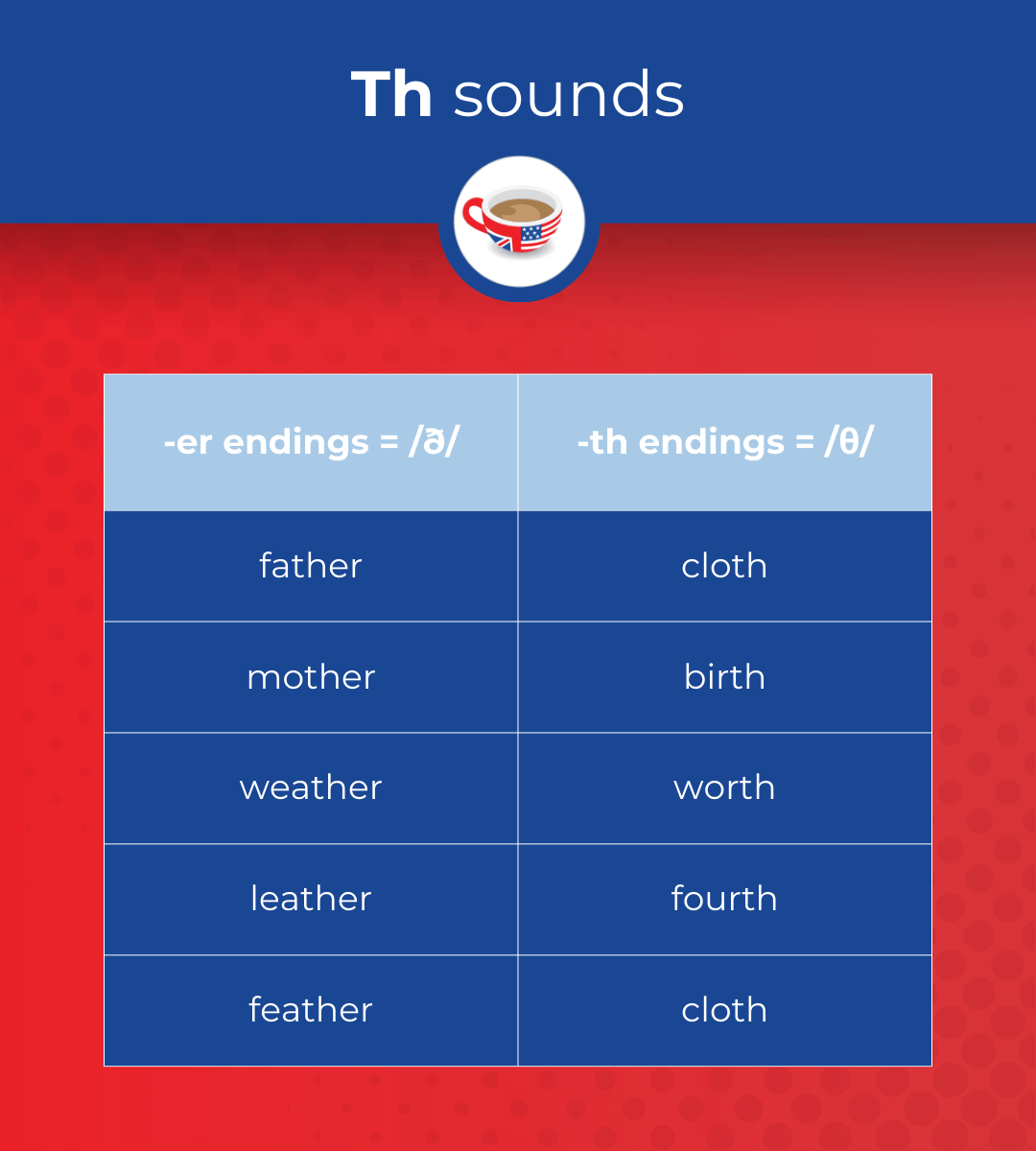
Let’s have a look at some examples:

Words that end in 'er': father, mother, weather, leatehr, feather words that end in 'th': cloth, birth, worth, fourth, cloth

Words that end in the: breathe, bathe, clothe(s) words that end in th: breath, bath, cloth

Let’s review 

So the fundamental difference between f and th in English is that /f/ needs the top lip on the bottom teeth, and /θ/ needs the tongue between the teeth, and /ð/ is the same but has a vibrating quality. As always, the best way to perfect these rules is to practise using the words and learning when to follow each rule. Now try saying the words in the visual below out loud! 🗣️

An explanation of th and f sounds with some examples

It’s your turn! 

Try saying these tongue twisters out loud to practise pronouncing these sounds correctly! Try this in front of a mirror and check you can see your tongue when making those th sounds. If you want, you can listen to Nick and Francesca saying them in the video, and repeat them after them.

👅🌪️

There are Thirty-three thick silk threads.

👅🌪️🌪️

Three thousand thick feathers float down the river.

👅🌪️🌪️🌪️

I thought a thought, but the thought I thought wasn’t the thought that I’d thought that I’d thought.

If you found this post interesting, make sure you listen to the full podcast episode with Nick and Francesca on The Coffee Break English Show. In this series, we talk about useful topics for English learners, so make sure to subscribe to our podcast feed and our channel on YouTube.

Plus, don’t miss your free worksheet – perfect for extra practice after the lesson! When you sign up, you’ll also receive our short coffee break-sized email lessons, delivered straight to your inbox every week, to help you build your English skills. 💪 You’ll even hear from Mark, the founder of Coffee Break Languages, who shares regular tips and motivation for learners of all levels. Sign up below! 👇

Try to practise the th sounds often at home! The more you practice, the more confident you will become. We recommend you make a list of the words with these sounds that you find difficult and practise saying them until you feel more confident making th sounds.

Remember that it’s ok not to sound exactly like a native speaker! The important thing is that you feel confident and comfortable when speaking and people can understand you.

Happy Coffee Breaking!

Listen to the podcast

CBF Scenes 1.09 | Un avenir à construire

In chapter 9 of Scenes, Jérôme considers a big career change, but he’s not sure if he’s up for the challenge. With help from friends, he prepares to apply for a new job, but will he go through with it?

Mark and Hélène discuss useful vocabulary such as lettre de motivation, stressé, and postuler.

Ne manquez pas ce nouvel épisode passionnant de Scenes !

CBS Scenes 1.08 | Sin vuelta atrás

In Chapter 8 of Scenes, our course for intermediate Spanish learners, we return to Isabel’s café, where she witnesses an emotional and unexpected moment between a couple. No obstante, cuando se cierra una puerta, se abre una ventana.

As always, Mark and Pablo will guide us through any challenging grammar and vocabulary in the text, helping to deepen our understanding of the language. This chapter introduces useful verbs like disculparse, abandonar, and quedarse helado/a.

CBG Scenes 1.08 | Ein Feierabendgespräch mit Felix

Mark and Thomas return with another engaging episode of Scenes! As the late shift winds down, Felix insists on staying longer, keeping busy while the narrator locks up. But when asked why he’s avoiding going home, he finally confesses—he’s dropped out of university but hasn’t told his parents yet.

Felix knows they’ll be disappointed, and as an only child, the pressure feels even greater. But as the narrator reminds him, hiding it will only make things worse in the long run. Will he find the courage to tell them the truth?

Mark and Thomas highlight useful grammar and vocabulary, such as pronominal adverbs and knowing when to use reflexive pronouns in the dative or the accusative.

Hör rein und finde heraus, ob Felix den Mut findet, die Wahrheit zu sagen!

CBI Scenes 1.08 | Che affare!

Join Francesca and Mark for this Chapter of Scenes from the Coffee Break Italian Café! In this episode, a familiar face comes to the bar with an unusually cheerful spirit! He shares his new idea: renting out his city apartment as a charming summer B&B. It sounds like a great deal could be worked out with the bar.

Future Tenses in English: Making Future Plans

A smiling woman in a blue shirt, with bold text around her reading 'Future tenses explained'.

Do you know the different ways to talk about future plans in English? Talking about your plans can be a little confusing as we don’t always use future tenses in English like we do in the present and past. Instead, we have different phrases we use to express specific ideas.

In this episode, Nick and Anabel look at will, be going to and the present continuous to see how we can express different ideas about our future plans in English.

The Coffee Break English Show is a podcast series of informal conversations to help you understand some difficult topics in English. In the latest episode, we discuss different ways to use future tenses in English to express future plans.

Continue reading to find out more and why not listen to the podcast as you go?

Let’s get started with will!

Future Tense Verbs – Will

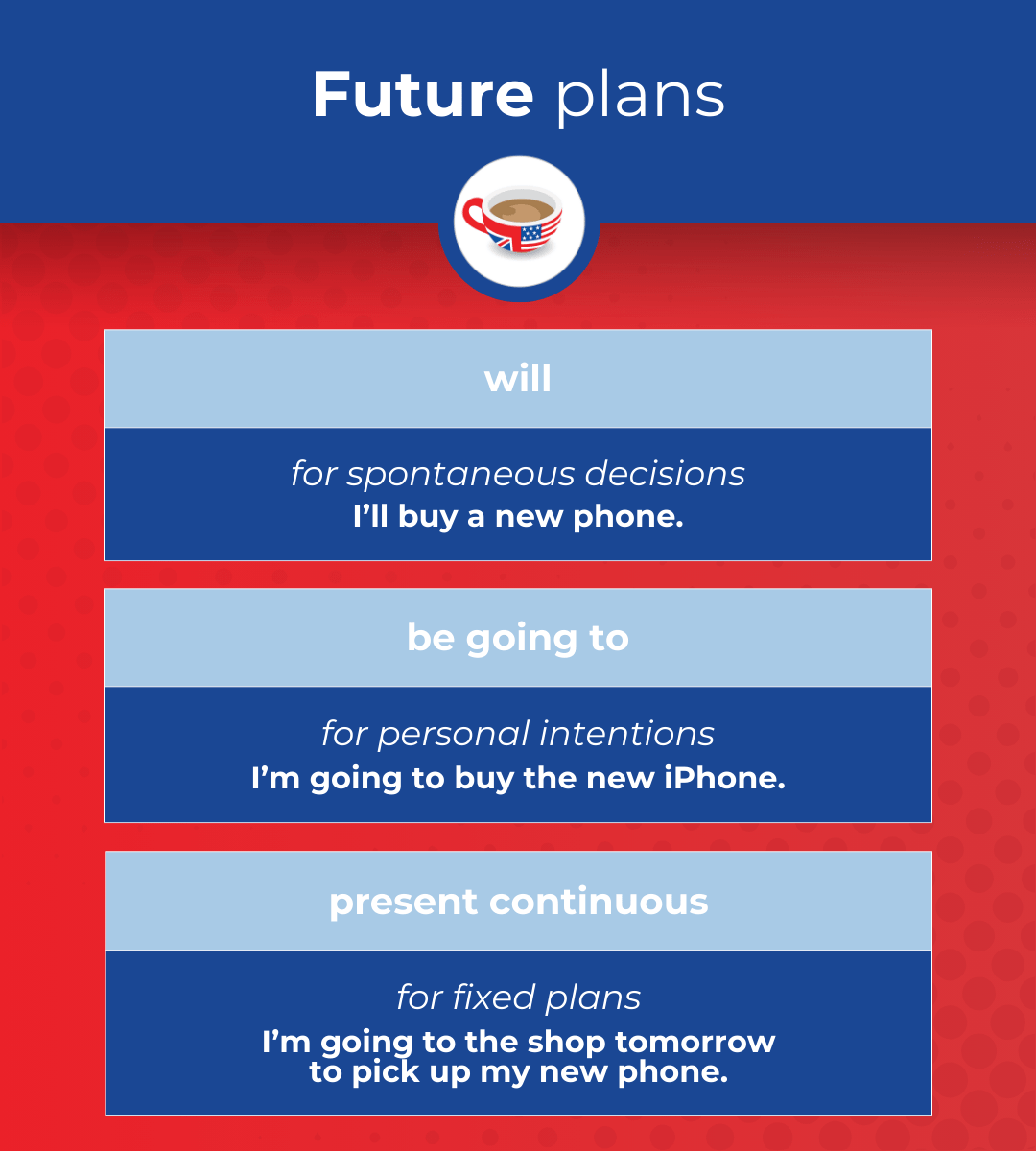
Let’s look at will first. One of the most common meanings of will is to express spontaneous decisions. We can consider a spontaneous decision as the birth of our plan, it has just been decided and is still new. To create this form, we use will, plus the bare infinitive (without to).

If we are hungry, we might say “I’ll go and buy a sandwich”. If it is cold we might say “I will put on a jumper”. It is something I decide to do in the moment.

Examples in positive, negatives and question form:

I will buy a new phone.

❌ I won’t buy a new phone.

❓ Will you buy a new phone?

Remember the contraction of will involves the subject and the last two letters of the verb will, with an apostrophe (‘ll). You may even hear this contraction with a noun but this is almost always only when we speak.

I’ll

you’ll

he’ll

she’ll

it’ll

we’ll

they’ll

Nick’ll

Anabel’ll (ok, this one is very difficult to pronounce!)

Future Tense Verbs – Be going to

We use be going to to describe the next stage of our plan. This is a decision which we have made in the past and we are now thinking about. We are now planning the details and it is our personal intention. We use the bare infinitive after be going to.

If I am talking about the weekend, I can say “I’m going to see my friends.” This means that the plan is being organised but maybe some details are not finalised.

Examples in positive, negatives and question form:

I am going to buy a new phone.

❌ I am not going to buy a new phone.

❓ Are you going to you buy a new phone?

Future Tense Verbs – Present Continuous

When we have finalised the important details and our plan is complete, we can use the present continuous. This shows that our plan is fixed and the details are confirmed. We use present continuous for fixed plans.

Examples in positive, negatives and question form:

I am buying a new phone.

❌ I am not buying a new phone.

❓ Are you buying a new phone?

Let’s review the future tenses in English

So let’s go over the different ways to use future tenses in English to express future plans.

First, we start with will to express a new plan. We make a spontaneous decision.

Then we use be going to when we have already made the decision and we now have a personal intention.

And finally we used present continuous to show we have finalised the details and we have a fixed plan.

Will is for spontaneous decisions. Be going to is for personal intentions. Present continuous is for fixed plans.

Remember! The present continuous and be going to are very similar and express slightly different ideas but can often be used in the same context with little difference in meaning. Don’t worry if sometimes you’re not sure which one to use, it probably means you can use both! If you feel you need more practice with future tenses in English, we take a look at other ways to use be going to and will in Episode 5 of Season 3.

It’s your turn!

Now, let’s practise using the future tenses in English to talk about future plans! Look at the prompts and think about which future form would be best to use. The answers are at the end of the blog post but don’t look until you’ve thought about your answers!

  1. It’s cold! (put on my jumper) …
  2. I am busy tonight. (meet my friends in town) …
  3. I’m on my summer holiday! Tomorrow (swim in the sea and sunbathe) …

If you found this post interesting, make sure you listen to the full podcast episode with Nick and Anabel on The Coffee Break English Show. We will release more episodes soon, about some more useful topics! Subscribe to our podcast feed and our channel on YouTube to learn when the next episode is available.

Plus, don’t miss your free worksheet – perfect for extra practice after the lesson! When you sign up, you’ll also receive our short coffee break-sized email lessons, delivered straight to your inbox every week, to help you build your English skills. 💪 You’ll even hear from Mark, the founder of Coffee Break Languages, who shares regular tips and motivation for learners of all levels. Sign up below! 👇

So, start trying to use different future tenses in English to be specific about your future plans when you can! Remember that when you learn new grammar, it will help you to express yourself as well as improving your understanding when listening to others. It’s all part of the language-learning journey. Are you going to try using these three future forms in your speech? Good luck!

Happy Coffee Breaking!

Here are some possible answers to the questions given above:

  1. It’s cold! I’ll put on my jumper.
  2. I am busy tonight. I’m meeting my friends in town.
  3. I’m on my summer holiday! Tomorrow I’m going to swim in the sea and sunbathe.

Listen to the podcast

CBF Scenes 1.08 | Une visite surprise

In chapter 8 of Scenes, a surprise visit brings exciting news to the café as a familiar face shares their latest achievement. Meanwhile, Nico takes a moment to appreciate the unique encounters his café brings.

In this episode, you’ll learn key expressions like se rendre compte, un rôle (dans un film), and radieuse.

Continuez à améliorer votre français avec ce nouveau chapitre de Scenes !

CBS Scenes 1.07 | Gracias por la suerte

In Chapter 7 of Scenes, our course for intermediate Spanish learners, we return to Isabel’s café and catch up with Miguel—someone we’ve met before. ¿Te acuerdas de él? Join Mark and Pablo as the story continues!

As always, Mark and Pablo will guide you through key grammar points and vocabulary. In this chapter, you’ll discover the meanings of ajetreado, mono, and celestina, as well as look into ojalá, a useful subjunctive trigger.

Don’t miss the latest episode of Scenes—keep improving your Spanish in a fun and engaging way!

CBG Scenes 1.07 | Kaffee, Klatsch und eine neue Lesegruppe

Mark and Thomas return with another Chapter of Scenes! Every day at exactly three o’clock, Charlotte arrives at the café for coffee, cake, and conversation. Today, she shares the latest neighbourhood gossip—though Erna is, as always, far more discreet with such things.

Meanwhile, another customer is quietly adjusting to a big change—her youngest son has moved out, and for the first time in years, she has her home all to herself. Before long, Charlotte introduces another topic—her new reading group. They meet right here in the café, and today’s book is Kabale und Liebe by Schiller. The narrator is tempted to join… and Charlotte doesn’t take no for an answer!

Mark and Thomas highlight useful grammar and vocabulary, such as using the subordinate clause to express hopes and wishes or using adjectives as nouns.

Mach es dir gemütlich, schnapp dir einen Kaffee und genieße eine weitere Szene aus Ernas Café!


CBI Scenes 1.07 | Un caffè fortunato

Conversations at the bar typically revolve around work, even during coffee breaks. However, tonight, with the arrival of three men carrying their laptops and big plans, something unusual could be about to happen… Join Francesca and Mark for this exciting Chapter of Scenes from the Coffee Break Italian Café!

‘Must’ and ‘have to’ grammar: four simple rules

A smiling woman in a red shirt holding a Coffee Break English mug, with bold text around her reading 'MUST', 'MUSTN’T', 'HAVE TO', and 'DON’T HAVE TO'.

Do you ever get confused with must and have to? These two verbs can be used in similar ways but we have to be careful when we use them in the negative as the meaning changes completely. This is particularly difficult for some language learners as there may only be one word in their language for both must and have to.

The Coffee Break English Show is a podcast series of informal conversations to help you understand some difficult topics in English! In the latest episode, Nick and Francesca look at how we can use must and have to in the positive and negative forms and provide four simple rules to show their differences in meaning.

So, let’s get started and look at the rules for must and have to. Why not get a cup of coffee or tea to enjoy while you read and listen to the podcast episode?

1. Must

We use must to talk about obligations. They can be external rules or laws but they can also express an obligation or strong advice. Let’s look at some examples:

👨🏻‍⚖️

You must wear a seatbelt when you are driving.

We use must to show we are obligated to do this.

🫵🏻

You must keep your dog on a lead in this park.

This is a rule. You are obligated to do this when you are in the park.

⚠️

You must be careful when carrying a knife.

This is strong advice based on what we believe to be a good idea.

2. Mustn’t

We use mustn’t to talk about prohibition. We are saying that it is not possible or permitted to do something.

Let’s look at some examples:

👨🏻‍⚖️

You mustn’t drive on the right side of the road in the UK.

This is a law. We use mustn’t to show you are prohibited from doing this.

🫵🏻

You mustn’t look at your phone during the exam.

This is a rule. You are prohibited from doing this when you are in the exam.

⚠️

You mustn’t touch the oven, it is hot.

This is strong advice based on what we believe to be a bad idea.

3. Have to

We use have to to talk about necessity. Have to can often be used to talk about obligations as there is a strong similarity here with must, but the idea is that we need to do something.

👨🏻‍⚖️

You have to wear a helmet when you cycle on the road.

This is a law. We use have to to show that it is necessary to do this action in this context.

🫵🏻

You have to pay attention during the safety explanation on an airplane.

This is a rule. Have to demonstrates that this is something we need to do.

⚠️

You have to wear warm clothes in the winter in Sweden.

This is advice that shows something is necessary in order to avoid something happening (being cold), or to make something happen (being warm).

4. Don’t/doesn’t have to

When using must and have to, we need to be careful with the negative forms. Because we are considering the meaning of have to as something that is necessary, it is now easy to understand that the negative form means something that is not necessary. It can show that there is no obligation in this situation.

Let’s look at some examples:

👨🏻‍⚖️

You don’t have to wear a seatbelt when the car is parked.

This shows the absence of a law. We use don’t have to to show that it is not necessary to do the action.

🫵🏻

He doesn’t have to wear a shirt and tie in the office. They have a casual dress code.

This shows the absence of a rule. It demonstrates that this is something we do not need to do in this context.

👐🏻

You don’t have to take a medical kit when you go on a walk but it could be a good idea in case someone gets injured. 

This shows that there is no obligation to take the item. You have a choice.

Choosing between must and have to

Because there is such a similarity in meaning between must and have to, it can be difficult to know which one you should use in different contexts. But it is important to remember that you can normally use both without really changing the meaning. 

Must is generally stronger than have to, so when you are choosing which one to use, think about how important the information is and if it is urgent, it is best to use must. If you are only communicating something general that doesn’t need urgency or to be convincing, have to might be better.

If you want more practice with have to, check out Coffee Break English episode 4: season 4!

Here’s a visual summary of ‘must’ and ‘have to’

must is for obligations, mustn't is for prohibition, have to is for necessary, don't have to is for not necessary

If you found this lesson helpful, make sure to watch the full episode of The Coffee Break English Show with Nick and Francesca, where we dive even deeper into must vs. have to! We release new episodes regularly, covering essential grammar topics to help you improve your English so make sure you subscribe to our YouTube channel so you never miss a lesson!

Plus, don’t miss your free worksheet – perfect for extra practice after the lesson! When you sign up, you’ll also receive our short coffee break-sized email lessons, delivered straight to your inbox every week, to help you build your English skills. 💪 You’ll even hear from Mark, the founder of Coffee Break Languages, who shares regular tips and motivation for learners of all levels. Sign up below! 👇

So, start practicing must and have to whenever you can!  Remember, small daily steps lead to big improvements. It’s all part of your language-learning journey.

Happy Coffee Breaking!

Listen to the podcast
CBF Scenes 1.07 | L’amour au café ?

Love is in the air Chez Nico in chapter 7 of Scenes! A chance encounter on the café terrace leads to an unexpected romance, while Nico reflects on preparing for the busy summer ahead.

Mark and Hélène highlight useful language points, including un clin d’œil and se douter de.

Rejoignez-nous et écoutez cet épisode captivant de Scenes !

CBS Scenes 1.06 | La inquilina

In Chapter 6 of Scenes, our course for intermediate Spanish learners, we return to Isabel’s café and catch up with Elena, the new teacher we met in Chapter 3. ¿Cómo le va en su nuevo trabajo? ¿Ha encontrado ya piso?

Join Mark and Pablo as they explore key phrases like cerquita, hoy en día, and cuesta arriba. Alongside these, you’ll continue expanding your vocabulary and reinforcing essential grammar in a natural, engaging way.

Don’t miss this chance to improve your Spanish while following another chapter of Scenes!

CBG Scenes 1.06 | Mit schwerem Herzen im Café

Mark and Thomas return with an emotional new episode of Scenes! It’s late in the evening, and Johanna is still sitting at her table, lost in thought. She’s usually happy to chat with Erna, but today, something is different.

After some gentle encouragement, Johanna finally admits what’s been bothering her—her close university friend Nadine is leaving for a year abroad, and it’s not just friendship that she’s worried about. As Johanna struggles to find the right words, Erna reminds her that some things are best said before it’s too late.

Mark and Thomas highlight useful grammar and vocabulary, such as verbs that always require a dative object or the multiple meanings of machen.

Begleite Johanna auf ihrem Weg – die ideale Gelegenheit, Deutsch mit einer bewegenden Geschichte zu lernen!

CBI Scenes 1.06 | Si balla alla sagra del cocomero

Join Francesca and Mark for the sixth Chapter of Scenes from the Coffee Break Italian Café!

In this episode, the local festival season has begun and the festivities seem to attract quite a crowd. A particularly elegant couple catches everyone’s attention, and their presence hints at a special evening ahead…