The Coffee Break Show

A surprised man in a red polo shirt reacting with raised hands. Bold text reads 'GET has HOW many meanings?!'.
Coffee Break English

Different Uses of ‘Get’ in English – Improve Your Vocabulary

Do you know how many different uses of get there are in English? This can be a difficult word for English learners because it has so many meanings, but if you can learn to use it well, you can really sound like a native speaker!  The Coffee Break English Show is a podcast series of informal
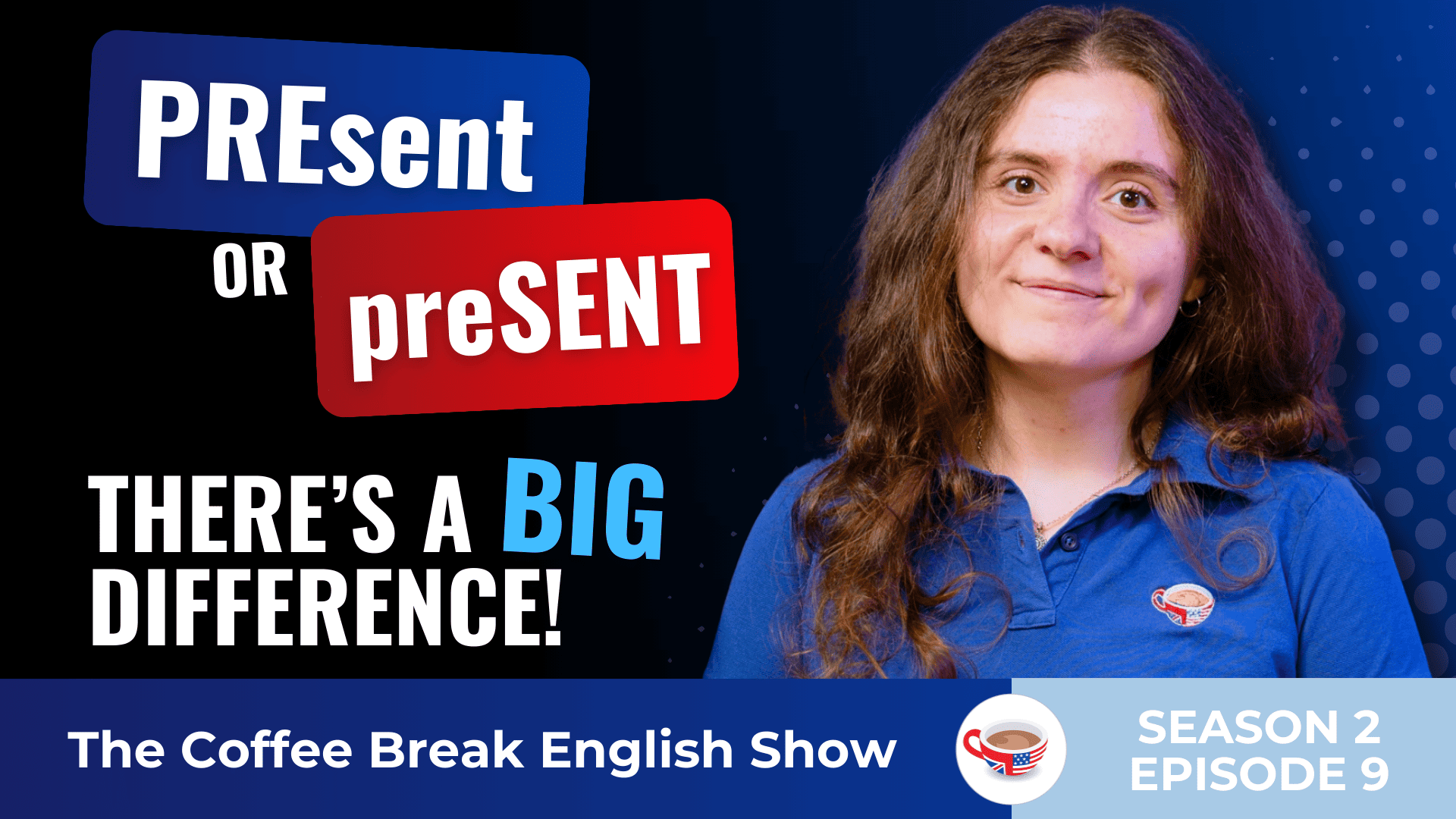
Anabel, the Coffee Break Spanish host in a blue shirt smiles beside bold text contrasting 'PREsent' and 'preSENT' with the caption 'There’s a BIG difference!' The background is dark with a dotted gradient.
Coffee Break English

English Word Stress explained: ‘PREsent’ or ‘preSENT’?

Do you know when to say PREsent and when to say preSENT? English pronunciation rules are an important aspect of improving your language skills. They help you to understand the language when you are listening, and to use the language confidently and effectively when you are speaking. One area that many learners find difficult is

A smiling man in a blue shirt pointing to bold text that reads 'Key Phrases for Natural English'. The background is dark with a gradient and polka dot pattern.
Coffee Break English

How to use ‘so’, ‘too’, ‘either’ or ‘neither’ in English

Do you know how to use so, too, either or neither when speaking in English? This can be a tricky grammar issue as we need to be careful about the auxiliary and the object pronoun but if we study them we can find simple ways to use them as well as more complete, complex ways. 

A man in a blue shirt with a thoughtful expression, touching his chin, beside bold text that reads 'JUST', 'ALREADY', 'YET' and 'WHICH SHOULD YOU USE?'.
Coffee Break English

Time Phrases: How to Use Present Perfect Adverbs in English

Have you ever wondered when to use just, yet, or already? These three time phrases are commonly used with the present perfect tense, but they each have specific meanings and uses. Using time phrases and adverbs with the present perfect helps to communicate more effectively and will make your sentences even clearer when having a

A smiling woman in a blue shirt, in a blue background.
Coffee Break English

Present Perfect Tense for Experiences

Using the present perfect tense can be difficult for many English learners. This is because it is used in a variety of ways that do not necessarily translate to similar grammar forms in other languages. The key is to consider the different contexts where you can use the present perfect, and then look at what

A man in a red shirt with a thoughtful expression, resting his chin on his hand.
Coffee Break English

‘Too Much’ or ‘Too Many’: Using Quantifiers in English

Have you ever wondered whether to say too much or too many? Or perhaps you’re unsure when to use enough? The good news is that learning these quantifiers in English will help you sound more natural! The Coffee Break English Show is a podcast series of informal conversations to help you understand some difficult topics

A smiling man in a red shirt holding, with bold text around him reading 'Pronouncing TH'
Coffee Break English

‘TH’ Sounds in English: How to Pronounce ‘TH’ Correctly

Making th sounds in English is a common problem that many English language learners face – but did you know that many native speakers also find th pronunciation difficult? It really is a tricky sound to make! But many words contain th sounds in English and mastering this sound will ensure you communicate clearly and effectively.  The Coffee

A smiling woman in a blue shirt, with bold text around her reading 'Future tenses explained'.
Coffee Break English

Future Tenses in English: Making Future Plans

Do you know the different ways to talk about future plans in English? Talking about your plans can be a little confusing as we don’t always use future tenses in English like we do in the present and past. Instead, we have different phrases we use to express specific ideas. In this episode, Nick and

A smiling woman in a red shirt holding a Coffee Break English mug, with bold text around her reading 'MUST', 'MUSTN’T', 'HAVE TO', and 'DON’T HAVE TO'.
Coffee Break English

‘Must’ and ‘have to’ grammar: four simple rules

Do you ever get confused with must and have to? These two verbs can be used in similar ways but we have to be careful when we use them in the negative as the meaning changes completely. This is particularly difficult for some language learners as there may only be one word in their language

Coffee Break English

Mastering comparative adjectives in English

Are you able to use comparative adjectives in English? Do you know the grammar rules? One thing that can be tricky in English is when you want to make the comparative stronger or weaker. There are different ways we can do this and we just need to practise them to get them right! The Coffee Break

Coffee Break English

6 examples of phrasal verbs to celebrate the holidays

Phrasal verbs are difficult for many English learners, there are so many to remember and not enough time! So, today, let’s learn some examples of phrasal verbs in the time it takes to have a coffee! In this episode of Coffee Break English Nick talks to Anabel about what is important to him during the

Coffee Break Spanish

How to react like a native speaker: Spanish filler words

Knowing how to react in a Spanish conversation can significantly enhance your fluency and make you sound more like a native speaker. Therefore, using Spanish filler words to react in a conversation is key. That’s why we didn’t want to finish this season of The Coffee Break Spanish Show without bringing you some tips on how

Coffee Break German

The many uses of the German verb ‘ziehen’

Today, we are looking at a single German word that many learners come across early in their studies: ziehen. You might have seen it on doors, where it means “to pull.” However, this verb is one of those versatile ones in German and it has multiple meanings depending on the context. Let’s explore some of

Coffee Break Italian

Italian words used in English: panini, lasagna, bruschetta and more

Panini, al fresco, latte, bolognese… There are many borrowed Italian words used in English. However, we don’t always pronounce them correctly and use them according to their original Italian meaning. As learners of Italian, it’s fascinating to see how Italian words used in English often get misinterpreted, mispronounced, or completely transformed. This blending of languages

Coffee Break French

‘Oui’ vs. ‘si’, ‘aussi’ vs. ‘non plus’: what’s the difference?

When learning French, one of the essential skills is knowing how to express agreement or disagreement with positive and negative statements. In this episode of The Coffee Break French Show, we’ll dive into the nuances of using moi si, pas moi / moi non, moi non plus and moi aussi in French. Understanding these expressions will

Coffee Break Spanish

4 ways to translate ‘to become’ in Spanish

Saying “to become” in Spanish can be a tricky task, because there are several verbs that express this concept. Today, we’ll explore the main translations and learn how to use them correctly. If you’re curious about how to say “to become” in Spanish or need tips on how to use these verbs properly, read on!

Coffee Break German

Using colours in German: when to adjust endings, hyphenate or use capitals

In this article, we’re not just learning the colours in German. You might pick up a few new words, but we’re focusing on how to use them as adjectives, what to keep in mind regarding spelling, and some key questions surrounding them. 

The Coffee Break German Show is a video and audio podcast series in

Two smiling male presenters wearing red and navy polo shirts sit against a blue background with text that reads 'The Coffee Break French Show.
Coffee Break French

How to form and use superlatives in French

Superlatives in French are essential for expressing the highest or lowest degree of a quality. Whether you are comparing adjectives, adverbs, verbs, or nouns, understanding the rules and exceptions will considerably help you sound more natural. In this episode of The Coffee Break French Show, Max and Pierre-Benoît take a closer look into the world

Coffee Break Spanish

The subjunctive in Spanish: all you need to know to start using it

Learning Spanish can be both exciting and challenging, especially when you encounter the subjunctive mood. If you’re wondering, “what is the subjunctive in Spanish?” or “when to use subjunctive in Spanish?”, you’re in the right place. This article will guide you through understanding and using the subjunctive in Spanish, focusing on present subjunctive conjugation and