
Do you know when to say PREsent and when to say preSENT?
English pronunciation rules are an important aspect of improving your language skills. They help you to understand the language when you are listening, and to use the language confidently and effectively when you are speaking. One area that many learners find difficult is English word stress, choosing the correct syllable to stress. 📣
The Coffee Break English Show is a podcast series of informal conversations to help you understand some difficult topics in English. In the latest episode, Nick and Anabel explore how syllable stress changes the meaning of certain words in English and take a closer look at English pronunciation rules with two-syllable verbs and nouns.
Because this episode focuses on pronunciation, it is best to watch the video or listen to the episode while you read this blog to hear Nick and Anabel pronouncing the words.
Have you got a COffee? Are you REAdy? Then let’s get started!
Syllables
Firstly, we should start by outlining what a syllable is. A syllable is a unit of pronunciation that contains one vowel sound. It often includes a consonant sound too.
The word ‘noun‘ has one syllable = /naʊn/.
The word ‘English‘ has two syllables = /ɪŋ – glɪʃ/
And the word ‘syllable‘ has three syllables = /sɪ – lə – bəl/
Two-syllable Words
Now we have a clear idea of what syllables are, we can focus on two-syllable words. English pronunciation rules are not always clear when it comes to syllable stress and we often have to learn the correct stress when we learn new words but there is a general rule that can help us with two-syllable words! Just be careful with exceptions…! 🧐
Nouns
Research into English word stress has shown that around 90% of two-syllable nouns are stressed on the first syllable. So when we see a two-syllable noun, we can be quite confident the word will be stressed on the first syllable.
e.g. APple, LIon, Orange, PERson, TEAcher, WINdow.
Verbs
Research also shows that around 70% of two-syllable verbs are stressed on the second syllable. We need to be more careful with verbs, but still most of them are stressed on the second syllable so we can make an educated guess here if necessary.
e.g. agREE, colLECT, deFEND, enJOY imPROVE, perFORM.
Words where the verb and noun have different stress
There are many examples where the verb and noun are similar but have different syllable stress. They generally follow the rules stated above, with the first syllable stressed with the noun and the second syllable stressed on the verb.
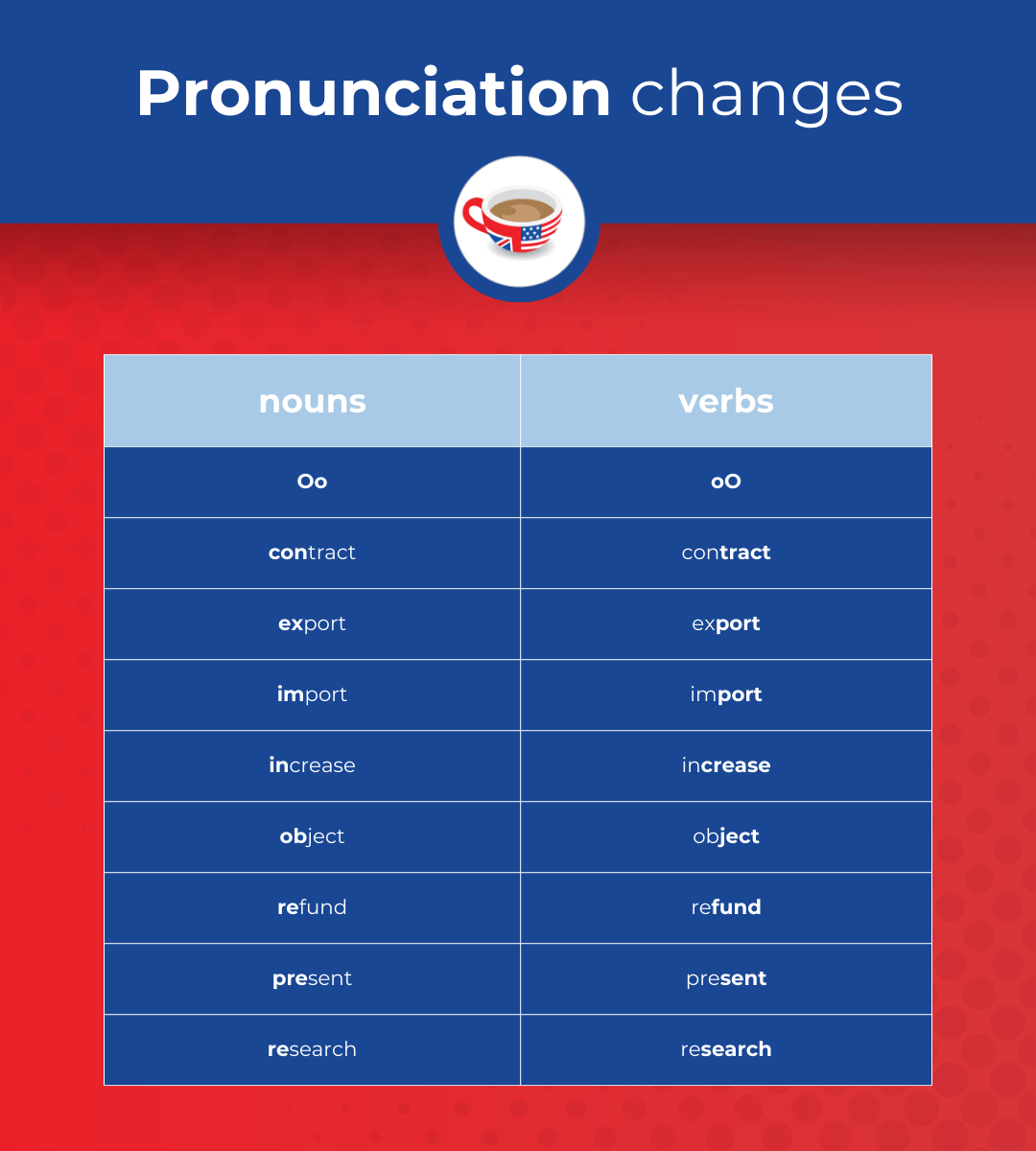
English Word Stress Exceptions
Be careful with the below verbs and nouns which do not follow this rule. It’s also important to note that some words change slightly from verb to noun like with effect and believe.
Stress on First Syllable
Some words are always stressed on the first syllable.

Stress on Second Syllable
Some words are always stressed on the second syllable.

Let’s review!
Here’s a quick summary of English word stress rules with two syllable words:
- 90% of two syllable nouns are stressed on the first syllable.
- Around 70% of two syllable verbs are stressed on the second syllable.
- Some words are the same as verbs and nouns but follow the two rules above with syllable stress.
- Some words are the same as verbs and nouns but do not follow the rule above.
If you want more practice with your pronunciation, check out Episode 8 of Season 2 of Coffee Break English, where we look at pronunciation of –ed endings.
It’s your turn!
Practise English word stress by deciding whether each word is a noun/adjective or a verb based on the sentence context and decide if the first or the second syllable should be stressed. Make sure you think about it before looking at the answer at the bottom of this blog post!
- She equaled the world record in the race.
- He is going to present an award at the Oscars tonight.
- We have just finished an important research project.
It’s a good idea to make a list of the words that have stress on the first or second syllable and practise using them in sentences to build your confidence with syllable stress. A little practice each day can really help build your confidence!
If you found this post interesting, make sure you watch the full video with Nick and Anabel on the Coffee Break English Youtube channel. In this series we look at lots of useful topics for English learners, so make sure to subscribe to our podcast feed and our channel on YouTube.
Plus, don’t miss your free worksheet – perfect for extra practice after the lesson! When you sign up, you’ll also receive our short coffee break-sized email lessons, delivered straight to your inbox every week, to help you build your English skills. 💪 You’ll even hear from Mark, the founder of Coffee Break Languages, who shares regular tips and motivation for learners of all levels. Sign up below! 👇
So, start paying attention to English word stress when you are speaking! The more you practice, the more confident you will become.
Happy Coffee Breaking!
P.s. Here are the answers to activity above:
- She equaled the world REcord in the race.
- He is going to preSENT an aWARD at the Oscars tonight.
- We have just finished an important REsearch PROject.