Coffee Break English Show

A surprised man in a red polo shirt reacting with raised hands. Bold text reads 'GET has HOW many meanings?!'.
Coffee Break English

Different Uses of ‘Get’ in English – Improve Your Vocabulary

Do you know how many different uses of get there are in English? This can be a difficult word for English learners because it has so many meanings, but if you can learn to use it well, you can really sound like a native speaker!  The Coffee Break English Show is a podcast series of informal
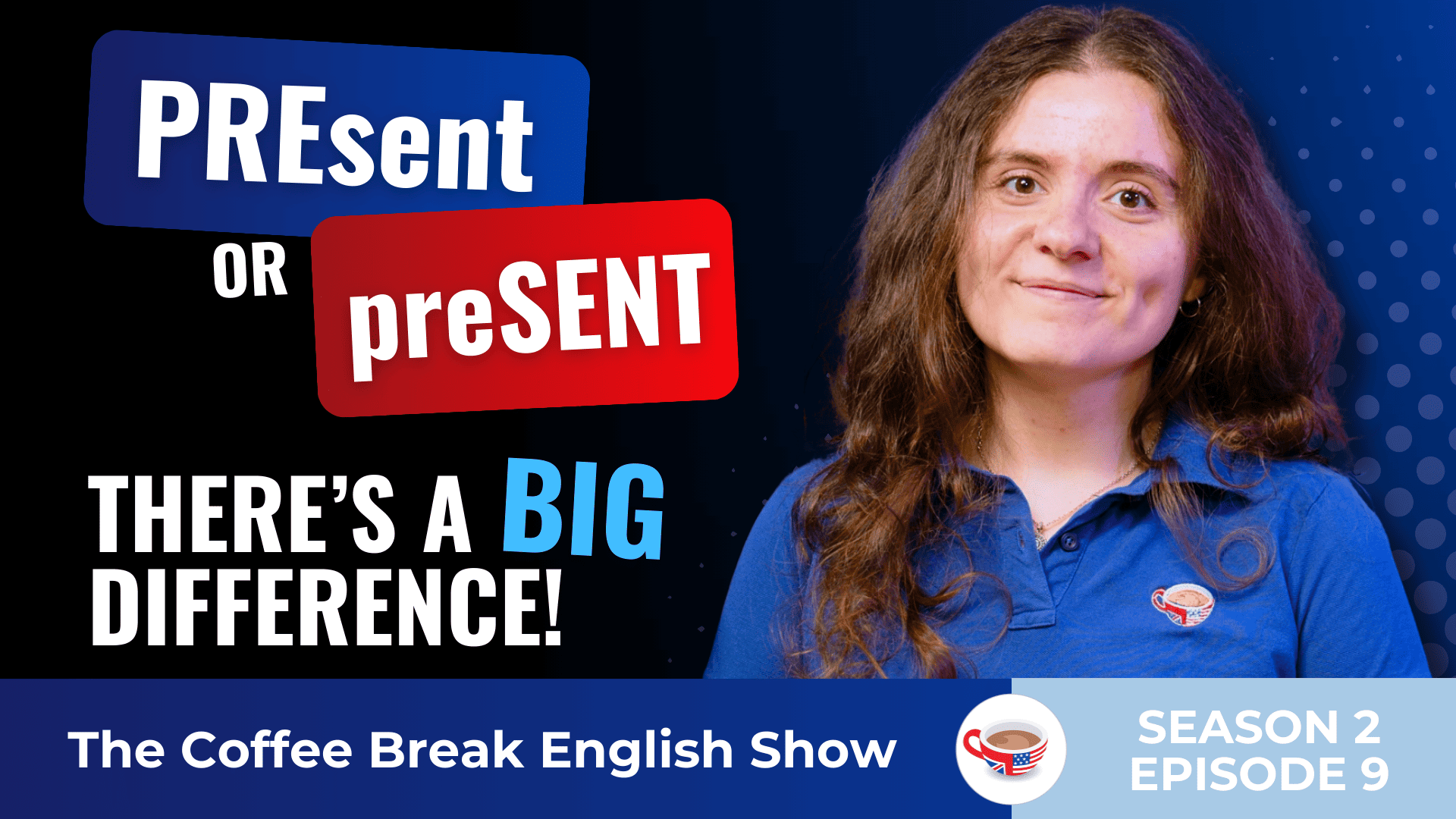
Anabel, the Coffee Break Spanish host in a blue shirt smiles beside bold text contrasting 'PREsent' and 'preSENT' with the caption 'There’s a BIG difference!' The background is dark with a dotted gradient.
Coffee Break English

English Word Stress explained: ‘PREsent’ or ‘preSENT’?

Do you know when to say PREsent and when to say preSENT? English pronunciation rules are an important aspect of improving your language skills. They help you to understand the language when you are listening, and to use the language confidently and effectively when you are speaking. One area that many learners find difficult is

A smiling man in a blue shirt pointing to bold text that reads 'Key Phrases for Natural English'. The background is dark with a gradient and polka dot pattern.
Coffee Break English

How to use ‘so’, ‘too’, ‘either’ or ‘neither’ in English

Do you know how to use so, too, either or neither when speaking in English? This can be a tricky grammar issue as we need to be careful about the auxiliary and the object pronoun but if we study them we can find simple ways to use them as well as more complete, complex ways. 

A man in a blue shirt with a thoughtful expression, touching his chin, beside bold text that reads 'JUST', 'ALREADY', 'YET' and 'WHICH SHOULD YOU USE?'.
Coffee Break English

Time Phrases: How to Use Present Perfect Adverbs in English

Have you ever wondered when to use just, yet, or already? These three time phrases are commonly used with the present perfect tense, but they each have specific meanings and uses. Using time phrases and adverbs with the present perfect helps to communicate more effectively and will make your sentences even clearer when having a

A smiling woman in a blue shirt, in a blue background.
Coffee Break English

Present Perfect Tense for Experiences

Using the present perfect tense can be difficult for many English learners. This is because it is used in a variety of ways that do not necessarily translate to similar grammar forms in other languages. The key is to consider the different contexts where you can use the present perfect, and then look at what

A man in a red shirt with a thoughtful expression, resting his chin on his hand.
Coffee Break English

‘Too Much’ or ‘Too Many’: Using Quantifiers in English

Have you ever wondered whether to say too much or too many? Or perhaps you’re unsure when to use enough? The good news is that learning these quantifiers in English will help you sound more natural! The Coffee Break English Show is a podcast series of informal conversations to help you understand some difficult topics

A smiling man in a red shirt holding, with bold text around him reading 'Pronouncing TH'
Coffee Break English

‘TH’ Sounds in English: How to Pronounce ‘TH’ Correctly

Making th sounds in English is a common problem that many English language learners face – but did you know that many native speakers also find th pronunciation difficult? It really is a tricky sound to make! But many words contain th sounds in English and mastering this sound will ensure you communicate clearly and effectively.  The Coffee

A smiling woman in a blue shirt, with bold text around her reading 'Future tenses explained'.
Coffee Break English

Future Tenses in English: Making Future Plans

Do you know the different ways to talk about future plans in English? Talking about your plans can be a little confusing as we don’t always use future tenses in English like we do in the present and past. Instead, we have different phrases we use to express specific ideas. In this episode, Nick and

A smiling woman in a red shirt holding a Coffee Break English mug, with bold text around her reading 'MUST', 'MUSTN’T', 'HAVE TO', and 'DON’T HAVE TO'.
Coffee Break English

‘Must’ and ‘have to’ grammar: four simple rules

Do you ever get confused with must and have to? These two verbs can be used in similar ways but we have to be careful when we use them in the negative as the meaning changes completely. This is particularly difficult for some language learners as there may only be one word in their language

Coffee Break English

Mastering comparative adjectives in English

Are you able to use comparative adjectives in English? Do you know the grammar rules? One thing that can be tricky in English is when you want to make the comparative stronger or weaker. There are different ways we can do this and we just need to practise them to get them right! The Coffee Break

Coffee Break English

6 examples of phrasal verbs to celebrate the holidays

Phrasal verbs are difficult for many English learners, there are so many to remember and not enough time! So, today, let’s learn some examples of phrasal verbs in the time it takes to have a coffee! In this episode of Coffee Break English Nick talks to Anabel about what is important to him during the

Coffee Break English

What’s the difference between ‘how much’ and ‘how many’?

Do you know when to use how much and how many in English? It can be confusing, but don’t worry – there are some clear rules to follow. In this episode of The Coffee Break English Show, we’ll help you understand when to use how much and how many to talk about countable and uncountable nouns.

Coffee Break English

How to pronounce ‘Tuesday’ and ‘Thursday’

Do you know how to say the words Tuesday and Thursday correctly in English? These two words can be confusing when it comes to pronunciation. This is because the sounds at the beginning of the words (tu and th) can be difficult to pronounce. There are lots of other words that contain these sounds, so

Coffee Break English

When to use ‘a’ and ‘the’ in English

Do you know when to use a and the in English? These little words are called articles. They can be difficult to use correctly, because they are used in different ways in different languages, and in some languages they don’t exist at all! The Coffee Break English Show is a podcast series of bite-sized, friendly

Coffee Break English

When to use ‘in’, ‘on’ or ‘at’ with time

Do you know when to use in, on, and at in English? These little words are called prepositions. They can be difficult to use correctly, because they appear very often, and there aren’t many rules to follow! The Coffee Break English Show is a podcast series of bite-sized, friendly conversations to help you understand some

Coffee Break English

Question tags: when to say ‘is it?’ at the end of a sentence

Do you know when to use is it? at the end of a phrase in English? Is it? is a question tag. Question tags can be a little difficult to use in English, but once you understand the rules, they are very useful. The Coffee Break English Show is a podcast series of bite-sized, friendly

Coffee Break English

What’s the difference between ‘like’ and ‘as’?

Do you know the difference between like and as when you’re speaking English? Using like and as can be a difficult topic for English learners, because these words can be used in similar ways. The Coffee Break English Show is a podcast series of bite-sized, friendly conversations to help you understand some difficult topics in

Coffee Break English

How to pronounce ‘eat’ and ‘it’ correctly

Do you know how to pronounce the words eat and it correctly in English? These two words sound very similar, and it can be difficult to understand the difference between them, when it comes to pronunciation. This is because the vowel (vowel = the letters a, e, i, o, u) sounds are very similar. There

Coffee Break English

When do I use ‘travel’, ‘trip’ and ‘journey’?

Do you know the difference between the words travel, trip and journey? They all have similar meanings, so it’s easy to confuse them! The Coffee Break English Show is a podcast series of bite-sized, friendly conversations to help you understand some difficult topics in English. In the latest episode, Mark and Josie talk about when to

Coffee Break English

The present simple and present continuous: ‘I work’ or ‘I am working’?

Do you know the difference between I work and I am working in English? This can be a challenging topic for English learners, especially because many languages just have one present tense. The Coffee Break English Show is a podcast series of bite-sized, friendly conversations to help you understand some difficult topics in English. In