Have you ever wondered when to use just, yet, or already? These three time phrases are commonly used with the present perfect tense, but they each have specific meanings and uses.
Using time phrases and adverbs with the present perfect helps to communicate more effectively and will make your sentences even clearer when having a conversation with people.
The Coffee Break English Show is a podcast series of informal conversations to help you understand some difficult topics in English. In the latest episode, Nick and Francesca explore how to use the present perfect adverbs just, yet and already, correctly.
If you haven’t listened to the podcast episode yet, why not listen to Nick and Francesca as you read?
So let’s get started and look at just, yet and already!
Time Phrases: The Present Perfect with Just, Yet, and Already
These three present perfect adverbs help us describe when an action happened in relation to now. We often use them with the present perfect tense and they have specific positions in a sentence.
Just
Just is used to indicate that something happened a very short time ago.
It comes between have/has and the past participle:
⏳ I have just finished my homework. ⏳
⏳ She has just arrived at the station. ⏳
👀 In the USA, you are often likely to hear just used with the past simple, not the present perfect! The meaning is exactly the same, though.
🇺🇸 Where’s David? He just went out. 🇺🇸
Yet
Yet is used to talk about something that has not happened but we expect to happen. We often use them in negative statements and questions.
Yet goes at the end of a sentence:
🔜 I haven’t finished my book yet. 🔜
🔜 Have you eaten yet? 🔜
Already
Already is used to show that something happened sooner than expected or before now.
It normally comes between have/has and the past participle but it can sometimes come at the end when we are speaking to create a strong emphasis:
⬅️ I have already seen this movie. ⬅️
⬅️ Wow! She has completed her assignment already! ⬅️
Let’s review
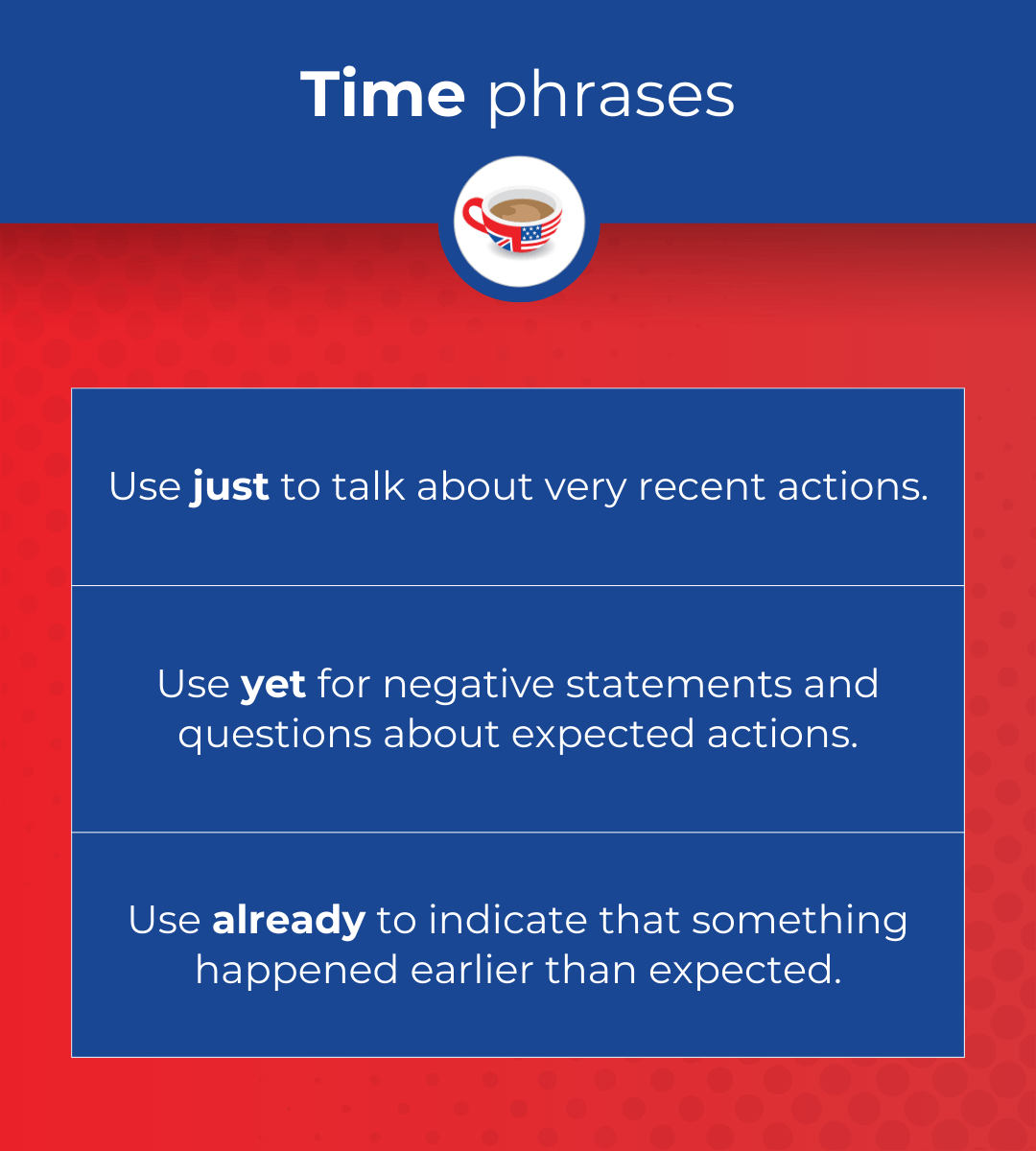
Here’s a summary of the time phrases in this episode:
If you found this useful, then you might find Episode 4 of our 2nd season of Coffee Break English helpful! We look at the time phrases for and since with the present perfect.
It’s your turn!
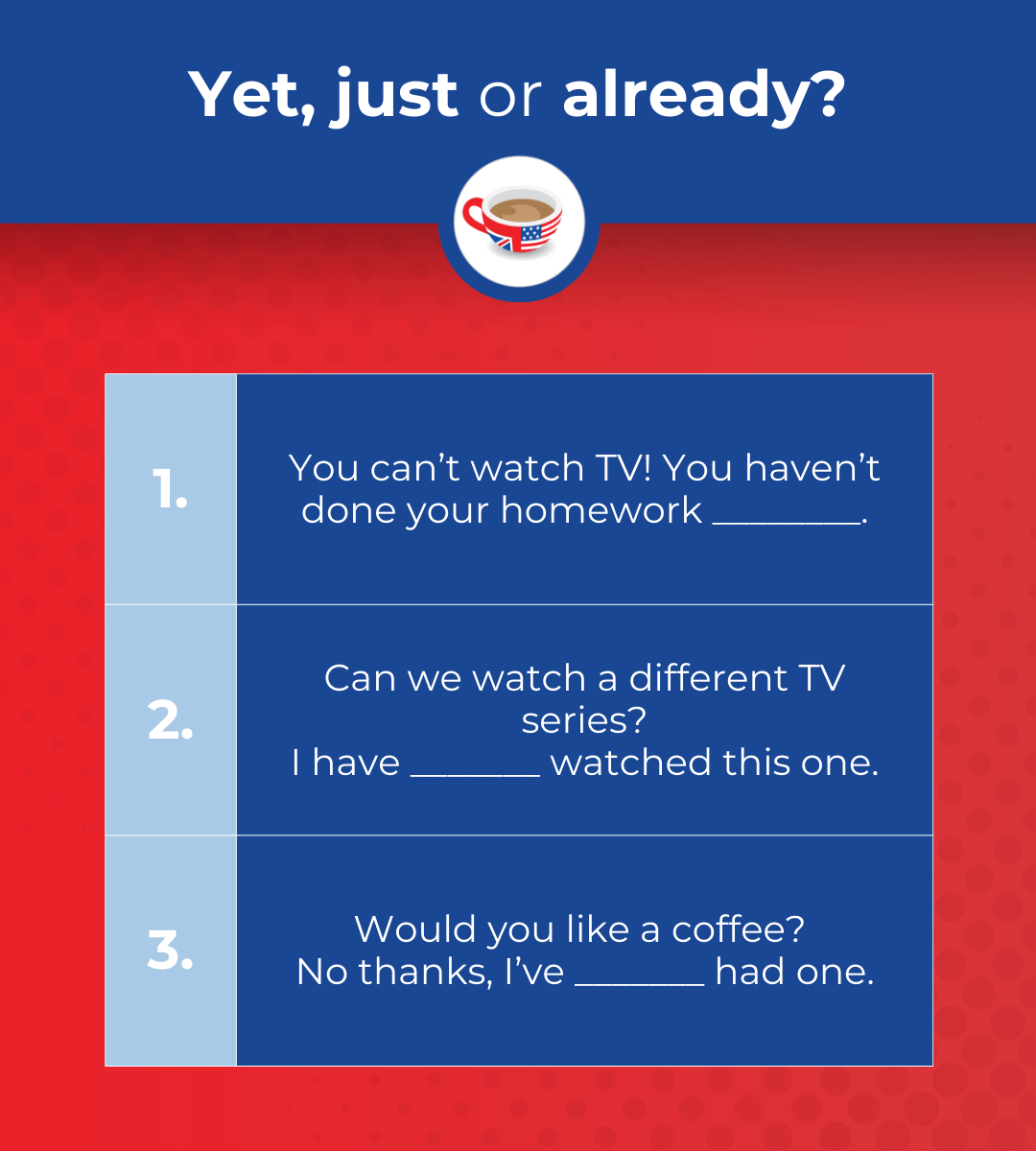
Now let’s practise! Which is the right word? Put yet, just or already in the spaces below. The answers are at the end of the blog post but don’t look until you’ve thought about your answers.
If you found this post interesting, then make sure you listen to the full podcast episode with Nick and Francesca on The Coffee Break English Show. This series looks at useful topics to help English learners improve their language skills, so make sure to subscribe to our podcast feed and our channel on YouTube.
Plus, don’t miss your free worksheet – perfect for extra practice after the lesson! When you sign up, you’ll also receive our short coffee break-sized email lessons, delivered straight to your inbox every week, to help you build your English skills. 💪 You’ll even hear from Mark, the founder of Coffee Break Languages, who shares regular tips and motivation for learners of all levels. Have you signed up yet? If not, sign up below! 👇
So, start using these time phrases in your conversations! The more you practice, the more confident you will become.
Happy Coffee Breaking!
Here are the answers to the questions in the practice section above:
- You can’t watch TV! You haven’t done your homework yet.
- Can we watch a different film? I have already watched this one.
- Would you like a coffee? No thanks, I’ve just had one.