Different Uses of ‘Get’ in English – Improve Your Vocabulary

A surprised man in a red polo shirt reacting with raised hands. Bold text reads 'GET has HOW many meanings?!'.

Do you know how many different uses of get there are in English?

This can be a difficult word for English learners because it has so many meanings, but if you can learn to use it well, you can really sound like a native speaker! 

The Coffee Break English Show is a podcast series of informal conversations to help you understand some difficult topics in English! In the latest episode, Nick and Anabel will help you  use the verb get in lots of different ways. 💪

There are many phrases with get, and if we include phrasal verbs, the list is too long to cover in one episode! But we can look at some synonyms that you can replace with the verb get. 📚

So, let’s get started! Continue reading to find out more, and why not listen to the podcast as you go!

Get = become

We use get with adjectives to mean become

>> It’s raining, take an umbrella or you will get wet. 💦

We can also use the verb get with comparative adjectives to show change.

>> In November the weather gets colder and the days get shorter. ❄️

Get = catch / take

Another one of the uses of get is to talk about taking transport. It has the same meaning as catch or take with nouns like bus, train and taxi. We can only use it with transport that it is possible to miss. I can’t get a bike to the office, for example. 

>> I got a taxi to the airport. 🚖

>> I got the train into town 🚂

Get = buy / obtain / receive

We use the verb get to mean buy, obtain or receive. They have similar meanings but aren’t always the same. This can cause some confusion when we talk about presents! Look at the following sentence:

>> I got a scarf for my birthday (In this sentence, get means receive.) 🎁

>> I got an A in my English exam (In this sentence, get means obtain.) 📝

>> I got my brother a present for his birthday (In this sentence, get means buy.) 💰

Get = understand

We can use the verb get to say that we understand something. This can be a topic or a joke.

>> Everyone laughed at the joke but I didn’t get the punchline. 🤔😂

>> He spoke so quickly I didn’t get what he was saying. 😵‍💫

Get = arrive 

We use the verb get with to to say when we arrive somewhere.

>> I got to the football match late and missed the first goal. ⚽️

Get = fetch 

We use the verb get to say ‘go and take’, or fetch.

>> Can you get me that newspaper over there? I want to show you an article. 🗞️

For more information about the different uses of get, why not watch Episode 10 from Season 2 of Coffee Break English? We go into more detail about phrasal verbs with get as well as looking at the different meanings of the verb get.

Here’s a visual of the different uses of get

A table showing the uses of get: become,catch, take, understand, buy, receive, obtain, arrive, fetch.

To help you remember the different meanings of get, we’ve created a worksheet for you so make sure you click on the link below to get some useful practice!

If you found this post interesting, make sure you listen to the full podcast episode with Nick and Anabel on The Coffee Break English Show. And why not subscribe to our podcast feed and our channel on YouTube to find episodes about some other useful topics for English learners?

Plus, don’t miss your free worksheet – perfect for extra practice after the lesson! When you sign up, you’ll also receive our short coffee break-sized email lessons, delivered straight to your inbox every week, to help you build your English skills. 💪 You’ll even hear from Mark, the founder of Coffee Break Languages, who shares regular tips and motivation for learners of all levels. Sign up below to get yours! 👇

So, start adding get into your speech whenever you get a chance! Remember that when you learn new vocabulary, it will help you to express yourself as well as improving your understanding when listening to others. It’s all part of the language-learning journey. Why not get a coffee now and start learning more about this extremely useful verb?

Happy Coffee Breaking!
Listen to the podcast

English Word Stress explained: ‘PREsent’ or ‘preSENT’?

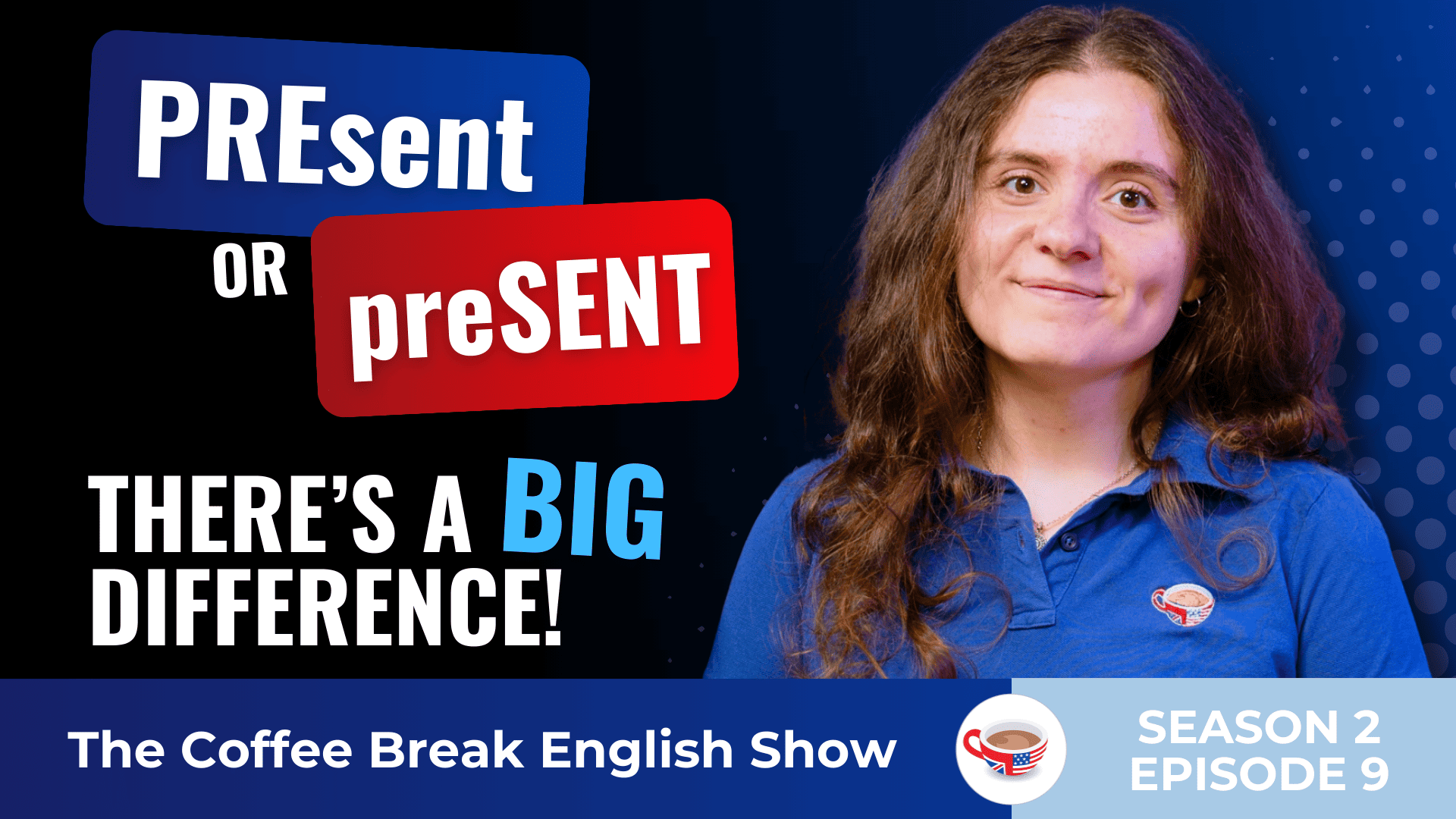
Anabel, the Coffee Break Spanish host in a blue shirt smiles beside bold text contrasting 'PREsent' and 'preSENT' with the caption 'There’s a BIG difference!' The background is dark with a dotted gradient.

Do you know when to say PREsent and when to say preSENT?

English pronunciation rules are an important aspect of improving your language skills. They help you to understand the language when you are listening, and to use the language confidently and effectively when you are speaking. One area that many learners find difficult is English word stress, choosing the correct syllable to stress. 📣

The Coffee Break English Show is a podcast series of informal conversations to help you understand some difficult topics in English. In the latest episode, Nick and Anabel explore how syllable stress changes the meaning of certain words in English and take a closer look at English pronunciation rules with two-syllable verbs and nouns. 

Because this episode focuses on pronunciation, it is best to watch the video or listen to the episode while you read this blog to hear Nick and Anabel pronouncing the words.

Have you got a COffee? Are you REAdy? Then let’s get started!

Syllables

Firstly, we should start by outlining what a syllable is. A syllable is a unit of pronunciation that contains one vowel sound. It often includes a consonant sound too.

The word ‘noun‘ has one syllable = /naʊn/.

The word ‘English‘ has two syllables = /ɪŋglɪʃ/

And the word ‘syllable‘ has three syllables = / bəl/

Two-syllable Words

Now we have a clear idea of what syllables are, we can focus on two-syllable words. English pronunciation rules are not always clear when it comes to syllable stress and we often have to learn the correct stress when we learn new words but there is a general rule that can help us with two-syllable words! Just be careful with exceptions…! 🧐

Nouns

Research into English word stress has shown that around 90% of two-syllable nouns are stressed on the first syllable. So when we see a two-syllable noun, we can be quite confident the word will be stressed on the first syllable. 

e.g. APple, LIon, Orange, PERson, TEAcher, WINdow.

Verbs

Research also shows that around 70% of two-syllable verbs are stressed on the second syllable. We need to be more careful with verbs, but still most of them are stressed on the second syllable so we can make an educated guess here if necessary.

e.g. agREE, colLECT, deFEND, enJOY imPROVE, perFORM.

Words where the verb and noun have different stress

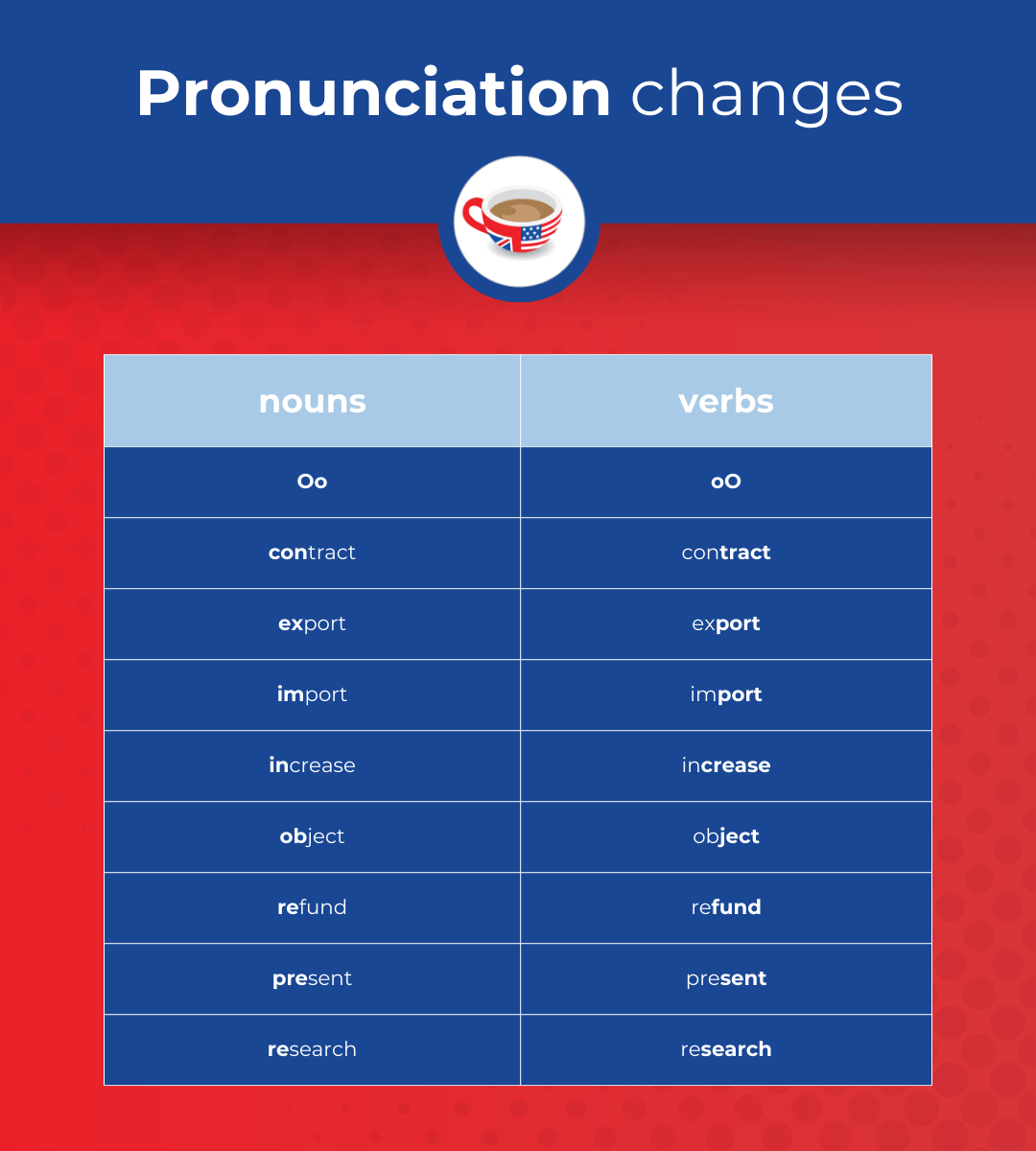
There are many examples where the verb and noun are similar but have different syllable stress. They generally follow the rules stated above, with the first syllable stressed with the noun and the second syllable stressed on the verb

A table that shows word stress changes for a selection of English words with two syllables

English Word Stress Exceptions

Be careful with the below verbs and nouns which do not follow this rule. It’s also important to note that some words change slightly from verb to noun like with effect and believe.

Stress on First Syllable

Some words are always stressed on the first syllable.

A table that shows English pronunciation rules for words with two syllables where the first syllable is always stressed.

Stress on Second Syllable

Some words are always stressed on the second syllable.

A table that shows English pronunciation rules for words with two syllables where the second syllable is always stressed.

Let’s review! 

Here’s a quick summary of English word stress rules with two syllable words:

  • 90% of two syllable nouns are stressed on the first syllable.
  • Around 70% of two syllable verbs are stressed on the second syllable.
  • Some words are the same as verbs and nouns but follow the two rules above with syllable stress.
  • Some words are the same as verbs and nouns but do not follow the rule above.

If you want more practice with your pronunciation, check out Episode 8 of Season 2 of Coffee Break English, where we look at pronunciation of –ed endings.

It’s your turn!

Practise English word stress by deciding whether each word is a noun/adjective or a verb based on the sentence context and decide if the first or the second syllable should be stressed. Make sure you think about it before looking at the answer at the bottom of this blog post!

  1. She equaled the world record in the race.
  2. He is going to present an award at the Oscars tonight.
  3. We have just finished an important research project.

It’s a good idea to make a list of the words that have stress on the first or second syllable and practise using them in sentences to build your confidence with syllable stress. A little practice each day can really help build your confidence!

If you found this post interesting, make sure you watch the full video with Nick and Anabel on the Coffee Break English Youtube channel. In this series we look at lots of useful topics for English learners, so make sure to subscribe to our podcast feed and our channel on YouTube.

Plus, don’t miss your free worksheet – perfect for extra practice after the lesson! When you sign up, you’ll also receive our short coffee break-sized email lessons, delivered straight to your inbox every week, to help you build your English skills. 💪 You’ll even hear from Mark, the founder of Coffee Break Languages, who shares regular tips and motivation for learners of all levels. Sign up below! 👇

So, start paying attention to English word stress when you are speaking! The more you practice, the more confident you will become.

Happy Coffee Breaking!

P.s. Here are the answers to activity above:

  1. She equaled the world REcord in the race.
  2. He is going to preSENT an aWARD at the Oscars tonight.
  3. We have just finished an important REsearch PROject.

Listen to the podcast

How to use ‘so’, ‘too’, ‘either’ or ‘neither’ in English

A smiling man in a blue shirt pointing to bold text that reads 'Key Phrases for Natural English'. The background is dark with a gradient and polka dot pattern.

Do you know how to use so, too, either or neither when speaking in English?

This can be a tricky grammar issue as we need to be careful about the auxiliary and the object pronoun but if we study them we can find simple ways to use them as well as more complete, complex ways. 

The Coffee Break English Show is a podcast series of informal conversations to help you understand some difficult topics in English. In the latest episode, Nick and Mark look at how to use so, too, either or neither to show similarity in conversations.

So let’s have a look at when we use these forms and how we can add them to our English conversations. And why not make yourself a cup of coffee or tea to enjoy while you read and listen to the podcast episode?

Similarity 

We use so, neither and too to demonstrate a similarity with what has just been said. These words are great for expressing to someone that you have had a similar experience to them. So and too express positive similarities and neither and not.. either express a negative similarity.

So

We use so to express positive similarity in conversations. It is normally in response to what someone else has said and we use the auxiliary verb from the sentence we are responding to in our answer. Let’s have a look:

When we use the verb be, the auxiliary in the second sentence will also be the verb be.

A: I am from the UK.                B: So am I!

In present simple sentences with a main verb that is not be, the auxiliary will normally be do.

A: I like pizza.                B: So do I!

In past simple sentences, the auxiliary is did (or was or were with the verb be).

A: I went to the cinema yesterday.                B: So did I!

In present perfect sentences, it is have.

A: I have had two cups of coffee this morning.                B: So have I!

In sentences with modal verbs, the modal verb is the auxiliary.

A: I can speak English.                B: So can I!

Too

We can use too in the same way as we do so to show similarity, but the structure changes. With too we have a simple option, a short option and a long option.

The simple option uses the object pronoun plus too. We don’t need to worry about a verb form. 

A: I can speak five languages.              B: Me too!

We can also use too with the auxiliary verb.

A: I am hungry.              B: I am too!

When we want to respond with a full sentence, we just need to add too at the end of the sentence.

A: I lived in Germany for two years.              B: I lived in Germany for two years too!

Either or Neither

We use ‘neither’ and ‘not.. either’ to talk about negative similarities. The way we use them is a bit different though so pay attention!

Neither – meaning

In simple answers, we use neither in the same way as we use too. The structure is the object pronoun plus neither.

A: I didn’t go to Spain on holiday.              B: Me neither!

We can also use neither in the same way as we use so. The structure is neither + auxiliary verb + subject.

A: I have never been to Argentina.               B: Neither have I!

Either – meaning

In short answers with the auxiliary verb, there is an important change. We use the negative form (not), and we do not put the ’n’ at the front of either.

A: I didn’t go to Spain on holiday.               B: I didn’t either!

In the full sentence form, the rule is the same as too, we just need to add either at the end.

A: I didn’t go to Spain on holiday.               B: I didn’t go to Spain on holiday either!

Pronunciation 🔊

One important aspect of the words either or neither that can confuse learners is that there are two ways to pronounce them. 

We can say them with an /ai/ sound like in why, and we can also say them with a long /i:/ or ‘e sound like in see.

There is absolutely no difference in meaning. 

Generally, /i:/ is more common in the US and /ai/ is more common in the UK but native speakers frequently use both forms so don’t worry, just pick one! 

If you want more practice with the long ‘e’ sound, check out Episode 4 of Season 1 of the Coffee Break Show!

Here’s a visual of today’s lesson

Here are the diffferent options for simple answers, short answers and full answers.

If you find choosing between negative and positive determiners difficult, you might find Episode 9 from Coffee Break English Season 3 really useful.  We take a look at the indefinite pronouns something, anything and nothing and explain when to use them.

A table of the different forms of too, so either or neither in simple answers.

A table of the different forms of too, so either or neither in short answers.

A table of the different forms of too, so either or neither in full answers.


If you found this lesson helpful, make sure to listen to the full podcast episode with Nick and Mark on The Coffee Break English Show, where we dive deeper into so, too, either and neither with more examples and practice. ☕🎧

We release new episodes regularly, covering useful grammar and vocabulary topics to help you sound more natural in English. Subscribe to our podcast feed and our YouTube channel so you never miss an episode.

Plus, don’t miss your free worksheet – perfect for extra practice after the lesson! When you sign up, you’ll also receive our short coffee break-sized email lessons, delivered straight to your inbox every week, to help you build your English skills. 💪 You’ll even hear from Mark, the founder of Coffee Break Languages, who shares regular tips and motivation for learners of all levels. Sign up below! 👇

Now, it’s your turn! Download the worksheet below for further practice and try using so, too, either or neither in your conversations whenever you can. The more you practise, the more natural it will feel.

Happy Coffee Breaking!

Listen to the podcast

Time Phrases: How to Use Present Perfect Adverbs in English

A man in a blue shirt with a thoughtful expression, touching his chin, beside bold text that reads 'JUST', 'ALREADY', 'YET' and 'WHICH SHOULD YOU USE?'.

Have you ever wondered when to use just, yet, or already? These three time phrases are commonly used with the present perfect tense, but they each have specific meanings and uses.

Using time phrases and adverbs with the present perfect helps to communicate more effectively and will make your sentences even clearer when having a conversation with people.

The Coffee Break English Show is a podcast series of informal conversations to help you understand some difficult topics in English. In the latest episode, Nick and Francesca explore how to use the present perfect adverbs just, yet and already, correctly.

If you haven’t listened to the podcast episode yet, why not listen to Nick and Francesca as you read?

So let’s get started and look at just, yet and already!

Time Phrases: The Present Perfect with Just, Yet, and Already

These three present perfect adverbs help us describe when an action happened in relation to now. We often use them with the present perfect tense and they have specific positions in a sentence.

Just

Just is used to indicate that something happened a very short time ago.

It comes between have/has and the past participle:

⏳    I have just finished my homework.  ⏳

⏳    She has just arrived at the station.  ⏳

 👀    In the USA, you are often likely to hear just used with the past simple, not the present perfect! The meaning is exactly the same, though.   

🇺🇸     Where’s David? He just went out.    🇺🇸

Yet

Yet is used to talk about something that has not happened but we expect to happen. We often use them in negative statements and questions.

Yet goes at the end of a sentence:

🔜    I haven’t finished my book yet.  🔜

🔜   Have you eaten yet?  🔜

Already

Already is used to show that something happened sooner than expected or before now.

It normally comes between have/has and the past participle but it can sometimes come at the end when we are speaking to create a strong emphasis:

⬅️    I have already seen this movie.  ⬅️

⬅️    Wow! She has completed her assignment already!    ⬅️

Let’s review

Here’s a summary of the time phrases in this episode:

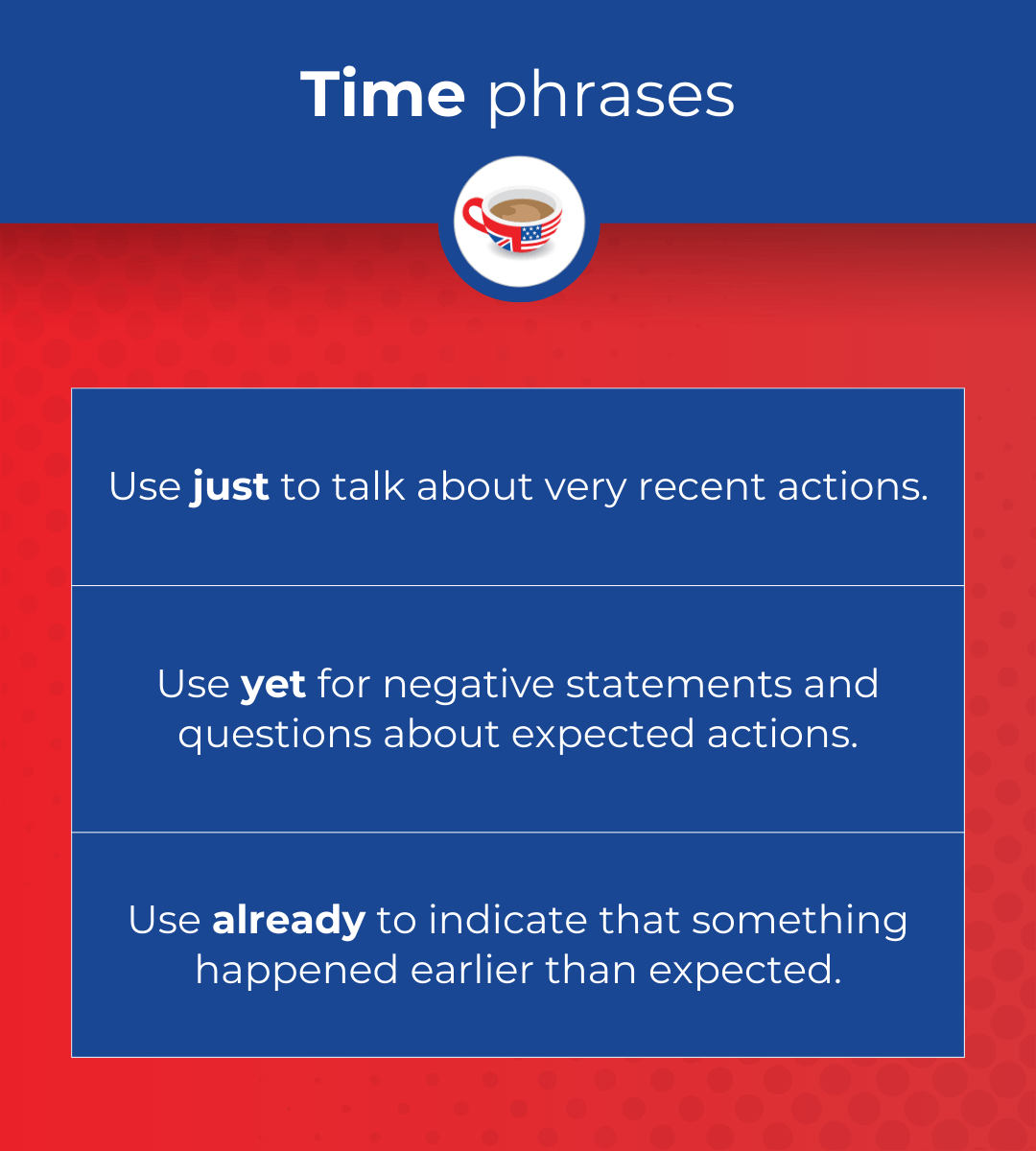
Present Perfect Adverbs: We use just to talk about very recent actions. Yet is used for negative statements and questions about expected actions. Use already to indicate that something happened earlier than expected.

If you found this useful, then you might find Episode 4 of our 2nd season of Coffee Break English helpful! We look at the time phrases for and since with the present perfect.

It’s your turn!

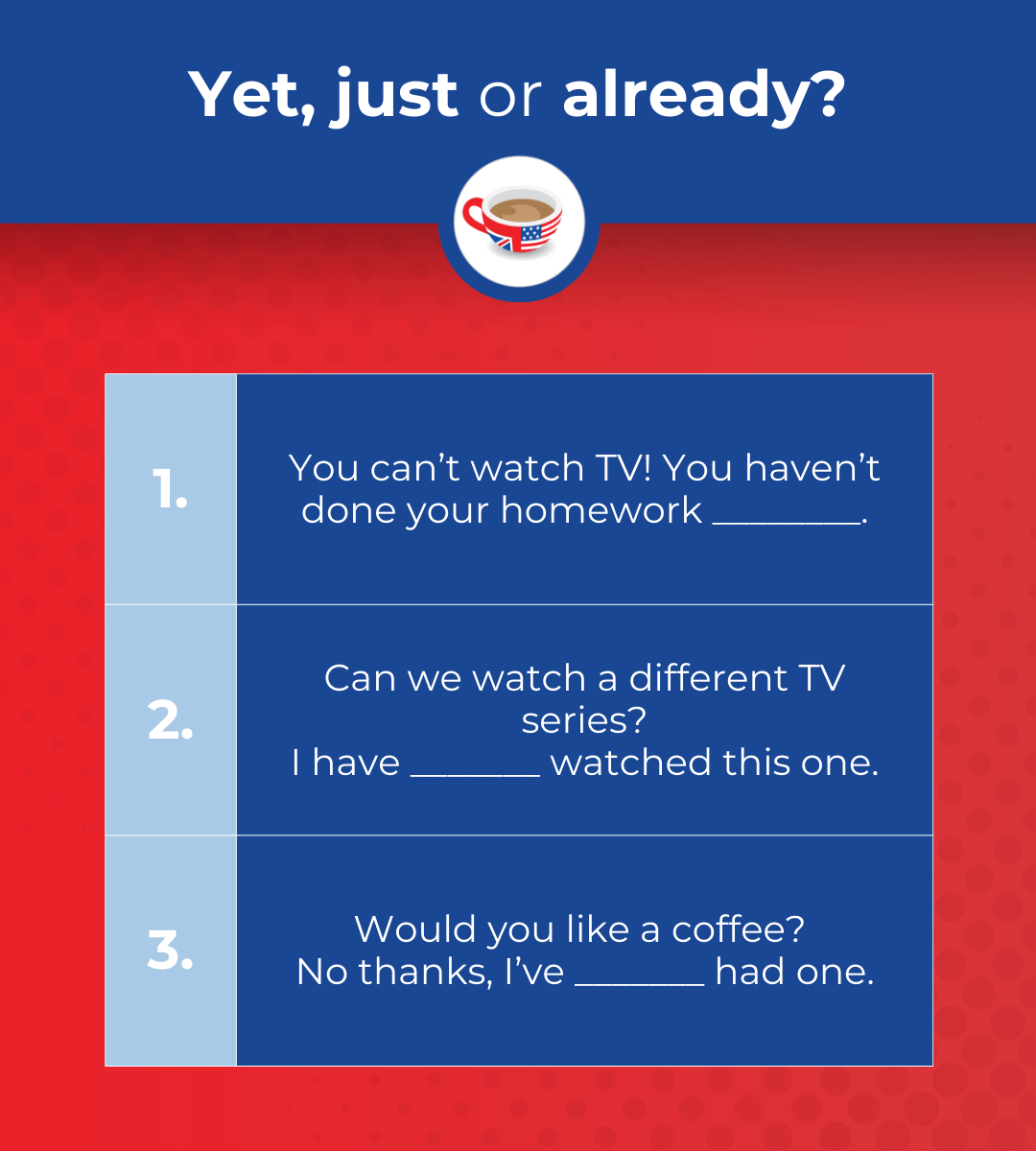
Now let’s practise! Which is the right word? Put yet, just or already in the spaces below. The answers are at the end of the blog post but don’t look until you’ve thought about your answers.

A quiz to practise the Present Perfect Adverbs yet, just and already.

If you found this post interesting, then make sure you listen to the full podcast episode with Nick and Francesca on The Coffee Break English Show. This series looks at useful topics to help English learners improve their language skills, so make sure to subscribe to our podcast feed and our channel on YouTube.

Plus, don’t miss your free worksheet – perfect for extra practice after the lesson! When you sign up, you’ll also receive our short coffee break-sized email lessons, delivered straight to your inbox every week, to help you build your English skills. 💪 You’ll even hear from Mark, the founder of Coffee Break Languages, who shares regular tips and motivation for learners of all levels. Have you signed up yet? If not, sign up below! 👇

So, start using these time phrases in your conversations! The more you practice, the more confident you will become.

Happy Coffee Breaking!

Here are the answers to the questions in the practice section above:

  1. You can’t watch TV! You haven’t done your homework yet.
  2. Can we watch a different film? I have already watched this one.
  3. Would you like a coffee? No thanks, I’ve just had one.

Listen to the podcast

Present Perfect Tense for Experiences

A smiling woman in a blue shirt, in a blue background.

Using the present perfect tense can be difficult for many English learners. This is because it is used in a variety of ways that do not necessarily translate to similar grammar forms in other languages.

The key is to consider the different contexts where you can use the present perfect, and then look at what message we want to express when using the present perfect or other forms. If you can understand this, then you will be a big step closer to managing conversations fluently in English!

The Coffee Break English Show is a podcast series of informal conversations to help you understand some difficult topics in English. In the latest episode, Nick and Francesca look at how to use the present perfect tense for experiences that you have had in the past, plus we explain the difference between been and gone.

Have you made yourself a coffee? Then let’s get started!

The Present Perfect Tense for Experiences

The present perfect tense is used to signify a variety of situations, but today we will look specifically at experiences. When we speak to friends or meet people for the first time, we often talk about our experiences. A common question is ‘Have you ever…?’ And a common response is ‘No, I’ve neverorYes, I have’. 

This gives us our question form for the present perfect, plus the short positive and negative forms. We can also give extra information. See the below conversation:

Present Perfect Examples: Have you ever been to Paris? Yes, I have. I have been to Paris 3 times! Hav you? No, I haven't. I've never been to Paris but I would like to go.

Been and Gone

In the example above been is used to express the idea of visiting a place. It is important to remember that we are talking about the experience of visiting Paris.

We can consider been as the past participle of go when describing an experience. The idea that we went to a place and then returned. This is also the case when we use a phrase like go skiing in the present perfect (I have been skiing in the Alps).

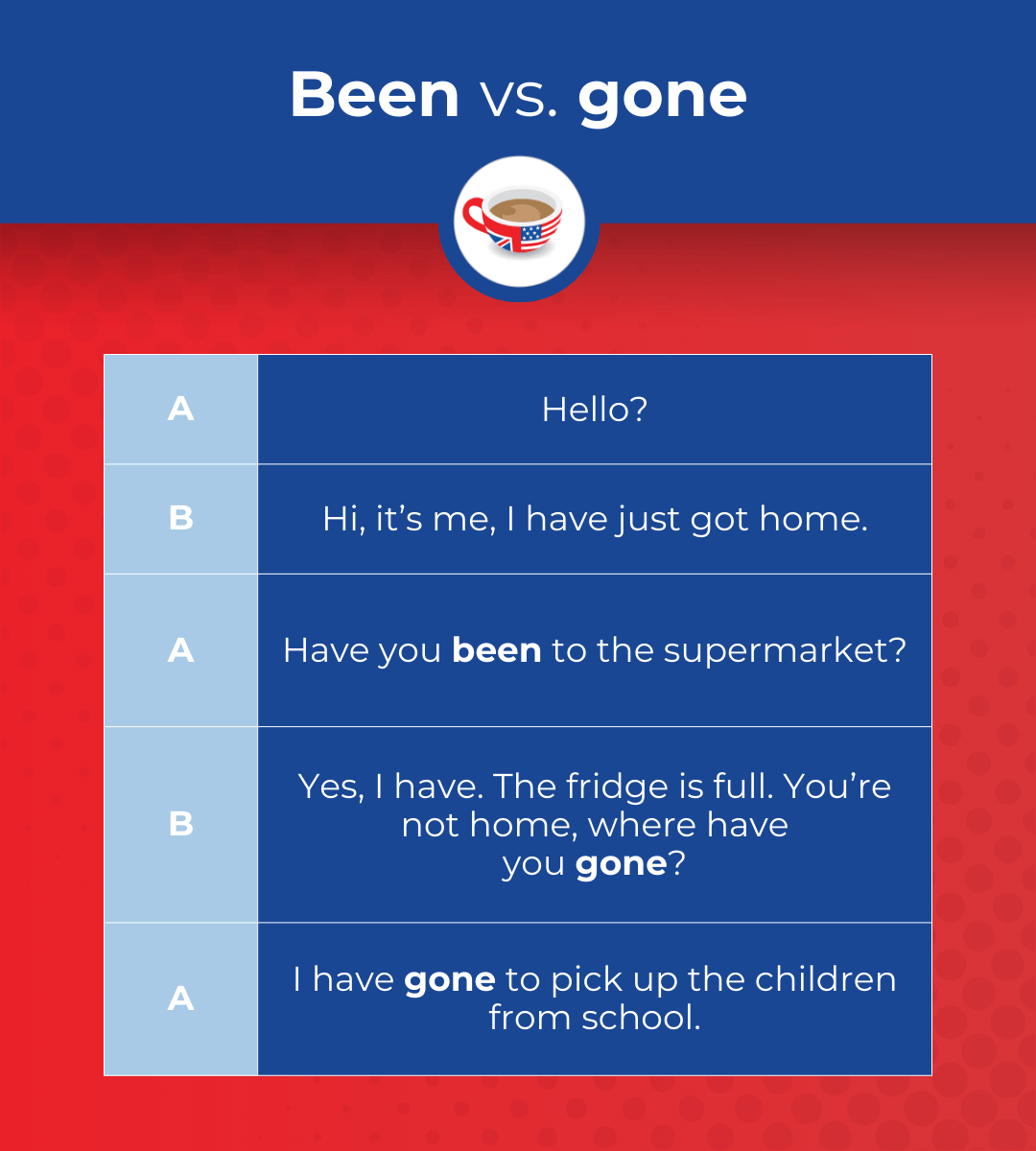
We use gone with the present perfect to express the idea of movement, or leaving a place. The idea that we went to a place and we haven’t returned. We can see the difference in the dialogue below:

A dfialogue showing the difference between been and gone

We can see that the wife has returned home but the husband has not. The wife has been to the supermarket but the husband has gone to pick up the children.

So we can use been when we use present perfect for experiences and gone when we use present perfect for recent actions.

For more on been and gone with the present perfect tense, see our 8th episode of Season 1.

Present Perfect Vs Past Simple

We use the present perfect tense for talking about experiences with no specific detail and we use the past simple to give further information about the experience. Here’s an example:

A dialogue showing the difference between the past simple and the present perfect tense.

We can see that the experience is introduced with the question have you ever? and then the follow up question is in the past simple. When we ask for detail we use the past simple, usually using open questions with question words such as who, what, why, when, etc.. 

From this point on, we normally use the past simple because we are talking about a finished activity and no longer a general experience.

For more practice with choosing the past simple or the present perfect tense, check out Episode 2 of Season 3 of Coffee Break English. 

It’s your turn!

Now, let’s practise! Try to decide which of the sentences below is a lie. Read to the bottom to find out which sentence is not true… Don’t check until you have guessed!

Coffee Break Languages founder, Mark Pentleton, has learnt 9 foreign languages.

Coffee Break Languages has been nominated for a Lovie Award for Best Science/Education Podcast.

Coffee Break Languages has created a podcast series for pets.

Practice makes a perfect tense!

Remember that the present perfect tense is difficult because we use it in a variety of ways and it doesn’t always have an equivalent form in other languages so be patient with yourself and always try to learn in context. Try using the present perfect tense for experiences in your conversations!

If you found this post interesting, make sure you listen to the full podcast episode with Nick and Francesca on The Coffee Break English Show. We will release more episodes soon, about some other useful topics! Subscribe to our podcast feed and our channel on YouTube to learn when the next episode is available.

Plus, don’t miss your free worksheet – perfect for extra practice after the lesson! When you sign up, you’ll also receive our short coffee break-sized email lessons, delivered straight to your inbox every week, to help you build your English skills. 💪 You’ll even hear from Mark, the founder of Coffee Break Languages, who shares regular tips and motivation for learners of all levels. Sign up below! 👇

So keep practising, deepening your knowledge and understanding, and remaining curious about the language you are learning and you will surely make progress. 🚀

Happy Coffee Breaking!

Here are the answers to the quiz:

Coffee Break Languages founder, Mark Pentleton, has learnt 10 foreign languages. True!

It is true, Mark has learnt 9 foreign languages and you can hear him speaking them here! 🌎

Coffee Break Languages has been nominated for a Lovie Award for Best Science/Education Podcast. True!

Coffee Break Languages has created a podcast series for pets. False!

This one is not true but we did pretend to do this in an April Fools’ Joke!  🤭

Listen to the podcast

‘Too Much’ or ‘Too Many’: Using Quantifiers in English

A man in a red shirt with a thoughtful expression, resting his chin on his hand.

Have you ever wondered whether to say too much or too many? Or perhaps you’re unsure when to use enough? The good news is that learning these quantifiers in English will help you sound more natural!

The Coffee Break English Show is a podcast series of informal conversations to help you understand some difficult topics in English. In the latest episode, Nick and Anabel explore how to use these common quantifiers in English and when to choose one over the other.

So let’s take a closer look at too much, too many and enough and start putting them into practice! Continue reading to find out more, and why not listen to the podcast as you go?

Countable and Uncountable Nouns

First we need to establish what countable and uncountable nouns are.

When we talk about countable nouns, we mean nouns that can be plural. We can say I have one apple, I have two apples, three apples, etc. We normally show the plural form by adding the letter s (or es for words like leaves, watches, etc.) at the end of words but some countable nouns are irregular (person – people, child – children, woman – women, etc.).

When we talk about uncountable nouns, we mean nouns that are not possible to count by expressing a simple number before them. Liquids are uncountable because it is impossible to put a simple numerical quantity to them (water, oil, coffee, etc.). Many abstract ideas are uncountable too, such as information, news, money and light.

A list of countable and uncountable nouns

Too Much, Too Many, and Enough

Understanding when to use quantifiers is essential for speaking English correctly. These words help us describe quantity, but they have specific rules for their usage.

Too Much vs. Too Many

These phrases mean “more than necessary” or “more than wanted,” but the difference depends on whether the noun is countable or uncountable

Too much is used with uncountable nouns:

  • There is too much sugar in my coffee.
  • She spends too much time on her phone.

Too many is used with countable nouns:

  • There are too many cars on the road at 5pm. Traffic is slow!
  • I bought too many apples at the market. My bag broke on the way home!

We should always remember that when we use too much and too many, we are expressing a negative idea. We are saying that the quantity is a problem. If we just want to say that there is a very large quantity using much and many, we can say so much and so many.

  • There is so much light in this room.
  • There are so many castles in Scotland!

If you want more practice with quantifiers in English, check out Episode 5 of Season 1 of Coffee Break English!

To much or too many. Rules and examples.

Enough

The word enough means “sufficient” or “the right amount.” It can be used with both countable and uncountable nouns.

 Before a noun:

  • We have enough chairs for everyone. 
  • There is enough food for everyone, help yourself! 

After an adjective:

  • She’s strong enough to lift the box. 
  • The oven is hot enough now, we can put the pie in.

Not Enough

We use not enough to show that something is “insufficient”. It can be used with both countable and uncountable nouns.

  • This coffee is not hot enough
  • She doesn’t have enough money to buy a new phone. 

Common mistakes

Here are some common mistakes learners make when using quantifiers in English:

There are too much people in the room.

There are too many people in the room.

I don’t have too many time.  

I don’t have too much time.

She didn’t buy enough big shoes.   

She didn’t buy big enough shoes.

Let’s Review

Use too much with uncountable nouns. Use too many with countable nouns. Use enough before a noun or after an adjective to show sufficiency. Use not enough to show something is insufficient.

It’s your turn!

Now, let’s practise using quantifiers in English! Here are four situations. Try to make a sentence to describe each one using too much, too many, enough or not enough for each one.

Some possible answers are at the end of this blog post, but don’t look until you’ve thought about your answers!

  1. I need £35 to pay for the dinner and I have £36.
  2. There are 5 students and 3 chairs.
  3. This pasta is extremely salty!
  4. There are 6 people and 5 spaces in the car.

If you found this post interesting, make sure you listen to the full podcast episode with Nick and Anabel on The Coffee Break English Show. In this series, we talk about useful topics for English learners, so make sure to subscribe to our podcast feed and our channel on YouTube.

Plus, don’t miss your free worksheet – perfect for extra practice after the lesson! When you sign up, you’ll also receive our short coffee break-sized email lessons, delivered straight to your inbox every week, to help you build your English skills. 💪 You’ll even hear from Mark, the founder of Coffee Break Languages, who shares regular tips and motivation for learners of all levels. Sign up below! 👇

So, start using quantifiers in English correctly whenever you can! The more you practice, the more natural your English will sound. Why not get a coffee now and test yourself with today’s practice exercises?

Happy Coffee Breaking!

P.s. Here are some possible answers to the prompts given above:

  1. I have enough money.
  2. There are not enough chairs (or there are too many students).
  3. They put too much salt on the pasta.
  4. There are not enough spaces in my car (or there are too many people for my car).

Listen to the podcast

‘TH’ Sounds in English: How to Pronounce ‘TH’ Correctly

A smiling man in a red shirt holding, with bold text around him reading 'Pronouncing TH'

Making th sounds in English is a common problem that many English language learners face – but did you know that many native speakers also find th pronunciation difficult?

It really is a tricky sound to make! But many words contain th sounds in English and mastering this sound will ensure you communicate clearly and effectively. 

The Coffee Break English Show is a podcast series of informal conversations to help you understand some difficult topics in English. In the latest episode, Nick and Francesca look at the difference between f and th pronunciation as well as voiced and unvoiced th sounds.

Because this episode focuses on pronunciation, it’s best to watch the video or listen to the podcast episode while you read this article, to hear Nick and Francesca making the sounds.

So let’s get started and look at th sounds in English!

‘Th’ Pronunciation in English

For many language learners, the pronunciation of th is a big challenge because this sound doesn’t exist in their language, or at least not in the same way. Today we want to demystify th pronunciation so that you feel more confident in future.

Th Vs f

The first challenge between f and th sounds is understanding how to make them.

The big difference is the position of the tongue!

F sounds are made by putting the top teeth on the bottom lip and blowing air through the gap. The tongue stays in the mouth. 🦷

Th sounds are made by putting the tongue between the top and bottom teeth and blowing air around the tongue. You should be able to see the tongue if you look in a mirror! 😛

Another good way to practise this sound is to put a pencil, or your finger, in front of your lips and make sure you touch the pencil with your tongue when you make the th sounds. You will find some fun sentences to do this at the end of this blog! 👅✏️

Spelling Rules

Now let’s look at when to use each one. If you are looking at a dictionary post of a word, you will see the spelling and the phonemic transcription. Understanding phonemic symbols can help you with your pronunciation because written English does not always help you understand how to say words in English. 

The good news is, for the difference between /f/ and /θ/, we can trust the spelling!

f = /f/

/f/ is almost always spelt with one or two f’s. It is never spelt th. This spelling rule really helps to know when to make each sound. We sometimes see /f/ spelt with gh (laugh, enough, etc.) or ph (photo, phone, physics, etc.)

th = /θ/

/θ/ is always spelt with th. There are no exceptions to this rule! 🥳

TH – voiced or unvoiced?

Now we come to a small problem with th pronunciation. There are two ways to pronounce th in English. One is voiced 🗣️ and the other is unvoiced 🔇.

We can see a clear difference between voiced and unvoiced sounds with the letters f and v. To make an f sound, you put your top teeth on your bottom lip and blow air. To make a v sound, you do the same, but you vibrate your voice box. You can feel this happening if you put your finger on the front of your throat and make the v sound. For this, try making the sound of a Formula One car! 🏎️

We can apply the same rule between /f/ and /v/ to th sounds. For the voiced th sound, the tongue remains between the teeth, but now we are vibrating the voice box. The symbol for this sound is /ð/. 

Th = /θ/ (unvoiced) e.g. theatre, bath, truth 🔇

Th = /ð/ (voiced) e.g the, then, breathe 🗣️

If you would like more practice with th pronunciation, check out how to pronounce ‘Tuesday’ and ‘Thursday’ in episode 9 from the first season of the Coffee Break Show!

Spelling Rules

The difference between f and th is quite easy to see in spelling. Unfortunately, it is not so easy with the difference between the th sounds /θ/ and /ð/. There are some general rules we can follow but we have to be careful for exceptions. 

Both /θ/ and /ð/ can appear at the beginning of words but /ð/ is more common. 

Many determiners begin with a /ð/ sound: the, this, that, these, those.

The numbers three, thirteen, thirty and thousand all have a /θ/ sound.

Generally, when th is at the end of the word, we say /θ/ (unvoiced).

When th is in the middle of the word we normally say /ð/ (voiced). But there are many exceptions to this rule so be careful! The best thing to do is learn the patterns where these rules do apply.

Let’s have a look at some examples:

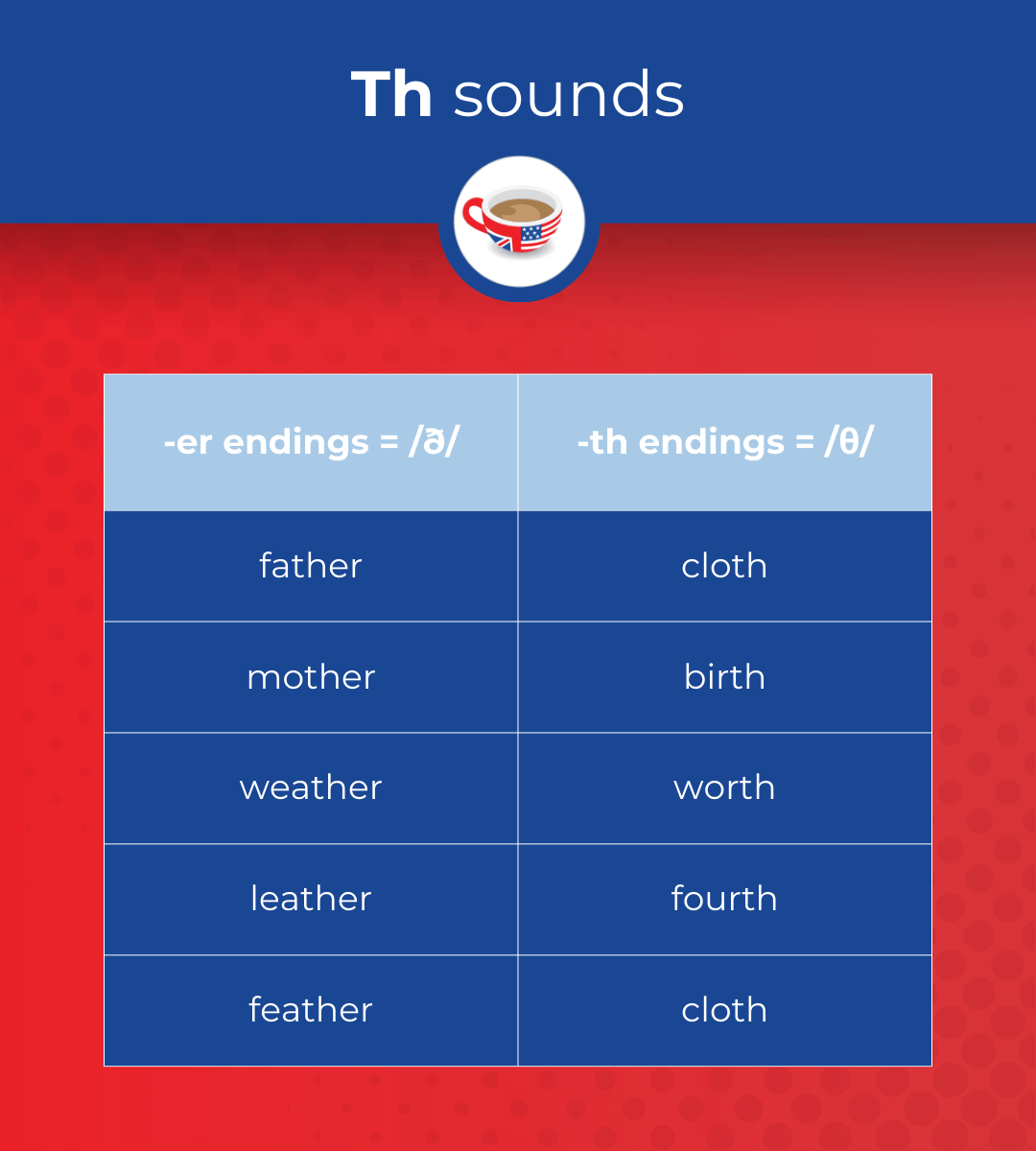
Words that end in 'er': father, mother, weather, leatehr, feather words that end in 'th': cloth, birth, worth, fourth, cloth

Words that end in the: breathe, bathe, clothe(s) words that end in th: breath, bath, cloth

Let’s review 

So the fundamental difference between f and th in English is that /f/ needs the top lip on the bottom teeth, and /θ/ needs the tongue between the teeth, and /ð/ is the same but has a vibrating quality. As always, the best way to perfect these rules is to practise using the words and learning when to follow each rule. Now try saying the words in the visual below out loud! 🗣️

An explanation of th and f sounds with some examples

It’s your turn! 

Try saying these tongue twisters out loud to practise pronouncing these sounds correctly! Try this in front of a mirror and check you can see your tongue when making those th sounds. If you want, you can listen to Nick and Francesca saying them in the video, and repeat them after them.

👅🌪️

There are Thirty-three thick silk threads.

👅🌪️🌪️

Three thousand thick feathers float down the river.

👅🌪️🌪️🌪️

I thought a thought, but the thought I thought wasn’t the thought that I’d thought that I’d thought.

If you found this post interesting, make sure you listen to the full podcast episode with Nick and Francesca on The Coffee Break English Show. In this series, we talk about useful topics for English learners, so make sure to subscribe to our podcast feed and our channel on YouTube.

Plus, don’t miss your free worksheet – perfect for extra practice after the lesson! When you sign up, you’ll also receive our short coffee break-sized email lessons, delivered straight to your inbox every week, to help you build your English skills. 💪 You’ll even hear from Mark, the founder of Coffee Break Languages, who shares regular tips and motivation for learners of all levels. Sign up below! 👇

Try to practise the th sounds often at home! The more you practice, the more confident you will become. We recommend you make a list of the words with these sounds that you find difficult and practise saying them until you feel more confident making th sounds.

Remember that it’s ok not to sound exactly like a native speaker! The important thing is that you feel confident and comfortable when speaking and people can understand you.

Happy Coffee Breaking!

Listen to the podcast

Future Tenses in English: Making Future Plans

A smiling woman in a blue shirt, with bold text around her reading 'Future tenses explained'.

Do you know the different ways to talk about future plans in English? Talking about your plans can be a little confusing as we don’t always use future tenses in English like we do in the present and past. Instead, we have different phrases we use to express specific ideas.

In this episode, Nick and Anabel look at will, be going to and the present continuous to see how we can express different ideas about our future plans in English.

The Coffee Break English Show is a podcast series of informal conversations to help you understand some difficult topics in English. In the latest episode, we discuss different ways to use future tenses in English to express future plans.

Continue reading to find out more and why not listen to the podcast as you go?

Let’s get started with will!

Future Tense Verbs – Will

Let’s look at will first. One of the most common meanings of will is to express spontaneous decisions. We can consider a spontaneous decision as the birth of our plan, it has just been decided and is still new. To create this form, we use will, plus the bare infinitive (without to).

If we are hungry, we might say “I’ll go and buy a sandwich”. If it is cold we might say “I will put on a jumper”. It is something I decide to do in the moment.

Examples in positive, negatives and question form:

I will buy a new phone.

❌ I won’t buy a new phone.

❓ Will you buy a new phone?

Remember the contraction of will involves the subject and the last two letters of the verb will, with an apostrophe (‘ll). You may even hear this contraction with a noun but this is almost always only when we speak.

I’ll

you’ll

he’ll

she’ll

it’ll

we’ll

they’ll

Nick’ll

Anabel’ll (ok, this one is very difficult to pronounce!)

Future Tense Verbs – Be going to

We use be going to to describe the next stage of our plan. This is a decision which we have made in the past and we are now thinking about. We are now planning the details and it is our personal intention. We use the bare infinitive after be going to.

If I am talking about the weekend, I can say “I’m going to see my friends.” This means that the plan is being organised but maybe some details are not finalised.

Examples in positive, negatives and question form:

I am going to buy a new phone.

❌ I am not going to buy a new phone.

❓ Are you going to you buy a new phone?

Future Tense Verbs – Present Continuous

When we have finalised the important details and our plan is complete, we can use the present continuous. This shows that our plan is fixed and the details are confirmed. We use present continuous for fixed plans.

Examples in positive, negatives and question form:

I am buying a new phone.

❌ I am not buying a new phone.

❓ Are you buying a new phone?

Let’s review the future tenses in English

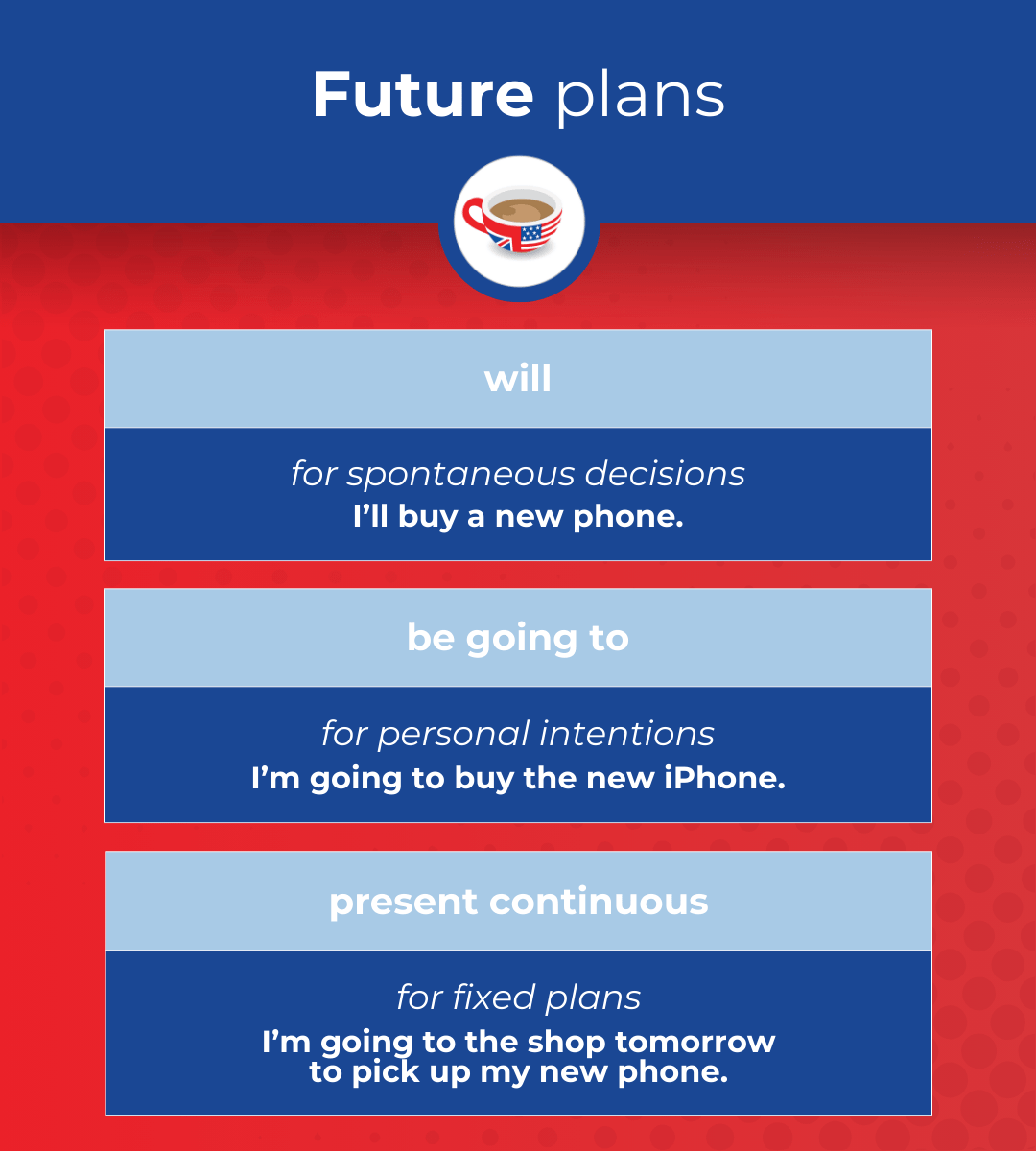
So let’s go over the different ways to use future tenses in English to express future plans.

First, we start with will to express a new plan. We make a spontaneous decision.

Then we use be going to when we have already made the decision and we now have a personal intention.

And finally we used present continuous to show we have finalised the details and we have a fixed plan.

Will is for spontaneous decisions. Be going to is for personal intentions. Present continuous is for fixed plans.

Remember! The present continuous and be going to are very similar and express slightly different ideas but can often be used in the same context with little difference in meaning. Don’t worry if sometimes you’re not sure which one to use, it probably means you can use both! If you feel you need more practice with future tenses in English, we take a look at other ways to use be going to and will in Episode 5 of Season 3.

It’s your turn!

Now, let’s practise using the future tenses in English to talk about future plans! Look at the prompts and think about which future form would be best to use. The answers are at the end of the blog post but don’t look until you’ve thought about your answers!

  1. It’s cold! (put on my jumper) …
  2. I am busy tonight. (meet my friends in town) …
  3. I’m on my summer holiday! Tomorrow (swim in the sea and sunbathe) …

If you found this post interesting, make sure you listen to the full podcast episode with Nick and Anabel on The Coffee Break English Show. We will release more episodes soon, about some more useful topics! Subscribe to our podcast feed and our channel on YouTube to learn when the next episode is available.

Plus, don’t miss your free worksheet – perfect for extra practice after the lesson! When you sign up, you’ll also receive our short coffee break-sized email lessons, delivered straight to your inbox every week, to help you build your English skills. 💪 You’ll even hear from Mark, the founder of Coffee Break Languages, who shares regular tips and motivation for learners of all levels. Sign up below! 👇

So, start trying to use different future tenses in English to be specific about your future plans when you can! Remember that when you learn new grammar, it will help you to express yourself as well as improving your understanding when listening to others. It’s all part of the language-learning journey. Are you going to try using these three future forms in your speech? Good luck!

Happy Coffee Breaking!

Here are some possible answers to the questions given above:

  1. It’s cold! I’ll put on my jumper.
  2. I am busy tonight. I’m meeting my friends in town.
  3. I’m on my summer holiday! Tomorrow I’m going to swim in the sea and sunbathe.

Listen to the podcast

‘Must’ and ‘have to’ grammar: four simple rules

A smiling woman in a red shirt holding a Coffee Break English mug, with bold text around her reading 'MUST', 'MUSTN’T', 'HAVE TO', and 'DON’T HAVE TO'.

Do you ever get confused with must and have to? These two verbs can be used in similar ways but we have to be careful when we use them in the negative as the meaning changes completely. This is particularly difficult for some language learners as there may only be one word in their language for both must and have to.

The Coffee Break English Show is a podcast series of informal conversations to help you understand some difficult topics in English! In the latest episode, Nick and Francesca look at how we can use must and have to in the positive and negative forms and provide four simple rules to show their differences in meaning.

So, let’s get started and look at the rules for must and have to. Why not get a cup of coffee or tea to enjoy while you read and listen to the podcast episode?

1. Must

We use must to talk about obligations. They can be external rules or laws but they can also express an obligation or strong advice. Let’s look at some examples:

👨🏻‍⚖️

You must wear a seatbelt when you are driving.

We use must to show we are obligated to do this.

🫵🏻

You must keep your dog on a lead in this park.

This is a rule. You are obligated to do this when you are in the park.

⚠️

You must be careful when carrying a knife.

This is strong advice based on what we believe to be a good idea.

2. Mustn’t

We use mustn’t to talk about prohibition. We are saying that it is not possible or permitted to do something.

Let’s look at some examples:

👨🏻‍⚖️

You mustn’t drive on the right side of the road in the UK.

This is a law. We use mustn’t to show you are prohibited from doing this.

🫵🏻

You mustn’t look at your phone during the exam.

This is a rule. You are prohibited from doing this when you are in the exam.

⚠️

You mustn’t touch the oven, it is hot.

This is strong advice based on what we believe to be a bad idea.

3. Have to

We use have to to talk about necessity. Have to can often be used to talk about obligations as there is a strong similarity here with must, but the idea is that we need to do something.

👨🏻‍⚖️

You have to wear a helmet when you cycle on the road.

This is a law. We use have to to show that it is necessary to do this action in this context.

🫵🏻

You have to pay attention during the safety explanation on an airplane.

This is a rule. Have to demonstrates that this is something we need to do.

⚠️

You have to wear warm clothes in the winter in Sweden.

This is advice that shows something is necessary in order to avoid something happening (being cold), or to make something happen (being warm).

4. Don’t/doesn’t have to

When using must and have to, we need to be careful with the negative forms. Because we are considering the meaning of have to as something that is necessary, it is now easy to understand that the negative form means something that is not necessary. It can show that there is no obligation in this situation.

Let’s look at some examples:

👨🏻‍⚖️

You don’t have to wear a seatbelt when the car is parked.

This shows the absence of a law. We use don’t have to to show that it is not necessary to do the action.

🫵🏻

He doesn’t have to wear a shirt and tie in the office. They have a casual dress code.

This shows the absence of a rule. It demonstrates that this is something we do not need to do in this context.

👐🏻

You don’t have to take a medical kit when you go on a walk but it could be a good idea in case someone gets injured. 

This shows that there is no obligation to take the item. You have a choice.

Choosing between must and have to

Because there is such a similarity in meaning between must and have to, it can be difficult to know which one you should use in different contexts. But it is important to remember that you can normally use both without really changing the meaning. 

Must is generally stronger than have to, so when you are choosing which one to use, think about how important the information is and if it is urgent, it is best to use must. If you are only communicating something general that doesn’t need urgency or to be convincing, have to might be better.

If you want more practice with have to, check out Coffee Break English episode 4: season 4!

Here’s a visual summary of ‘must’ and ‘have to’

must is for obligations, mustn't is for prohibition, have to is for necessary, don't have to is for not necessary

If you found this lesson helpful, make sure to watch the full episode of The Coffee Break English Show with Nick and Francesca, where we dive even deeper into must vs. have to! We release new episodes regularly, covering essential grammar topics to help you improve your English so make sure you subscribe to our YouTube channel so you never miss a lesson!

Plus, don’t miss your free worksheet – perfect for extra practice after the lesson! When you sign up, you’ll also receive our short coffee break-sized email lessons, delivered straight to your inbox every week, to help you build your English skills. 💪 You’ll even hear from Mark, the founder of Coffee Break Languages, who shares regular tips and motivation for learners of all levels. Sign up below! 👇

So, start practicing must and have to whenever you can!  Remember, small daily steps lead to big improvements. It’s all part of your language-learning journey.

Happy Coffee Breaking!

Listen to the podcast

Mastering comparative adjectives in English

Are you able to use comparative adjectives in English? Do you know the grammar rules?

One thing that can be tricky in English is when you want to make the comparative stronger or weaker. There are different ways we can do this and we just need to practise them to get them right!

The Coffee Break English Show is a podcast series of informal conversations to help you understand some difficult topics in English. In the latest episode, Nick and Mark look at how to use modifiers to strengthen (and weaken) comparative sentences.

Continue reading to find out more and why not listen to the podcast as you go?

So, let’s get started and look at comparative sentences!

A review of comparative adjectives in English

Here is a quick review of the grammar rules for comparative adjectives in English. If you would like more practice with comparative adjectives, check out Episode 1 of Season 3 of Coffee Break English!

One-syllable adjectives

clean >> cleaner than

big >> bigger than 

small >> smaller than

Two-syllable adjectives with -y

happy >> happier than

funny >> funnier than

Adjectives with two or more syllables

expensive >> more expensive than

comfortable >> more comfortable than

Exceptions

fun >> more fun than

good >> better than

bad >> worse than

far >> further than

Modifying comparative sentences

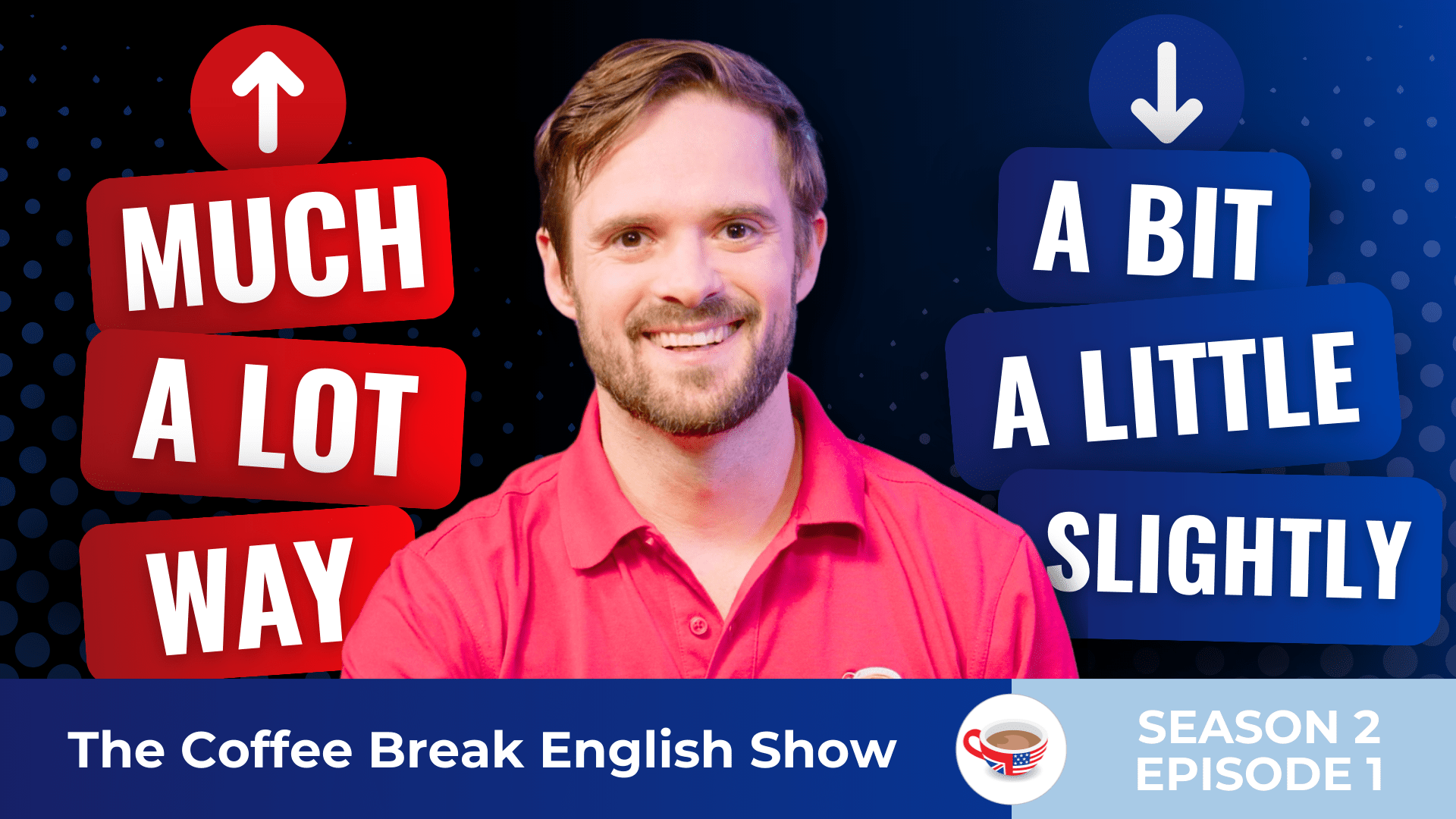
We use modifiers to make comparative adjectives stronger or weaker. A modifier is a word that changes the meaning of a sentence, in this case making the sentence stronger or weaker. If you want to make your comparisons stronger you can use intensifiers. Common examples of English adverbs that intensify an idea are much, a lot and way. We can also use far and significantly in more formal situations.

Big differences: much - I am much more relaxed now that I have retired. a lot - my niece is a lot taller than she was last year. way - the new italian restaurant is way better than the old one.

But maybe you want to make your comparison less strong. In that case, you should use weakeners. Some common examples of English adverbs that weaken ideas are a bit, a little and slightly.

Small differences: a bit - Dogs are a bit friendlier than cats. a little - Bools are a little more interesting than films. slightly - my brother is slightly taller than me.

Sounding natural when making comparisons

When we use modifiers with comparative adjectives, we often change our intonation to emphasise what we want to say. This means that we often stress the modifier more than the adjective.

When we are making the meaning of the sentence stronger, we can stress the word in a loud and deep way. For example:

My dog is way bigger than yours.

When we want to say that the difference is small, we can still stress the modifier, but the intonation is different. We often make the sound of the word softer and our intonation goes up. Here’s an example:

I’m feeling a little better today.

It’s your turn!

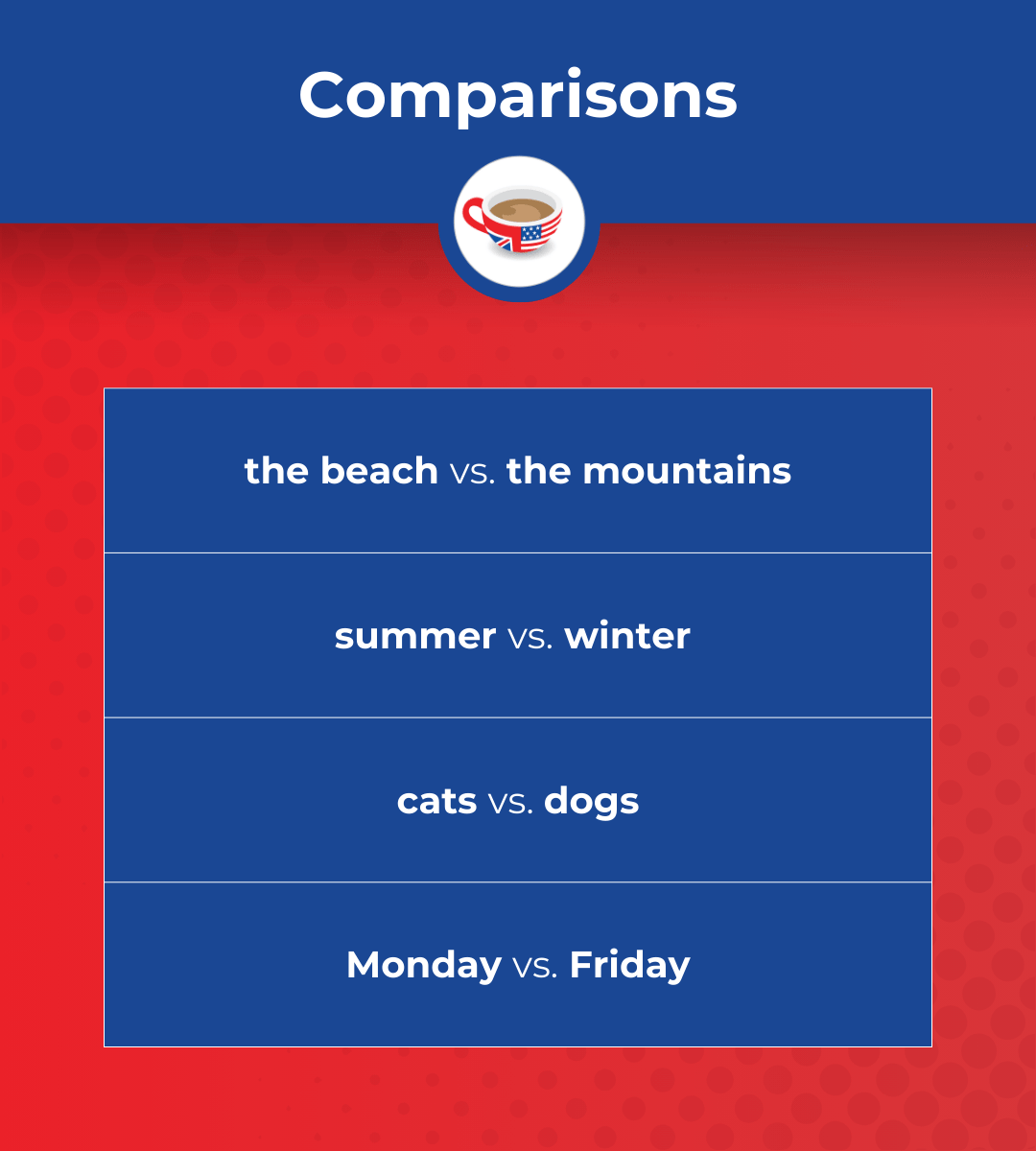
Now, let’s practise! Write down sentences comparing the ideas below and try to modify the comparative adjectives to show big and small differences. You can find some examples at the end of this blog post.

the beach compared to the mountains summer compared to winter cats compared to dogs Monday compared to Friday

Always try to give as much detail as you can when you use a foreign language. The easy option is to stay in your comfort zone but the best way to learn is to try to be as descriptive as possible which will definitely help you increase your speaking (or writing) level. Be ambitious!

If you found this post interesting, make sure you listen to the full podcast episode with Nick and Mark on The Coffee Break English Show. We will release more episodes soon about some more useful topics! Subscribe to our podcast feed and our channel on YouTube to learn when the next episode is available.

Plus, don’t miss your free worksheet – perfect for extra practice after the lesson! When you sign up, you’ll also receive our short coffee break-sized email lessons, delivered straight to your inbox every week, to help you build your English skills. 💪 You’ll even hear from Mark, the founder of Coffee Break Languages, who shares regular tips and motivation for learners of all levels. Sign up below! 👇

Try modifying your comparative sentences whenever you can. By trying to be as precise and detailed as possible when communicating, you are improving your control of the language. Don’t worry if you make mistakes – it’s about regular and consistent practice and not just taking the easiest way to achieving your communicative goal, but challenging yourself to improve with every practice opportunity.

Happy Coffee Breaking!

P.s. Here are some possible answers to the prompts given above:

  • The mountains are much more interesting than the beach.
  • Summer is way more fun than winter.
  • Dogs are a bit nicer than cats. 
  • Monday is a lot more difficult than Friday!

Listen to the podcast