How to ask for directions in Spanish: key phrases, tips, and a real-life dialogue

Learning how to ask for directions in Spanish is essential, especially if you’re travelling to a Spanish-speaking country. In this episode, we’ll walk you through some essential vocabulary and phrases to use when asking for and giving directions in Spanish. We’ve also included a sample dialogue between a tourist and a local to give you real-life context.

For those looking to improve listening comprehension, we also recommend tuning in to our podcast episode, where you’ll hear a real-life Spanish conversation about asking for directions.

Why is learning to ask for directions in Spanish useful?

When exploring a new place, knowing a few key phrases for asking directions can be incredibly helpful. Spanish is widely spoken across the globe, and even knowing just a few phrases can make navigating easier. 

By learning how to ask for directions in Spanish, you’ll not only become more independent in your travels but also have a better chance of connecting with locals. And as we go through some helpful phrases, remember that giving directions in Spanish follows some standard patterns, which you’ll get familiar with in this guide.

If you don’t know how to ask for directions in Spanish, don’t forget to listen again to the lesson or read the blog article about asking for directions in Spanish before this episode. ¡Será de gran ayuda!

Sample dialogue: tourist asking for directions

Below is a sample dialogue where a tourist is asking for information at a tourist information centre. Let’s imagine María, the tourist, is looking for a post office and a popular tourist attraction. 

This short dialogue will help you remember how to ask for directions in Spanish, but remember that the audio podcast features a longer and more detailed dialogue.

Dialogue in Spanish

You can read the dialogue out loud to practise your pronunciation while consolidating how to ask for directions in Spanish.

  • María: Hola, buenos días.
  • Local guide: ¡Buenos días! Dígame, ¿en qué puedo ayudarle?
  • María: Necesito un poco de información. Estoy buscando atracciones turísticas y me gustaría saber si hay alguna oficina de correos cerca.
  • Local guide: Claro. ¿Tiene coche?
  • María: No, no tengo coche.
  • Local guide: En ese caso, la oficina de correos está a diez minutos, pero tendría que coger el autobús.
  • María: ¿Hay una parada cerca?
  • Local guide: Sí, la parada está a dos calles de aquí. Solo necesita tomar la línea 5.
  • María: Perfecto, muchas gracias.
  • Local guide: De nada. ¡Adiós!
  • María: Adiós.

Explanation of key vocabulary

In this dialogue, we see María using some of the most essential phrases for how to ask for directions in Spanish. Let’s go over the key parts:

  • Dígame, ¿en qué puedo ayudarle? – The guide uses this to show they’re ready to assist María. It’s a polite and welcoming way to start the conversation.
  • Necesito un poco de información. – María begins her request for directions in Spanish by explaining that she needs information. This phrase sets the context.
  • ¿Tiene coche? – This question is useful to understand if María has a vehicle, as it affects the directions given.
  • La oficina de correos está a diez minutos. – Here, the guide explains how far away the post office is, an example of giving directions in Spanish.
  • Pero tendría que coger el autobús. – Since María doesn’t have a car, the guide suggests taking a bus.
  • ¿Hay una parada cerca? – María asks if there’s a bus stop nearby, which is crucial information for any tourist without a vehicle.
  • Muchas gracias. – María thanked the guide for politely ending the conversation.

This is a straightforward dialogue, but it’s packed with phrases and structure that can be very helpful as you learn to ask for directions in Spanish.

Tips for using these phrases in real life

Here are some tips to make the most out of these phrases when travelling:

  • Be polite and friendly: Starting with Hola, Hello, and ending with Muchas gracias, Thank you very much, or Adiós, Goodbye makes a big difference.
  • Ask for clarification if needed: Don’t hesitate to say ¿Puede repetirlo? Can you repeat that? or No entiendo bien I don’t understand well if you’re confused.
  • Use landmarks: Locals often give directions based on landmarks, so knowing a few related words, like parque park or museo museum, can help.

If you want to hear more examples and practise with real-life conversations, be sure to listen to our podcast episode, where you’ll hear Spanish speakers discussing directions and asking for information. It’s a great way to familiarise yourself with pronunciation and get used to the flow of natural dialogue.

By learning how to ask for directions in Spanish and understanding these common phrases, you’ll be able to navigate new places with greater confidence. Remember that most locals are patient and they appreciate it when you try to speak their language, even if it’s just a few phrases.

So, don’t hesitate to practise – the more you do, the more comfortable you’ll feel! In our next episode and blog article of Coffee Break Spanish, we practise and consolidate our medical knowledge so you feel confident at the doctor’s. 

Meet the team at the London Language Show

This weekend (Friday 30th October – Sunday 1st November) the Radio Lingua team will be at the Language Show in London’s Olympia. We’ll be talking to language learners, answering questions, and offering visitors the chance to win a new iPod nano (the cool one with the video camera!) pre-loaded with a premium language course of your choice. There are free tickets available for the show from the official website and we’ll be among hundreds of companies and organisations involved in language learning who will be exhibiting.

Come along and chat with Mark from Coffee Break Spanish/French and Pierre-Benoît from Walk, Talk and Learn French. If you’re a teacher you can find out more about our education workshops and products through Radio Lingua Schools, and take advantage of our show offers (40% off any subscription when bought at the show). We’ll be tweeting from the show about interesting language-learners we meet, so make sure you’re following @radiolingua on Twitter if you can’t attend.

We’re at stand 33, to the left as you enter the main entrance. If you’re planning to come and say “bonjour”, “hola” or whatever other language you’ve been learning with us, do let us know by posting a comment below, and we’ll look out for you. There may even be an exclusive Radio Lingua free gift for you!

Season 2 – Lesson 29 – Coffee Break French

This week’s Coffee Break French deals with hiring a car in a French-speaking area. Like our last episode, this lesson focuses on using the language we’ve been working on recently in a practical context. Please note that lesson 29 of Season 2 was originally known as lesson 69 of Coffee Break French. We have renumbered the lessons of each season as lessons 1-40 to make things more simple for our listeners.

Radio Lingua celebrates 3 years of language-learning

3rdbirthday

On 18th October 2006, episode one of a new language-learning podcast called Coffee Break Spanish was released to the world. This show was a bit different from the other Spanish learning shows out there: it was a gradual introduction to basic Spanish presented by teacher Mark, teaching student Kara. At this stage no-one really knew if the idea would work, but Coffee Break Spanish grew to become one of the most popular ways to learn Spanish online. The show quickly climbed the charts on iTunes UK and US, and began to feature in the top podcasts at Podcast Alley and on Libsyn.

Three years down the line and the Radio Lingua Network now produces twenty-seven language courses in eighteen languages and this week saw the sixty millionth download of our language lessons! That means – on average – around 55,000 downloads per day, every day for the last three years.

It’s time to celebrate!

3rdbirthday-couponTo celebrate this milestone in our company’s development, we’re reducing everything to 60% of the normal prices, ie. 40% off, for one week only, from noon GMT on 18th October through to midnight GMT on 25th October. There has never been a better time to purchase our lesson guides, enhanced podcasts and extra listening materials. Simply use coupon code sixty when you sign up for any of our shows. You can choose between Coffee Break Spanish, Coffee Break French and Show Time Spanish, or indeed one of our shorter One Minute or TwitterLearn courses. By purchasing a membership you can access a range of materials including pdf lesson guides featuring the words and phrases included in each lesson, enhanced podcasts which are perfect for listening on the iPod Touch or iPhone where you can see the flashcards synchronised to the audio, and bonus listening materials to help you improve your language skills even more.
Please note that the coupon code can’t be used in conjunction with any other offer and is limited to one purchase per member. Please note too that in order to qualify for the discount, the coupon code must be used at checkout time. We can’t offer retrospective discounts if the coupon code was not used.

Announcing a new development

We’ve been reading your comments regarding discussion boards and building a community around our lessons. Our previous discussion boards were created before we developed our membership system, so were unfortunately not linked to the system. Today we’re launching our new Community area where listeners can interact with each other, share their language-learning experiences and benefit from collaborative learning with fellow listeners. Accessing the Community is free, but you’ll need to sign up for an account in our system, so we’ll hopefully avoid the spam problems we’ve had in the past.

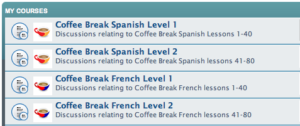
Screen shot 2009-10-17 at 16.46.45If you’re already a member of our system then you’ll be able to access My Courses in the community, where we’ll lead activities and generate discussions in which you can practise what you’ve learned in each lesson. My Courses is restricted to our premium members, so if you’ve purchased a Season Pass to Coffee Break French Level 2, you’ll see this course in My Courses, allowing you to interact with your fellow learners in the activities and discussions there. And if you’re not yet a premium member, you can join this week at a hugely discounted price! We’re looking forward to interacting with all our learners in My Courses.

Any questions? Get in touch with us, or post your question in our Community area.

Here’s to many more years of language learning with Radio Lingua!

A message from Mark

Over the past five weeks things haven’t been going too smoothly here at Radio Lingua, but we’re getting back to business now. I thought it would be useful to explain to  our listeners what’s been happening.

Recently we’ve been experiencing a huge number of problems with our server. It appears that the traffic to our site and our podcasts has been growing significantly, which is fantastic. However, it meant that fairly suddenly we outgrew our existing server and needed to rework things quite a bit. As you probably know, we’re a very small company with just three core members of staff and we don’t have a technical department ready to tackle any small – or bigger – issues which crop up. We tend to do everything in house which of course means that if we’re tackling technical problems then the ongoing teaching and production will inevitably suffer.

However, this time round the problems were just too great and we’ve been working with some very helpful technical wizards and over the past two weeks we’ve been preparing all our content for a huge migration over to a new server. With hundreds of lessons in many languages, and several parts of our site all spread across different servers, it has been quite a job bringing everything together and putting it back together again on our new server. The final stage of the migration began yesterday and by the time you read this we should be fully migrated.

In this changeover time we’ve missed a few comments and some users have had problems accessing materials. We are confident that these problems have been resolved and that all users should now be able to access the materials associated with their free or paid subscriptions.

What’s changed?

For users there shouldn’t really be anything visible that has changed, other than the fact that all our sites (with the exception of our Helpdesk at radiolinguahelpdesk.com) will now be accessed at radiolingua.com, instead of being shared across radiolingua.com, rlnvault.com and radiolinguamedia.com. To make sure you’re on the right site, simply check your browser bar which should read https://coffeebreaklanguages.com/… Members’ materials should also be accessed via radiolingua.com.

One other point which is worth mentioning is that where we’ve updated our premium content you’ll notice that the podcast names in iTunes have changed from “RLN Coffee Break French…” (or equivalent) to “RLN * Coffee Break French”, ie. with an asterisk after RLN. This will only be the case for active feeds, those which are being actively updated, ie. Coffee Break Spanish, Coffee Break French and Show Time Spanish.

Anything else?

Well, since you ask, yes! But you’ll have to wait until Sunday 18th October to find out what! Sunday is a bit of a special day, and we’ll explain everything then.

Finally, on behalf of our small team, I’d like to thank all our listeners and premium subscribers for your patience and understanding both in the past few weeks and in the coming days as we work through any possible teething troubles with our new setup. We hope that the new server and a more robust, integrated site setup will make it easier to access our materials and learn more languages.

Mark Pentleton
Radio Lingua Director

More on Spanish shopping vocabulary – Clothes

Shopping can be a delightful experience, especially when you get to practice a new language. For beginner learners, understanding key Spanish shopping vocabulary can make your experience more enjoyable and less stressful. 

In this blog article, we’ll explore essential phrases and words to help you navigate stores and markets in Spanish-speaking countries. Whether you’re a fan of shopping or just need to buy a few essentials, this knowledge will come in handy.

We have another blog article and episode on shopping, so if you want to know the basics of shopping, we recommend you cover that vocabulary first. If you feel confident enough, then let’s get started and learn more useful phrases to use when going shopping for clothes.

As always, don’t forget to listen to the podcast to get a good understanding of how to pronounce correctly the phrases we’ll be learning in the article. ¡Empezamos! 

Basic Spanish shopping vocabulary 

When you first enter a store, it’s helpful to know some basic phrases to start your shopping experience in Spanish. After the question, ¿Puedo ayudarle? (Can I help you?) you can answer by saying what you would like to buy.

  • Quisiera… I would like…
  • Me gustaría… I would like…
  • Quiero… I want…

These phrases are perfect for expressing your needs and preferences. For example, you might say, Quisiera ver esos zapatos, which means I would like to see those shoes.

The phrases that we have just seen are mostly interchangeable, but quiero is the most direct and informal and quisiera is the most formal one.

Asking for different sizes

One of the most important aspects of the Spanish shopping vocabulary is finding the right size. Here are some phrases to help you ask for the correct one:

  • ¿Tiene una treinta y ocho? Do you have a size 38?
  • ¿Los tienen en una cuarenta? Do you have them in a size 40?
  • Quisiera una cincuenta de estos pantalones. I would like these trousers in a size 50.

Using these phrases, you can ensure that you get the right fit for your clothes or shoes. 

Trying on clothes

Trying on clothes is a crucial part of the shopping experience in Spanish. Here are some phrases to help you with that. 

  • ¿Puedo probármelos? Can I try them on?
  • ¿Dónde puedo probarme la ropa? Where can I try the clothes?
  • Me gustaría probarme esta corbata. I would like to try this tie.

As you can see, in these three sentences we use the reflexive verb probarse, which means ‘to try something on’.

Common store interactions

When interacting with store staff, this Spanish shopping vocabulary can be particularly useful:

  • Se nos ha agotado. We have run out.
  • ¿Quieren acompañarme a la caja? Would you like to accompany me to the cashier?
  • ¿Es eso todo? Is that all?

These phrases help you understand availability and complete your transactions smoothly. 

Shopping in Spanish can be a fun and rewarding way to practice your language skills. By familiarising yourself with this Spanish shopping vocabulary, you can confidently navigate stores and communicate your needs effectively. 

Whether you’re saying Quisiera probarme estos zapatos I would like to try on these shoes, or asking ¿Tiene una treinta y ocho? Do you have a size 38?, these phrases will make your shopping experience much smoother.

Remember, practice makes perfect, and shopping is a great way to immerse yourself in the language. So next time you’re out and about, try using some of these phrases and enjoy the experience. 

In the next episode and blog article, we will cover some essential vocabulary to avoid getting lost in a place, directions in Spanish

¡No te lo pierdas y happy Coffee Breaking!

Lesson 36 – Show Time Spanish

¡Estamos de vuelta! It’s been a few weeks since our last episode of Show Time Spanish, and this has been the result of major server problems. We’ve completed a migration of all our content to new servers today, and we’re delighted to be back with a new episode of Show Time Spanish in which Mark is joined by Loreto, from Chile. In this first of two episodes with Loreto, we learn about the geography and culture of Chile.

Members | Purchase | RSS | iTunes link

Season 2 – Lesson 28 – Coffee Break French

It’s time to put the language we’ve been learning into practice and return to some transactional situations, this time equipped with a thorough understanding of how the language works. In this week’s show Mark and Anna discuss travelling by taxi in French, and use the constructions and expressions learned in recent weeks within this context. Please note that lesson 28 of Season 2 was originally known as lesson 68 of Coffee Break French. We have renumbered the lessons of each season as lessons 1-40 to make things more simple for our listeners.