What are learning goals (and why do they matter in language learning)?

Flat lay of a takeaway coffee cup with a black lid, a black pen, and a stack of notebooks—one spiral-bound with a blank white cover on a light wooden surface.

A common question that comes up when embarking on a new language adventure is: “Do I really need to set learning goals for my language learning?”. We believe that the answer is yes! 

Clear goals act as a roadmap on your language journey, guiding you towards your destination. In fact, goal-setting techniques can help you break down learning into manageable steps, allowing you to make real progress. 

And the way you set your learning goals can influence your success. So, let’s explore together how to create effective language-learning goals and understand why they’re so important.

Simple framework for learning goals

First things first: what are learning goals? As you can imagine, they are specific objectives that learners set for themselves to guide their journey. These goals act like helpful signposts that guide you on your journey to learn a new language. They give you a clear direction and allow you to keep track of how you’re doing along the way.

But how do you set language-learning goals? If you’re looking for some great tips and prefer visual content, we recommend checking out the video below, created by Mark, the founder of Coffee Break Languages. 

1. Set small ‘session’ goals

One of the best ways to learn a new language is to maintain focus, and breaking your learning into ‘session’ goals might help you do that. Instead of saying ‘I’ll study Spanish this week’, try setting a mini-goal for each study session. For example, ‘Today I’ll learn 5 new travel phrases’

Having a clear purpose for each study session makes it more enjoyable and keeps your practice focused. In addition to that, every little achievement gives you a happy boost and encourages you to keep going, fuelling your enthusiasm to continue.

2. Use weekly learning goals to build consistency

Besides focus, another key factor in learning a new language is consistency. That is why setting weekly learning goals is so important. 

These longer-term goals give you slightly larger targets that build momentum over time. For example, as Mark mentions as an example in the video, you can set objectives like: ‘This week I will finish Chapter 3 of my textbook’’ or ‘By Sunday I’ll be able to introduce myself in French without notes’

These weekly milestones help connect your daily efforts to your bigger objectives, ensuring that you’re steadily moving forward. In other words, weekly goals help you build long-term consistency in your routine.

Why is this important? Consistent practice beats occasional cramming every time in language learning. Setting a weekly goal helps you develop a habit of consistent study, and those habits can be truly powerful. In fact, many studies have shown that people who celebrate small wins are more likely to stay committed to their routines (like learning a language) and gradually turn those weekly goals into lasting habits.

3. Long-term goals – visualise your success!

On top of the ‘session’ objectives and weekly learning goals, you also need to consider what you would like to achieve in the language down the line. Is it speaking to a coworker? A family member? Ordering a coffee abroad, if you are fortunate to visit a country where the language you are learning is spoken? Reading a novel?

Whatever this long-term goal might be or how long it might take to achieve it (a month, six months, a year, or more), one powerful technique to keep your motivation to study high is to visualise your success. This is a great strategy used by many successful learners (and by members of our team) to boost confidence and focus!

By imagining the end result – the conversations you’ll have, the experiences you’ll enjoy – you remind yourself why you started learning in the first place. This emotional connection to your goal makes it easier to stay driven when lessons get tough or life gets busy.

It’s like seeing a sneak preview of the reward waiting for you, which can motivate you to move forward. So when motivation is not at its peak, you can close your eyes and envision that moment of triumph when you realise ‘Wow, I’m really doing this!’. That little exercise can reignite your passion to keep going. 

4. Write your goals down 

It’s not enough just to have goals in your mind; writing them down is a crucial step that many learners overlook. When you write down your learning goals, you transform vague ideas into a clear plan. 

In fact, research suggests that putting your goals on paper makes you significantly more likely to achieve them. A study from the Dominican University of California found that people who wrote down their goals were 42% more likely to reach them than those who didn’t. All from simply grabbing a pen, a notebook or a smartphone and writing it down! 

Why does writing help so much? First, it forces you to get specific about what you want to accomplish, and secondly, it works as a visible reminder that you can tick off, cross out, or tap to close. 

Moreover, having our language-learning objectives written down provides a record of how far you’ve come and reinforces that satisfying feeling of accomplishment. Remember that each goal you write and achieve, no matter how small, builds confidence for the next one!

Turn your goals into a language-learning success story!

By now, we hope you can see how setting clear learning goals will help your language-learning journey. From focusing your daily studies with mini session goals, to building consistency with weekly targets, to motivating yourself through vivid visualisation and written commitments – these strategies will keep you moving towards your objective, whatever it might be.

Now it’s time to put this into action. What will your next language-learning goal be? Whether it’s learning a new tense, having a 5-minute conversation, or watching a movie without subtitles, write it down and go for it.

And if you’re eager for more ways to improve your language skills, we’ve got you covered. For example, listening comprehension can be a challenge for many learners. If you want to learn how to improve your listening skills, be sure to check out our blog post on the topic next!

Can you learn two languages at once? Understand how it is possible!

A stack of books resting on sand by the seashore, suggesting a relaxed summer reading scene.

Learning a new language is such an exciting adventure, but what if you’re dreaming even bigger and want to tackle two at the same time? You might wonder, ‘can you learn two languages at once?’. The good news is, absolutely, yes! However, it does come with its own set of challenges.

Whether you’re looking to make the most out of your travels, boost your career or pursue personal growth, learning two languages is a journey that calls for a bit of strategy, some discipline and a sprinkle of creativity. In this blog post, we’ll explain more about how you can learn two languages at once, taking into consideration the challenges you might face and some practical tips to help you on your way. 

So, let’s get started! 

Can you learn two languages at once? Why do it?

Before considering the challenges and how to do it, let’s discuss why you should do it. Firstly, learning a new language broadens your cultural horizons, as each language unlocks access to a unique culture, history, and way of thinking. 

For instance, exploring Romance languages like Spanish and French opens up a wonderful opportunity to discover the rich cultures of Latin America, Europe, and Africa. This journey not only enhances your language skills but also deepens your appreciation and understanding of the diverse world we live in.

Secondly, embracing multilingualism can help your career advancement. In our globalised world, being able to communicate in multiple languages is such a valuable asset. If you’re thinking about a career in business or tourism, for instance, knowing several languages can really help you stand out from the competition and unlock exciting new opportunities!

 Plus, learning languages comes with some amazing cognitive benefits. Studies have found that picking up a second language can boost your memory, enhance your multitasking skills, and sharpen your problem-solving abilities. And if you take on two languages at the same time, you might just magnify these advantages, keeping your brain sharp and flexible.

So, can you learn two languages at once? The answer is yes! 

Challenges of learning two languages simultaneously and how to overcome them

Now that we know that you can learn two languages at once, let’s look at some of the challenges of doing so. Learning two languages at once can be really exciting, but it can also come with its difficulties. So, before you embark on this journey, we think it’s a great idea to be aware of those challenges and discover how to tackle them effectively!

1. Mixing up languages

Language interference is one of the most common challenges we can face when learning a second language. This happens when words or grammar rules from one language sneak into another, often without us realising it!

It’s quite common when the languages are closely related. But don’t worry – this is all just part of your exciting learning journey.

2. Increased cognitive load

Learning a language requires time, focus, and energy. Doubling the workload can make you feel a bit overwhelmed at times. To keep your motivation high and help you avoid feeling burned out, it’s vital to find a language-learning technique that makes you feel like you are making progress.

3. Time management

Finding enough time to practise both languages consistently can be difficult, especially if you have other commitments, such as work, university, or family. That’s why exploring microlearning language platforms can be such a great option, as they break lessons into easy-to-handle chunks, making your progress feel more enjoyable and achievable!

Tips for learning two languages at once

Now that we’ve explored the question, ‘Can you learn two languages at once?’, and you’re aware of some of the challenges that might pop up, here’s the exciting part: it’s totally possible with the right approach! When choosing your languages, think about how similar or different they are. This can make your learning journey even more enjoyable! 

As we mentioned before, learning two closely related languages, like Italian and French or Spanish and Portuguese, can really help you notice some exciting patterns! Or, if your two languages are from distinct language families, you’ll have the opportunity to appreciate the variety that exists within the world’s languages and the unique characteristics of different language families.

Take a moment to define what drives you to learn each language and set some achievable milestones along the way. If you need help with that, check out this video with some valuable tips from Mark, the founder of Coffee Break Languages: 

Think of each language as a unique project. To keep things organised, try dedicating specific days or times to each one. For example, you might enjoy studying German on Mondays, Wednesdays, and Fridays, while saving Italian for Tuesdays, Thursdays, and Saturdays.

To celebrate the uniqueness of each language, try exploring a variety of fun tools and materials. You might enjoy watching movies in one language while listening to catchy songs in another. Keeping separate notebooks for vocabulary and grammar of each of your languages can also be a great way to stay organised!

Additionally, staying consistent is so important. Even if you can only spare 15 minutes a day to learn a new language, practising regularly will really help you remember what you’ve learned and gain some great momentum. And remember, don’t let the fear of making mistakes stop you! Making mistakes is a completely normal part of the learning journey and can actually help you learn even more quickly.

To learn more about the best way to learn any language, check out the blog post we prepared with other tips to help you take your dream of speaking a language off paper!

Different Uses of ‘Get’ in English – Improve Your Vocabulary

A surprised man in a red polo shirt reacting with raised hands. Bold text reads 'GET has HOW many meanings?!'.

Do you know how many different uses of get there are in English?

This can be a difficult word for English learners because it has so many meanings, but if you can learn to use it well, you can really sound like a native speaker! 

The Coffee Break English Show is a podcast series of informal conversations to help you understand some difficult topics in English! In the latest episode, Nick and Anabel will help you  use the verb get in lots of different ways. 💪

There are many phrases with get, and if we include phrasal verbs, the list is too long to cover in one episode! But we can look at some synonyms that you can replace with the verb get. 📚

So, let’s get started! Continue reading to find out more, and why not listen to the podcast as you go!

Get = become

We use get with adjectives to mean become

>> It’s raining, take an umbrella or you will get wet. 💦

We can also use the verb get with comparative adjectives to show change.

>> In November the weather gets colder and the days get shorter. ❄️

Get = catch / take

Another one of the uses of get is to talk about taking transport. It has the same meaning as catch or take with nouns like bus, train and taxi. We can only use it with transport that it is possible to miss. I can’t get a bike to the office, for example. 

>> I got a taxi to the airport. 🚖

>> I got the train into town 🚂

Get = buy / obtain / receive

We use the verb get to mean buy, obtain or receive. They have similar meanings but aren’t always the same. This can cause some confusion when we talk about presents! Look at the following sentence:

>> I got a scarf for my birthday (In this sentence, get means receive.) 🎁

>> I got an A in my English exam (In this sentence, get means obtain.) 📝

>> I got my brother a present for his birthday (In this sentence, get means buy.) 💰

Get = understand

We can use the verb get to say that we understand something. This can be a topic or a joke.

>> Everyone laughed at the joke but I didn’t get the punchline. 🤔😂

>> He spoke so quickly I didn’t get what he was saying. 😵‍💫

Get = arrive 

We use the verb get with to to say when we arrive somewhere.

>> I got to the football match late and missed the first goal. ⚽️

Get = fetch 

We use the verb get to say ‘go and take’, or fetch.

>> Can you get me that newspaper over there? I want to show you an article. 🗞️

For more information about the different uses of get, why not watch Episode 10 from Season 2 of Coffee Break English? We go into more detail about phrasal verbs with get as well as looking at the different meanings of the verb get.

Here’s a visual of the different uses of get

A table showing the uses of get: become,catch, take, understand, buy, receive, obtain, arrive, fetch.

To help you remember the different meanings of get, we’ve created a worksheet for you so make sure you click on the link below to get some useful practice!

If you found this post interesting, make sure you listen to the full podcast episode with Nick and Anabel on The Coffee Break English Show. And why not subscribe to our podcast feed and our channel on YouTube to find episodes about some other useful topics for English learners?

Plus, don’t miss your free worksheet – perfect for extra practice after the lesson! When you sign up, you’ll also receive our short coffee break-sized email lessons, delivered straight to your inbox every week, to help you build your English skills. 💪 You’ll even hear from Mark, the founder of Coffee Break Languages, who shares regular tips and motivation for learners of all levels. Sign up below to get yours! 👇

So, start adding get into your speech whenever you get a chance! Remember that when you learn new vocabulary, it will help you to express yourself as well as improving your understanding when listening to others. It’s all part of the language-learning journey. Why not get a coffee now and start learning more about this extremely useful verb?

Happy Coffee Breaking!

Listen to the podcast

English Word Stress explained: ‘PREsent’ or ‘preSENT’?

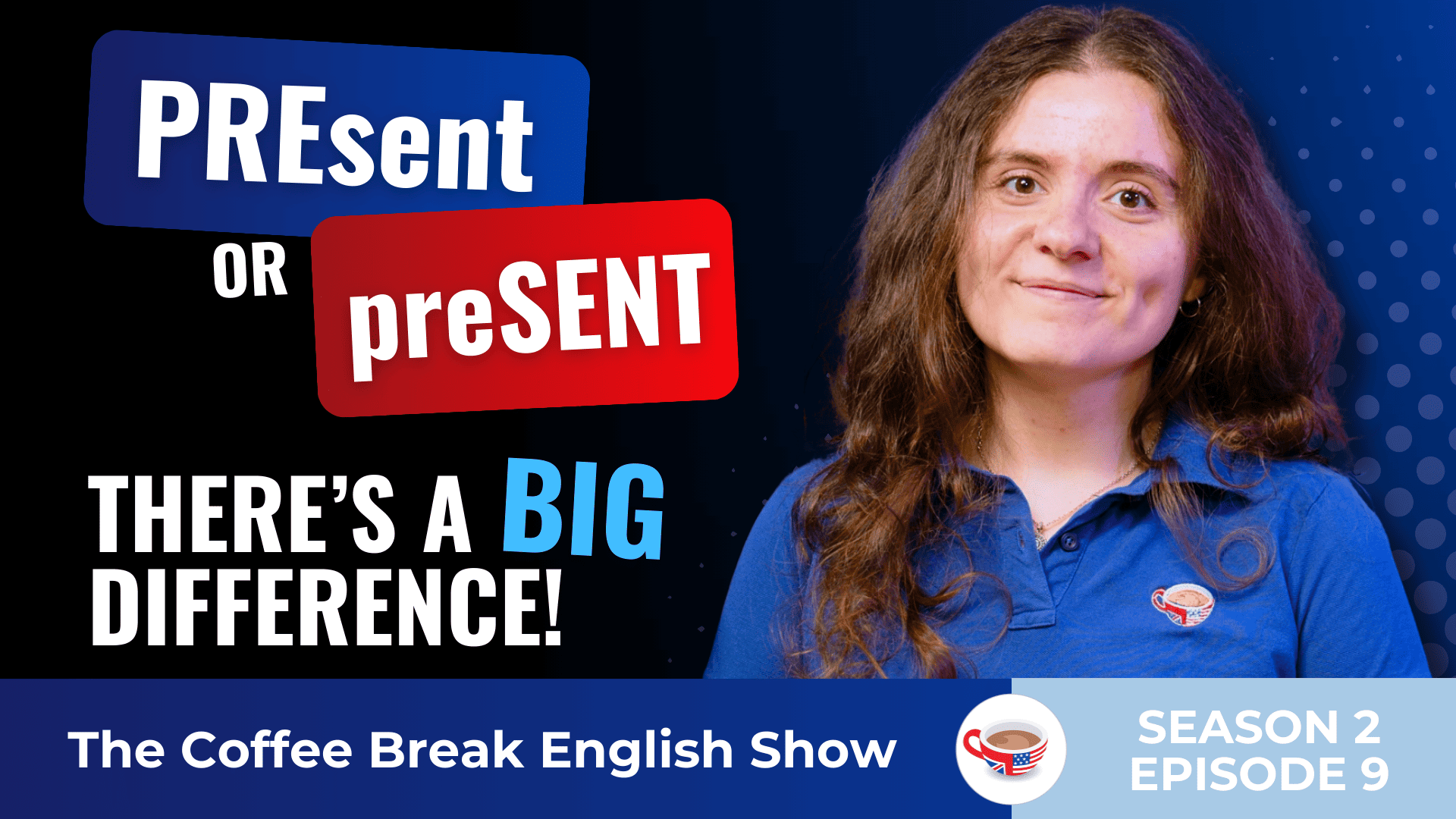
Anabel, the Coffee Break Spanish host in a blue shirt smiles beside bold text contrasting 'PREsent' and 'preSENT' with the caption 'There’s a BIG difference!' The background is dark with a dotted gradient.

Do you know when to say PREsent and when to say preSENT?

English pronunciation rules are an important aspect of improving your language skills. They help you to understand the language when you are listening, and to use the language confidently and effectively when you are speaking. One area that many learners find difficult is English word stress, choosing the correct syllable to stress. 📣

The Coffee Break English Show is a podcast series of informal conversations to help you understand some difficult topics in English. In the latest episode, Nick and Anabel explore how syllable stress changes the meaning of certain words in English and take a closer look at English pronunciation rules with two-syllable verbs and nouns. 

Because this episode focuses on pronunciation, it is best to watch the video or listen to the episode while you read this blog to hear Nick and Anabel pronouncing the words.

Have you got a COffee? Are you REAdy? Then let’s get started!

Syllables

Firstly, we should start by outlining what a syllable is. A syllable is a unit of pronunciation that contains one vowel sound. It often includes a consonant sound too.

The word ‘noun‘ has one syllable = /naʊn/.

The word ‘English‘ has two syllables = /ɪŋglɪʃ/

And the word ‘syllable‘ has three syllables = / bəl/

Two-syllable Words

Now we have a clear idea of what syllables are, we can focus on two-syllable words. English pronunciation rules are not always clear when it comes to syllable stress and we often have to learn the correct stress when we learn new words but there is a general rule that can help us with two-syllable words! Just be careful with exceptions…! 🧐

Nouns

Research into English word stress has shown that around 90% of two-syllable nouns are stressed on the first syllable. So when we see a two-syllable noun, we can be quite confident the word will be stressed on the first syllable. 

e.g. APple, LIon, Orange, PERson, TEAcher, WINdow.

Verbs

Research also shows that around 70% of two-syllable verbs are stressed on the second syllable. We need to be more careful with verbs, but still most of them are stressed on the second syllable so we can make an educated guess here if necessary.

e.g. agREE, colLECT, deFEND, enJOY imPROVE, perFORM.

Words where the verb and noun have different stress

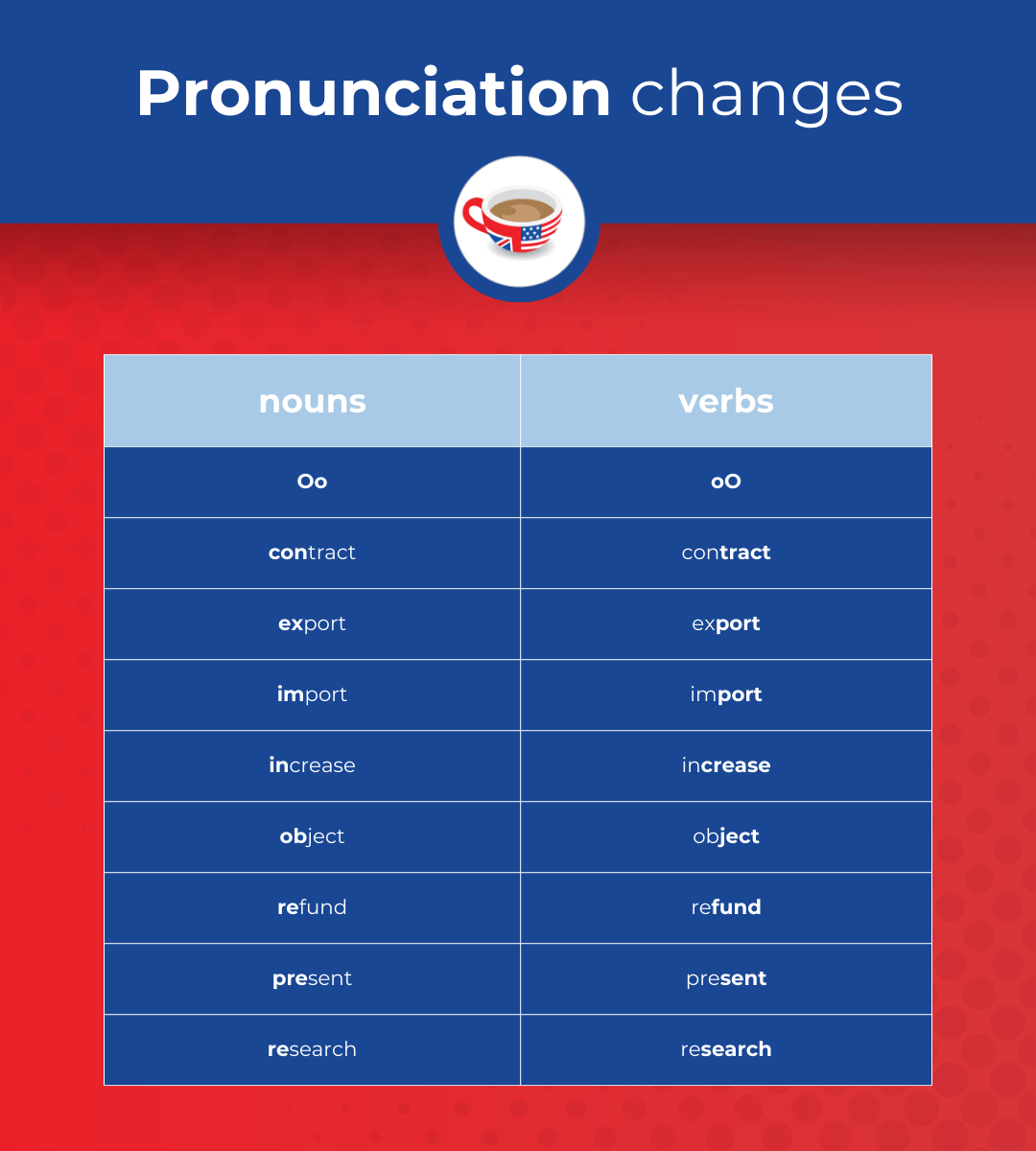
There are many examples where the verb and noun are similar but have different syllable stress. They generally follow the rules stated above, with the first syllable stressed with the noun and the second syllable stressed on the verb

A table that shows word stress changes for a selection of English words with two syllables

English Word Stress Exceptions

Be careful with the below verbs and nouns which do not follow this rule. It’s also important to note that some words change slightly from verb to noun like with effect and believe.

Stress on First Syllable

Some words are always stressed on the first syllable.

A table that shows English pronunciation rules for words with two syllables where the first syllable is always stressed.

Stress on Second Syllable

Some words are always stressed on the second syllable.

A table that shows English pronunciation rules for words with two syllables where the second syllable is always stressed.

Let’s review! 

Here’s a quick summary of English word stress rules with two syllable words:

  • 90% of two syllable nouns are stressed on the first syllable.
  • Around 70% of two syllable verbs are stressed on the second syllable.
  • Some words are the same as verbs and nouns but follow the two rules above with syllable stress.
  • Some words are the same as verbs and nouns but do not follow the rule above.

If you want more practice with your pronunciation, check out Episode 8 of Season 2 of Coffee Break English, where we look at pronunciation of –ed endings.

It’s your turn!

Practise English word stress by deciding whether each word is a noun/adjective or a verb based on the sentence context and decide if the first or the second syllable should be stressed. Make sure you think about it before looking at the answer at the bottom of this blog post!

  1. She equaled the world record in the race.
  2. He is going to present an award at the Oscars tonight.
  3. We have just finished an important research project.

It’s a good idea to make a list of the words that have stress on the first or second syllable and practise using them in sentences to build your confidence with syllable stress. A little practice each day can really help build your confidence!

If you found this post interesting, make sure you watch the full video with Nick and Anabel on the Coffee Break English Youtube channel. In this series we look at lots of useful topics for English learners, so make sure to subscribe to our podcast feed and our channel on YouTube.

Plus, don’t miss your free worksheet – perfect for extra practice after the lesson! When you sign up, you’ll also receive our short coffee break-sized email lessons, delivered straight to your inbox every week, to help you build your English skills. 💪 You’ll even hear from Mark, the founder of Coffee Break Languages, who shares regular tips and motivation for learners of all levels. Sign up below! 👇

So, start paying attention to English word stress when you are speaking! The more you practice, the more confident you will become.

Happy Coffee Breaking!

P.s. Here are the answers to activity above:

  1. She equaled the world REcord in the race.
  2. He is going to preSENT an aWARD at the Oscars tonight.
  3. We have just finished an important REsearch PROject.

Listen to the podcast