
What are the Romance languages? Learn more about them

A magnifying glass resting on a white keyboard beside a tablet.

Have you ever wondered how certain languages are related or where they originated? The Romance languages offer a fascinating example of how language evolves over time and across regions. But what are the Romance languages and why are they so significant?

In this blog post, we’ll explore the basics of these wonderful languages, their fascinating history, and what makes them so captivating! Whether you’re considering picking up a new language or simply have a curious mind, this guide will help you discover what the Romance languages are all about.

What are the Romance languages?

First, let’s have a look at what Romance languages are. You might be surprised to learn that, despite their name, they don’t actually relate to romance or love. Instead, the term ‘Romance’ connects to their roots in the Roman Empire.

They developed from Vulgar Latin, the version of Latin commonly spoken back then. Unlike Classical Latin, which was used in writing and in official documents, and what you might study in Latin classes today, Vulgar Latin was the everyday language that people would use to connect with each other. 

The evolution of the dialects that emerged in the regions conquered by the Roman Empire gave rise to the variants of the Romance languages we have today. The most widely spoken  ones are:

  • Spanish – Spoken by over 500 million people worldwide, it is the language with the second-largest number of native speakers in the world;
  • French –  A key language used in diplomacy and therefore commonly taught in schools in certain areas of the world, French is spoken on five continents;
  • Italian – Often associated with art, music, and cuisine, Italian is the language of Dante and opera;
  • Portuguese – Spoken in Portugal, Brazil, and several countries in Africa and Asia, it is one of the fastest-growing languages;
  • Romanian – Though geographically isolated, with Romania sharing no borders with another Romance-language country, Romanian retains many features of Classical Latin.

Other Romance languages include Catalan, Occitan, Galician, and Sardinian.

What makes Romance languages unique?

Now that you’re familiar with the Romance family of languages, you might be wondering what its characteristics are and how it differs from other language families. Thanks to their shared background, the Romance languages share many features, including similar words, grammar, and sounds. 

For example, many Romance languages use the concept of grammatical gender for nouns and have unique ways of changing verbs based on who is doing the action. 

1. Grammar and syntax

The sentence structure of many Romance languages follows a subject-verb-object (SVO) order, although there are exceptions to this. A lot of Romance languages also have verb conjugation systems that are more complex than languages from other families, gendered nouns, and the use of definite and indefinite articles.

2. Vocabulary

Many words in Romance languages are directly derived from Latin. For example:

  • father is padre in Spanish, père in French, pai in Portuguese and padre in Italian;
  • water is agua in Spanish, eau in French, água in Portuguese and acqua in Italian.

3. Phonetics and pronunciation

The Romance languages are known for their fluid, melodic sounds. Although they share many phonetic similarities, every language has its own unique characteristics that make it special. 

For example, Spanish is known for its clear vowels and rhythmic flow, whereas French adds a touch of nasal sounds and liaisons. Italian, in contrast, has lots of open vowel sounds. Portuguese, just like French, showcases those nasal sounds as well. And let’s not forget Romanian, which has some wonderful influences from the Slavic languages!

Why learn a Romance language?

Considering what the Romance languages are and the similarities they have, learning one of them opens up a world of opportunities. For example, remembering new words in a new language and learning a language from scratch becomes much easier if you are already familiar with one Romance language.  

If you picked up a bit of French back in school, you’ll find that learning Spanish feels much more intuitive since they share quite a bit of vocabulary. Even for English speakers, learning Romance languages can be straightforward in some ways, as English has borrowed so much from Latin and French.

Additionally, the cultural aspect is a fantastic reason to learn a Romance language. They open the door to vibrant cultures from all over the world, filled with fascinating history, literature, and delicious cuisine. Plus, if you are able to explore the world and travel, your adventures will be so much richer — imagine sipping an espresso in Rome, wandering through beautiful vineyards in Bordeaux, or dancing samba in the lively streets of Rio de Janeiro, while being able to truly connect with the culture and people around you.

Finally, in our global world, having an understanding of a Romance language can open up exciting career opportunities, particularly in fields like international business, marketing, and education.

And there you have it! Now you have a clearer understanding of what the Romance languages are and how you could benefit from them. From Spanish and French to Italian and beyond, this group of languages opens up opportunities for you, whether you’re learning for travel, career, or personal enrichment.

Now, you may be wondering how long it takes to learn a new language – Romance or otherwise. If you’re curious, we invite you to explore our blog post filled with helpful tips!

How to use ‘so’, ‘too’, ‘either’ or ‘neither’ in English

A smiling man in a blue shirt pointing to bold text that reads 'Key Phrases for Natural English'. The background is dark with a gradient and polka dot pattern.

Do you know how to use so, too, either or neither when speaking in English?

This can be a tricky grammar issue as we need to be careful about the auxiliary and the object pronoun but if we study them we can find simple ways to use them as well as more complete, complex ways. 

The Coffee Break English Show is a podcast series of informal conversations to help you understand some difficult topics in English. In the latest episode, Nick and Mark look at how to use so, too, either or neither to show similarity in conversations.

So let’s have a look at when we use these forms and how we can add them to our English conversations. And why not make yourself a cup of coffee or tea to enjoy while you read and listen to the podcast episode?

Similarity 

We use so, neither and too to demonstrate a similarity with what has just been said. These words are great for expressing to someone that you have had a similar experience to them. So and too express positive similarities and neither and not.. either express a negative similarity.

So

We use so to express positive similarity in conversations. It is normally in response to what someone else has said and we use the auxiliary verb from the sentence we are responding to in our answer. Let’s have a look:

When we use the verb be, the auxiliary in the second sentence will also be the verb be.

A: I am from the UK.                B: So am I!

In present simple sentences with a main verb that is not be, the auxiliary will normally be do.

A: I like pizza.                B: So do I!

In past simple sentences, the auxiliary is did (or was or were with the verb be).

A: I went to the cinema yesterday.                B: So did I!

In present perfect sentences, it is have.

A: I have had two cups of coffee this morning.                B: So have I!

In sentences with modal verbs, the modal verb is the auxiliary.

A: I can speak English.                B: So can I!

Too

We can use too in the same way as we do so to show similarity, but the structure changes. With too we have a simple option, a short option and a long option.

The simple option uses the object pronoun plus too. We don’t need to worry about a verb form. 

A: I can speak five languages.              B: Me too!

We can also use too with the auxiliary verb.

A: I am hungry.              B: I am too!

When we want to respond with a full sentence, we just need to add too at the end of the sentence.

A: I lived in Germany for two years.              B: I lived in Germany for two years too!

Either or Neither

We use ‘neither’ and ‘not.. either’ to talk about negative similarities. The way we use them is a bit different though so pay attention!

Neither – meaning

In simple answers, we use neither in the same way as we use too. The structure is the object pronoun plus neither.

A: I didn’t go to Spain on holiday.              B: Me neither!

We can also use neither in the same way as we use so. The structure is neither + auxiliary verb + subject.

A: I have never been to Argentina.               B: Neither have I!

Either – meaning

In short answers with the auxiliary verb, there is an important change. We use the negative form (not), and we do not put the ’n’ at the front of either.

A: I didn’t go to Spain on holiday.               B: I didn’t either!

In the full sentence form, the rule is the same as too, we just need to add either at the end.

A: I didn’t go to Spain on holiday.               B: I didn’t go to Spain on holiday either!

Pronunciation 🔊

One important aspect of the words either or neither that can confuse learners is that there are two ways to pronounce them. 

We can say them with an /ai/ sound like in why, and we can also say them with a long /i:/ or ‘e sound like in see.

There is absolutely no difference in meaning. 

Generally, /i:/ is more common in the US and /ai/ is more common in the UK but native speakers frequently use both forms so don’t worry, just pick one! 

If you want more practice with the long ‘e’ sound, check out Episode 4 of Season 1 of the Coffee Break Show!

Here’s a visual of today’s lesson

Here are the diffferent options for simple answers, short answers and full answers.

If you find choosing between negative and positive determiners difficult, you might find Episode 9 from Coffee Break English Season 3 really useful.  We take a look at the indefinite pronouns something, anything and nothing and explain when to use them.

A table of the different forms of too, so either or neither in simple answers.

A table of the different forms of too, so either or neither in short answers.

A table of the different forms of too, so either or neither in full answers.


If you found this lesson helpful, make sure to listen to the full podcast episode with Nick and Mark on The Coffee Break English Show, where we dive deeper into so, too, either and neither with more examples and practice. ☕🎧

We release new episodes regularly, covering useful grammar and vocabulary topics to help you sound more natural in English. Subscribe to our podcast feed and our YouTube channel so you never miss an episode.

Plus, don’t miss your free worksheet – perfect for extra practice after the lesson! When you sign up, you’ll also receive our short coffee break-sized email lessons, delivered straight to your inbox every week, to help you build your English skills. 💪 You’ll even hear from Mark, the founder of Coffee Break Languages, who shares regular tips and motivation for learners of all levels. Sign up below! 👇

Now, it’s your turn! Download the worksheet below for further practice and try using so, too, either or neither in your conversations whenever you can. The more you practise, the more natural it will feel.

Happy Coffee Breaking!

Listen to the podcast

Time Phrases: How to Use Present Perfect Adverbs in English

A man in a blue shirt with a thoughtful expression, touching his chin, beside bold text that reads 'JUST', 'ALREADY', 'YET' and 'WHICH SHOULD YOU USE?'.

Have you ever wondered when to use just, yet, or already? These three time phrases are commonly used with the present perfect tense, but they each have specific meanings and uses.

Using time phrases and adverbs with the present perfect helps to communicate more effectively and will make your sentences even clearer when having a conversation with people.

The Coffee Break English Show is a podcast series of informal conversations to help you understand some difficult topics in English. In the latest episode, Nick and Francesca explore how to use the present perfect adverbs just, yet and already, correctly.

If you haven’t listened to the podcast episode yet, why not listen to Nick and Francesca as you read?

So let’s get started and look at just, yet and already!

Time Phrases: The Present Perfect with Just, Yet, and Already

These three present perfect adverbs help us describe when an action happened in relation to now. We often use them with the present perfect tense and they have specific positions in a sentence.

Just

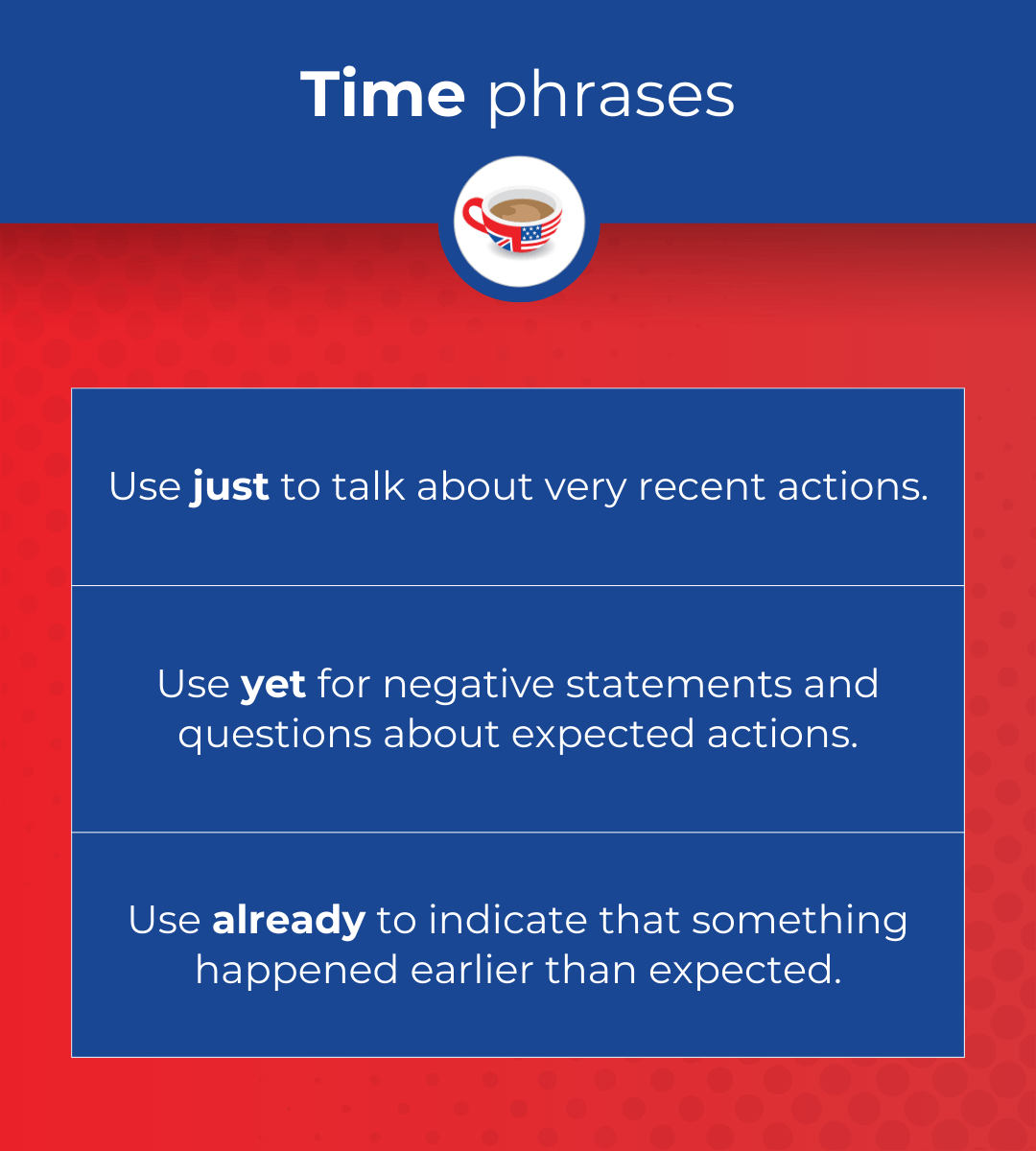
Just is used to indicate that something happened a very short time ago.

It comes between have/has and the past participle:

⏳    I have just finished my homework.  ⏳

⏳    She has just arrived at the station.  ⏳

 👀    In the USA, you are often likely to hear just used with the past simple, not the present perfect! The meaning is exactly the same, though.   

🇺🇸     Where’s David? He just went out.    🇺🇸

Yet

Yet is used to talk about something that has not happened but we expect to happen. We often use them in negative statements and questions.

Yet goes at the end of a sentence:

🔜    I haven’t finished my book yet.  🔜

🔜   Have you eaten yet?  🔜

Already

Already is used to show that something happened sooner than expected or before now.

It normally comes between have/has and the past participle but it can sometimes come at the end when we are speaking to create a strong emphasis:

⬅️    I have already seen this movie.  ⬅️

⬅️    Wow! She has completed her assignment already!    ⬅️

Let’s review

Here’s a summary of the time phrases in this episode:

Present Perfect Adverbs: We use just to talk about very recent actions. Yet is used for negative statements and questions about expected actions. Use already to indicate that something happened earlier than expected.

If you found this useful, then you might find Episode 4 of our 2nd season of Coffee Break English helpful! We look at the time phrases for and since with the present perfect.

It’s your turn!

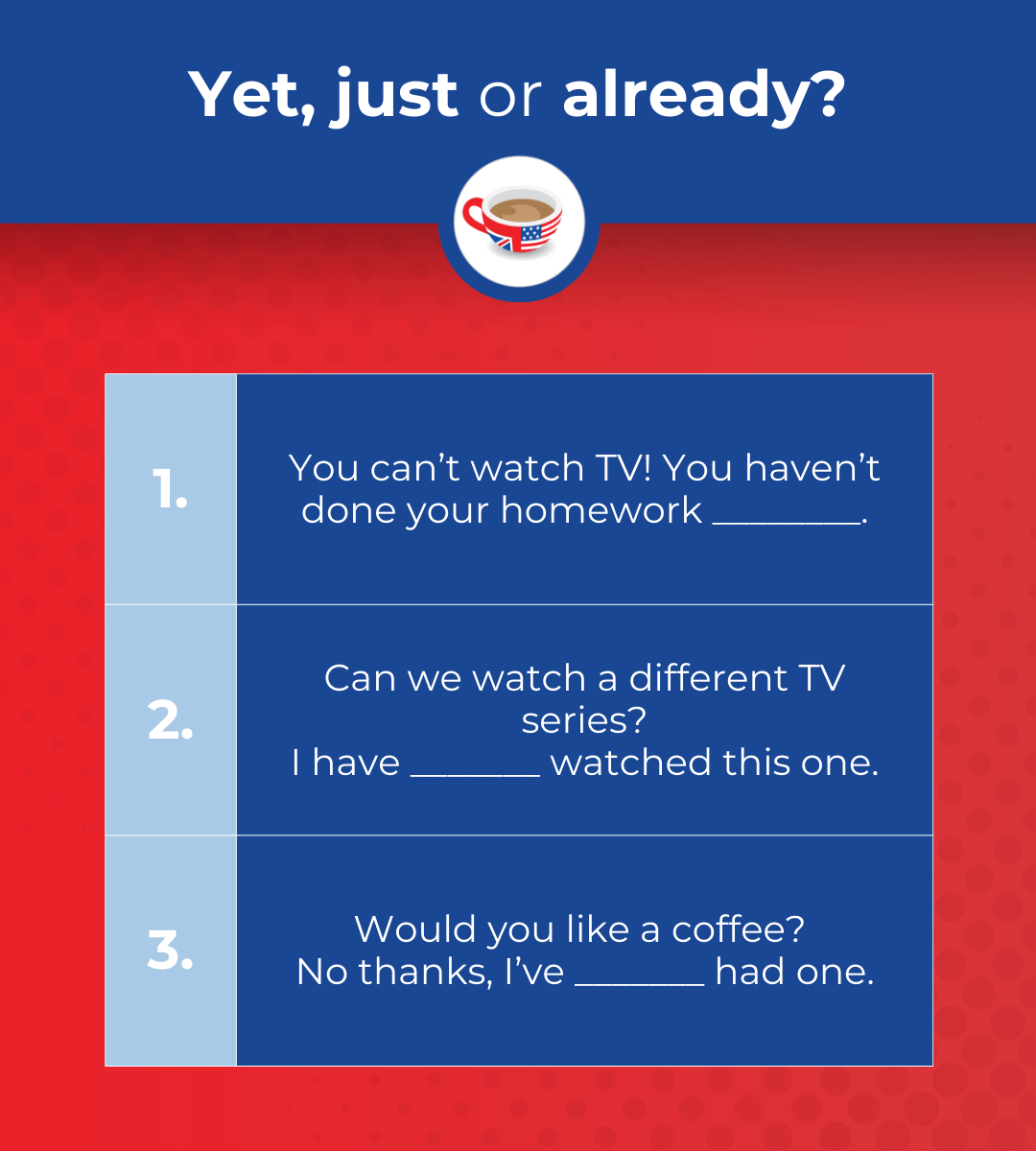
Now let’s practise! Which is the right word? Put yet, just or already in the spaces below. The answers are at the end of the blog post but don’t look until you’ve thought about your answers.

A quiz to practise the Present Perfect Adverbs yet, just and already.

If you found this post interesting, then make sure you listen to the full podcast episode with Nick and Francesca on The Coffee Break English Show. This series looks at useful topics to help English learners improve their language skills, so make sure to subscribe to our podcast feed and our channel on YouTube.

Plus, don’t miss your free worksheet – perfect for extra practice after the lesson! When you sign up, you’ll also receive our short coffee break-sized email lessons, delivered straight to your inbox every week, to help you build your English skills. 💪 You’ll even hear from Mark, the founder of Coffee Break Languages, who shares regular tips and motivation for learners of all levels. Have you signed up yet? If not, sign up below! 👇

So, start using these time phrases in your conversations! The more you practice, the more confident you will become.

Happy Coffee Breaking!

Here are the answers to the questions in the practice section above:

  1. You can’t watch TV! You haven’t done your homework yet.
  2. Can we watch a different film? I have already watched this one.
  3. Would you like a coffee? No thanks, I’ve just had one.

Listen to the podcast

How long does it take to learn a new language?

Small table clock on top of a table.

A common question that comes up when considering the adventure of learning a new language is: “How long does it take to learn a new language?”. We believe that the answer isn’t simple, as it is tied to many factors, such as the complexity of the language, your learning environment, and your unique personal circumstances. 

Let’s have a look at these factors together to create a clearer picture of what to expect on your exciting language-learning journey. Keep reading – there’s so much to discover!

1. Language complexity and similarity

So, how long does it take to learn a new language? Well, one of the biggest factors that influence this is how similar it is to your native language. For example, if you are a native English speaker, learning a language like Spanish or German might be quicker because these languages share many similarities with English in terms of vocabulary and grammatical structure.

Moreover, learning Italian, French, or Portuguese can be much quicker if you already speak Spanish. In contrast, languages that are structurally different from English, such as Mandarin Chinese, may take more time to master. 

2. Time commitment and consistency

Another factor that determines how long it takes to learn a new language is time commitment. Remember that the time you invest each week really influences how fast you’ll make progress. Regular practice is essential to your journey! 

Research suggests that learners who study regularly, even if it’s just 20 minutes a day, tend to make faster progress than those who study sporadically. That is why microlearning and approaches like the one we have here at Coffee Break Languages – which emphasises short, regular study sessions that fit easily into your daily routine – are ideal for people with busy schedules. 

The Coffee Break method allows you to make steady progress without feeling overwhelmed by breaking down the language-learning process into manageable chunks. You can dedicate just fifteen minutes each day to listen to a podcast episode and practise vocabulary, all while enjoying your coffee break.

If you’re looking for some great tips on sticking to a language-learning routine, we recommend checking out the video created by Mark, the founder of Coffee Break Languages. 

3. Learning environment

The environment you learn in can also greatly influence your language journey. Typically, immersive settings, where you are surrounded by native speakers and you have the chance to use the language in everyday situations, can really speed up your learning process.

That is why, if you have the opportunity and are fortunate enough to visit a country where you can practise the language you are learning, you should take advantage! Also, if your learning environment or platform offers classes with native speakers, that can also help you learn faster, as you will be able to understand accents and pronunciation in a much easier way.

At the same time, learning and practising with a non-native speaker of the language you’re learning also has an important role to play. If your teacher or speaking-practice partner has learned the language in the same way you have (rather than having grown up speaking it) they’ll understand the language and its complexities from your point of view.   

Pen on top of notebook.

How to accelerate your language learning

Now that you understand that the answer to the question ‘How long does it take to learn a new language?’ can vary, it’s great to know there are some strategies you can use to speed up your learning journey! For starters, think about setting your own language-learning goals. Whether it’s reaching conversational fluency, enjoying movies in a new language or ordering a coffee in a different country, each step will bring you closer to your objectives! 

After all, clear goals can help you stay motivated and focused. Plus, as we talked about earlier, language-learning apps and podcasts are great tools to boost your skills. And remember, making mistakes is nothing to worry about; it’s actually one of the best ways to learn a language since it’s just a natural part of the journey.

Well, we hope you now understand a little more about how long it takes to learn a new language and what you can do to accelerate the process. In conclusion, by setting clear goals, maintaining a consistent study routine, and engaging in regular practice, you can accelerate your language-learning journey and enjoy the cultural and personal growth that comes with it.

If you want to learn more about how the Coffee Break method can help you achieve your language-learning goals, check out more about the Coffee Break Academy!

Present Perfect Tense for Experiences

A smiling woman in a blue shirt, in a blue background.

Using the present perfect tense can be difficult for many English learners. This is because it is used in a variety of ways that do not necessarily translate to similar grammar forms in other languages.

The key is to consider the different contexts where you can use the present perfect, and then look at what message we want to express when using the present perfect or other forms. If you can understand this, then you will be a big step closer to managing conversations fluently in English!

The Coffee Break English Show is a podcast series of informal conversations to help you understand some difficult topics in English. In the latest episode, Nick and Francesca look at how to use the present perfect tense for experiences that you have had in the past, plus we explain the difference between been and gone.

Have you made yourself a coffee? Then let’s get started!

The Present Perfect Tense for Experiences

The present perfect tense is used to signify a variety of situations, but today we will look specifically at experiences. When we speak to friends or meet people for the first time, we often talk about our experiences. A common question is ‘Have you ever…?’ And a common response is ‘No, I’ve neverorYes, I have’. 

This gives us our question form for the present perfect, plus the short positive and negative forms. We can also give extra information. See the below conversation:

Present Perfect Examples: Have you ever been to Paris? Yes, I have. I have been to Paris 3 times! Hav you? No, I haven't. I've never been to Paris but I would like to go.

Been and Gone

In the example above been is used to express the idea of visiting a place. It is important to remember that we are talking about the experience of visiting Paris.

We can consider been as the past participle of go when describing an experience. The idea that we went to a place and then returned. This is also the case when we use a phrase like go skiing in the present perfect (I have been skiing in the Alps).

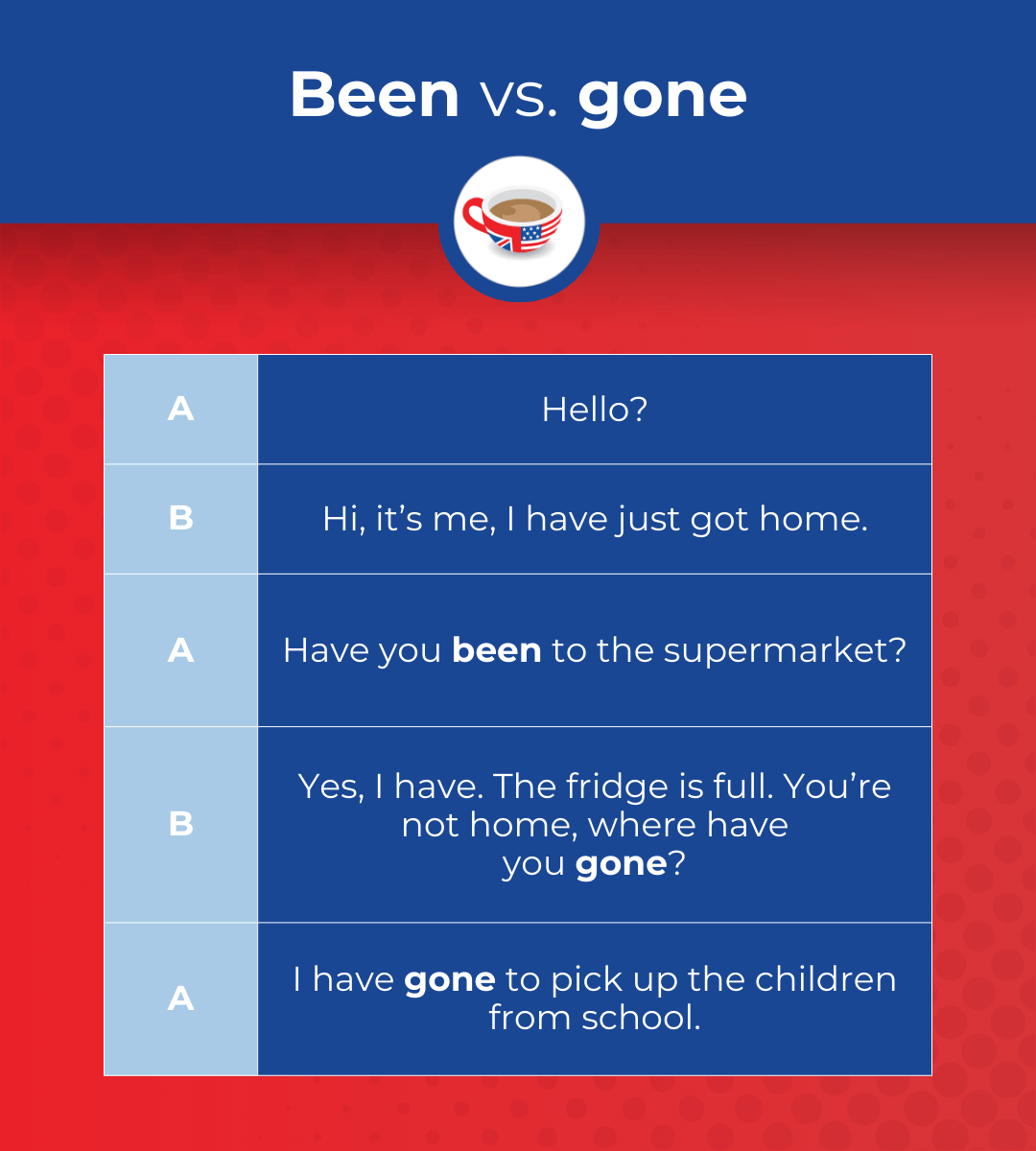
We use gone with the present perfect to express the idea of movement, or leaving a place. The idea that we went to a place and we haven’t returned. We can see the difference in the dialogue below:

A dfialogue showing the difference between been and gone

We can see that the wife has returned home but the husband has not. The wife has been to the supermarket but the husband has gone to pick up the children.

So we can use been when we use present perfect for experiences and gone when we use present perfect for recent actions.

For more on been and gone with the present perfect tense, see our 8th episode of Season 1.

Present Perfect Vs Past Simple

We use the present perfect tense for talking about experiences with no specific detail and we use the past simple to give further information about the experience. Here’s an example:

A dialogue showing the difference between the past simple and the present perfect tense.

We can see that the experience is introduced with the question have you ever? and then the follow up question is in the past simple. When we ask for detail we use the past simple, usually using open questions with question words such as who, what, why, when, etc.. 

From this point on, we normally use the past simple because we are talking about a finished activity and no longer a general experience.

For more practice with choosing the past simple or the present perfect tense, check out Episode 2 of Season 3 of Coffee Break English. 

It’s your turn!

Now, let’s practise! Try to decide which of the sentences below is a lie. Read to the bottom to find out which sentence is not true… Don’t check until you have guessed!

Coffee Break Languages founder, Mark Pentleton, has learnt 9 foreign languages.

Coffee Break Languages has been nominated for a Lovie Award for Best Science/Education Podcast.

Coffee Break Languages has created a podcast series for pets.

Practice makes a perfect tense!

Remember that the present perfect tense is difficult because we use it in a variety of ways and it doesn’t always have an equivalent form in other languages so be patient with yourself and always try to learn in context. Try using the present perfect tense for experiences in your conversations!

If you found this post interesting, make sure you listen to the full podcast episode with Nick and Francesca on The Coffee Break English Show. We will release more episodes soon, about some other useful topics! Subscribe to our podcast feed and our channel on YouTube to learn when the next episode is available.

Plus, don’t miss your free worksheet – perfect for extra practice after the lesson! When you sign up, you’ll also receive our short coffee break-sized email lessons, delivered straight to your inbox every week, to help you build your English skills. 💪 You’ll even hear from Mark, the founder of Coffee Break Languages, who shares regular tips and motivation for learners of all levels. Sign up below! 👇

So keep practising, deepening your knowledge and understanding, and remaining curious about the language you are learning and you will surely make progress. 🚀

Happy Coffee Breaking!

Here are the answers to the quiz:

Coffee Break Languages founder, Mark Pentleton, has learnt 10 foreign languages. True!

It is true, Mark has learnt 9 foreign languages and you can hear him speaking them here! 🌎

Coffee Break Languages has been nominated for a Lovie Award for Best Science/Education Podcast. True!

Coffee Break Languages has created a podcast series for pets. False!

This one is not true but we did pretend to do this in an April Fools’ Joke!  🤭

Listen to the podcast

CBS Scenes 1.10 | Una gran familia

In the final chapter of Scenes, our course for intermediate Spanish learners, Isabel shares more about her Chicos de oro and the wonderful plans they enjoy together. ¡Son como una gran familia!

Join Mark and Pablo in this last episode and take your Spanish to the next level! In Chapter 10, we’ll continue practising and reinforcing key concepts while expanding our vocabulary. For example, Mark and Pablo will explore quedarse followed by an adjective, unirse a, and interesting nouns like velada.

¡No te pierdas este último capítulo sobre el bar de Isabel y sus encantadores clientes!

CBG Scenes 1.10 | Begegnungen, die den Alltag bereichern

Mark and Thomas return for the final episode of Season 1 of Scenes! A quiet afternoon at the café allows the narrator to enjoy a peaceful moment—until an unexpected visitor arrives. Heinz shows up at an unusual time, surprising not only the narrator but also Charlotte, who has never met him before.

As Charlotte and Heinz strike up a conversation, the narrator reflects on the unique charm of Erna’s café. Every guest, whether a loyal regular or an occasional visitor, contributes to the stories that unfold here. Some are heartwarming, some bittersweet, and others remain unfinished—but each one is part of the café’s rhythm.

Mark and Thomas highlight useful grammar and vocabulary, such as der Schnappschnuss or vorschlagen or how to talk about assumptions or probability.

Lass dir dieses letzte Kapitel der Staffel nicht entgehen – eine wunderbare Möglichkeit, dein Deutsch mit einer besonderen Geschichte abzurunden!

CBI Scenes 1.10 | L’inizio di un amore

Join Francesca and Mark for the last Chapter of Scenes from the Coffee Break Italian Café! Summer has finally arrived, and as two high school students return, there’s a noticeable shift in the atmosphere between them. What happens next could very well change everything for them…

‘Too Much’ or ‘Too Many’: Using Quantifiers in English

A man in a red shirt with a thoughtful expression, resting his chin on his hand.

Have you ever wondered whether to say too much or too many? Or perhaps you’re unsure when to use enough? The good news is that learning these quantifiers in English will help you sound more natural!

The Coffee Break English Show is a podcast series of informal conversations to help you understand some difficult topics in English. In the latest episode, Nick and Anabel explore how to use these common quantifiers in English and when to choose one over the other.

So let’s take a closer look at too much, too many and enough and start putting them into practice! Continue reading to find out more, and why not listen to the podcast as you go?

Countable and Uncountable Nouns

First we need to establish what countable and uncountable nouns are.

When we talk about countable nouns, we mean nouns that can be plural. We can say I have one apple, I have two apples, three apples, etc. We normally show the plural form by adding the letter s (or es for words like leaves, watches, etc.) at the end of words but some countable nouns are irregular (person – people, child – children, woman – women, etc.).

When we talk about uncountable nouns, we mean nouns that are not possible to count by expressing a simple number before them. Liquids are uncountable because it is impossible to put a simple numerical quantity to them (water, oil, coffee, etc.). Many abstract ideas are uncountable too, such as information, news, money and light.

A list of countable and uncountable nouns

Too Much, Too Many, and Enough

Understanding when to use quantifiers is essential for speaking English correctly. These words help us describe quantity, but they have specific rules for their usage.

Too Much vs. Too Many

These phrases mean “more than necessary” or “more than wanted,” but the difference depends on whether the noun is countable or uncountable

Too much is used with uncountable nouns:

  • There is too much sugar in my coffee.
  • She spends too much time on her phone.

Too many is used with countable nouns:

  • There are too many cars on the road at 5pm. Traffic is slow!
  • I bought too many apples at the market. My bag broke on the way home!

We should always remember that when we use too much and too many, we are expressing a negative idea. We are saying that the quantity is a problem. If we just want to say that there is a very large quantity using much and many, we can say so much and so many.

  • There is so much light in this room.
  • There are so many castles in Scotland!

If you want more practice with quantifiers in English, check out Episode 5 of Season 1 of Coffee Break English!

To much or too many. Rules and examples.

Enough

The word enough means “sufficient” or “the right amount.” It can be used with both countable and uncountable nouns.

 Before a noun:

  • We have enough chairs for everyone. 
  • There is enough food for everyone, help yourself! 

After an adjective:

  • She’s strong enough to lift the box. 
  • The oven is hot enough now, we can put the pie in.

Not Enough

We use not enough to show that something is “insufficient”. It can be used with both countable and uncountable nouns.

  • This coffee is not hot enough
  • She doesn’t have enough money to buy a new phone. 

Common mistakes

Here are some common mistakes learners make when using quantifiers in English:

There are too much people in the room.

There are too many people in the room.

I don’t have too many time.  

I don’t have too much time.

She didn’t buy enough big shoes.   

She didn’t buy big enough shoes.

Let’s Review

Use too much with uncountable nouns. Use too many with countable nouns. Use enough before a noun or after an adjective to show sufficiency. Use not enough to show something is insufficient.

It’s your turn!

Now, let’s practise using quantifiers in English! Here are four situations. Try to make a sentence to describe each one using too much, too many, enough or not enough for each one.

Some possible answers are at the end of this blog post, but don’t look until you’ve thought about your answers!

  1. I need £35 to pay for the dinner and I have £36.
  2. There are 5 students and 3 chairs.
  3. This pasta is extremely salty!
  4. There are 6 people and 5 spaces in the car.

If you found this post interesting, make sure you listen to the full podcast episode with Nick and Anabel on The Coffee Break English Show. In this series, we talk about useful topics for English learners, so make sure to subscribe to our podcast feed and our channel on YouTube.

Plus, don’t miss your free worksheet – perfect for extra practice after the lesson! When you sign up, you’ll also receive our short coffee break-sized email lessons, delivered straight to your inbox every week, to help you build your English skills. 💪 You’ll even hear from Mark, the founder of Coffee Break Languages, who shares regular tips and motivation for learners of all levels. Sign up below! 👇

So, start using quantifiers in English correctly whenever you can! The more you practice, the more natural your English will sound. Why not get a coffee now and test yourself with today’s practice exercises?

Happy Coffee Breaking!

P.s. Here are some possible answers to the prompts given above:

  1. I have enough money.
  2. There are not enough chairs (or there are too many students).
  3. They put too much salt on the pasta.
  4. There are not enough spaces in my car (or there are too many people for my car).

Listen to the podcast

CBF Scenes 1.10 | Une fête inoubliable

It’s the big day in this final chapter of Scenes, the village festival has arrived! Chez Nico is at the heart of the action, bringing locals together for a day of fun, food, and festivities.

This episode explores key language points, including se régaler and inoubliable.

Join us for this final chapter of Scenes, a perfect way to celebrate your progress in French!


8 German movies for learners

Have you been looking for some German movies to supplement your language learning? The variety within the German movie industry really is astonishing, but we have managed to find some of the most highly-rated films to give you a taste of what’s produced for the silver screen there. They can be enjoyed with or without subtitles.

Before we get started, we have a curiosity to share with you! Do you know what ab Donnerstag im Kino means? The translation is from Thursday in the cinema, and it’s a common phrase associated with films because new films are traditionally released on a Thursday in Germany.

Interessant, right? With that, schnapp’ dir eine Schüssel Popcorn und los geht’s!

1. Good Bye, Lenin! (2003)

Set against a time of great change, der Mauerfall and die Wiedervereinigung, “Good bye Lenin!” relays the tale of a young man’s efforts to hide the true events of German history from his mum. He does this with the best of intentions, as she is not to receive any shock that may have a detrimental effect on her health after being in a coma. 

Consequently, Alex goes to great lengths to maintain the pretence that everything is as it was, never letting on to his Mum that the Berlin Wall has fallen. How far will Alex go in contriving elaborate schemes in order to shield his mum from the reality of the outer world?


2. Sophie Scholl – Die letzten Tage (2005)

Based on the life of anti-Nazi heroine Sophie Scholl, played by Julia Jentsch, this story is set in 1943 in Munich. The plot of this German movie deals with the interrogation process and the last six days of Scholl’s life.

Genuine incarceration records were used to help make the film. She and her brother were members of the student resistance group “The White Rose”. They have been detained after distributing leaflets which criticise the regime. The police inspector, Robert Mohr, played by Alexander Held, is unsuccessful in retrieving the information he needs from Sophie. With her firm, idealist values, Sophie does not budge on her stance for a lighter sentence in return for accomplices’ names. 

At its core, the film is a debate over which side is freer: those who bow down to the regime in fear, or those who defy it and remain true to their beliefs. The former may conform to survive, but can anyone truly ‘live’?

3. Die Fälscher (2007)

In 2007, this German movie won the best foreign language film at the Oscars. A Jewish prisoner of war has skills that are valuable to the camp commandant. His counterfeiting abilities are used by his captors against the Allies. 

Do the prisoners go along with the guards’ plan for their own self-preservation in a desperate situation, or do they try to outsmart the guards and remain loyal to the Allies?

4. Oh Boy! (2012)

This black and white German movie is a comedy that introduces the viewer to Niko. He’s unemployed, having dropped out of his Jurastudium 2 years ago, but didn’t let his dad know this important detail about this change in his life. His dad isn’t happy to learn he’s been funding his son’s carefree lifestyle.

Niko begins to learn that his dry wit will only get him so far in life. When he strikes up a romance with a former school friend, he confides in her, Kennst du das, wenn man so das Gefühl hat, dass die Menschen um einen herum irgendwie merkwürdig sind? Und dir wird irgendwie klar, dass vielleicht nicht die Anderen, sondern dass man selbst das Problem ist? Is Niko beginning to look at his choices in life again?

5. Honig im Kopf (2014)

Til Schweiger has not only written and directed this German movie but also stars in it, alongside his daughter, who plays his daughter in the film. It makes it clear that family is a core theme of the film, revolving around the grandfather’s Alzheimer’s disease. 

As the grandfather’s condition worsens, Niko, his son, decides he cannot keep sidestepping the inevitability of putting his dad in a home. Tilda, the granddaughter, has different ideas and, in a bid to save her grandfather from this fate, sets off with him on an adventure to Venice. It’s a place full of fond memories, as this is where he spent his honeymoon with his wife, who died sometime before. There are laughs to be had at the granddad’s inappropriate remarks, which raise a few eyebrows, and tears, when reliving the past proves to be tough with a fading memory.

6. Das finstere Tal (2014)

Next on our list of German movies for learners is Das finstere Tal. This film is a chilling Western-style revenge drama set in a remote mountain village in the Alps. 

When a mysterious stranger arrives, claiming to be a photographer, his presence stirs unease among the villagers. As secrets from the past unravel, tensions rise, and the stranger’s true motives come to light. 

With stunning landscapes and a dark, atmospheric tone, this film offers a gripping narrative that can captivate viewers from start to finish.

7. Vincent will Meer (2010)

In this heartwarming road German movie, Vincent, a young man with Tourette’s syndrome, embarks on an unplanned journey to fulfill his late mother’s dream: to scatter her ashes at the Italian seaside. 

Along for the ride are two unlikely companions – Marie, a spirited woman with anorexia, and Alexander, a control-freak patient with obsessive-compulsive disorder. Their adventure takes them through breathtaking landscapes and humorous, touching moments as they learn to accept themselves and each other.

8. Der Vorname (2018)

In this German film, a seemingly ordinary dinner party takes a sharp turn when a provocative question is raised: What if someone named their child “Adolf”? As friends and family debate the appropriateness of the name, tensions boil over, exposing hidden grudges, long-held secrets, and unresolved conflicts. 

Der Vorname is a sharp, witty comedy that mixes humour with social commentary, providing an entertaining yet thought-provoking experience.

We hope you’ve enjoyed exploring this selection of German movies for learners. Each of these films offers a unique window into German culture, providing entertainment and an opportunity to immerse yourself in authentic language usage. So, grab a bowl of popcorn, press play on one of these pictures and let your language learning journey begin.

Want to watch even more foreign-language films? Check out our film recommendations for French, Italian and Spanish learners too!