When it comes to Spanish pronunciation, some aspects of it are relatively easy to get your head around. However, at times, things can get a little tricky when it comes to knowing which syllable to stress when pronouncing a word in Spanish.
Like in English, the stress of words is not always on the same syllable. On top of this, what happens with the accents when written? Have you ever wondered why some words have an accent on the stressed vowel and why other words don’t?
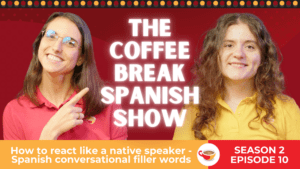
The Coffee Break Spanish Show is a podcast series of short, informal conversations to help you understand some difficult topics in Spanish. In the latest episode, Mark and Concha look at where the stress can be in a Spanish word and learn when to use accent marks on vowels.
Continue reading to find out more and why not listen to the podcast as you go?
To make this easier, we can divide all Spanish words into four categories, depending on which syllable of a word is stressed.
1 – aguda
When a word has the stress on the final syllable, it is called aguda. Agudas have an accent on the vowel of the final syllable when the word ends in -n, -s or a vowel. Here are some examples of agudas:
mujer
woman
The stress is muJER, but there’s no accent because it ends in -r.
ajedrez
chess
The stress is ajeDREZ, but there’s no accent because the word ends in -z.
televisión
television
The stress is televiSIÓN, and there’s an accent because it ends in -n.
interés
interest
The stress is inteRÉS, and there’s an accent because it ends in -s.
café
coffee
The stress is caFÉ, and there’s an accent because it ends in a vowel.
2 – llana
When a word has the stress on the second-last syllable, it is called llana. Llanas have an accent on the penultimate syllable when the word doesn’t end in -n, -s or a vowel. Here are some examples:
volumen
volume
The stress is voLUmen, and there’s no accent because the word ends in -n.
estatuas
statues
The stress is esTAtuas, and there’s no accent because the word ends in -s.
caja
box
The stress is CAja, and there’s no accent because the word ends in a vowel.
dólar
dollar
The stress is DÓlar, and there’s an accent because the word ends in -r.
móvil
mobile
The stress is MÓvil, and there’s an accent because the word ends in -l.
3 – esdrújula
When a word is stressed in the third-to-last syllable, it is called esdrújula. Esdrújulas always have an accent showing the stressed syllable. Here are some examples:
música
music
The stress is MÚsica.
América
America
The stress is aMÉrica.
miércoles
Wednesday
The stress is MIÉRcoles.
¡Cuidado! Sometimes, forming the plural of a word can add another syllable, making the word require an accent when before it didn’t need one.
Here’s an example:
examen
exam
The stress is eXAmen, so it’s llana and it doesn’t have an accent because it ends in -n.
exámenes
exams
The stress is eXÁmenes, so it’s esdrújula and so it does have an accent.
Something similar happens with an infinitive form of the verb when we use more than one pronoun:
dártelo (dar + te + lo)
to give it to you
4 – sobresdrújula
Occasionally, we are going to find words that are stressed on the fourth-to-last syllable. This type of stress is called sobresdrújula. These types of words always have an accent mark and they are often found in verbs with pronouns. For example:
devuélvemelo (devolver in the imperative form + me + lo)
give it back to me
comprándotelo (comprar in the gerund form + te + lo)
buying it for you
The other situation where we find this stress pattern is in adverbs ending in -mente. When forming adverbs in -mente, the adjective retains the same accented syllable as before and so we don’t ever need to add or take away an accent when written. So, that’s why we have:
fácilmente (fácil + mente)
easily
difícilmente (difícil + mente)
with difficulty
lentamente (lento + mente)
slowly
¡Un consejo! With a very long word, we recommend practising by splitting it into chunks of two or three syllables and saying them out loud individually until you can combine them. Por ejemplo:
devuélvemelo > devuelve-melo
comprándotelo > comprando-telo

¡Hora de practicar!
Now it’s time to put your knowledge to the test! Translate the following phrases into Spanish. Think carefully about where to place any accents and which syllable to stress when saying each word out loud. You’ll find the answers at the end of this article.
- immediately
- write it (la carta) to me
- say it (el mensaje) to him
We hope that you found this article useful. Make sure to listen to the full episode with Mark and Concha on The Coffee Break Spanish Show. This is the series in which we look at a range of topics for Spanish learners, so make sure to subscribe to our podcast feed and our channel on YouTube.
Plus! To get regular free Spanish lessons in your inbox, you can sign up for our short (coffee-break-sized) email lessons that will help you improve your Spanish. You will also hear from Mark, the founder of Coffee Break Languages, giving advice for language learners at any level. Sign up below!
Scroll down for the answers to the translation challenge. Next time you read a Spanish text pay special attention to the accents and ask yourself: is it aguda, llana, esdrújula or sobresdrújula?
Happy Coffee Breaking!
PS. Here are the answers to the translation challenge.
- inmediatamente (inmediata + mente)
The adjective inmediato/a is llana ending in a vowel, so there’s no accent. - escríbemela (escribe + me + la)
- dímelo (di + me + lo)