
Speaking with confidence: how to apply the ‘Anticipation Technique’ to language learning

A hand holding a blank speech bubble cutout against a bright blue sky, symbolising conversation and communication.

Picture this: you’re learning a new language and are excited to test your skills by ordering a coffee, asking for information or chatting with a native speaker. But just thinking about it (and it doesn’t matter if you are a beginner or an advanced learner), you start to feel a bit overwhelmed or nervous that you might not understand what they will say to you. Don’t worry. Speaking with confidence in a different language depends on many things, like your mindset, how you practise, and how comfortable you feel with the language. 

To help you feel more at ease when encountering situations like this, we have a great strategy, which we like to call the Anticipation Technique. In this blog post, we will explain more about this method and share a couple of tips to help you speak confidently in your target language. 

The Anticipation Technique

Here at Coffee Break, we believe that speaking with confidence often comes from feeling prepared. And that is where the Anticipation Technique, created by Mark, the founder of Coffee Break Languages, comes in handy. 

This approach comes from his years of experience as a language learner and as a language teacher. It involves predicting or anticipating what you might need to say or hear in a conversation and preparing for it in advance. If you think about it, we already do it in our native languages!

For example, if you’re about to speak to the waiter, take a few minutes beforehand to imagine how the conversation might go. What questions might the other person ask you (e.g. “Would you like to sit in or take away?” or “Cream or sugar?”)? What might they say to you (e.g. “We don’t have any soy milk.” or “The muffins were baked yesterday”)? 

And the key question is: how could you respond to these questions or statements? By preparing some answers and useful phrases ahead of time, you’ll walk into the conversation with phrases and vocabulary you’re ready to use. This reduces the anxiety of coming up with sentences on the spot. 

In the same way, if you’re going to talk about a particular topic like travel, work or family with a friend or work colleague, try to anticipate relevant words or expressions in the language you are learning that you might need. Knowing that you have this vocabulary up your sleeve will make speaking with confidence a lot easier. 

For a practical demonstration of the Anticipation Technique in action using a different example, check out this video Mark prepared:

Other tips for speaking with confidence

As well as the Anticipation Technique, there are other strategies you can use for speaking with confidence. Let’s have a look at some other tips:

Embrace making mistakes!

One of the biggest barriers is the fear of making mistakes. However, whether you are learning a language from scratch or have been learning it for a while, making mistakes is completely normal. Our tip for you is to embrace it. As we like to say around here: sbagliando s’impara. So, next time you’re speaking in the language you’re learning, keep this Italian proverb in mind and remember that by making mistakes, one learns.

If you use the wrong word or make a grammar mistake, what’s the worst that can happen? In most cases, your conversation partner will still understand you, or they might gently correct you. All you need to remember is that people always appreciate when a learner makes an effort.

Immerse yourself in the language

It may seem unrelated, but improving your listening skills can do wonders for speaking with confidence. Why? The better you understand others, the more you can talk without hesitation. 

So, try to check out podcasts, music, or TV shows, and pay attention to common phrases and how native speakers use them. Then, the next time you’re in a real conversation, those sentences or expressions might come to you more automatically because you’ve heard them before.

Additionally, listening a lot helps you pick up the natural rhythm and melody of the language, which is a big part of speaking with confidence. You’ll start to internalise when to pause, which words to stress, and how to pronounce tricky sounds.

Talk to yourself 

Another key to speaking with confidence is regular practice in low-pressure situations. So, why not practise talking to yourself? For instance, you can try to describe your day out loud in the language while you’re driving or cooking, or repeat dialogues from language podcasts. 

This tip might surprise you, but trust us – it works! The important thing is to get used to hearing yourself speak the language without the fear of judgement. 

Well, we hope that the Anticipation Technique and the other strategies we shared make you feel more confident in your next conversation. As you practise these tips, you’ll notice a shift in your mindset: what once felt intimidating will start to feel exciting.

If you’d like to continue building your repertoire of recommendations for learning a new language, check out the blog post we prepared on the B.L.E.N.D. Method, which allows you to make steady progress, all during your coffee breaks!

How to become a polyglot? 7 tips to help you in this journey

A scenic ridge path lined with wooden railings, overlooking lush green valleys, lakes, and mountains under a colourful sunset sky.

Isn’t it inspiring to see people who can effortlessly switch between multiple languages? Have you ever dreamed of holding a conversation in Spanish, ordering delicious food in German, or enjoying French movies without needing subtitles? If that sounds like you, you might be curious about how to become a polyglot!

Learning multiple languages can feel like a big challenge, but it’s achievable with the right mindset, strategies, and consistency! Whether you’re just beginning your language adventure or starting with your third or fourth language, this guide we prepared is here to help you explore the world of polyglots. 

Let’s get started!

Polyglot vs multilingual: is there a difference?

Before we look into some helpful tips on how to become a polyglot, let’s take a moment to clarify a question that many people have: Is there really a difference between being multilingual and being a polyglot?

According to the Cambridge Dictionary, the term multilingual refers to ‘people or groups able to use more than two languages for communication, or understand something written or spoken in more than two different languages.’ Meanwhile, when we look at the definition of a polyglot, the Cambridge Dictionary describes it as ‘someone who speaks or uses several different languages.

To sum it up, these two terms are connected. You might say that a polyglot enjoys learning new languages purely for the joy it brings, while a multilingual person speaks several languages thanks to their rich exposure to a multilingual environment.

What about bilinguals?

A bilingual person is someone who speaks two languages fluently, and there are so many reasons for it! It might be because you have parents who are fluent in different languages, live in a bilingual country, or even find yourself in a job where people speak multiple languages. 

If you’re already comfortable with two languages, you probably have a great grasp of grammar, pronunciation, and helpful language-learning tactics. So, if you’re already bilingual, congratulations! You’re one step closer to becoming a polyglot. And if you’re monolingual, don’t worry – learning multiple languages is entirely within reach for anyone with the right mindset and approach.

7 tips on how to become a polyglot

Now that you are more familiar with the key terms, are you ready to check out some tips on how to become a polyglot? Regularly switching between languages helps develop cognitive flexibility, making it easier to pick up new ones. Many people even enjoy learning two languages at the same time!

So, here are the tips we prepared to help you achieve your goal of becoming a polyglot.

1. Start with a strong reason

What inspires you to learn multiple languages? Is it to explore new places, enhance your career, deepen your cultural appreciation, or take on a personal challenge? The first step to becoming a polyglot is nurturing a strong motivation to carry you on your journey.

Whether you aim to connect with diverse cultures, unlock more job opportunities, or simply give your brain a fun workout, understanding your “why” will help you stay dedicated. If you need some tips on how to maintain motivation, Mark, the founder of Coffee Break Languages, shares a couple of good strategies:

2. Choose languages strategically

If you’re starting on your exciting journey to become a polyglot, choosing languages that naturally complement each other can make things a bit easier for you. Romance languages like Spanish, French, Italian, and Portuguese share many delightful similarities, which makes it a breeze to transfer your knowledge from one to another.

Similarly, if you already have a grasp of English, you’ll find that German and Dutch feel much more familiar. If you’re feeling adventurous, why not learn fascinating languages like Mandarin, Arabic, or Russian? Whichever language you choose, just ensure it sparks your interest and aligns with your long-term language-learning goals!

3. Use the right language-learning methods

Not all language-learning methods work for everyone. So, you need to find the one that suits you best. There are many strategies and resources out there to help you – it’s just a question of finding the right ones for you.

Listening to native speakers through podcasts, songs, or even TV shows is a fantastic way to enhance your pronunciation. Plus, by concentrating on the most commonly used words and phrases, you’ll be mastering the essentials of everyday conversations before you know it.

4. Think in your target language

A fantastic tip on becoming a polyglot or learning any language is to encourage your brain to start thinking in the language you’re learning. What do we mean by this? Well, rather than translating words from your native tongue, try forming sentences directly in the target language.

We suggest that you try to narrate your daily activities in the language you’re learning. For example, while cooking, if you are learning Italian, you can think, Ora sto cucinando la pasta Now I am cooking pasta.

The more you practise this, the easier it gets to think naturally in the language.

5. Speak from day one

The fifth step on how to become a polyglot is: speak! Trust us, it’s totally normal to hesitate when it comes to engaging in conversation because it might feel like you don’t know enough yet. But waiting until you feel “ready” can hold you back. Start speaking right from the start, even if you only know a handful of words.

Making mistakes is part of the process – don’t be afraid of them!

6. Be consistent and make it fun

The sixth tip on your journey of how to become a polyglot is to stay consistent. We believe that dedicating 15–30 minutes each day can really add up over time. Plus, if you use microlearning, you’ll find it an incredibly helpful tool to keep you engaged and motivated. 

You can make learning enjoyable by incorporating your hobbies into the process. For example, if you love music, listen to songs; if you enjoy cooking, try to learn recipes; and for all the gaming enthusiasts, you could even tweak the settings in a new game to align with the language you’re eager to master. Enjoy the journey!

7. Don’t give up 

The last tip on how to become a polyglot is simply not to give up! Learning a new language is a beautiful journey that takes time, patience, and dedication. You might experience challenges along the way, but always remember that every little step forward is a victory worth celebrating. 

Embrace mistakes, celebrate those little victories, and keep moving forward! With these tips in your pocket, the big question is: which language will you explore first (or next)? Keep in mind that every polyglot began their adventure as a beginner, just like you, no matter where you are on your language-learning journey. 

If you’re looking to make your journey easier and more enjoyable, why not explore how to take notes in a new language? This can really help you retain new vocabulary. Check out the blog post we’ve prepared and get ready for some exciting learning ahead!

Qualities of a good teacher: key traits that inspire language learners

An open book on a wooden table with pages slightly curved, a stack of closed books in the background, and a blurred warm-toned setting.

When considering what makes language learning truly effective, it’s important to reflect on the qualities of a good teacher. After all, a great tutor isn’t just someone who speaks the language fluently; they also possess qualities that make learning effective, enjoyable, and memorable. 

Here at Coffee Break Languages, we believe that skilled, friendly, and passionate tutors can make a difference in supporting your learning. If you want to know how three of the most important qualities of a good teacher can inspire you as a language learner, continue reading this blog post.

1. Passion and enthusiasm

One of the qualities of a great language tutor is their passion for the language they teach. Their passion is truly contagious, and when you’re learning from someone enthusiastic about the language, it naturally helps you stay motivated and excited to learn more.

Moreover, enthusiastic teachers inspire you to stay curious and eager to learn, helping you enjoy the journey of mastering a new language. Plus, they’re there to support you and keep you motivated, even when you encounter challenging verb conjugations, tricky grammar rules, or pronunciation aspects.

We are sure you still remember a teacher or tutor who taught you something you’ve never forgotten. Mark, the founder of Coffee Break Languages, shared some examples of his experiences and also his views on what the qualities of a good and inspiring teacher are. Check out the video below: 

2. Empathy with learners

Learning a new language can sometimes be challenging, and it’s completely normal to feel like you are not progressing as fast as you hoped for. That’s why one of the qualities of a good teacher is empathy – the ability to truly understand and share in your experience. After all, everyone learns at their own unique pace and faces their own particular challenges.

Our team of tutors consists of experienced language learners who understand the challenges first-hand because, like you, they’ve been through the process of learning a new language. That’s a wonderful thing because they know exactly how you feel at times and can support you on your language-learning journey. 

Coffee Break presenters

Another important quality of a good teacher, which goes along with empathy, is patience. A good tutor can understand that language learning is a process that involves gradual improvement, and they’re with you every step of the way. At Coffee Break, we recognise that our learners come from diverse backgrounds and have varying levels of experience with language. That’s why we ensure that our style of teaching makes the language accessible for anyone, even if you wouldn’t usually think of yourself as a language learner. 

And when you feel supported and understood, learning becomes a more enjoyable and exciting experience.

3. Expertise and knowledge of the language

Last on our list of key qualities of a good teacher is: their knowledge of the language they’re teaching. A great language tutor inspires a learner to do more than just know the words by helping you understand the aspects that make up grammar, pronunciation, and usage in everyday conversations. 

They guide you not only in speaking the language but also in understanding the why behind the rules, helping you apply them naturally in different contexts. This kind of understanding helps simplify complex concepts and break them down into manageable pieces. So, instead of overwhelming you with confusing terms, they use everyday language to explain grammar points, new vocabulary, or cultural nuances.

At Coffee Break, our tutors also bring cultural insights into the lessons because we believe language and culture go hand in hand, and it’s all about preparing you to use the language confidently in the real world. 

Related topic: What is the best way to learn a language?

Moreover, we believe in using a clear, approachable teaching style that prioritises understanding. We break down lessons into small, digestible chunks and use plenty of examples to help solidify the new concepts. Whether you’re listening to a podcast episode or following along with our interactive exercises, our goal is to ensure that you always understand what you’re learning and how to apply it.

How a good language teacher can help with your learning

By now, you probably have a better idea of the qualities of a good teacher – one who brings expertise, patience, empathy, and passion to the table. When you learn with a tutor like this, your language-learning journey becomes more enjoyable and rewarding, leading to quicker progress. A wonderful teacher can boost your confidence, help you overcome challenges, and guide you in developing the skills you need to speak the language fluently.

At Coffee Break Languages, our team of tutors reflects these qualities, and we’re here to support you every step of the way. Whether you’re listening to our podcasts, following one of our online courses, or exploring our library of video lessons on our CoffeeBreakTV app and web platform, our tutors work hard to inspire you and to make sure you have the best possible learning experience.

If you’re looking for a tutor who has all the qualities of a good teacher, as we mentioned, and who will inspire you and guide you towards success in your language-learning journey, why not consider joining the welcoming Coffee Break community? Explore our variety of courses and discover the perfect level for you!

How to learn a new language by yourself? Learn how to do it using podcasts

A wooden desk with a cup of coffee, white earphones, and part of a computer keyboard.

Have you ever wondered how to learn a new language by yourself? If so, whether because a formal classroom setting doesn’t appeal to you, or you don’t have the time for long sessions, there’s good news: you can learn a new language using a simple tool – podcasts!

Language podcasts offer a unique way to help you immerse yourself in a new language while fitting into your lifestyle. Whether you’re sipping your morning coffee, commuting to work or enjoying a quiet evening at home, podcasts make language learning accessible, enjoyable, and flexible. 

In this blog post, we’ll guide you through the process of learning a language independently, using podcasts as your ultimate companion.

Why learn a new language?

Learning a new language from scratch can be incredibly rewarding. It opens doors to new cultures, deepens your understanding of the world, and helps you connect with people. If you speak another language, you are not just communicating; you can build bridges and foster a sense of belonging. Additionally, it provides practical benefits, such as improving your career prospects and enriching your travel experiences. 

Beyond these cultural and practical advantages, picking up a new language is an amazing workout for your brain! Research shows that being bilingual not only enhances memory but also sharpens your problem-solving skills and helps delay cognitive decline.

On top of that, learning a new language is a fantastic way to grow personally. It encourages you to step out of your comfort zone, build resilience, and find joy in making mistakes along the way. Whether you’re learning for travel, work, or just out of curiosity, each word you master brings you one step closer to becoming a more enriched and confident version of yourself.

Why are podcasts a perfect match for language learning?

Podcasts are a fantastic tool for language learning! They provide an experience that mirrors how we naturally pick up languages. You’ll find authentic conversations, cultural insights, and practical phrases that immerse you in the language just as it’s spoken in daily life. This way, you’re not only learning words but also how to use them naturally! Additionally, many language podcasts are hosted by native speakers who share tips on pronunciation and intonation. 

Another reason why podcasts are a perfect match for language learning is flexibility. You can listen while you’re cooking, walking the dog, or working out. Podcasts fit into your daily routine, transforming those little bits of idle time into productive learning moments.

Some of our podcasts come with extra perks! Here at Coffee Break, we have over 18 years of experience helping millions of learners. We provide engaging transcripts, practice exercises, and more useful bonus content for those who opt for the premium version of our courses.

How to learn a new language by yourself using podcasts?

As we mentioned before, studying independently has its perks – you set your pace, tailor your learning to your interests, and choose resources that suit your goals. However, what strategies can be used to learn a new language independently through podcasts?

Let’s start with something essential: knowing what you’d like to achieve! Whether you’re excited about an upcoming trip or simply eager to dive into learning, setting clear goals can transform your study routine into a much more inviting and enjoyable experience. 

Next up on how to learn a new language by yourself using podcasts is to take your time picking the right podcast. It’s all about finding one that aligns with your skill level and interests. At Coffee Break, we provide step-by-step lessons that gently build your skills, allowing you to easily learn practical and everyday phrases, all while creating a deeper understanding of the structure and grammar of the language without you even realising it.

Thirdly, it’s a good idea to learn from the hosts’ pronunciation and intonation. Many podcasts invite you to repeat phrases, so feel free to join in and practise your speaking skills. 

Another habit we’d encourage is to revisit those episodes. Listening again really helps reinforce what you’ve learned and allows you to see how much progress you’ve made.

Finally, as we often mention, consistency plays a vital role in language learning. Just dedicating 15 minutes each day can truly make a big difference! And remember to celebrate your milestones and reward yourself as you go – whether it’s having your first conversation or mastering that challenging verb tense, recognising your progress makes the journey all the more delightful! 

And now you know how to learn a new language using podcasts! By weaving this habit into your daily routine, creating clear goals, and maintaining consistency, you’ll be amazed at how quickly you’ll move forward. The language-learning adventure is right at your fingertips – just one episode (or coffee break!) away.

If you’re short on time but eager to learn new languages, consider exploring our blog post on how microlearning can enhance your language learning. In the article, we look at effective strategies that use bite-sized lessons, making this process more accessible and efficient.

Learn how to improve your listening skills in a new language

Beige and white over-ear headphones resting on silky brown fabric.

Being able to understand conversations in a different language or communicate smoothly with the server in a restaurant or café is definitely a very special moment for any language learner. However, if you are not quite there yet or would like some more practice, you’re likely wondering how to improve your listening skills in a new language.

We believe the answer isn’t as simple as just listening more, as improving your listening comprehension is tied to many factors – from the techniques you use to the content you choose and your own daily habits. That’s why we prepared this blog post with four strategies to help you get to where you would like to be… faster. Keep reading!

4 strategies on how to improve your listening skills 

Listening is one of the most important skills in language learning. It’s not just about hearing sounds, it’s about training your brain to recognise patterns, decode meaning, and react. To help you with that, we’ve prepared a list of four strategies. 

If you’d prefer a visual overview, be sure to watch the video below, where Mark, the founder of Coffee Break Languages, shares more about each one of the tips on how to improve your listening skills.

1. Slowing down

This is a highly controversial strategy, but at Coffee Break, we believe it can be incredibly beneficial for language learners at the beginner and intermediate levels. Trust us: using playback controls in audio or video platforms is not cheating, but rather a smart tool to help your brain catch every word, and it might be a useful exercise to add to your learning routine

When you slow audio down (let’s say to 0.75x), everything becomes clearer: you can distinguish syllables, spot new vocabulary and tune your pronunciation accuracy. So, rather than feeling embarrassed for using slow playback, think of it as training wheels for your ears. Your understanding will grow faster than if you only ever use normal speed.

And, once you feel more comfortable, you can gradually increase the speed until you’re ready to match real-life conversations. Additionally, you can find content that is specifically created for your level of skills, in which (if you are at beginner or intermediate level) the hosts or tutors will speak a bit slower than in a natural conversation.  

2. Ask people to speak more slowly

Next on our list of strategies on how to improve your listening skills is to ask people to speak slowly. Just like with audio or video, you’ll find that over time, you’ll understand more and more and will probably be able to catch most of what’s being said.

Remember, this isn’t ‘cheating’. It’s a simple and helpful way to become more familiar with the language’s flow and pronunciation.

3. The “magic boundary”: where words become clear

In the video, Mark describes a powerful moment in any learner’s journey: the ‘magic boundary’. That’s the point when speech goes from a jumble to a stream of recognisable words and phrases. So, how do you get there? Through focused and repeated exposure.

You can start by choosing short, clear audio, like a Coffee Break Languages podcast or video lesson, and listen to it multiple times. Over time, your brain develops the ability to recognise patterns and sounds automatically, understanding where each word starts and ends. 

4. Native-speed content is crucial too

Slowing down helps build clarity, but we can’t stay there forever. That’s why the fourth strategy on how to improve your listening skills is to look for authentic exposure. So, after you’ve got familiar with a piece of audio (through slowed-down and repeated listens), don’t stop there. Go back to normal speed and see how you cope now. Push yourself gradually with slightly faster playback, as this trains your brain to process speech in real-time.

It’s fine if you can only catch 60–70% initially. Over time, what was fast becomes easier to meet. You can try to find podcasts directed at native speakers or even find a series or movie in your target language. It helps you get the ‘musicality’ of language, and that helps you speak with confidence when the time comes.

A step-by-step listening practice routine

Now that you have all the strategies on how to improve your listening skills, you may wonder how to incorporate them into your learning routine and daily life. To help you with that, here is a suggestion: try to listen to slowed-down content, but also listen to it at a normal speed. 

You can choose a 2–3 minute video or a Coffee Break short podcast, for example. Listen at first at normal speed and then select a 0.5x or a 0.75 speed. If you are using content specifically designed for learners, you can speed it up to 1.25x or 1.5x. It is great practice because it prepares you for real-world scenarios.

If you’d like guided practice and more tips for learning a new language, check out the blog where we talk about our B.L.E.N.D. method and key strategies to make consistent and real progress! 

The B.L.E.N.D. method: 5 tips for learning a new language and making real progress

Open book and a pink coffee mug on a wooden table, with a blurred background of greenery and benches.

Learning a new language is an adventure that unlocks many incredible new experiences, personal growth and, of course, new friendships. However, we know it can also feel overwhelming at times. With so many methods and resources out there, you might be wondering what the best tips for learning a new language are. 

Over our many years of helping learners, we’ve found that success often comes down to a few key principles. In fact, one of the ways we like to summarise these is in a handy acronym: B.L.E.N.D. This research-backed approach can help you start learning any language with confidence while fitting your studies into your daily routine.

But what does each part of the B.L.E.N.D. method involve, and how can it help you on your language-learning journey? Let’s take a closer look at these five essential tips.

5 tips for learning a new language with the B.L.E.N.D. method

Here at Coffee Break Languages, we know that learning a new language isn’t just about memorising vocabulary lists or studying grammar rules – it’s about finding a method that fits your lifestyle and keeps you motivated. That’s why we’ve developed the B.L.E.N.D. method – a practical and flexible approach to language learning that’s designed to help learners at any level make steady progress. 

The B.L.E.N.D. method offers a simple and effective approach through five tips for learning a new language: Building your foundation, Listening first, Embracing mistakes, Noticing patterns, and Doing it daily. If you’re a visual learner and want to discover more about this approach, you might enjoy watching the video below, made by Mark, the founder of Coffee Break Languages, where he summarises this strategy:

1. Building your foundation

The first letter in our acronym and also the first one of our tips for learning a new language stands for Building your foundation, which means getting in the right mindset for learning.

Before you start going through reading strategies or start listening to a podcast, ask yourself: ‘Why do I want to learn this language?’. This positive start and the focus on your learning goals will keep you motivated even when you face challenges. 

A great way to begin strengthening your foundation is by creating a special space or setting aside a specific time dedicated to learning. When you incorporate these study moments into your daily routine, it becomes easier and more enjoyable, turning it from a chore into a habit.

2. Listening first

The “L” stands for Listening first. So the second one of our tips for learning a new language is to start by immersing yourself in the sounds of the language before worrying about speaking – think about how babies learn, listening for months before they say their first words. 

Moreover, listening helps you absorb pronunciation and language patterns naturally, making speaking further down the line easier. If you can, to improve your listening skills, look for content designed for native speakers of the language (like songs, podcasts or TV shows). Even if you don’t catch every word, your brain is already absorbing the nuances of the language. 

To sum up, give yourself permission to just listen and enjoy at the beginning!

3. Embracing mistakes

The “E” in our method stands for Embracing mistakes. As you’ll hear in the video above, one of Mark’s favourite Italian sayings is: sbagliando s’impara by making mistakes, one learns, and that is one of the tips for learning a new language that applies to many other scenarios. So, if you say something incorrectly and someone corrects you, that’s great: now you know the right way to say it! 

Actually, learners who are comfortable making mistakes gain more confidence in real-life situations than those who are hesitant. After all, communicating is more important than being perfect, and every mistake you make is an opportunity to learn and grow.

And, after someone corrects you or points out how a word should be pronounced, chances are you are never going to forget it, turning it into a special language-learning moment. 

4. Noticing patterns

Noticing patterns is a big part of language learning and that’s what the “N” stands for in our list of tips for learning a new language. Instead of entering headfirst into complex grammar rules in isolation or counting words that you are familiar with, focus on observing patterns in the language.

One example that Mark uses in the video we mentioned above is the pattern for introducing people in French. To introduce someone, you might say:

  • Ça c’est ma sœur. This is my sister. 
  • Ça c’est ma mère. This is my mother. 
  • Ça c’est mon frère. This is my brother.

You might notice that the pattern changes from ma for feminine nouns to mon for masculine nouns. This pattern can be reapplied to different contexts, and with no effort, you just learned a grammar rule simply by noticing this pattern.  

5. Doing it daily

The final one of our tips for learning a new language is Doing it daily. We believe that consistency is key for learning a new language and that practising a little each day is far more effective than an occasional marathon study session. 

That’s why our Coffee Break lessons are short and structured. Our lessons focus on a microlearning approach to help you fit learning into your daily routine and build a habit of regular study. For example, you can dedicate your commute to a quick language session, or the time you are doing the dishes to listen to a podcast. Even on busy days, you can try to squeeze in 5 or 10 minutes of practice before bed or during a coffee break. 

Daily learning helps make it easier to recall new information over time. 

Bringing it all together

By now, we hope you’ve seen how the B.L.E.N.D. method and our helpful tips for learning a new language can make a difference. But how can you start applying these ideas? Let us show you a seven-day plan to get you going:

  • On your first day of learning a new language, you can set up your learning space and listen to a podcast or music while walking your dog or on your commute. 
  • On day two, you can watch a video lesson to pick up your first phrases. 
  • On day three, you can listen to a podcast and make a word list. 
  • On day four, consider creating an imaginary dialogue and putting your speaking skills into practice. Don’t forget to embrace your mistakes in the process.
  • On day five, you might be able to notice patterns and be able to repeat phrases that are frequently used in the materials you are learning.
  • On day six, you can build on what you’ve learned that week and maybe be more comfortable putting a couple of words together.
  • On day seven, continue building on what you learn – listen to a podcast, watch videos, create imaginary conversations or describe what you are doing in your daily life.   

If you’re ready to put these tips into action, check out more about Coffee Break Languages, find our courses that embrace these principles and a variety of languages to choose from. Before long, you’ll be ordering a coffee or striking up conversations in your new language with confidence!

What are learning goals (and why do they matter in language learning)?

Flat lay of a takeaway coffee cup with a black lid, a black pen, and a stack of notebooks—one spiral-bound with a blank white cover on a light wooden surface.

A common question that comes up when embarking on a new language adventure is: “Do I really need to set learning goals for my language learning?”. We believe that the answer is yes! 

Clear goals act as a roadmap on your language journey, guiding you towards your destination. In fact, goal-setting techniques can help you break down learning into manageable steps, allowing you to make real progress. 

And the way you set your learning goals can influence your success. So, let’s explore together how to create effective language-learning goals and understand why they’re so important.

Simple framework for learning goals

First things first: what are learning goals? As you can imagine, they are specific objectives that learners set for themselves to guide their journey. These goals act like helpful signposts that guide you on your journey to learn a new language. They give you a clear direction and allow you to keep track of how you’re doing along the way.

But how do you set language-learning goals? If you’re looking for some great tips and prefer visual content, we recommend checking out the video below, created by Mark, the founder of Coffee Break Languages. 

1. Set small ‘session’ goals

One of the best ways to learn a new language is to maintain focus, and breaking your learning into ‘session’ goals might help you do that. Instead of saying ‘I’ll study Spanish this week’, try setting a mini-goal for each study session. For example, ‘Today I’ll learn 5 new travel phrases’

Having a clear purpose for each study session makes it more enjoyable and keeps your practice focused. In addition to that, every little achievement gives you a happy boost and encourages you to keep going, fuelling your enthusiasm to continue.

2. Use weekly learning goals to build consistency

Besides focus, another key factor in learning a new language is consistency. That is why setting weekly learning goals is so important. 

These longer-term goals give you slightly larger targets that build momentum over time. For example, as Mark mentions as an example in the video, you can set objectives like: ‘This week I will finish Chapter 3 of my textbook’’ or ‘By Sunday I’ll be able to introduce myself in French without notes’

These weekly milestones help connect your daily efforts to your bigger objectives, ensuring that you’re steadily moving forward. In other words, weekly goals help you build long-term consistency in your routine.

Why is this important? Consistent practice beats occasional cramming every time in language learning. Setting a weekly goal helps you develop a habit of consistent study, and those habits can be truly powerful. In fact, many studies have shown that people who celebrate small wins are more likely to stay committed to their routines (like learning a language) and gradually turn those weekly goals into lasting habits.

3. Long-term goals – visualise your success!

On top of the ‘session’ objectives and weekly learning goals, you also need to consider what you would like to achieve in the language down the line. Is it speaking to a coworker? A family member? Ordering a coffee abroad, if you are fortunate to visit a country where the language you are learning is spoken? Reading a novel?

Whatever this long-term goal might be or how long it might take to achieve it (a month, six months, a year, or more), one powerful technique to keep your motivation to study high is to visualise your success. This is a great strategy used by many successful learners (and by members of our team) to boost confidence and focus!

By imagining the end result – the conversations you’ll have, the experiences you’ll enjoy – you remind yourself why you started learning in the first place. This emotional connection to your goal makes it easier to stay driven when lessons get tough or life gets busy.

It’s like seeing a sneak preview of the reward waiting for you, which can motivate you to move forward. So when motivation is not at its peak, you can close your eyes and envision that moment of triumph when you realise ‘Wow, I’m really doing this!’. That little exercise can reignite your passion to keep going. 

4. Write your goals down 

It’s not enough just to have goals in your mind; writing them down is a crucial step that many learners overlook. When you write down your learning goals, you transform vague ideas into a clear plan. 

In fact, research suggests that putting your goals on paper makes you significantly more likely to achieve them. A study from the Dominican University of California found that people who wrote down their goals were 42% more likely to reach them than those who didn’t. All from simply grabbing a pen, a notebook or a smartphone and writing it down! 

Why does writing help so much? First, it forces you to get specific about what you want to accomplish, and secondly, it works as a visible reminder that you can tick off, cross out, or tap to close. 

Moreover, having our language-learning objectives written down provides a record of how far you’ve come and reinforces that satisfying feeling of accomplishment. Remember that each goal you write and achieve, no matter how small, builds confidence for the next one!

Turn your goals into a language-learning success story!

By now, we hope you can see how setting clear learning goals will help your language-learning journey. From focusing your daily studies with mini session goals, to building consistency with weekly targets, to motivating yourself through vivid visualisation and written commitments – these strategies will keep you moving towards your objective, whatever it might be.

Now it’s time to put this into action. What will your next language-learning goal be? Whether it’s learning a new tense, having a 5-minute conversation, or watching a movie without subtitles, write it down and go for it.

And if you’re eager for more ways to improve your language skills, we’ve got you covered. For example, listening comprehension can be a challenge for many learners. If you want to learn how to improve your listening skills, be sure to check out our blog post on the topic next!

Can you learn two languages at once? Understand how it is possible!

A stack of books resting on sand by the seashore, suggesting a relaxed summer reading scene.

Learning a new language is such an exciting adventure, but what if you’re dreaming even bigger and want to tackle two at the same time? You might wonder, ‘can you learn two languages at once?’. The good news is, absolutely, yes! However, it does come with its own set of challenges.

Whether you’re looking to make the most out of your travels, boost your career or pursue personal growth, learning two languages is a journey that calls for a bit of strategy, some discipline and a sprinkle of creativity. In this blog post, we’ll explain more about how you can learn two languages at once, taking into consideration the challenges you might face and some practical tips to help you on your way. 

So, let’s get started! 

Can you learn two languages at once? Why do it?

Before considering the challenges and how to do it, let’s discuss why you should do it. Firstly, learning a new language broadens your cultural horizons, as each language unlocks access to a unique culture, history, and way of thinking. 

For instance, exploring Romance languages like Spanish and French opens up a wonderful opportunity to discover the rich cultures of Latin America, Europe, and Africa. This journey not only enhances your language skills but also deepens your appreciation and understanding of the diverse world we live in.

Secondly, embracing multilingualism can help your career advancement. In our globalised world, being able to communicate in multiple languages is such a valuable asset. If you’re thinking about a career in business or tourism, for instance, knowing several languages can really help you stand out from the competition and unlock exciting new opportunities!

 Plus, learning languages comes with some amazing cognitive benefits. Studies have found that picking up a second language can boost your memory, enhance your multitasking skills, and sharpen your problem-solving abilities. And if you take on two languages at the same time, you might just magnify these advantages, keeping your brain sharp and flexible.

So, can you learn two languages at once? The answer is yes! 

Challenges of learning two languages simultaneously and how to overcome them

Now that we know that you can learn two languages at once, let’s look at some of the challenges of doing so. Learning two languages at once can be really exciting, but it can also come with its difficulties. So, before you embark on this journey, we think it’s a great idea to be aware of those challenges and discover how to tackle them effectively!

1. Mixing up languages

Language interference is one of the most common challenges we can face when learning a second language. This happens when words or grammar rules from one language sneak into another, often without us realising it!

It’s quite common when the languages are closely related. But don’t worry – this is all just part of your exciting learning journey.

2. Increased cognitive load

Learning a language requires time, focus, and energy. Doubling the workload can make you feel a bit overwhelmed at times. To keep your motivation high and help you avoid feeling burned out, it’s vital to find a language-learning technique that makes you feel like you are making progress.

3. Time management

Finding enough time to practise both languages consistently can be difficult, especially if you have other commitments, such as work, university, or family. That’s why exploring microlearning language platforms can be such a great option, as they break lessons into easy-to-handle chunks, making your progress feel more enjoyable and achievable!

Tips for learning two languages at once

Now that we’ve explored the question, ‘Can you learn two languages at once?’, and you’re aware of some of the challenges that might pop up, here’s the exciting part: it’s totally possible with the right approach! When choosing your languages, think about how similar or different they are. This can make your learning journey even more enjoyable! 

As we mentioned before, learning two closely related languages, like Italian and French or Spanish and Portuguese, can really help you notice some exciting patterns! Or, if your two languages are from distinct language families, you’ll have the opportunity to appreciate the variety that exists within the world’s languages and the unique characteristics of different language families.

Take a moment to define what drives you to learn each language and set some achievable milestones along the way. If you need help with that, check out this video with some valuable tips from Mark, the founder of Coffee Break Languages: 

Think of each language as a unique project. To keep things organised, try dedicating specific days or times to each one. For example, you might enjoy studying German on Mondays, Wednesdays, and Fridays, while saving Italian for Tuesdays, Thursdays, and Saturdays.

To celebrate the uniqueness of each language, try exploring a variety of fun tools and materials. You might enjoy watching movies in one language while listening to catchy songs in another. Keeping separate notebooks for vocabulary and grammar of each of your languages can also be a great way to stay organised!

Additionally, staying consistent is so important. Even if you can only spare 15 minutes a day to learn a new language, practising regularly will really help you remember what you’ve learned and gain some great momentum. And remember, don’t let the fear of making mistakes stop you! Making mistakes is a completely normal part of the learning journey and can actually help you learn even more quickly.

To learn more about the best way to learn any language, check out the blog post we prepared with other tips to help you take your dream of speaking a language off paper!

Different Uses of ‘Get’ in English – Improve Your Vocabulary

A surprised man in a red polo shirt reacting with raised hands. Bold text reads 'GET has HOW many meanings?!'.

Do you know how many different uses of get there are in English?

This can be a difficult word for English learners because it has so many meanings, but if you can learn to use it well, you can really sound like a native speaker! 

The Coffee Break English Show is a podcast series of informal conversations to help you understand some difficult topics in English! In the latest episode, Nick and Anabel will help you  use the verb get in lots of different ways. 💪

There are many phrases with get, and if we include phrasal verbs, the list is too long to cover in one episode! But we can look at some synonyms that you can replace with the verb get. 📚

So, let’s get started! Continue reading to find out more, and why not listen to the podcast as you go!

Get = become

We use get with adjectives to mean become

>> It’s raining, take an umbrella or you will get wet. 💦

We can also use the verb get with comparative adjectives to show change.

>> In November the weather gets colder and the days get shorter. ❄️

Get = catch / take

Another one of the uses of get is to talk about taking transport. It has the same meaning as catch or take with nouns like bus, train and taxi. We can only use it with transport that it is possible to miss. I can’t get a bike to the office, for example. 

>> I got a taxi to the airport. 🚖

>> I got the train into town 🚂

Get = buy / obtain / receive

We use the verb get to mean buy, obtain or receive. They have similar meanings but aren’t always the same. This can cause some confusion when we talk about presents! Look at the following sentence:

>> I got a scarf for my birthday (In this sentence, get means receive.) 🎁

>> I got an A in my English exam (In this sentence, get means obtain.) 📝

>> I got my brother a present for his birthday (In this sentence, get means buy.) 💰

Get = understand

We can use the verb get to say that we understand something. This can be a topic or a joke.

>> Everyone laughed at the joke but I didn’t get the punchline. 🤔😂

>> He spoke so quickly I didn’t get what he was saying. 😵‍💫

Get = arrive 

We use the verb get with to to say when we arrive somewhere.

>> I got to the football match late and missed the first goal. ⚽️

Get = fetch 

We use the verb get to say ‘go and take’, or fetch.

>> Can you get me that newspaper over there? I want to show you an article. 🗞️

For more information about the different uses of get, why not watch Episode 10 from Season 2 of Coffee Break English? We go into more detail about phrasal verbs with get as well as looking at the different meanings of the verb get.

Here’s a visual of the different uses of get

A table showing the uses of get: become,catch, take, understand, buy, receive, obtain, arrive, fetch.

To help you remember the different meanings of get, we’ve created a worksheet for you so make sure you click on the link below to get some useful practice!

If you found this post interesting, make sure you listen to the full podcast episode with Nick and Anabel on The Coffee Break English Show. And why not subscribe to our podcast feed and our channel on YouTube to find episodes about some other useful topics for English learners?

Plus, don’t miss your free worksheet – perfect for extra practice after the lesson! When you sign up, you’ll also receive our short coffee break-sized email lessons, delivered straight to your inbox every week, to help you build your English skills. 💪 You’ll even hear from Mark, the founder of Coffee Break Languages, who shares regular tips and motivation for learners of all levels. Sign up below to get yours! 👇

So, start adding get into your speech whenever you get a chance! Remember that when you learn new vocabulary, it will help you to express yourself as well as improving your understanding when listening to others. It’s all part of the language-learning journey. Why not get a coffee now and start learning more about this extremely useful verb?

Happy Coffee Breaking!

Listen to the podcast

English Word Stress explained: ‘PREsent’ or ‘preSENT’?

Anabel, the Coffee Break Spanish host in a blue shirt smiles beside bold text contrasting 'PREsent' and 'preSENT' with the caption 'There’s a BIG difference!' The background is dark with a dotted gradient.

Do you know when to say PREsent and when to say preSENT?

English pronunciation rules are an important aspect of improving your language skills. They help you to understand the language when you are listening, and to use the language confidently and effectively when you are speaking. One area that many learners find difficult is English word stress, choosing the correct syllable to stress. 📣

The Coffee Break English Show is a podcast series of informal conversations to help you understand some difficult topics in English. In the latest episode, Nick and Anabel explore how syllable stress changes the meaning of certain words in English and take a closer look at English pronunciation rules with two-syllable verbs and nouns. 

Because this episode focuses on pronunciation, it is best to watch the video or listen to the episode while you read this blog to hear Nick and Anabel pronouncing the words.

Have you got a COffee? Are you REAdy? Then let’s get started!

Syllables

Firstly, we should start by outlining what a syllable is. A syllable is a unit of pronunciation that contains one vowel sound. It often includes a consonant sound too.

The word ‘noun‘ has one syllable = /naʊn/.

The word ‘English‘ has two syllables = /ɪŋglɪʃ/

And the word ‘syllable‘ has three syllables = / bəl/

Two-syllable Words

Now we have a clear idea of what syllables are, we can focus on two-syllable words. English pronunciation rules are not always clear when it comes to syllable stress and we often have to learn the correct stress when we learn new words but there is a general rule that can help us with two-syllable words! Just be careful with exceptions…! 🧐

Nouns

Research into English word stress has shown that around 90% of two-syllable nouns are stressed on the first syllable. So when we see a two-syllable noun, we can be quite confident the word will be stressed on the first syllable. 

e.g. APple, LIon, Orange, PERson, TEAcher, WINdow.

Verbs

Research also shows that around 70% of two-syllable verbs are stressed on the second syllable. We need to be more careful with verbs, but still most of them are stressed on the second syllable so we can make an educated guess here if necessary.

e.g. agREE, colLECT, deFEND, enJOY imPROVE, perFORM.

Words where the verb and noun have different stress

There are many examples where the verb and noun are similar but have different syllable stress. They generally follow the rules stated above, with the first syllable stressed with the noun and the second syllable stressed on the verb

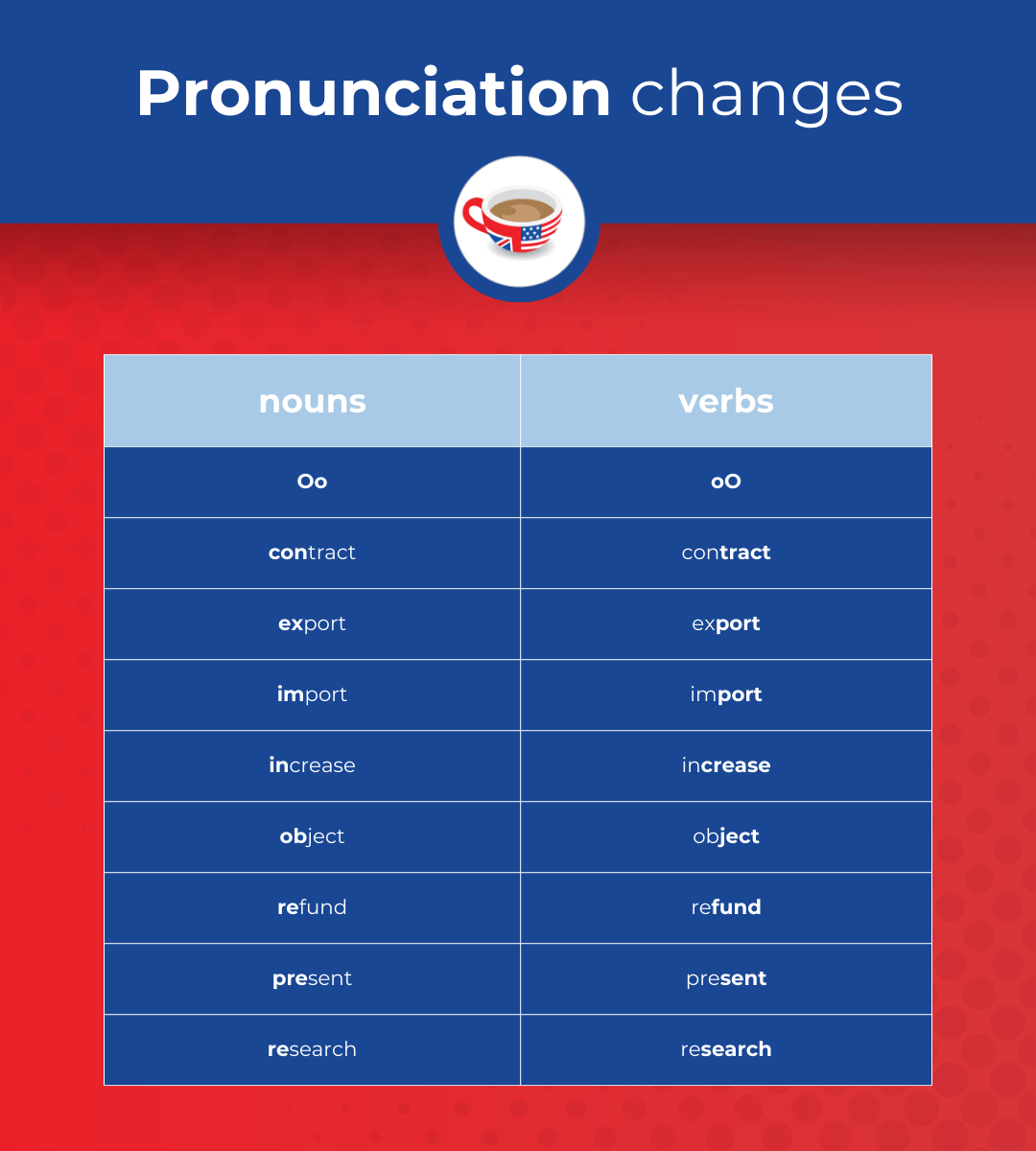
A table that shows word stress changes for a selection of English words with two syllables

English Word Stress Exceptions

Be careful with the below verbs and nouns which do not follow this rule. It’s also important to note that some words change slightly from verb to noun like with effect and believe.

Stress on First Syllable

Some words are always stressed on the first syllable.

A table that shows English pronunciation rules for words with two syllables where the first syllable is always stressed.

Stress on Second Syllable

Some words are always stressed on the second syllable.

A table that shows English pronunciation rules for words with two syllables where the second syllable is always stressed.

Let’s review! 

Here’s a quick summary of English word stress rules with two syllable words:

  • 90% of two syllable nouns are stressed on the first syllable.
  • Around 70% of two syllable verbs are stressed on the second syllable.
  • Some words are the same as verbs and nouns but follow the two rules above with syllable stress.
  • Some words are the same as verbs and nouns but do not follow the rule above.

If you want more practice with your pronunciation, check out Episode 8 of Season 2 of Coffee Break English, where we look at pronunciation of –ed endings.

It’s your turn!

Practise English word stress by deciding whether each word is a noun/adjective or a verb based on the sentence context and decide if the first or the second syllable should be stressed. Make sure you think about it before looking at the answer at the bottom of this blog post!

  1. She equaled the world record in the race.
  2. He is going to present an award at the Oscars tonight.
  3. We have just finished an important research project.

It’s a good idea to make a list of the words that have stress on the first or second syllable and practise using them in sentences to build your confidence with syllable stress. A little practice each day can really help build your confidence!

If you found this post interesting, make sure you watch the full video with Nick and Anabel on the Coffee Break English Youtube channel. In this series we look at lots of useful topics for English learners, so make sure to subscribe to our podcast feed and our channel on YouTube.

Plus, don’t miss your free worksheet – perfect for extra practice after the lesson! When you sign up, you’ll also receive our short coffee break-sized email lessons, delivered straight to your inbox every week, to help you build your English skills. 💪 You’ll even hear from Mark, the founder of Coffee Break Languages, who shares regular tips and motivation for learners of all levels. Sign up below! 👇

So, start paying attention to English word stress when you are speaking! The more you practice, the more confident you will become.

Happy Coffee Breaking!

P.s. Here are the answers to activity above:

  1. She equaled the world REcord in the race.
  2. He is going to preSENT an aWARD at the Oscars tonight.
  3. We have just finished an important REsearch PROject.

Listen to the podcast

What are the Romance languages? Learn more about them

A magnifying glass resting on a white keyboard beside a tablet.

Have you ever wondered how certain languages are related or where they originated? The Romance languages offer a fascinating example of how language evolves over time and across regions. But what are the Romance languages and why are they so significant?

In this blog post, we’ll explore the basics of these wonderful languages, their fascinating history, and what makes them so captivating! Whether you’re considering picking up a new language or simply have a curious mind, this guide will help you discover what the Romance languages are all about.

What are the Romance languages?

First, let’s have a look at what Romance languages are. You might be surprised to learn that, despite their name, they don’t actually relate to romance or love. Instead, the term ‘Romance’ connects to their roots in the Roman Empire.

They developed from Vulgar Latin, the version of Latin commonly spoken back then. Unlike Classical Latin, which was used in writing and in official documents, and what you might study in Latin classes today, Vulgar Latin was the everyday language that people would use to connect with each other. 

The evolution of the dialects that emerged in the regions conquered by the Roman Empire gave rise to the variants of the Romance languages we have today. The most widely spoken  ones are:

  • Spanish – Spoken by over 500 million people worldwide, it is the language with the second-largest number of native speakers in the world;
  • French –  A key language used in diplomacy and therefore commonly taught in schools in certain areas of the world, French is spoken on five continents;
  • Italian – Often associated with art, music, and cuisine, Italian is the language of Dante and opera;
  • Portuguese – Spoken in Portugal, Brazil, and several countries in Africa and Asia, it is one of the fastest-growing languages;
  • Romanian – Though geographically isolated, with Romania sharing no borders with another Romance-language country, Romanian retains many features of Classical Latin.

Other Romance languages include Catalan, Occitan, Galician, and Sardinian.

What makes Romance languages unique?

Now that you’re familiar with the Romance family of languages, you might be wondering what its characteristics are and how it differs from other language families. Thanks to their shared background, the Romance languages share many features, including similar words, grammar, and sounds. 

For example, many Romance languages use the concept of grammatical gender for nouns and have unique ways of changing verbs based on who is doing the action. 

1. Grammar and syntax

The sentence structure of many Romance languages follows a subject-verb-object (SVO) order, although there are exceptions to this. A lot of Romance languages also have verb conjugation systems that are more complex than languages from other families, gendered nouns, and the use of definite and indefinite articles.

2. Vocabulary

Many words in Romance languages are directly derived from Latin. For example:

  • father is padre in Spanish, père in French, pai in Portuguese and padre in Italian;
  • water is agua in Spanish, eau in French, água in Portuguese and acqua in Italian.

3. Phonetics and pronunciation

The Romance languages are known for their fluid, melodic sounds. Although they share many phonetic similarities, every language has its own unique characteristics that make it special. 

For example, Spanish is known for its clear vowels and rhythmic flow, whereas French adds a touch of nasal sounds and liaisons. Italian, in contrast, has lots of open vowel sounds. Portuguese, just like French, showcases those nasal sounds as well. And let’s not forget Romanian, which has some wonderful influences from the Slavic languages!

Why learn a Romance language?

Considering what the Romance languages are and the similarities they have, learning one of them opens up a world of opportunities. For example, remembering new words in a new language and learning a language from scratch becomes much easier if you are already familiar with one Romance language.  

If you picked up a bit of French back in school, you’ll find that learning Spanish feels much more intuitive since they share quite a bit of vocabulary. Even for English speakers, learning Romance languages can be straightforward in some ways, as English has borrowed so much from Latin and French.

Additionally, the cultural aspect is a fantastic reason to learn a Romance language. They open the door to vibrant cultures from all over the world, filled with fascinating history, literature, and delicious cuisine. Plus, if you are able to explore the world and travel, your adventures will be so much richer — imagine sipping an espresso in Rome, wandering through beautiful vineyards in Bordeaux, or dancing samba in the lively streets of Rio de Janeiro, while being able to truly connect with the culture and people around you.

Finally, in our global world, having an understanding of a Romance language can open up exciting career opportunities, particularly in fields like international business, marketing, and education.

And there you have it! Now you have a clearer understanding of what the Romance languages are and how you could benefit from them. From Spanish and French to Italian and beyond, this group of languages opens up opportunities for you, whether you’re learning for travel, career, or personal enrichment.

Now, you may be wondering how long it takes to learn a new language – Romance or otherwise. If you’re curious, we invite you to explore our blog post filled with helpful tips!

How to use ‘so’, ‘too’, ‘either’ or ‘neither’ in English

A smiling man in a blue shirt pointing to bold text that reads 'Key Phrases for Natural English'. The background is dark with a gradient and polka dot pattern.

Do you know how to use so, too, either or neither when speaking in English?

This can be a tricky grammar issue as we need to be careful about the auxiliary and the object pronoun but if we study them we can find simple ways to use them as well as more complete, complex ways. 

The Coffee Break English Show is a podcast series of informal conversations to help you understand some difficult topics in English. In the latest episode, Nick and Mark look at how to use so, too, either or neither to show similarity in conversations.

So let’s have a look at when we use these forms and how we can add them to our English conversations. And why not make yourself a cup of coffee or tea to enjoy while you read and listen to the podcast episode?

Similarity 

We use so, neither and too to demonstrate a similarity with what has just been said. These words are great for expressing to someone that you have had a similar experience to them. So and too express positive similarities and neither and not.. either express a negative similarity.

So

We use so to express positive similarity in conversations. It is normally in response to what someone else has said and we use the auxiliary verb from the sentence we are responding to in our answer. Let’s have a look:

When we use the verb be, the auxiliary in the second sentence will also be the verb be.

A: I am from the UK.                B: So am I!

In present simple sentences with a main verb that is not be, the auxiliary will normally be do.

A: I like pizza.                B: So do I!

In past simple sentences, the auxiliary is did (or was or were with the verb be).

A: I went to the cinema yesterday.                B: So did I!

In present perfect sentences, it is have.

A: I have had two cups of coffee this morning.                B: So have I!

In sentences with modal verbs, the modal verb is the auxiliary.

A: I can speak English.                B: So can I!

Too

We can use too in the same way as we do so to show similarity, but the structure changes. With too we have a simple option, a short option and a long option.

The simple option uses the object pronoun plus too. We don’t need to worry about a verb form. 

A: I can speak five languages.              B: Me too!

We can also use too with the auxiliary verb.

A: I am hungry.              B: I am too!

When we want to respond with a full sentence, we just need to add too at the end of the sentence.

A: I lived in Germany for two years.              B: I lived in Germany for two years too!

Either or Neither

We use ‘neither’ and ‘not.. either’ to talk about negative similarities. The way we use them is a bit different though so pay attention!

Neither – meaning

In simple answers, we use neither in the same way as we use too. The structure is the object pronoun plus neither.

A: I didn’t go to Spain on holiday.              B: Me neither!

We can also use neither in the same way as we use so. The structure is neither + auxiliary verb + subject.

A: I have never been to Argentina.               B: Neither have I!

Either – meaning

In short answers with the auxiliary verb, there is an important change. We use the negative form (not), and we do not put the ’n’ at the front of either.

A: I didn’t go to Spain on holiday.               B: I didn’t either!

In the full sentence form, the rule is the same as too, we just need to add either at the end.

A: I didn’t go to Spain on holiday.               B: I didn’t go to Spain on holiday either!

Pronunciation 🔊

One important aspect of the words either or neither that can confuse learners is that there are two ways to pronounce them. 

We can say them with an /ai/ sound like in why, and we can also say them with a long /i:/ or ‘e sound like in see.

There is absolutely no difference in meaning. 

Generally, /i:/ is more common in the US and /ai/ is more common in the UK but native speakers frequently use both forms so don’t worry, just pick one! 

If you want more practice with the long ‘e’ sound, check out Episode 4 of Season 1 of the Coffee Break Show!

Here’s a visual of today’s lesson

Here are the diffferent options for simple answers, short answers and full answers.

If you find choosing between negative and positive determiners difficult, you might find Episode 9 from Coffee Break English Season 3 really useful.  We take a look at the indefinite pronouns something, anything and nothing and explain when to use them.

A table of the different forms of too, so either or neither in simple answers.

A table of the different forms of too, so either or neither in short answers.

A table of the different forms of too, so either or neither in full answers.


If you found this lesson helpful, make sure to listen to the full podcast episode with Nick and Mark on The Coffee Break English Show, where we dive deeper into so, too, either and neither with more examples and practice. ☕🎧

We release new episodes regularly, covering useful grammar and vocabulary topics to help you sound more natural in English. Subscribe to our podcast feed and our YouTube channel so you never miss an episode.

Plus, don’t miss your free worksheet – perfect for extra practice after the lesson! When you sign up, you’ll also receive our short coffee break-sized email lessons, delivered straight to your inbox every week, to help you build your English skills. 💪 You’ll even hear from Mark, the founder of Coffee Break Languages, who shares regular tips and motivation for learners of all levels. Sign up below! 👇

Now, it’s your turn! Download the worksheet below for further practice and try using so, too, either or neither in your conversations whenever you can. The more you practise, the more natural it will feel.

Happy Coffee Breaking!

Listen to the podcast

Time Phrases: How to Use Present Perfect Adverbs in English

A man in a blue shirt with a thoughtful expression, touching his chin, beside bold text that reads 'JUST', 'ALREADY', 'YET' and 'WHICH SHOULD YOU USE?'.

Have you ever wondered when to use just, yet, or already? These three time phrases are commonly used with the present perfect tense, but they each have specific meanings and uses.

Using time phrases and adverbs with the present perfect helps to communicate more effectively and will make your sentences even clearer when having a conversation with people.

The Coffee Break English Show is a podcast series of informal conversations to help you understand some difficult topics in English. In the latest episode, Nick and Francesca explore how to use the present perfect adverbs just, yet and already, correctly.

If you haven’t listened to the podcast episode yet, why not listen to Nick and Francesca as you read?

So let’s get started and look at just, yet and already!

Time Phrases: The Present Perfect with Just, Yet, and Already

These three present perfect adverbs help us describe when an action happened in relation to now. We often use them with the present perfect tense and they have specific positions in a sentence.

Just

Just is used to indicate that something happened a very short time ago.

It comes between have/has and the past participle:

⏳    I have just finished my homework.  ⏳

⏳    She has just arrived at the station.  ⏳

 👀    In the USA, you are often likely to hear just used with the past simple, not the present perfect! The meaning is exactly the same, though.   

🇺🇸     Where’s David? He just went out.    🇺🇸

Yet

Yet is used to talk about something that has not happened but we expect to happen. We often use them in negative statements and questions.

Yet goes at the end of a sentence:

🔜    I haven’t finished my book yet.  🔜

🔜   Have you eaten yet?  🔜

Already

Already is used to show that something happened sooner than expected or before now.

It normally comes between have/has and the past participle but it can sometimes come at the end when we are speaking to create a strong emphasis:

⬅️    I have already seen this movie.  ⬅️

⬅️    Wow! She has completed her assignment already!    ⬅️

Let’s review

Here’s a summary of the time phrases in this episode:

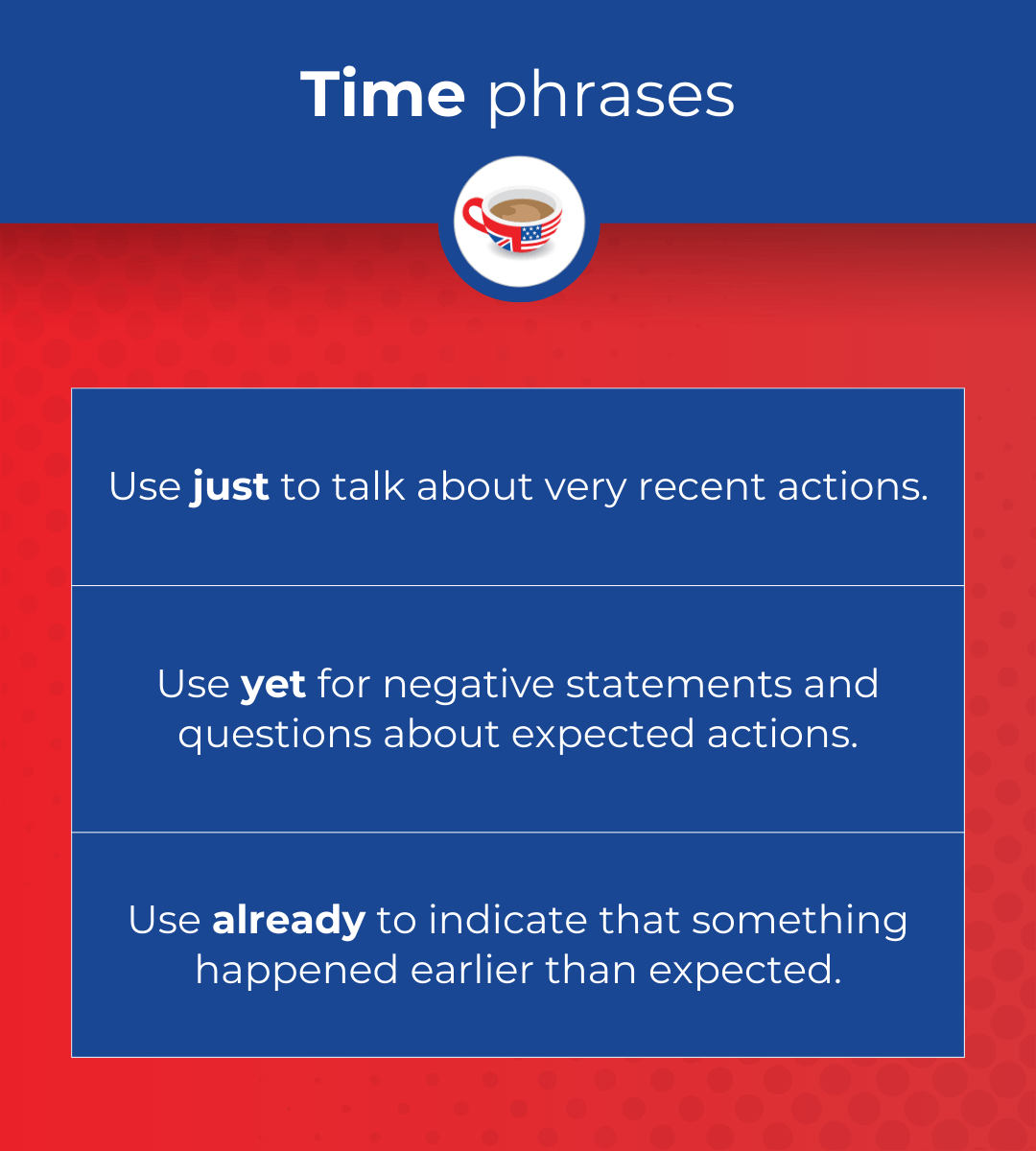
Present Perfect Adverbs: We use just to talk about very recent actions. Yet is used for negative statements and questions about expected actions. Use already to indicate that something happened earlier than expected.

If you found this useful, then you might find Episode 4 of our 2nd season of Coffee Break English helpful! We look at the time phrases for and since with the present perfect.

It’s your turn!

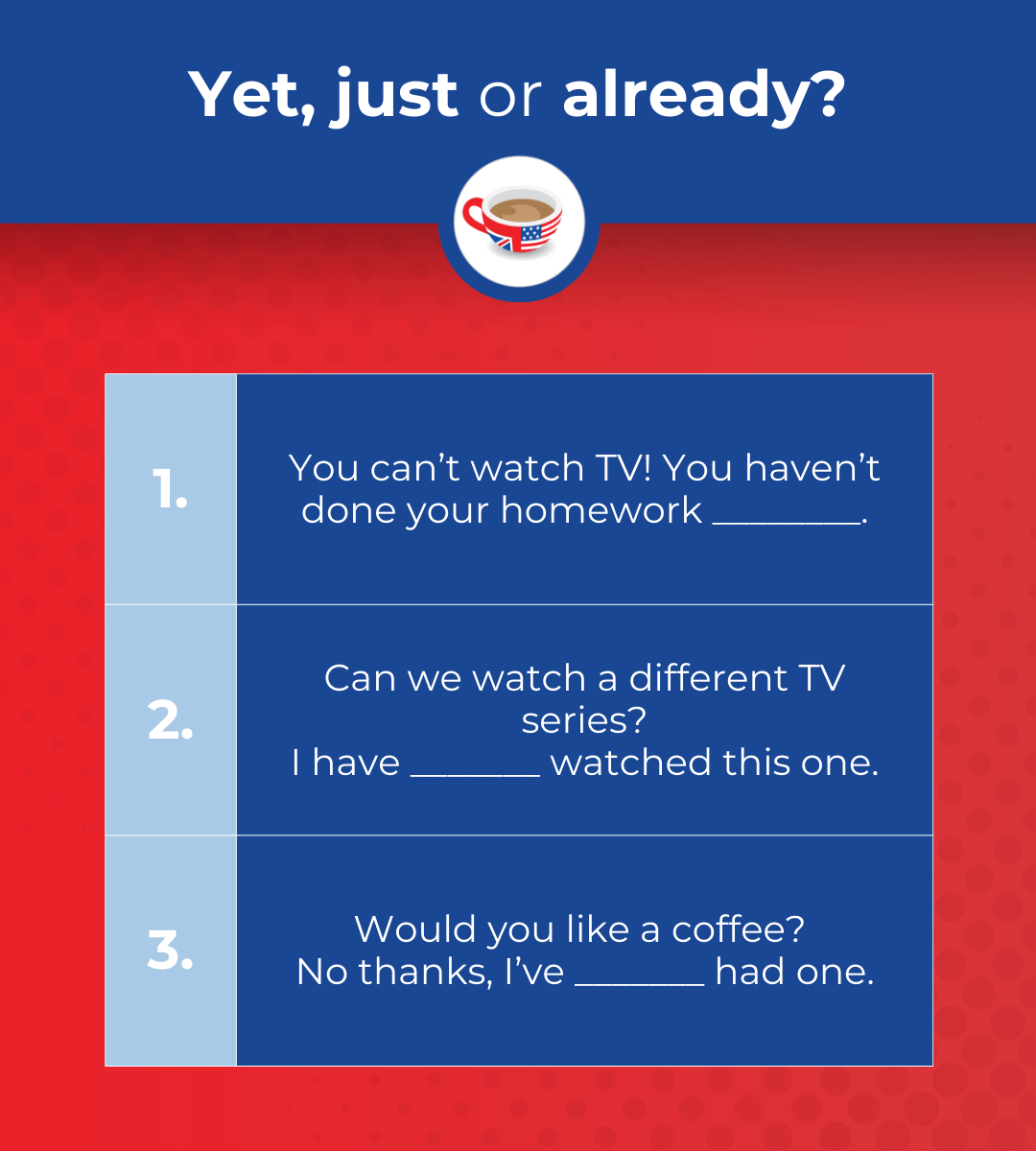
Now let’s practise! Which is the right word? Put yet, just or already in the spaces below. The answers are at the end of the blog post but don’t look until you’ve thought about your answers.

A quiz to practise the Present Perfect Adverbs yet, just and already.

If you found this post interesting, then make sure you listen to the full podcast episode with Nick and Francesca on The Coffee Break English Show. This series looks at useful topics to help English learners improve their language skills, so make sure to subscribe to our podcast feed and our channel on YouTube.

Plus, don’t miss your free worksheet – perfect for extra practice after the lesson! When you sign up, you’ll also receive our short coffee break-sized email lessons, delivered straight to your inbox every week, to help you build your English skills. 💪 You’ll even hear from Mark, the founder of Coffee Break Languages, who shares regular tips and motivation for learners of all levels. Have you signed up yet? If not, sign up below! 👇

So, start using these time phrases in your conversations! The more you practice, the more confident you will become.

Happy Coffee Breaking!

Here are the answers to the questions in the practice section above:

  1. You can’t watch TV! You haven’t done your homework yet.
  2. Can we watch a different film? I have already watched this one.
  3. Would you like a coffee? No thanks, I’ve just had one.

Listen to the podcast

How long does it take to learn a new language?

Small table clock on top of a table.

A common question that comes up when considering the adventure of learning a new language is: “How long does it take to learn a new language?”. We believe that the answer isn’t simple, as it is tied to many factors, such as the complexity of the language, your learning environment, and your unique personal circumstances. 

Let’s have a look at these factors together to create a clearer picture of what to expect on your exciting language-learning journey. Keep reading – there’s so much to discover!

1. Language complexity and similarity

So, how long does it take to learn a new language? Well, one of the biggest factors that influence this is how similar it is to your native language. For example, if you are a native English speaker, learning a language like Spanish or German might be quicker because these languages share many similarities with English in terms of vocabulary and grammatical structure.

Moreover, learning Italian, French, or Portuguese can be much quicker if you already speak Spanish. In contrast, languages that are structurally different from English, such as Mandarin Chinese, may take more time to master. 

2. Time commitment and consistency

Another factor that determines how long it takes to learn a new language is time commitment. Remember that the time you invest each week really influences how fast you’ll make progress. Regular practice is essential to your journey! 

Research suggests that learners who study regularly, even if it’s just 20 minutes a day, tend to make faster progress than those who study sporadically. That is why microlearning and approaches like the one we have here at Coffee Break Languages – which emphasises short, regular study sessions that fit easily into your daily routine – are ideal for people with busy schedules. 

The Coffee Break method allows you to make steady progress without feeling overwhelmed by breaking down the language-learning process into manageable chunks. You can dedicate just fifteen minutes each day to listen to a podcast episode and practise vocabulary, all while enjoying your coffee break.

If you’re looking for some great tips on sticking to a language-learning routine, we recommend checking out the video created by Mark, the founder of Coffee Break Languages. 

3. Learning environment

The environment you learn in can also greatly influence your language journey. Typically, immersive settings, where you are surrounded by native speakers and you have the chance to use the language in everyday situations, can really speed up your learning process.

That is why, if you have the opportunity and are fortunate enough to visit a country where you can practise the language you are learning, you should take advantage! Also, if your learning environment or platform offers classes with native speakers, that can also help you learn faster, as you will be able to understand accents and pronunciation in a much easier way.

At the same time, learning and practising with a non-native speaker of the language you’re learning also has an important role to play. If your teacher or speaking-practice partner has learned the language in the same way you have (rather than having grown up speaking it) they’ll understand the language and its complexities from your point of view.   

Pen on top of notebook.

How to accelerate your language learning

Now that you understand that the answer to the question ‘How long does it take to learn a new language?’ can vary, it’s great to know there are some strategies you can use to speed up your learning journey! For starters, think about setting your own language-learning goals. Whether it’s reaching conversational fluency, enjoying movies in a new language or ordering a coffee in a different country, each step will bring you closer to your objectives! 

After all, clear goals can help you stay motivated and focused. Plus, as we talked about earlier, language-learning apps and podcasts are great tools to boost your skills. And remember, making mistakes is nothing to worry about; it’s actually one of the best ways to learn a language since it’s just a natural part of the journey.

Well, we hope you now understand a little more about how long it takes to learn a new language and what you can do to accelerate the process. In conclusion, by setting clear goals, maintaining a consistent study routine, and engaging in regular practice, you can accelerate your language-learning journey and enjoy the cultural and personal growth that comes with it.

If you want to learn more about how the Coffee Break method can help you achieve your language-learning goals, check out more about the Coffee Break Academy!