
Using the present perfect tense can be difficult for many English learners. This is because it is used in a variety of ways that do not necessarily translate to similar grammar forms in other languages.
The key is to consider the different contexts where you can use the present perfect, and then look at what message we want to express when using the present perfect or other forms. If you can understand this, then you will be a big step closer to managing conversations fluently in English!
The Coffee Break English Show is a podcast series of informal conversations to help you understand some difficult topics in English. In the latest episode, Nick and Francesca look at how to use the present perfect tense for experiences that you have had in the past, plus we explain the difference between been and gone.
Have you made yourself a coffee? Then let’s get started!
The Present Perfect Tense for Experiences
The present perfect tense is used to signify a variety of situations, but today we will look specifically at experiences. When we speak to friends or meet people for the first time, we often talk about our experiences. A common question is ‘Have you ever…?’ And a common response is ‘No, I’ve never’ or ‘Yes, I have’.
This gives us our question form for the present perfect, plus the short positive and negative forms. We can also give extra information. See the below conversation:

Been and Gone
In the example above been is used to express the idea of visiting a place. It is important to remember that we are talking about the experience of visiting Paris.
We can consider been as the past participle of go when describing an experience. The idea that we went to a place and then returned. This is also the case when we use a phrase like go skiing in the present perfect (I have been skiing in the Alps).
We use gone with the present perfect to express the idea of movement, or leaving a place. The idea that we went to a place and we haven’t returned. We can see the difference in the dialogue below:
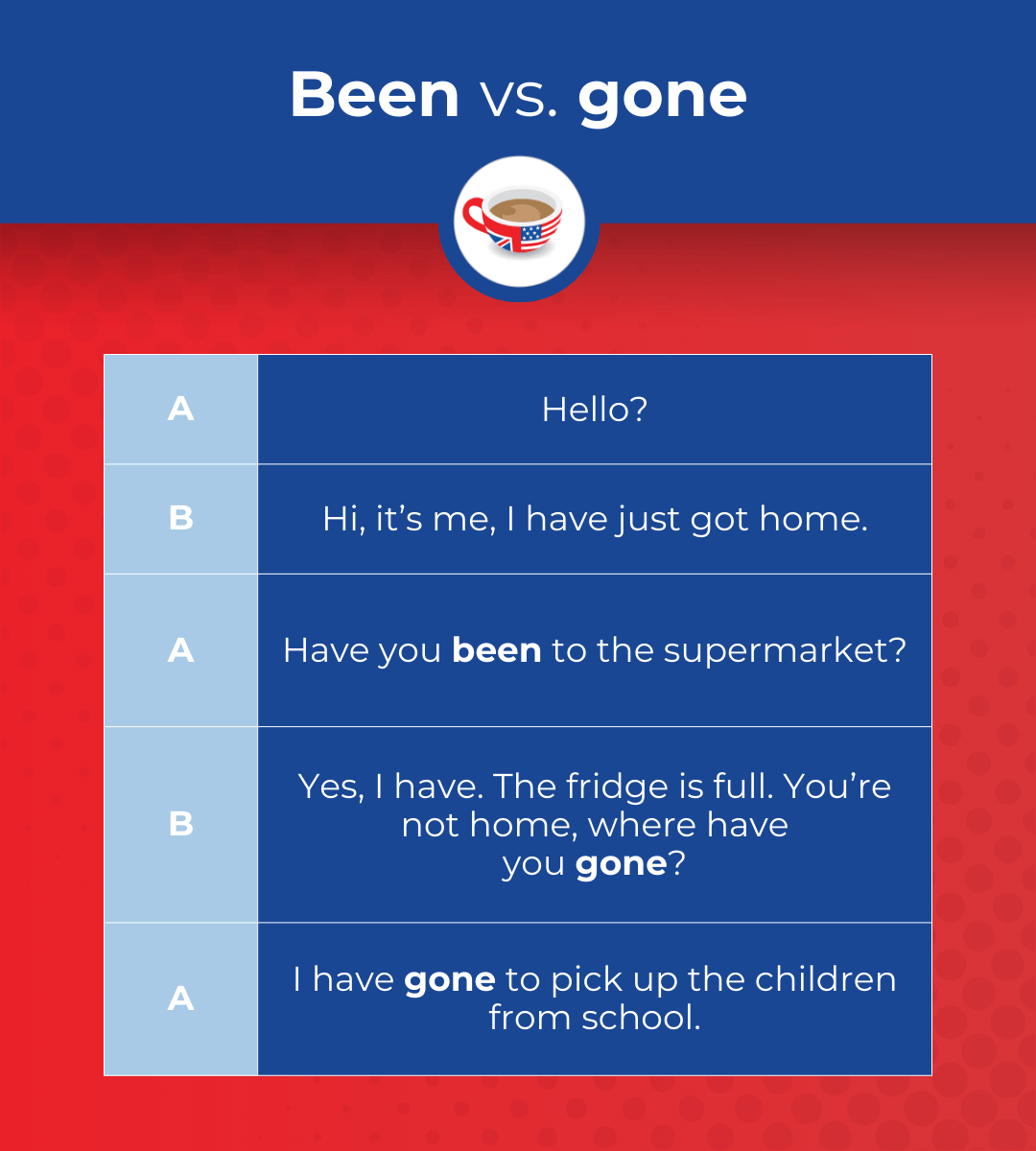
We can see that the wife has returned home but the husband has not. The wife has been to the supermarket but the husband has gone to pick up the children.
So we can use been when we use present perfect for experiences and gone when we use present perfect for recent actions.
For more on been and gone with the present perfect tense, see our 8th episode of Season 1.
Present Perfect Vs Past Simple
We use the present perfect tense for talking about experiences with no specific detail and we use the past simple to give further information about the experience. Here’s an example:

We can see that the experience is introduced with the question have you ever? and then the follow up question is in the past simple. When we ask for detail we use the past simple, usually using open questions with question words such as who, what, why, when, etc..
From this point on, we normally use the past simple because we are talking about a finished activity and no longer a general experience.
For more practice with choosing the past simple or the present perfect tense, check out Episode 2 of Season 3 of Coffee Break English.
It’s your turn!
Now, let’s practise! Try to decide which of the sentences below is a lie. Read to the bottom to find out which sentence is not true… Don’t check until you have guessed!
Coffee Break Languages founder, Mark Pentleton, has learnt 9 foreign languages.
Coffee Break Languages has been nominated for a Lovie Award for Best Science/Education Podcast.
Coffee Break Languages has created a podcast series for pets.
Practice makes a perfect tense!
Remember that the present perfect tense is difficult because we use it in a variety of ways and it doesn’t always have an equivalent form in other languages so be patient with yourself and always try to learn in context. Try using the present perfect tense for experiences in your conversations!
If you found this post interesting, make sure you listen to the full podcast episode with Nick and Francesca on The Coffee Break English Show. We will release more episodes soon, about some other useful topics! Subscribe to our podcast feed and our channel on YouTube to learn when the next episode is available.
Plus, don’t miss your free worksheet – perfect for extra practice after the lesson! When you sign up, you’ll also receive our short coffee break-sized email lessons, delivered straight to your inbox every week, to help you build your English skills. 💪 You’ll even hear from Mark, the founder of Coffee Break Languages, who shares regular tips and motivation for learners of all levels. Sign up below! 👇
So keep practising, deepening your knowledge and understanding, and remaining curious about the language you are learning and you will surely make progress. 🚀
Happy Coffee Breaking!
Here are the answers to the quiz:
Coffee Break Languages founder, Mark Pentleton, has learnt 10 foreign languages. True!
It is true, Mark has learnt 9 foreign languages and you can hear him speaking them here! 🌎
Coffee Break Languages has been nominated for a Lovie Award for Best Science/Education Podcast. True!
Coffee Break Languages has created a podcast series for pets. False!
This one is not true but we did pretend to do this in an April Fools’ Joke! 🤭