Question tags: when to say ‘is it?’ at the end of a sentence

Do you know when to use is it? at the end of a phrase in English?

Is it? is a question tag. Question tags can be a little difficult to use in English, but once you understand the rules, they are very useful.

The Coffee Break English Show is a podcast series of bite-sized, friendly conversations to help you understand some difficult topics in English. In the latest episode, Josie and Mark talk about the rules for how to use question tags, and give some examples to practise.

Continue reading to find out more and why not listen to the podcast as you go?

So, now we can start looking at question tags, can’t we?

How to use question tags

Question tags are like “mini-questions”, which we add onto the end of phrases or sentences to check that the information we are giving is correct.

For example, if I think it is not raining outside, but I want to check that I am right, I can say:

It’s not raining, is it?

Is it? is a question tag. All question tags are made of a verb and the subject from the main sentence.

When the first verb in the sentence is in the negative form, the question tag is in the affirmative form, like in the example above. However, when the first verb is in the affirmative form, the question tag is in the negative form, like this:

It’s raining outside, isn’t it?

Now, let’s talk about how to make question tags. The rules depend on the first verb in the main sentence.

Question tags with the verb ‘be’

When the first verb in the main sentence is be, this is the verb that we use in the question tag. Here are some examples:

She is a doctor, isn’t she?

We are not late, are we?

You’re going running this evening, aren’t you?

I’m not wrong, am I?

Question tags with modal verbs and auxiliary verbs

When the first verb in the main sentence is a modal verb or an auxiliary verb, we use this verb in the question tag.

Remember, modal verbs are verbs that we put before the main verb, to add a “flavour” of meaning, like possibility, obligation, or probability. Some examples are must, should, can, would and will.

Auxiliary verbs are verbs that we use to build verb tenses, like have.

Let’s look at some examples:

You can speak Spanish, can’t you?

You can’t tap dance, can you?

We should shut the door, shouldn’t we?

I shouldn’t go to bed late, should I?

You have been to Paris, haven’t you?

We haven’t seen that movie, have we?

Question tags with present simple verbs

When the first verb in the main sentence is in the present simple, we use do, does, don’t or doesn’t in the question tag. Here are some examples:

You like pizza, don’t you?

He doesn’t play the piano, does he?

Question tags with past simple verbs

When the first verb in the main sentence is in the past simple, we use did or didn’t in the question tag. Here are some examples:

You read that book, didn’t you?

You didn’t go to Spain, did you?

It’s your turn, isn’t it?

Now, let’s practise! Here are five sentences. Complete each of them with a question tag. The answers are at the end of this blog post, but don’t look until you’ve thought about the answers!

  1. Mark is from Scotland, … ?
  2. You don’t like fish, … ?
  3. You can speak ten languages, … ?
  4. Josie has never been skiing, … ?
  5. They went to Manchester at the weekend, … ?

We’ve not finished already, have we?

Question tags can be difficult to think of fast when you are speaking, so why not review the rules and write your own example sentences using question tags?

If you found this post interesting, make sure you listen to the full podcast episode with Mark and Josie on The Coffee Break English Show. We will release more episodes soon, about some more useful topics! Subscribe to our podcast feed and our channel on YouTube to learn when the next episode is available.

Plus! To get regular free English lessons in your inbox, you can sign up for our email lessons. We regularly send short (coffee-break-sized) email lessons that will help you improve your English. You will also hear from Mark, the founder of Coffee Break Languages, giving advice for language learners at any level. Sign up below!

So, keep practising question tags! Remember that all English learners make mistakes, but people can usually still understand you. It’s all part of the language-learning journey.

Happy Coffee Breaking!

PS. Here are the answers to the test.

1. Mark is from Scotland, isn’t he?
2. You don’t like fish, do you?
3. You can speak ten languages, can’t you?
4. Josie has never been skiing, has she?
5. They went to Manchester at the weekend, didn’t they?

Listen to the podcast

How to know which syllable to stress in Spanish

When it comes to Spanish pronunciation, some aspects of it are relatively easy to get your head around. However, at times, things can get a little tricky when it comes to knowing which syllable to stress when pronouncing a word in Spanish.

Like in English, the stress of words is not always on the same syllable. On top of this, what happens with the accents when written? Have you ever wondered why some words have an accent on the stressed vowel and why other words don’t?

The Coffee Break Spanish Show is a podcast series of short, informal conversations to help you understand some difficult topics in Spanish. In the latest episode, Mark and Concha look at where the stress can be in a Spanish word and learn when to use accent marks on vowels.

Continue reading to find out more and why not listen to the podcast as you go?

To make this easier, we can divide all Spanish words into four categories, depending on which syllable of a word is stressed.

1 – aguda

When a word has the stress on the final syllable, it is called aguda. Agudas have an accent on the vowel of the final syllable when the word ends in -n, -s or a vowel. Here are some examples of agudas:

mujer
woman
The stress is muJER, but there’s no accent because it ends in -r.

ajedrez
chess
The stress is ajeDREZ, but there’s no accent because the word ends in -z.

televisión
television
The stress is televiSIÓN, and there’s an accent because it ends in -n.

interés
interest
The stress is inteRÉS, and there’s an accent because it ends in -s.

café
coffee
The stress is caFÉ, and there’s an accent because it ends in a vowel.

2 – llana

When a word has the stress on the second-last syllable, it is called llana. Llanas have an accent on the penultimate syllable when the word doesn’t end in -n, -s or a vowel. Here are some examples:

volumen
volume
The stress is voLUmen, and there’s no accent because the word ends in -n.

estatuas
statues
The stress is esTAtuas, and there’s no accent because the word ends in -s.

caja
box
The stress is CAja, and there’s no accent because the word ends in a vowel.

dólar
dollar
The stress is DÓlar, and there’s an accent because the word ends in -r.

móvil
mobile
The stress is MÓvil, and there’s an accent because the word ends in -l.

3 – esdrújula

When a word is stressed in the third-to-last syllable, it is called esdrújula. Esdrújulas always have an accent showing the stressed syllable. Here are some examples:

música
music
The stress is MÚsica.

América
America
The stress is aMÉrica.

miércoles
Wednesday
The stress is MIÉRcoles.

¡Cuidado! Sometimes, forming the plural of a word can add another syllable, making the word require an accent when before it didn’t need one.

Here’s an example:

examen
exam
The stress is eXAmen, so it’s llana and it doesn’t have an accent because it ends in -n.

exámenes
exams
The stress is eXÁmenes, so it’s esdrújula and so it does have an accent.

Something similar happens with an infinitive form of the verb when we use more than one pronoun:

dártelo (dar + te + lo)
to give it to you

4 – sobresdrújula

Occasionally, we are going to find words that are stressed on the fourth-to-last syllable. This type of stress is called sobresdrújula. These types of words always have an accent mark and they are often found in verbs with pronouns. For example:

devuélvemelo (devolver in the imperative form + me + lo)
give it back to me

comprándotelo (comprar in the gerund form + te + lo)
buying it for you

The other situation where we find this stress pattern is in adverbs ending in -mente. When forming adverbs in -mente, the adjective retains the same accented syllable as before and so we don’t ever need to add or take away an accent when written. So, that’s why we have:

fácilmente (fácil + mente)
easily

difícilmente (difícil + mente)
with difficulty

lentamente (lento + mente)
slowly

¡Un consejo! With a very long word, we recommend practising by splitting it into chunks of two or three syllables and saying them out loud individually until you can combine them. Por ejemplo:

devuélvemelo > devuelve-melo

comprándotelo > comprando-telo

¡Hora de practicar!

Now it’s time to put your knowledge to the test! Translate the following phrases into Spanish. Think carefully about where to place any accents and which syllable to stress when saying each word out loud. You’ll find the answers at the end of this article.

  1. immediately
  2. write it (la carta) to me
  3. say it (el mensaje) to him

We hope that you found this article useful. Make sure to listen to the full episode with Mark and Concha on The Coffee Break Spanish Show. This is the series in which we look at a range of topics for Spanish learners, so make sure to subscribe to our podcast feed and our channel on YouTube.

Plus! To get regular free Spanish lessons in your inbox, you can sign up for our short (coffee-break-sized) email lessons that will help you improve your Spanish. You will also hear from Mark, the founder of Coffee Break Languages, giving advice for language learners at any level. Sign up below!

Scroll down for the answers to the translation challenge. Next time you read a Spanish text pay special attention to the accents and ask yourself: is it aguda, llana, esdrújula or sobresdrújula?

Happy Coffee Breaking!

PS. Here are the answers to the translation challenge.

  1. inmediatamente (inmediata + mente)
    The adjective inmediato/a is llana ending in a vowel, so there’s no accent.
  2. escríbemela (escribe + me + la)
  3. dímelo (di + me + lo)

Listen to the podcast

An introduction to German cases

When we start to learn German, one of the most important steps is to get our heads around cases of nouns and pronouns.

For that reason, it’s time for a crash course on cases in German!

The Coffee Break German Show is a podcast series of bite-sized, friendly conversations, in which we demystify tricky German language topics. In the latest episode, Mark and Olivera discuss the four German cases and how to identify and use them.

Continue reading to find out more and why not listen to the podcast as you go?

What do cases do?

Each case serves a different grammatical function and indicates the role a noun or pronoun plays in a sentence.

Let’s look at the four German cases, one by one.

Nominative case: ‘Nominativ’

The nominative is used for the subject of a sentence. It represents the “doer” or the one performing the action. For example:

Der Lehrer unterrichtet.
The teacher teaches.

It’s also used for predicate nouns (that means nouns that come directly after verbs, for example sein and werden), indicating a state of being. Here are some examples:

Sie ist Lehrerin.
She is a teacher.

Mario ist ein guter Schüler.
Mario is a good student.

Accusative case: ‘Akkusativ’

The accusative is used for the direct object of a sentence. It represents the noun or pronoun that receives the action of the verb. Let’s look at some examples. The noun or pronoun that is in the accusative in each German sentence is in italics.

Ich mag dich.
I like you.

Ich esse den leckeren Apfel.
I am eating the delicious apple.

It’s also used after certain prepositions indicating motion or direction:

Wir fliegen in den Urlaub.
We are flying away on holiday / vacation.

Wir gehen zu unserer Oma.
We are going to our grandma’s.

Wir fahren an den See.
We are going to the lake.

Dative case: ‘Dativ’

The dative case is used for the indirect object of a sentence. It represents the noun or pronoun that benefits from the action of the verb. Take a look at the following sentences, where the examples of the dative are in italics:

Ich helfe dir.
I am helping you.

Ich schenke meiner Schwester einen Apfel.
I give an apple to my sister. (Note that the direct object, “apple”, is in the accusative.)

It’s also used after certain prepositions indicating location, time or direction:

Das Essen ist im Kühlschrank.
The food is in the fridge.

Das Buch liegt auf dem Tisch.
The book is lying on the table.

Wir sind im Theater.
We are in the theatre.

Die Kinder sind bei den Nachbarn.
The children are at the neighbours’ house.

Note that in the dative case we add an -n or -en to the end of plural nouns, as can be seen in Nachbarn.

Genitive case: ‘Genitiv’

The genitive case is used to indicate possession, origin or relationships between nouns. This will become clear with some more examples. Again, we’ve put the nouns that are in the genitive in the German sentences in italics:

das Foto des Mädchens
the girl’s photo

Das ist das Hemd meines Vaters.
That is my father’s shirt.

der schönste Ort der Welt
the most beautiful place in the world

Note that when using the genitive case an -es or -s is added to the end of masculine and neuter nouns, as seen in the examples above: des Mädchens, meines Vaters.

In conclusion

There is a lot more to discover about cases, but we hope that this article and episode have given you a brief overview to help you get started.

If you found this post interesting, make sure to listen to the full episode with Mark and Olivera on The Coffee Break German Show. This is the series in which we look at a range of topics for German learners, and we’ll certainly cover German cases in more detail in future episodes, so make sure to subscribe to our podcast feed or our channel on YouTube.

Plus! To get regular free German lessons in your inbox, you can sign up for our short (coffee-break-sized) email lessons that will help you improve your German. You will also hear from Mark, the founder of Coffee Break Languages, giving advice for language learners at any level. Sign up below!

Happy Coffee Breaking!

Listen to the podcast

‘Avere’ expressions practice

There are many expressions in Italian that are used very often, but which you may have to think twice about before translating directly from English. If you want to say that you’re hungry, for example, it may take a while before it feels natural not to use the verb essere (“to be”).

In this article we are looking at everyday avere expressions. These are expressions that use the verb avere in Italian, but whose English equivalent doesn’t contain the verb “to have”.

The Coffee Break Italian Show is a podcast series of bite-sized, friendly conversations, in which we demystify tricky Italian language topics. In the latest episode, Francesca and Maurizio discuss the verb avere and some of the most common expressions featuring this verb, which don’t translate using “to have” in English. This episode is the second part of a double episode on this topic. So, before we start, if you haven’t already watched our other episode on this topic, or read its accompanying blog article, you can find it here.

When you’re ready, continue reading to find out more and why not listen to the podcast as you go?

Everyday ‘avere’ expressions: a quick recap

To help you review the expressions we discussed in our previous episode and blog article, let’s do a quick recap – cominciamo con un ripassino!

While in English you use the verb “to be” to talk about how old you are, in Italian you have to use the verb avere.

avere _ anni
to be _ years old

For example:

Ho diciotto anni.
I’m eighteen years old.

The same happens with other expressions, such as:

avere caldo
to be warm / hot

avere freddo
to be cold

Remember that you don’t need to worry about gender agreement with these expressions because we are using avere and not essere. For example, both Francesca and Maurizio would say ho freddo or ho caldo to say that they’re feeling cold or warm.

The following expressions also use avere, whereas in English they are translated using the verb “to be”.

avere fame
to be hungry

avere sete
to be thirsty

avere sonno
to be sleepy

For example:

Abbiamo sempre sonno.
We are always sleepy.

Francesca and Maurizio also mention some other expressions, such as:

avere ragione
to be right

avere torto
to be wrong

Here are some examples:

Tu hai ragione.
You’re right.

Francesca non ha mai torto.
Francesca is never wrong.

We also use avere to express being in a hurry.

avere fretta
to be in a hurry

For example:

Ho fretta!
I’m in a hurry!

To say that you are scared of something, in Italian we literally say that you “have fear of” something.

avere paura (di)
to be scared (of)

For example:

Ho paura del buio.
I’m scared of the dark.

Finally, to say that you need or feel like something, in Italian you literally “have need of” or “have desire of” something.

avere bisogno di
to need

avere voglia di
to feel like, to want, to fancy, to crave

For example:

Ho bisogno di aiuto.
I need help.

Ho voglia di un gelato.
I’m craving ice cream.

Ho voglia di leggere un libro.
I feel like reading a book.

Let’s practise!

Now it’s time for una piccola sfida, “a little challenge”. In the second part of the podcast episode, Francesca and Maurizio challenge each other to use as many avere expressions as possible to describe how they feel in each of the scenarios they give each other.

Below are the written versions of the short paragraphs Francesca and Maurizio come up with. Why not have a go yourself and write down your own paragraph for each of the situations presented, fitting in as many avere expressions as you can?

Cominciamo!

Situation 1

It’s a snowy day and you have to go to work.

Take a few minutes to write down your own answer, then take a look at what Francesca comes up with below.

Francesca’s answer:

Ho freddo. Ho voglia di un caffè / tè bollente. Ho bisogno di una giacca pesante. Ho sonno.

I’m cold. I fancy a hot coffee / tea. I need a heavy jacket. I’m sleepy.

Situation 2

You’ve just come back from a hard day at work and you haven’t had your dinner yet.

How many avere expressions can you use to describe how you feel in this scenario?

Here’s Maurizio’s answer:

Ho molta fame. Ho famissima! Ho sonno perché ho lavorato. Ho voglia di una pizza. Ho bisogno di rilassarmi.
I’m very hungry. I’m super hungry! I’m sleepy because I’ve worked. I’m craving a pizza. I need to relax.

Situation 3

You’re on holiday on a tropical island and the sun is shining.

Here’s what Francesca comes up with:

Ho caldo. Ho bisogno della crema solare. Ho voglia di uno spritz. E anche probabilmente ho paura di scottarmi.
I’m warm. I need sunscreen. I feel like a spritz. And I’m also probably afraid of getting sunburned.

Situation 4

You’re moving to a new house with a friend of yours.

Have a go at writing your answer to this final challenge before looking at Maurizio’s answer below.

Maurizio’s answer:

Ho sete. Ho voglia di un bicchiere d’acqua. Devo avere pazienza perché il trasloco è stancante. Ho voglia di fare una festa.

I’m thirsty. I want a glass of water. I have to be patient because moving is tiring. I want to have a party.

È tutto per oggi

Ed eccoci alla fine! We hope you enjoyed practising these expressions with avere. We’re sure that they will come in handy in many conversations you’ll have in Italian.

Make sure to listen to the full podcast episode that accompanies this blog article with Francesca and Maurizio on The Coffee Break Italian Show. This is the series in which we look at a range of topics for Italian learners, so subscribe to our podcast feed and our channel on YouTube to find out when the next episode is available.

Plus! To get regular free Italian lessons in your inbox, you can sign up for our short (coffee-break-sized) email lessons that will help you improve your Italian. You will also hear from Mark, the founder of Coffee Break Languages, giving advice for language learners at any level. Sign up below!

Happy Coffee Breaking!

Listen to the podcast

Mastering French pronunciation: a comprehensive guide to the letter ‘e’

French pronunciation can be a challenge, but understanding the rules regarding certain vowels and consonant combinations can make all the difference in your language-learning journey.

In this article, we’ll focus on one very common letter than can have different pronunciations, depending on accents and the letters that follow – the letter e

The Coffee Break French Show is a podcast series of bite-sized, friendly conversations, in which we demystify tricky French language topics. In the latest episode, Mark and Max discuss how to pronounce the letter e with no accent and how to pronounce é and è, as well as looking at other letter combinations that create the same sounds.

Continue reading to find out more and be sure to listen along to the podcast episode – hearing Max’s pronunciation will be essential for you to get the most from this article.

The sound ‘é’

The French letter é, with an acute accent, maintains a consistent pronunciation – the sound you hear in the word café. This sound is always the same when you encounter the letter é. Here are some examples of words containing é:

été
summer

météo
weather

déjeuner
lunch

Note, however, that there are other combinations of letters that produce exactly the same sound as the é.

We find the é sound in infinitive verbs ending in -er. For example:

parler
to speak

manger
to eat

When verbs are conjugated in the vous form, the -ez ending is also pronounced é. For example:

parlez
you speak

donnez
you give

In three-letter words, the combination -es also produces the é sound.

les
the

des
of the, some

mes
my

tes
your

ses
his, her

ces
these, those

The sound ‘è’

The French letter è, with a grave accent, also remains consistent in terms of pronunciation. Make sure to listen to the audio or video version of this episode to tune into how è sounds. Here are some common nouns containing this letter and sound:

frère
brother

père
father

bière
beer

The same sound can be obtained with the two-letter combination ai. For example:

français
French

paix
peace

Another way to obtain the sound è is when the letter e is followed by two consonants. Let’s see some more examples:

merci
thanks

respect
respect

appelle
call

In addition, the letters ei are also pronounced è. For example:

neige
snow

beige
beige

peine
sorrow

Max mentions an important point in the episode: as with many pronunciation points, there are regional differences and you may hear these letters and letter combinations pronounced in different ways, depending on where you are in the French-speaking world. So, listen out for slight differences in these vowel sounds and remember that there isn’t one specific regional variety of French to learn or copy – all accents and pronunciations are correct.

The sound ‘e’

The letter e, with no accent and when not part of the previously mentioned combinations, is pronounced something like an euh – exactly as it is pronounced in the French alphabet. Here are some common words that contain this sound:

petit
small

ce
this, that

le
the

Again, remember to listen to the podcast and practise this sound with Max and Mark.

In conclusion

Voilà pour ce mini-guide de la lettre ‘e’ !

Mastering French pronunciation takes time and practice, but understanding these rules can significantly improve your language skills. Don’t worry if you find these sounds difficult to master – French speakers will love that you are making an effort to pronounce them correctly.

Make sure to listen to the full episode with Mark and Max on The Coffee Break French Show. This is the series in which we look at a range of topics for French learners, so make sure to subscribe to our podcast feed and our channel on YouTube.

If you’d like more help with your pronunciation of French vowel sounds, you can watch a previous episode of The Coffee Break French Show in which Max and Mark discussed the tricky sounds and ou. Click here to find the episode and the accompanying blog article.

Plus! To get regular free French lessons in your inbox, you can sign up for our short (coffee-break-sized) email lessons that will help you improve your French. You will also hear from Mark, the founder of Coffee Break Languages, giving advice for language learners at any level. Sign up below!

Keep practising your e sounds and you’ll become more confident in your ability to speak and be understood in French. Bonne chance !

Happy Coffee Breaking!

Listen to the podcast

What’s the difference between ‘like’ and ‘as’?

Do you know the difference between like and as when you’re speaking English?

Using like and as can be a difficult topic for English learners, because these words can be used in similar ways.

The Coffee Break English Show is a podcast series of bite-sized, friendly conversations to help you understand some difficult topics in English. In the latest episode, Josie and Mark talk about the rules for when to use like and as, and they give examples to help you to remember them.

Plus, don’t miss our free worksheet at the end to practise deciding between like and as in English!

So, let’s get started and look at the rules for like and as. Why not get a cup of coffee or tea to enjoy while you read and listen to the podcast episode?

Making comparisons using ‘like’ and ‘as’

We use like + noun to compare two or more real things, and say that they are similar. Here are some examples:

She’s like my mother.

My shirt is like your shirt.

My perfume smells like flowers.

He looks like a famous actor.

We use like + subject + verb, or as if + subject + verb to compare something real to something imaginary, or not real. Here are some examples:

Mark, you look like you’ve seen a ghost!
Mark, you look as if you’ve seen a ghost!
= Mark looks very scared, but he hasn’t really seen a ghost.

It feels like it’s 50 degrees in this studio.
It feels as if it’s 50 degrees in this studio.
= The temperature in the studio is very hot, but it isn’t 50 degrees.

There’s just one more comparison to talk about now. We use as + adjective/adverb + as to compare two things, and say that they are equal. Here are some examples of this:

I can run as fast as you.

This pizza is as delicious as the pizza I ate in Italy.

He is not as tired as he was yesterday.

Giving examples using ‘like’ and ‘such as’

We use both like and such as to give examples of things. Let’s look at some examples:

Why don’t you try a new hobby, like tennis?
Why don’t you try a new hobby, such as tennis?

I’ll bring some snacks, like popcorn.
I’ll bring some snacks, such as popcorn.

Saying something is part of a group using ‘like’

We use like when we’re talking about a group of people or things, and we want to mention something which is part of that group. Here, like means “including”. Here are a few examples:

Lots of young people, like my cousin, go to university after they finish school.

Like many cities, Paris has a metro system.

Describing a job or function using ‘as’

We use as to describe the job or the function of something. Let’s look at some examples:

He works as an architect.

I didn’t have a knife, so I used my spoon as a knife.

She wears an old t-shirt as pyjamas.

Using ‘as’ to mean ‘because’

As can also mean “because”. Here are some examples:

I didn’t go to the beach as the weather wasn’t very good.

As I had a doctor’s appointment, I arrived late to work.

She has lots of work to catch up on, as she was on holiday last week.

Using ‘as’ to mean ‘while’ or ‘during’

Finally, as can also mean “while” or “during”, so we use it when two actions happen at the same time. Here are the final examples that Josie and Mark mention in this episode:

She called her husband as she left work.

It started raining as I got home.

As we got to the station, the train was leaving.

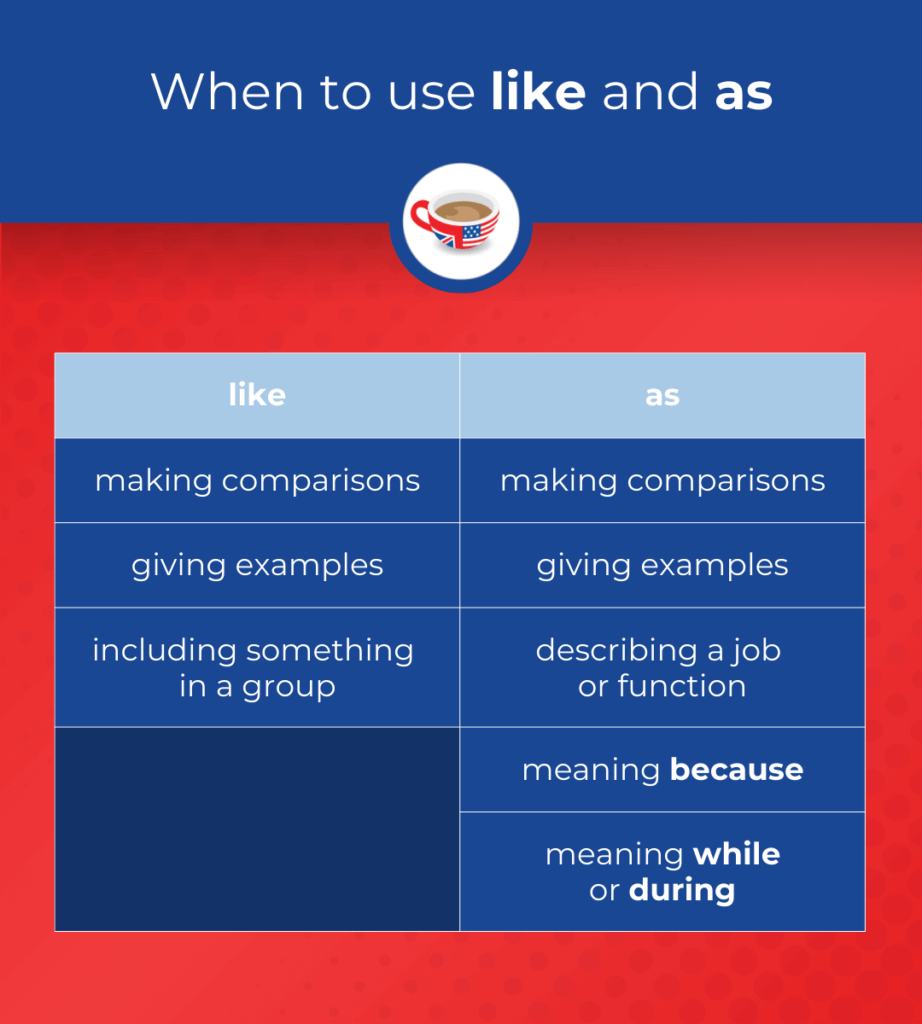
A visual summary of when to use ‘like’ and ‘as’

Coffee Break English Show - When to use like and as

Keep practising using ‘like’ and ‘as’

These little words can be confusing, so why not review the rules and write your own example sentences with like and as?

For a little more practice, download the free worksheet below and see how much you’ve learned about using ‘like’ and ‘as’.

If you found this post interesting, make sure you listen to the full podcast episode with Mark and Josie on The Coffee Break English Show. We will release more episodes soon, about some more useful topics! Subscribe to our podcast feed and our channel on YouTube to learn when the next episode is available.

Plus! To get regular free English lessons in your inbox, you can sign up for our email lessons. We regularly send short (coffee-break-sized) email lessons that will help you improve your English. You will also hear from Mark, the founder of Coffee Break Languages, giving advice for language learners at any level. Sign up below!

So, keep practising like and as! Remember that all English learners make mistakes, but people can usually still understand you. It’s all part of the language-learning journey.

Happy Coffee Breaking!

Listen to the podcast

How flexible are Spanish adverbs?

Spanish is a very flexible language, in the sense that we can often move things around in the sentence and change the word order. However, sometimes a different word order can result in a difference in emphasis or in meaning.

This is especially important to remember with some adverbs.

The Coffee Break Spanish Show is a podcast series of short, informal conversations to help you understand some difficult topics in Spanish. In the latest episode, Mark and Anabel talk about where you can place adverbs in your sentences when you are speaking Spanish and how it affects what you are saying.

Continue reading to find out more and why not listen to the podcast as you go?

What is an adverb?

First of all, let’s refresh our memory. What are adverbs and how do we use them?

Adverbs are words that modify verbs (and occasionally adjectives and other adverbs). Some examples are:

muy
very

simplemente
simply

siempre
always

a veces
sometimes

fácilmente
easily

Adverbs of quantity and manner

Adverbs of quantity and manner usually go after the verb. Let’s look at some examples:

Me gusta mucho.
I like it a lot.
(Mucho is an adverb of quantity.)

Hablas bien español.
You speak Spanish well.
(Bien is an adverb of manner.)

In certain cases, you could use the adverb before the verb, but this results in a strong emphasis. For example:

Me gustan mucho los cacahuetes, pero mucho me gustan.
I like peanuts a lot – I really like them.

Some adverbs that go with a direct object could have three different placements:

Leo un libro despacio.
Leo despacio un libro.
Despacio leo un libro.
I read a book slowly.

¡Ojo! All three versions mean “I read a book slowly”, but the third one places more emphasis on the fact that we are reading the book slowly (rather than quickly). When this adverb placement is used it gives dramatic effect.

It’s also important to keep in mind that if you’re placing an adverb before the verb, it has to come before any auxiliary verb or pronoun used with the verb. An adverb cannot go between an auxiliary verb and a past participle, or between an object pronoun and a conjugated verb, for example. Let’s see the following examples:

Despacio lo leo.
I read it slowly.

Despacio he leído.
I have read slowly.

Despacio lo he leído.
I have read it slowly.

Adverbs of place and frequency

Adverbs of place and frequency – such as a veces (“sometimes”), frecuentemente (“frequently”) and cerca (“nearby”) – also allow you to use the adverb in the same three places. Here are some examples:

Allí vi a Juan.
Vi allí a Juan.
Vi a Juan allí.
I saw Juan there.

Siempre ve la tele.
Ve siempre la tele.
Ve la tele siempre.
He always watches TV.

Adverbs of time

Adverbs or phrases of time – such as hoy (“today”), esta mañana (“this morning”) and el verano pasado (“last summer”) – have a fourth placement option, as they can also go at the beginning of the sentence. For example:

Ayer Rafa ganó el campeonato.
Rafa ayer ganó el campeonato.
Rafa ganó ayer el campeonato.
Rafa ganó el campeonato ayer.
Yesterday, Rafa won the competition.

Let’s practise!

Now, how could we say “I quickly finished my breakfast” in Spanish? Try to write down all the possible options and we’ll tell you the answers at the end of this article.

If you want an extra challenge, also try writing down all the possible options if you translate the sentence using the perfect tense (i.e. he terminado) in Spanish.

¿Lo aprendiste rápidamente?

Listen out for native speakers using adverbs in conversation and on TV and see if you can notice how the meaning subtly changes depending on the placement. The more exposure you have to the language, the more natural things like adverb placement will feel when you are speaking Spanish.

If you found this post interesting, make sure to listen to the full episode with Mark and Anabel on The Coffee Break Spanish Show. This is the series in which we look at a range of topics for Spanish learners, so make sure to subscribe to our podcast feed and our channel on YouTube.

Plus! To get regular free Spanish lessons in your inbox, you can sign up for our short (coffee-break-sized) email lessons that will help you improve your Spanish. You will also hear from Mark, the founder of Coffee Break Languages, giving advice for language learners at any level. Sign up below!

Happy Coffee Breaking!

PS. Here are the answers to the translation challenge.

First of all, using the preterite tense:

  1. Terminé mi desayuno rápidamente.
  2. Terminé rápidamente mi desayuno.
  3. Rápidamente terminé mi desayuno. (Remember that this is the emphatic structure, so can only be used in certain contexts.)

Now, using the present perfect tense:

  1. He terminado mi desayuno rápidamente.
  2. He terminado rápidamente mi desayuno.
  3. Rápidamente he terminado mi desayuno. (Remember that this is the emphatic structure, so can only be used in certain contexts.)

Listen to the podcast

How to use the formal ‘you’ in German

It’s time to get to know “you”! Saying “you” in German is slightly more complicated than in English, but what an important word it is.

It won’t surprise you that the word “you”’ is one of the most commonly used words in English. It’s equally as common in German, but there are seven different ways to say “you”.

The Coffee Break German Show is a podcast series of bite-sized, friendly conversations, in which we demystify tricky German language topics. In the latest episode, Mark and Thomas look at how to say “you” when you are in conversation with a German speaker.

Continue reading to find out more and why not listen to the podcast as you go?

The 7 ways to say “you”

First things first, what are the seven forms of “you” in German?

You might know about du, Sie and ihr. However, another four arise because of the different cases in German. These are: dir, dich, euch and Ihnen.

What is the formal “you” in German?

The formal forms of “you” are Sie (nominative), Sie (accusative) and Ihnen.

Note that this formal form of “you” always has a capital S-, or capital I- for Ihnen. It can be distinguished from the word for “she” and “they”, sie, which always has a lower case s- (apart from at the beginning of a sentence).

Sie – nominative

Sie can be used as the subject of a sentence, in the nominative case. Here are some example sentences:

Möchten Sie etwas trinken?
Would you like to have something to drink?

Sie sprechen sehr gut Deutsch.
You speak German very well.

Sie – accusative

Sie is also used as an object of a sentence, in the accusative case. For example:

Ich kann Sie gut verstehen.
I can understand you well.

Darf ich Sie etwas fragen?
Can I ask you something?

Ihnen – dative

Ihnen is used as an indirect object, in the dative case. Here are some examples:

Wie geht es Ihnen?
How are you?

Kann ich Ihnen helfen?
Can I help you?

When to use the formal “you”

There are general rules you can follow so you know when to use the correct form of “you” with German speakers (du, Sie or ihr).

The formal form of “you” should be used with:

  • people you don’t know very well
  • people in the workplace
  • people in a position of authority, such as the police
  • people who are older than you

Note that there can be some regional differences. Thomas explains in the podcast that in Austria and in southern Germany the du form is more commonly used.

Let’s look at an example context. Imagine you go into an ice cream shop and ask for help. The correct and polite way to address someone in that situation is with the formal form:

Können Sie mir helfen?
Can you help me?

However, if the shop assistant was clearly younger than you, and since it is a relatively informal setting, it would be normal to use du when speaking to the assistant. Indeed, it can be seen as a compliment to someone to address them as du, depending on the setting.

Moving from formal to informal

Once you’ve known someone a little while or the situation has changed to become less formal, you may use the following expression in the transition from Sie to du:

das Du anbieten
to offer the informal “you”

Let’s see this phrase in context in some examples:

Mein Chef hat mir das Du angeboten.
My boss offered that I call him by the informal “you”.

Ich biete dir das Du an. Wir sind gute Freunde.
I am offering that you call me by the informal “you”. We are good friends.

Duzen and siezen

The verb duzen can also be used after das Du anbieten. Duzen means “to use the du form of “you”. For example:

Wir duzen uns.
We are using the informal “you”.

Wir können uns duzen.
We can use the informal “you” with one another.

There is also the verb siezen, which means “to use the Sie form of “you”. Here are some examples:

Sie siezen sich.
They use the formal form of “you”.

Hier in der Arbeit siezen sich alle.
Here at work, everyone uses the formal form of “you”.

A visual summary

We hope that you found this short overview of how and when to use the formal “you” in German useful. If you still have any doubts, the most important thing is not to worry about this – German speakers will still understand you regardless of which form of “you” you use and you will be sure to get more used to this cultural nuance the more you speak the language.

If you found this post interesting, make sure to listen to the full episode with Mark and Thomas on The Coffee Break German Show. This is the series in which we look at a range of topics for German learners, so make sure to subscribe to our podcast feed or our channel on YouTube.

Plus! To get regular free German lessons in your inbox, you can sign up for our short (coffee-break-sized) email lessons that will help you improve your German. You will also hear from Mark, the founder of Coffee Break Languages, giving advice for language learners at any level. Sign up below!

Happy Coffee Breaking!

Listen to the podcast

Useful expressions with ‘avere’

The verb avere was probably one of the first verbs you came across in Italian. Of course, its basic meaning is “to have”, but there are many useful everyday expressions that use avere in which the verb doesn’t translate as “to have”.

The Coffee Break Italian Show is a podcast series of bite-sized, friendly conversations in which we demystify tricky Italian language topics. In the latest Italian episode, Mark and Maurizio discuss the verb avere and many useful expressions featuring this verb.

Continue reading to find out more, and why not listen to the podcast as you go?

A review of the verb ‘avere’

First of all, let’s take a second to review the conjugation of avere in the present tense:

avere – present tense:


ho
hai
ha
abbiamo
avete
hanno

As you can see, it’s an irregular verb, but it is also one of the most useful verbs to understand in Italian.

Let’s examine how we use avere, when it doesn’t mean “to have”.

‘Avere’ expressions where “to be” is used in English

As mentioned above, there are some Italian expressions using avere that take the verb “to be” when translated into English. Let’s take a look at these one by one, or in logical pairs.

Age

avere _ anni
to be _ years old

For example:

Ho quarantatré anni.
I’m forty-three years old.

Quanti anni hai?
How old are you?

To be cold or hot

avere freddo
to be cold

avere caldo
to be warm / hot

For example:

Martino ha freddo mentre Arianna ha caldo.
Martino is (feeling) cold while Arianna is (feeling) hot.

To be thirsty or hungry

avere sete
to be thirsty

avere fame
to be hungry

For example:

Hai sete?
Are you thirsty?

Ho sempre fame!
I’m always hungry!

To be sleepy

avere sonno
to be sleepy

For example:

Hai sonno?
Are you sleepy?

Sono stanco e ho sonno.
I’m tired and I’m (feeling) sleepy.

As a side note, Maurizio and Mark also mention the very Italian expression avere l’abbiocco, which means “to be sleepy from eating too much” and describes the feeling of tiredness after having a hearty meal like, for example, a delicious Sunday lunch with your Italian family!

To be patient

avere pazienza
to be patient

For example:

Bisogna avere pazienza con i bambini.
You need to be patient with children.

To be right or wrong

avere ragione
to be right

avere torto
to be wrong

For example:

Paola ha ragione, ma Maurizio ha torto.
Paola is right, but Maurizio is wrong.

To be in a hurry

avere fretta
to be in a hurry

For example:

Non ho fretta, possiamo prendere un caffè e parlare.
I’m not in a hurry, we can have a coffee and have a chat.

To be scared

avere paura (di)
to be scared (of)

For example:

Avevo paura del buio quando ero un bambino / da bambino.
I used to be scared of the dark when I was a child / as a child.

To need

There are also other expressions with avere that are translated using neither “to be” nor “to have” in English. The first of these is:

avere bisogno di
to need

For example:

Ho bisogno di quel libro.
I need that book.


Ho bisogno di una mano.
I need a hand / help.

To want or feel like something

Finally, let’s look at:

avere voglia di
to feel like, to want

For example:

Ho voglia di andare in discoteca.
I feel like going to a nightclub.


Ho sempre voglia di un gelato.
I’m always craving an ice cream.

È tutto per oggi

These expressions with avere will come in useful in many everyday Italian conversations, so keep up your practice and listen out for them.

If you found this interesting, make sure you listen to the full podcast episode with Mark and Maurizio on The Coffee Break Italian Show. We will regularly be uploading more episodes for Italian learners, so make sure to subscribe to our podcast feed or our channel on YouTube.

Plus! To get regular free Italian lessons in your inbox, you can sign up for our short (coffee-break-sized) email lessons that will help you improve your Italian. You will also hear from Mark, the founder of Coffee Break Languages, giving advice for language learners at any level. Sign up below!

Happy Coffee Breaking!

Listen to the podcast

What’s the difference between ‘jour’ and ‘journée’ in French?

Why does French have two words for “day”? The distinction between jour and journée can be confusing for French learners and can seem subtle, but we’re going to look at the nuances of each word to help you know when to translate “day” as jour and when it should be journée.

The Coffee Break French Show is a podcast series of bite-sized, friendly conversations in which we demystify tricky French language topics. In the latest episode, Mark and Max explore the distinction between jour and journée in French, and similar word pairs like soir and soirée, an and année or matin and matinée.

These pairs of words are often used interchangeably by learners, but they have subtle differences in their meanings that deserve exploration, as using the right one will be an extra step towards feeling more confident in French.

Continue reading to find out more and why not listen to the podcast as you go?

‘Jour’ and ‘journée’: what’s the difference?

First and foremost, it’s important to understand that jour (a masculine noun) refers to a 24-hour period, as in one calendar day. On the other hand, journée (a feminine noun) refers to the time during the day when the sun is shining, as in from sunrise to sunset.

When we use un jour, it encompasses all the different parts of the day, including la matinée (“the morning”), la journée (“the day”), la soirée (“the evening”) and la nuit (“the night”). Let’s compare jour and journée by looking at the following examples:

Nous avons passé trois jours à Paris.
We spent three days in Paris.

Nous avons passé la journée à Paris.
We spent the day in Paris.

‘Tous les jours’ and ‘toute la journée’

It’s also important to note that tous les jours means “every day”, while toute la journée means “all day long”. So, while these two phrases may appear to be similar at first glance, this distinction is crucial to understand when conveying the duration of an activity or event.

‘Matin’ and ‘matinée’, ‘soir’ and ‘soirée’

The same pattern applies to matin (a masculine noun) and matinée (a feminine noun). Le matin describes the time of day, whereas la matinée describes a length of time during which an action takes place.

Similarly, we can differentiate between soir and soirée. Soir refers to a period between sunset and the beginning of the night – the evening as a period in time. It is often used as context for something else that happens within that timeframe. This is different from the word soirée, which indicates the duration of the evening.

This is perhaps easiest to understand with two examples:

Ce soir, je vais chez mon ami Nicolas.
Tonight, I’m going to my friend Nicolas’s house (i.e. at some point this evening or tonight, I will travel to Nicolas’s house).

On the other hand:

Je vais passer la soirée chez Nicolas.
I’m going to spend the evening at Nicolas’s (i.e. I will be at Nicolas’s for the duration of the evening).

It’s worth noting that soirée can also mean a “party” or “gathering” held at night, adding another layer to its usage.

‘An’ and ‘année’

Lastly, let’s touch on the difference between an and année.

An primarily denotes a year as a unit of time and it is mostly used with numbers (for example, when talking about age or dates) or with expressions like tous les ans (“every year”).

On the other hand, année is used with adjectives (for example, bonne, longue, magnifique) and with quantifiers (for example, chaque, quelques, combien).

A visual summary

To finish off, if you have watched or listened to this episode of The Coffee Break French Show, you will have heard some examples to think about. Here they are in writing:

Katia va au supermarché tous les matins.
Katia goes to the supermarket every morning.

Qu’est-ce que tu fais ce soir ?
What are you doing this evening?

Passe une bonne soirée chez Louis.
Have a good evening at Louis’s.

L’année prochaine nous allons à Tokyo.
Next year, we’re going to Tokyo.

The nuances between jour and journée, soir and soirée, as well as matin and matinée and an and année may seem subtle, but they play a crucial role in conveying precise meanings. By understanding these differences, you can enhance your communication skills in the French language and express yourself more accurately.

Of course, don’t worry if you do mix these words up – French speakers will have no problem understanding what you mean and the more you use the language, the more natural this will become.

If you found this post interesting, make sure to listen to the full episode with Mark and Max on The Coffee Break French Show. This is the series in which we look at a range of topics for French learners, so make sure to subscribe to our podcast feed or our channel on YouTube.

Plus! To get regular free French lessons in your inbox, you can sign up for our short (coffee-break-sized) email lessons that will help you improve your French. You will also hear from Mark, the founder of Coffee Break Languages, giving advice for language learners at any level. Sign up below!

So, whether you’re planning a soirée or looking forward to an année filled with adventures, remember the distinctions and you’ll master the art of using these words effectively.

Happy Coffee Breaking!

Listen to the podcast

How to pronounce ‘eat’ and ‘it’ correctly

Do you know how to pronounce the words eat and it correctly in English?

These two words sound very similar, and it can be difficult to understand the difference between them, when it comes to pronunciation.

This is because the vowel (vowel = the letters a, e, i, o, u) sounds are very similar. There are lots of pairs of words that people often mix up, because they contain these sounds.

The Coffee Break English Show is a podcast series of bite-sized, friendly conversations to help you understand some difficult topics in English. In the latest episode, Josie and Maurizio talk about the difference between these vowel sounds and how to pronounce eat and it correctly.

Continue reading to find out more and, because this episode focuses on pronunciation, it’s best to watch the video or listen to the episode before you read this blog, to hear Josie and Maurizio making the sounds.

So, let’s get started and look at these two vowel sounds. Why not get a cup of coffee or tea to enjoy while you read and listen?

The vowel sound in ‘eat’

The vowel sound in the word eat is a long sound. To make it, your jaw should be tense (tense = not relaxed), and you should look like you are smiling. The symbol for this sound in the International Phonetic Alphabet is /i:/. Other words that contain this sound are:

feet
e.g. He has small feet.

sheep
e.g. There are nine sheep in that field.

beat
e.g. My team beat your team in the football match last night.

these
e.g. These microphones are powerful.

cheap
e.g. My new bike was very cheap.

The vowel sound in ‘it’

The vowel sound in the word it is a short sound. To make it, your jaw and mouth should be relaxed, and the tip of your tongue should be behind your bottom teeth. The symbol for this sound in the International Phonetic Alphabet is /ɪ/. Other words that contain this sound are:

fit
e.g. I go running to keep fit.

ship
e.g. They travelled by ship to America.

bit
e.g. I speak a bit of German.

this
e.g. This table is big.

chip
e.g. My favourite meal is fish and chips.

Example sentences with /i:/ and /ɪ/

Is everything clear so far? We hope you are ready for a challenge! Here are some example sentences containing the vowel sounds /i:/ and /ɪ/. Try to say them several times to practise your pronunciation.

I sit on the seat.

Can I eat it?

The shoes fit on my feet.

Is that a ship or a sheep?

Let’s review

It’s a good idea to practise the sounds /i:/ and /ɪ/ because they are very similar, and it’s possible that people could misunderstand you if you don’t pronounce them correctly. Try making a list of all the words with these sounds that you find difficult to pronounce, and practise them every day.

However, remember that it’s OK if you don’t sound like a native speaker when you’re speaking English. It’s more important that you are confident when you’re speaking, and that people can understand you.

If you found this post interesting, listen to the full episode with Josie and Maurizio on The Coffee Break English Show. In this series we look at lots of useful topics for English learners, so make sure to subscribe to our podcast feed and our channel on YouTube.

Plus! To get regular free English lessons in your inbox, you can sign up for our email lessons. We regularly send short (coffee-break-sized) email lessons that will help you improve your English. You will also hear from Mark, the founder of Coffee Break Languages, giving advice for language learners at any level. Sign up below!

Happy Coffee Breaking!

Listen to the podcast

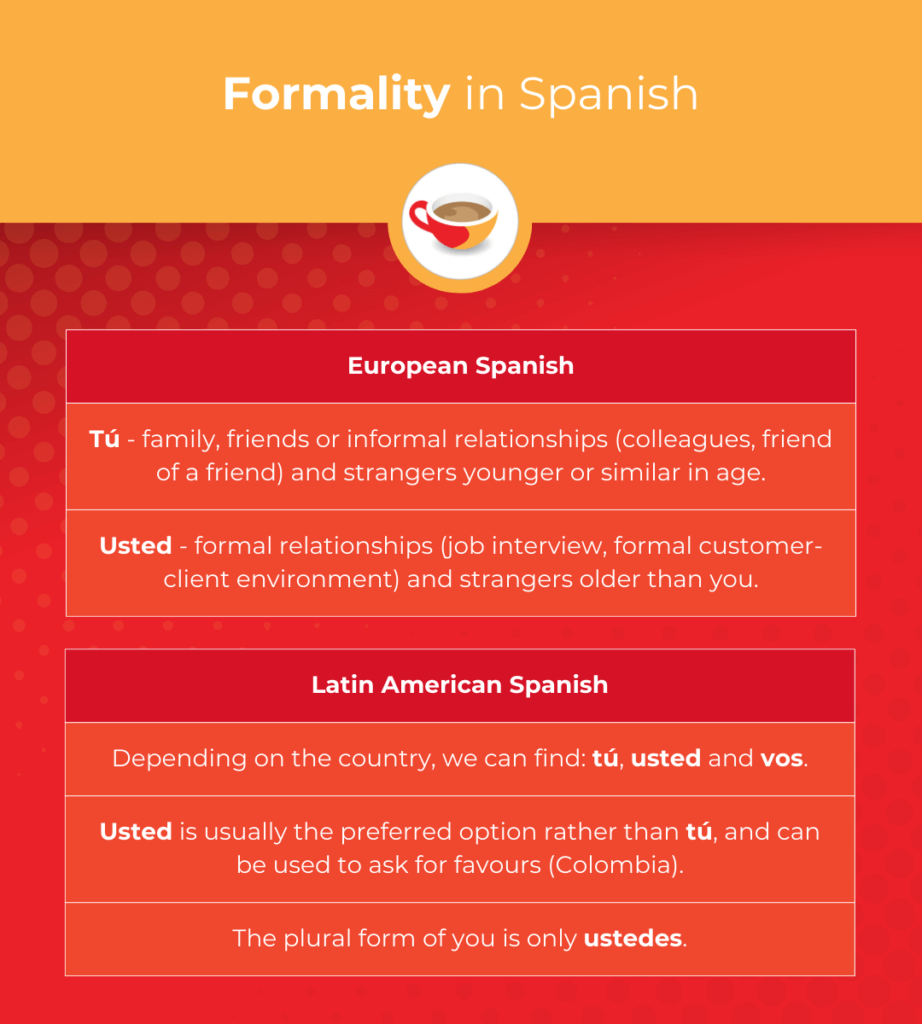
Converse in Spanish like a native: choosing ‘tú’ or ‘usted’

Knowing when to use and when to use usted can be challenging for any learner of Spanish, especially because it depends on the location where you are speaking Spanish.

The Coffee Break Spanish Show is a podcast series of bite-sized, friendly conversations, in which we demystify tricky Spanish language topics. In the latest episode, Anabel and Concha look into how to use and usted like native speakers in Spanish and sound natural in any part of the Spanish-speaking world.

Continue reading to find out more and why not listen to the podcast as you go?

Should I say ‘tú’ or ‘usted’?

In European Spanish, in general, we use both  and usted, and there are actually verbs to describe both of these actions:

tutear
to use the tú form with 

ustedear
to use the usted form with

The use of one or the other will be determined by the context and how formal or informal the situation is. For example, we use when talking to people close to our age and with friends and family. We use usted when talking to strangers, especially if they are older than us, in order to show respect.

However, the lines aren’t always clear, so don’t worry! Here are some key points to remember:

  • Use with your colleagues and maybe managers if the relationship is informal.
  • With strangers, use with people younger or around your age.
  • In customer service we can find both and usted. is used when the brand looks for a more relaxed and friendly tone with their customers and usted if they prefer to show professionalism. Both are correct and it depends mainly on the company ethos.
  • As for the plural forms, to address more than one person, we use vosotros/as in all the situations where you would use tú with an individual, and we use ustedes in the situations where you would use usted with an individual.

What about in Latin America?

In Latin American Spanish, the diversity in usage is greater and it will depend on the country.

In some countries, the use of vos instead of is the preferred option, while in other countries Spanish speakers prefer usted over .

One thing all Latin American countries have in common is that the plural form tends to always be ustedes, and not vosotros/as in informal contexts.

Another specific usage to note is that in Colombia, we can use usted to ask for a favour or to talk dearly to someone:

Anabel, ¿puede llevarme a la estación de tren en coche, por favor?
Anabel, can you take me to the train station by car, please?

Another regional difference

If you have enjoyed learning about the local differences and uses of , usted and vos, you may like this!

In the west of Andalucía, Concha says in the episode that she uses ustedes instead of vosotros, but using the vosotros conjugation of verbs. This means that Concha would naturally say ustedes tenéis for “you have”. Qué interesante, ¿verdad?

Keep practising ‘tuteando’ and ‘ustedeando’

One important thing to keep in mind is that we don’t need to stress too much about all these differences. Native speakers will be able to understand what you mean! However, it’s always nice to learn about the cultural differences and the diversity we can find in the Spanish language.

If you found this post interesting, make sure to listen to the full episode with Concha and Anabel on The Coffee Break Spanish Show. This is the series in which we look at a range of topics for Spanish learners, so make sure to subscribe to our podcast feed and our channel on YouTube.

Plus! To get regular free Spanish lessons in your inbox, you can sign up for our short (coffee-break-sized) email lessons that will help you improve your Spanish. You will also hear from Mark, the founder of Coffee Break Languages, giving advice for language learners at any level. Sign up below!

Remember to keep practising using and usted when you are in a Spanish-speaking country, and listen out to hear how others do so. This is something you will get the hang of little by little and we’re sure that it will start to feel more instinctive in no time.

Happy Coffee Breaking

Listen to the podcast

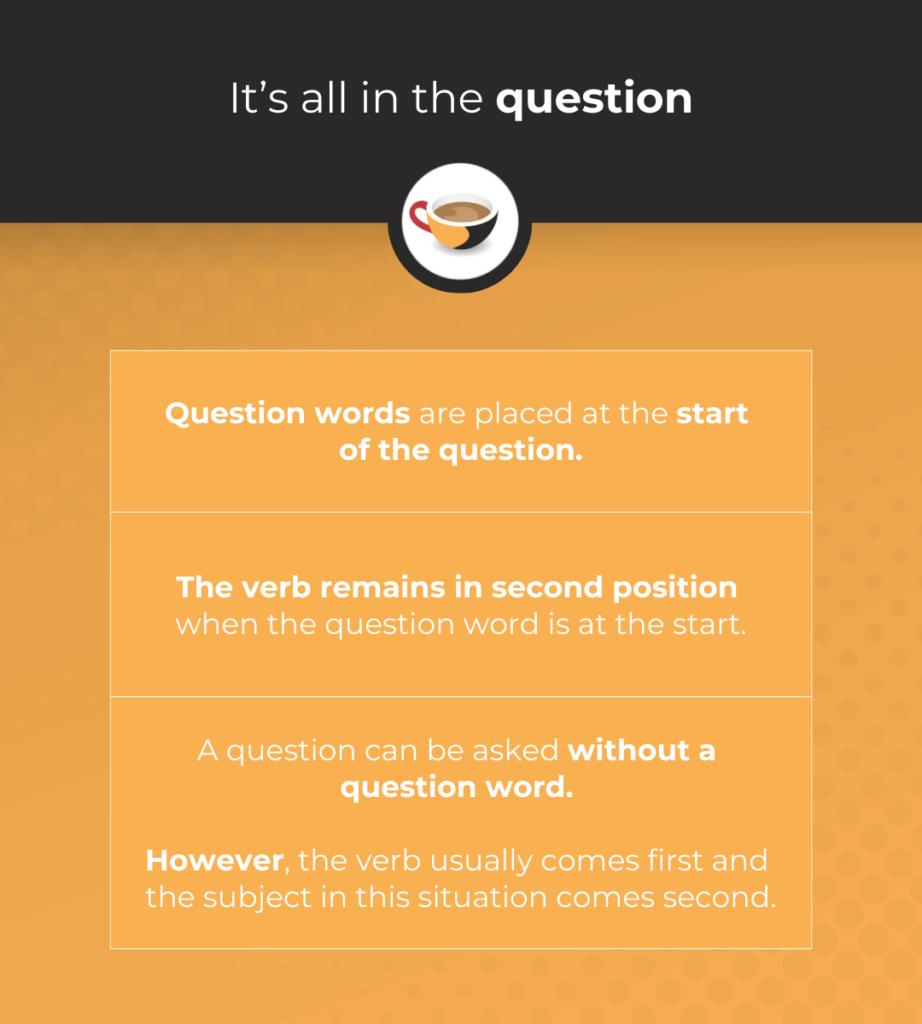
A guide to forming questions in German

How do you ask questions in German?

Questions are essential to every conversation and will always be part of your interactions when visiting a German-speaking country.

So, read on, as we’re going to answer all your questions about forming questions in German!

The Coffee Break German Show is a podcast series of bite-sized, friendly conversations, in which we demystify tricky German language topics. In the latest episode, Mark and Thomas look at how to form questions in German, focusing on the different question words, as well as sentence structure.

Continue reading to find out more and why not listen to the podcast episode as you go?

Die W-Wörter

All question words in German begin with the letter w. We’ll look at each of these in turn.

Wann?

Wann? means “when?”. Let’s start by looking at some examples using this question word.

Wann öffnet das Museum?
When does the museum open?

Wann fährst du nach Slowenien?
When are you going to Slovenia?

You’ll notice that the question word, wann?, starts the sentence, then the verb is next to it, in second position. The subject is in the third position, after the verb:

question word > verb > subject

Was?

Was? means “what?”. For questions with was?, we follow a similar structure.

Was denkst du?
What do you think?

Wer?

Wer? means “who?”. This question word looks and sounds a little like “where” in English, but it means “who”.

Wer kommt zur Party?
Who is coming to the party?

In the above example the pattern is:

question word > verb > object (location)

Note that wer is functioning as the subject of the sentence in this case.

Wo?

Wo? means “where?”. For example:

Wo liegt die Kirche?
Where is the church?

Wo ist die Bäckerei?
Where is the bakery?

Woher?

Woher? means “from where?” or “where from?”. Let’s see an example:

Woher kommst du?
Where do you come from?

“Where” can sometimes be used in English where woher would be needed in German. The suffix -her can be detached and be placed at the end of a question. This does not change the meaning of the question at all:

Wo kommst du her?
Where do you come from?

Wohin?

Wohin? means “where to?”. For example:

Wohin fährst du?
Where are you going to?

Wohin fährst du in den Ferien?
Where are you going to in the holidays?

Wo cannot be used where wohin would be needed in German. As Thomas mentions in the podcast, there’s a handy trick. The suffix -hin can be detached and added at the end of a question:

Wo fährst du morgen hin?
Where are you travelling to tomorrow?

Wie?

Wie? means “how?”. Here are some examples:

Wie viel kostet das?
How much does that cost?

Wie geht’s dir?
How are you?

As Thomas mentions, wie can be combined with other words to form other questions besides “how”.

Wie spät ist es?
What time is it? (literally, “how late is it?”)

Warum?

Warum? means “why?”. Let’s see this in an example sentence:

Warum lernen wir Fragewörter?
Why are we learning question words?

Wieso can also be used to mean “why”, as can weshalb. There can be regional differences in which question words are used. For example, wieso is more common in the south of Germany.

Forming yes/no or closed questions

The word order changes slightly for this type of question, but there is no question word. The verb comes first, so the subject is next. For example, here’s a question that Coffee Break German learners will be very familiar with from the start of our lessons!

Bist du bereit?
Are you ready?

Let’s see how a previous example question can be altered to become a yes/no question:

Wann fährst du nach Slowenien? > Fährst du nach Slowenien? 
When are you going to Slovenia? > Are you going to Slovenia?

Here, the sentence structure is:

verb > subject > object (location)

A visual summary

Getting used to forming questions in German can take some time, but don’t worry, the more you practise and hear people having conversations the more natural questions will become.

If you found this post interesting, make sure to listen to the full episode with Mark and Thomas on The Coffee Break German Show. This is the series in which we look at a range of topics for German learners, so make sure to subscribe to our podcast feed or our channel on YouTube.

Plus! To get regular free German lessons in your inbox, you can sign up for our short (coffee-break-sized) email lessons that will help you improve your German. You will also hear from Mark, the founder of Coffee Break Languages, giving advice for language learners at any level. Sign up below!

Happy Coffee Breaking!

Listen to the podcast

How to say ‘can’ in Italian: potere, sapere, riuscire

Did you know that the English verb “can” can be translated into Italian in three different ways? Each of the three verbs brings its own twist to the concept of “can” – creating a painter’s palette of nuanced expressions!

The Coffee Break Italian Show is a podcast series of bite-sized, friendly conversations in which we demystify tricky Italian language topics. In the latest episode, Francesca and Mark guide us through this topic to understand these three verbs and discover how they transform the simple idea of “can”. They discuss the different uses of the three verbs and also their irregular conjugations.

Continue reading to find out more, and why not listen to the podcast as you go!

sapere

sapere – present tense:
so
sai
sa
sappiamo
sapete
sanno

This verb is used to talk about our abilities and skills that you have acquired. The idea is that there has been a learning process that has allowed you to know how to do something. Here are some examples to clarify this point:

Luca sa suonare il violino.
Luca can / knows how to play the violin.

So giocare a golf.
I can / know how to play golf.

I miei amici non sanno cucinare.
My friends can’t / don’t know how to cook.

potere

potere – present tense:
posso
puoi
può
possiamo
potete
possono

You should use this verb when you have the possibility of doing something or the permission to do something. As Francesca explains, the idea is that other people or some external factors affect your ability to do something. Let’s look at some examples:

Questa sera Anna può uscire perché non lavora.
Tonight, Anna can go out because she is not working.

Non posso mangiare i crostacei.
I can’t eat shellfish.

Notice the difference if we decide to use sapere for this last sentence:

Non so mangiare i crostacei.
I can’t eat shellfish (because I don’t know how to clean them, for example, rather than because of an allergy).

Potere is also a verb of politeness and it is used to make requests. For example:

Puoi prestarmi il motorino, per favore?
Can you lend me your moped, please?

riuscire

riuscire – present tense:
riesco
riesci
riesce
riusciamo
riuscite
riescono

Our last verb for today is riuscire, which conveys the idea of succeeding in doing something or managing to do something. It indicates that the person has made an effort to do something. For example, we would say:

riuscire a fare qualcosa
to manage to do something

As you can see there, when using this verb, it is important to remember that it is followed by a + an infinitive. Here are some examples:

Non riesco a trovare le chiavi.
I can’t find my keys (because I left them somewhere).

Luisa riesce sempre a sorprendermi.
Luisa always succeeds in surprising me.

Nuances of ‘sapere’, ‘potere’ & ‘riuscire’

We can see the nuances of these three verbs in Italian by changing the verb in this example:

Riesci ad aprire questa bottiglia?
Can you manage to open this bottle?

Puoi aprire questa bottiglia?
Can you / Are you allowed to open this bottle? (Maybe you’ve been saving it for some time for a specific occasion.)

Sai aprire questa bottiglia?
Can you / Do you know how to open this bottle? (Maybe it’s tricky to open because there is a specific way of opening it.)

A little test… Can you do it?

Here’s a final test to check if you have understood the difference between sapere, potere and riuscire! Can you identify the subtle difference in meaning between each sentence below? Think about what the context may be in each situation, then scroll down to the end of the article to find the answers.

  1. Non so guidare il camper.
  2. Non posso guidare il camper.
  3. Non riesco a guidare il camper.

Eccoci alla fine!

The next time you’re in Italy or engaging in an Italian conversation, remember these three useful verbs. They will not only enrich your language skills but also open doors to a better understanding of the nuances of the Italian language.

If you found this post interesting, make sure to listen to the full episode with Mark and Maurizio on The Coffee Break Italian Show. This is the series in which we look at a range of topics for Italian learners, so make sure to subscribe to our podcast feed or our channel on YouTube.

Plus! To get regular free Italian lessons in your inbox, you can sign up for our short (coffee-break-sized) email lessons that will help you improve your Italian. You will also hear from Mark, the founder of Coffee Break Languages, giving advice for language learners at any level. Sign up below!

Happy Coffee Breaking!

PS. Here are the answers to our test:

  1. Non so guidare il camper. I can’t / I don’t know how to drive the camper van. (I have never learned how to drive one.)
  2. Non posso guidare il camper. I can’t / I’m not allowed to drive the camper van. (I don’t have permission to do so, perhaps I don’t have the right licence or insurance policy to do so.)
  3. Non riesco a guidare il camper. I can’t / I’m not able to drive the camper van. (No matter how hard I try – perhaps it feels too big).

Listen to the podcast

Useful expressions with ‘avoir’

Which French expressions do you know that use the verb avoir? There are many to choose from! While avoir translates into English as “to have”, its use goes beyond possession and ownership, extending to sensations, emotions and age.

The Coffee Break French Show is a podcast series of bite-sized, friendly conversations in which we demystify tricky French language topics. In the latest episode, Mark and Max chat about the verb avoir and look at some common expressions in which avoir is used differently from “to have” in English.

French’s linguistic quirks make it fascinating and, at times, tricky for learners, so using avoir correctly is an important learning point.

Continue reading to find out more and why not listen to the podcast as you go?

Common expressions that use ‘avoir’

Let’s look at how avoir can be combined with various nouns to take on a variety of meanings that may not necessarily relate to possession or ownership.

Age

avoir _ ans
to be _ years old

In French, your age is something you “have”. For example:

J’ai 30 ans.
I am 30 years old.

To be hungry or thirsty

avoir faim
to be hungry

avoir soif
to be thirsty

When you’re hungry or thirsty, in French this is expressed as “having” the feeling of “hunger” or “thirst”. For example:

J’ai faim.
I am hungry.

J’ai soif.
I am thirsty.

To be hot or cold

avoir chaud
to be hot

avoir froid
to be cold

French speakers also use avoir to express temperature sensations. For example:

J’ai chaud.
I am hot.

J’ai froid.
I am cold.

To be right or wrong

avoir raison
to be right

avoir tort
to be wrong

In French, you don’t say that “you are right or wrong”. Instead, “you have reason or wrong”. Here’s an example:

Je pense qu’il a raison.
I think he is right.

To be scared

avoir peur de
to be afraid of, to be scared of

When it comes to fear, we also express this using avoir in French. Let’s look at an example:

J’ai peur des araignées.
I am afraid of spiders.

To be sleepy

avoir sommeil
to be sleepy

When you’re feeling sleepy, you don’t say that “you are sleepy” in French, rather, “you have sleepiness”.

J’ai sommeil ce soir.
I’m sleepy tonight.

To need something

avoir besoin de
to need

To express that you need something in French, we literally say that “you have need of” whatever it is. For example:

J’ai besoin de deux kilos de pommes.
I need two kilograms of apples.

To want or feel like something

avoir envie de
to want, to feel like

We can also express a desire or craving for something using an avoir expression in French. Note that avoir envie de can be followed either by a verb (in the infinitive form) or a noun. Here’s an example:

Tu as envie de manger une tarte aux pommes ?
Do you feel like eating an apple pie?

A little challenge

Let’s see if you can remember some of these expressions we’ve talked about. Here are three sentences for you to translate into French, using avoir expressions:

  1. My mother is always right.
  2. I needed five more minutes.
  3. It’s 3 am and I am not sleepy.

Once you have your answers, scroll down to the bottom of the page to see how you got on.

In conclusion

As we’ve seen, the use of avoir in French very often cannot be translated into English as “to have”. Combined with different nouns, its meaning can range from sensations, to emotions and even age.

While these nuances may initially leave learners a little perplexed, don’t worry, you’ll get used to them. Ultimately, they add depth and character to the language, so the next time you encounter avoir, enjoy the thought that this little word can be used for expressing such a wide range of human experiences!

If you found this post interesting, make sure to listen to the full episode with Mark and Max on The Coffee Break French Show. This is the series in which we look at a range of topics for French learners, so make sure to subscribe to our podcast feed and our channel on YouTube.

Plus! To get regular free French lessons in your inbox, you can sign up for our short (coffee-break-sized) email lessons that will help you improve your French. You will also hear from Mark, the founder of Coffee Break Languages, giving advice for language learners at any level. Sign up below!

Happy Coffee Breaking!

PS. Here are the answers to the challenge:

  1. My mother is always right. Ma mère a toujours raison.
  2. I needed five more minutes. J’avais besoin de cinq minutes de plus.
  3. It’s 3 am and I am not sleepy. Il est trois heures du matin et je n’ai pas sommeil.

Listen to the podcast

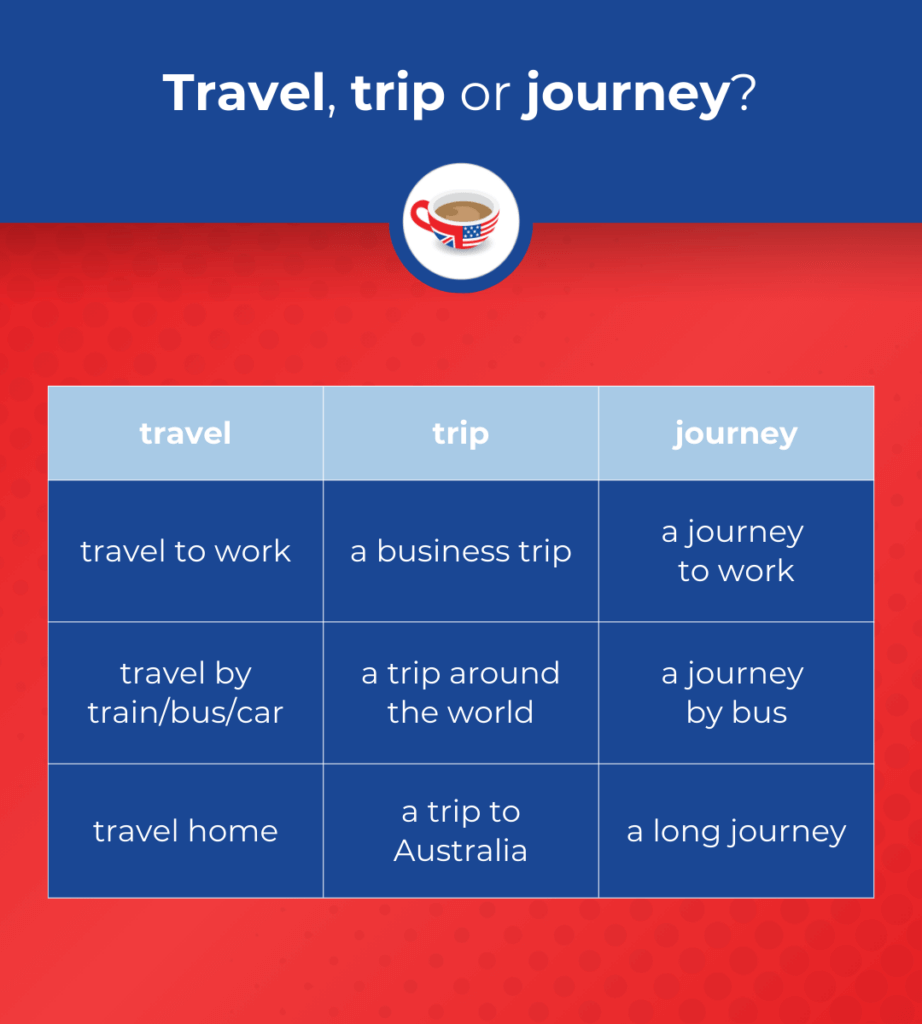
When do I use ‘travel’, ‘trip’ and ‘journey’?

Do you know the difference between the words travel, trip and journey? They all have similar meanings, so it’s easy to confuse them!

The Coffee Break English Show is a podcast series of bite-sized, friendly conversations to help you understand some difficult topics in English. In the latest episode, Mark and Josie talk about when to use travel, trip and journey correctly.

Continue reading to find out more and why not listen to the podcast as you go?
So, let’s get started and look at the words travel, trip and journey.

Travel

Travel is a verb. It describes the action of going to a place.

Here are some examples using travel:

They travelled to London by train.

I’m going to travel to Australia this summer.

Top tip: we can often replace travel with go.

Travel is usually a verb, but not always. The word travels describes the action of visiting different places, and we can replace it with adventures. We use travels in the expressions go on your travels and be off on your travels. For example:

Now that my daughter has finished high school, she’s off on her travels.

When are you going on your travels in Europe?

Journey

Journey is a noun. It describes the action of travelling from one place to another place. For example:

Mark’s journey to work takes 20 minutes.

I am exhausted after my long bus journey.

Have a safe journey home!

Trip

Like journey, trip is also a noun. It describes the process of travelling to a place, doing things in that place, and travelling back home again. We use trip in the expressions take a trip and go on a trip. For example:

She’s going on a business trip to Thailand.

We’re taking a trip to Greece this summer.

Let’s practise!

Now, let’s practise! Here are five sentences. Complete the spaces with travel, trip, or journey. The answers are at the end of this blog post, but don’t look until you’ve thought about the answers!

  1. I ___ to work by train.
  2. It was a really long car ___.
  3. I’d love to go on a ___ around the world.
  4. How long will the ___ to Rome take?
  5. My brother is on a work ___ this week.

Happy Coffee Breaking!

If you found this post interesting, make sure you listen to the full podcast episode with Mark and Josie on The Coffee Break English Show. We will release more episodes soon, about some more useful topics! Subscribe to our podcast feed and our channel on YouTube to learn when the next episode is available.

Plus! To get regular free English lessons in your inbox, you can sign up for our email lessons. We regularly send short (coffee-break-sized) email lessons that will help you improve your English. You will also hear from Mark, the founder of Coffee Break Languages, giving advice for language learners at any level. Sign up below!

So, keep practising when to use travel, trip, and journey! Remember that all English learners make mistakes, but people can usually still understand you. It’s all part of the language-learning journey.

Happy Coffee Breaking!

PS. Here are the answers to the questions:

  1. I travel to work by train.
  2. It was a really long car journey.
  3. I’d love to go on a trip around the world.
  4. How long will the journey to Rome take?
  5. My brother is on a work trip this week.

Listen to the podcast

How to use ‘me gusta’ in Spanish

Me gusta el español may be one of the first sentences we learn when we start studying Spanish. However, gustar can be a tricky verb to use!

In fact, “how do you say that you like something?” is one of the questions we get asked the most by our Coffee Break Spanish community. That’s why in the latest episode of The Coffee Break Spanish Show Mark and Concha are chatting about how the structure me gusta works and teaching us how to use it in different tenses and situations.

The Coffee Break Spanish Show is a podcast series of bite-sized, friendly conversations in which we demystify tricky Spanish language topics, and we hope that after listening to the episode and reading this article you’ll be confident using the verb gustar in many different situations.

Continue reading to find out more and why not listen to the podcast as you go?

Me gusta

Verbs like gustar (used to talk about liking things) or encantar (used to talk about loving things) are back-to-front verbs when we compare the structure to English. Let’s take an example:

Me gusta el café.
I like coffee.

Yes, this means “I like coffee”, but its literal meaning is “to me (me) it pleases (gusta) the coffee (el café)”. Or, in other words, “coffee pleases me” = me gusta el café.

Understanding this structure is key to using the verb properly, because the verb is conjugated according to what is pleasing to us or what we like.

That might sound a bit obscure, so here are three examples where we can see how it is used in different situations:

me gusta + singular noun

e.g. Me gusta la manzana.
I like the apple.

me gustan + plural noun

e.g. Me gustan las tazas.
I like the mugs.

me gusta + verb (infinitive)

e.g. Me gusta estudiar español.
I like studying Spanish.

As you can see in the second structure, when we have a plural noun (tazas – “mugs”), instead of using me gusta (gustar in the third person singular form) we use me gustan (in the third person plural form). Remember that in Spanish we are saying “something pleases me”. When that something is a plural noun (as is the case with tazas), we are therefore saying “they please” (gustan), rather then “it pleases” (gusta).

‘Gustar’ in different tenses

Now, let’s take this a stage further and try using gustar in different tenses. How would you say the following sentences in Spanish?

I have liked them a lot.

I liked them a lot.

You will like them.

You are going to like them.

Think about them for as long as you need to, then check the answers below:

I have liked them a lot.

Here, we are using the perfect tense:
Me han gustado mucho.

I liked them a lot.

Now, we are using the preterite tense.
Me gustaron mucho.

You will like them.

Using the future tense, this would be:
Te gustarán mucho.

You are going to like them.

Here, we use the structure ir a + infinitive, and here we have two possible options. In the first option, the pronoun (te) goes before the van a gustar structure. In the second option, the pronoun goes after and is attached to the infinitive. Both are correct and there’s no difference in meaning:
Te van a gustar mucho. / Van a gustarte mucho.

How to say “I like you”

We have seen how to use gustar in different tenses and structures, so now, can you guess how “I like you” is expressed in Spanish?

Since we are literally saying “you please me”, this would be me gustas (tú), where the verb is conjugated according to the subject, . Remember that the subject pronoun is optional, as usual in Spanish.

To ask somebody “do you like me?”, you would say ¿te gusto?, literally meaning “do I please you?”

Note that using gustar in this way suggests liking someone in a romantic way.

“I like you” – with friends

If you want to say you like someone, but not in a romantic way, we use caer bien in Spanish. ¡Ojo! Caer is an irregular verb in some tenses. Let’s look at some examples:

La novia de mi hermano me cae bien.
I like my brother’s girlfriend
 (literally, “my brother’s girlfriend falls well to me”).

Los vecinos no me cayeron bien.
I didn’t like the neighbours.

Translation challenge

Let’s put what we’ve learned to the test. How would you say the following sentence in Spanish? Try translating it using gustar first, then using caer bien, and think about how the meaning changes with each verb. You can find the answers at the end of this article. Here’s your translation challenge:

At the beginning I didn’t like you, but now I like you very much.

Conclusion and answers

If you found this post interesting, make sure to listen to the full episode with Mark and Concha on The Coffee Break Spanish Show. This is the series in which we look at a range of topics for Spanish learners, so make sure to subscribe to our podcast feed and our channel on YouTube.

Plus! To get regular free Spanish lessons in your inbox, you can sign up for our short (coffee-break-sized) email lessons that will help you improve your Spanish. You will also hear from Mark, the founder of Coffee Break Languages, giving advice for language learners at any level. Sign up below!

Happy Coffee Breaking!

PS. Here are the translations of the sentence:

Using caer bien:
Al principio no me caíste bien, pero ahora me caes muy bien.
You would use this when talking to a friend or an acquaintance.

Using gustar:
Al principio no me gustabas, pero ahora me gustas mucho.
You would use this when talking to somebody you are romantically interested in.

Listen to the podcast

Everything you need to know about the German umlaut

As you may already know, the umlaut in German is the two small dots that can be used above the letters aand u. But when and why do we use an umlaut? And how does the umlaut change the sound of the letter?

The Coffee Break German Show is a podcast series of bite-sized, friendly conversations in which we demystify tricky German language topics. In the latest episode, Mark and Thomas look at exactly how to pronounce letters with an umlaut and they chat about its different uses.

Continue reading to find out more and why not listen to the podcast as you go?

How did umlauts evolve?

It is said the umlaut came about through laziness! Thomas describes them as “vowel harmonies”. Basically, words that had an a, o or u alongside the letter i were difficult to pronounce and over time these letter combinations became ä, ö and ü.

One example of such an evolution in spelling is in the word for “goose”, Gansi > Gänse.

Pronunciation

There are three letters that can be written with the umlaut in German. Let’s tackle them one by one.

‘a’ with an umlaut: ä

Let’s take a look at the ä sound. It is pronounced like the e sound in the English word “egg”. Though beware – different accents in English pronounce such words differently! Here are some examples of the umlaut in action:

Äpfel
apples

Hände
hands

ähnlich
similar

Käfer
bug, beetle

Of course, there are often exceptions to a rule. The ä sound in the following words has a slightly different pronunciation. To perfect these words, listen carefully to Thomas in the episode and really focus on the pronunciation.

Käse
cheese

Mädchen
girl

Allgäu
an area in Germany

Mäuse
mice

A little note about that last example: it is quite common in German to have a word of only one syllable in the singular, for example Maus (“mouse”), which adds an umlaut in the plural, as well as the -e at the end, in this case becoming Mäuse (“mice”).

‘o’ with an umlaut: ö

Now, let’s look at the sound created by ö. It can be pronounced as a short sound. You can hear these examples in the episode:

öffnen
to open

können
to be able to

In some words, the ö sound is longer. This can be heard in:

Öl
oil

schön
beautiful

‘u’ with an umlaut: ü

Next, we’ll look at ü, which you can pronounce by making an “ee” sound in English, but then pursing your lips. Thomas gives a great demonstration of this in the episode. Here are some examples of words containing ü:

fünf
five

Müll
rubbish

Tür
door

üben
to practise

übertrieben
over the top

Note that in the first two examples above the ü has a short sound, but in the last three it has a longer sound.

By the way, the last word is one that Thomas used at the start of the episode to describe how excited he was about this topic!

What else do we need to know about umlauts?

It is essential to take note that where an umlaut is found can make a difference not only to the sound of a word, but its meaning, too.

One example is that the word schon means “already”, but schön means “beautiful”. It is only the addition of the umlaut that distinguishes the two words from one another, yet it changes the meaning significantly.

Adding an umlaut can create a plural noun

As we’ve seen, adding an umlaut is often how the plural of a noun is formed, particularly for single-syllable nouns. Here are some more examples:

Maus > Mäuse
mouse > mice

Haus > Häuser
house > houses

Hand > Hände
hand > hands

Zug > Züge
train > trains

Adding an umlaut to form the comparative

When changing an adjective into the comparative form, an umlaut is often added to create that form. For example:

groß > größer
big > bigger

arm > ärmer
poor > poorer

It is often the case that one-syllable adjectives form the comparative by adding an umlaut (similar to one-syllable nouns). Obviously, the comparative adds the –er ending as well as adding the umlaut.

Umlauts in conjugated verbs

Often, when a verb is conjugated in the present tense, an umlaut is added. Thomas mentions the verb that was the focus of a previous episode in this series, fahren. Previously, we looked at when to use fahren and when to use gehen to translate “to go”, but now let’s see how different parts of the verb are spelled differently, involving an umlaut:

ich fahre
du fährst
er/sie/es fährt
wir fahren
ihr fahrt
Sie/sie fahren

A visual summary

We hope that you now know how and when to use an umlaut in German. If you’re unsure of how to type letters with umlauts on your keyboard, scroll down to take a look at our tips.

If you found this post interesting, make sure to listen to the full episode with Mark and Thomas on The Coffee Break German Show. This is the series in which we look at a range of topics for German learners, so make sure to subscribe to our podcast feed or our channel on YouTube.

Plus! To get regular free German lessons in your inbox, you can sign up for our short (coffee-break-sized) email lessons that will help you improve your German. You will also hear from Mark, the founder of Coffee Break Languages, giving advice for language learners at any level. Sign up below!

Remember to bookmark this article so that you can refer back to it for help with the pronunciation and uses of the umlaut. We’ll be back soon with another interesting German language topic.

Happy Coffee Breaking!

How to type an umlaut on your keyboard

Finally, here is our guide on how to type an umlaut when you are writing on a keyboard or phone.

This, of course, depends on which operating system you use. As Thomas says, if you have a German keyboard, it’s easy as there is an umlaut key on the keyboard.

If you are using a Mac:

  1. Hold down the option/alt key + u, which gives the umlaut.
  2. Then release the keys and type the letter over which you want the umlaut (a, o or u).

If you are using a PC, it’s a little more complicated. Different systems have their own shortcuts, but there is one fail-safe option:

  1. Hold down the Windows key + r to open the Run dialog box, then type in “charmap” and press enter. The character map box should appear.
  2. Double click on the character you want to copy so that it appears in the text box.
  3. Click on “copy” to copy the character, then you can paste it anywhere with the ctrl + v shortcut.

With most smartphones, hold down the letter to which you want to add the umlaut and options will appear. Scroll or swipe along to select the one you want to use.

If you are unable to use any of these options, you can write the letter e after the a, o or u. This option will give the same sound as using an umlaut so it will be understood by readers.

Listen to the podcast

5 rules for when to use ‘a’ and ‘in’ in Italian

Going to a café can be a great opportunity to sit down and listen to one of our Coffee Break Italian podcasts with a nice cup of coffee or tea. In this article we’re talking about prepositions, so do you know which preposition you’d use in Italian to talk about going to a café or being in a café?

The Coffee Break Italian Show is a podcast series of bite-sized, friendly conversations in which we demystify tricky Italian language topics. In the latest episode Mark and Maurizio talk about prepositions and, in particular, when to use a and when to use in.

These prepositions can describe both being in a location and motion towards a place. Depending on how they are used in a sentence, a and in could be translated into English as “in”, “at” or “to”.

If this sounds confusing just now, don’t worry! In the episode, Maurizio gives us five rules to help us remember when to use these prepositions.

Read on to find out more, and why not listen to the podcast as you go?

Rule 1: use ‘a’ with cities

In Italian, the preposition a is used to describe both being in a city and going to a city. Let’s look at some examples:

Sono a Londra.
I’m in London.

Vado a Londra.
I go to London.

Abito a Roma.
I live in Rome.

Tommaso va spesso a Dublino.
Tommaso often goes to Dublin.

Rule 2: use ‘in’ with countries

The preposition in is used to talk about location and motion when it comes to bigger geographical areas, such as continents, countries, states, and regions. For example:

Tommaso va spesso in Irlanda.
Tommaso often goes to Ireland.

Oggi ci troviamo in Oregon.
Today, we are in Oregon (literally, “we find ourselves in Oregon’”).

Mi piace viaggiare in Asia.
I like travelling in Asia.

Vivete in Piemonte o in Liguria?
Do you (plural) live in Piedmont or in Liguria?

Rule 3: use ‘in’ with rooms

We also use the preposition in with rooms. Again, it can mean either “in” or “to”, depending on the context. For example:

Sto andando in cucina per preparare il pranzo.
I’m going to the kitchen to make lunch.

Vado in bagno.
I’m going to the bathroom.

Siamo in classe.
We’re in class.

Andiamo in cucina.
We go to the kitchen.

Dormiamo in camera da letto.
We sleep in the bedroom.

Rule 4: use ‘in’ with buildings

When you’re talking about being at or going to a building, you should use the preposition in. Let’s look at these examples:

Andiamo in chiesa.
We go to church.

I miei figli vanno in palestra.
My children go to the gym.

Ora sono in banca.
I’m at the bank now.

Lavorano in ufficio.
They work at the office.

We also use in when talking about places ending in -ia or -teca:

Andiamo in biblioteca.
We go to the library.

Mangiamo in pizzeria.
We eat at the pizzeria.

Rule 5: rules have exceptions!

Mark and Maurizio also mention other phrases with a and in that don’t really follow the previous rules.

Despite being a building, we always use the preposition a when we are talking about a house or home. So, a casa can mean both “in the house” and “to the house”. For example:

Sei già a casa?
Are you already home?

Other similar exceptions are school and theatre – a scuola, for example, meaning both “at” or “to the school”, and a teatro, meaning “at” or “to the theatre”. Here are some examples:

Sei ancora a scuola?
Are you still at school?

Andiamo a teatro stasera.
We’re going to the theatre tonight.

Andiamo al teatro alla Scala.
We’re going to La Scala theatre.

Another tricky one is when you go to bed. We mentioned that we say in camera da letto. However, for being “in” or going “to bed” we say a letto.

Sono a letto.
I’m in bed.

Finally, Mark and Maurizio mention some specific phrases with in in relation to going on holiday:

andare in vacanza
to go on holiday

andare in montagna
to go to the mountains

essere in spiaggia
to be at the beach

andare in campagna
to go to the countryside

essere in hotel / albergo
to be in the hotel

A visual summary and a challenge!

Siamo pronti? Let’s see if you can translate the following sentences:

Right now, I’m in the office in Milan, in Lombardy, in Italy, in Europe.
Tomorrow, I’ll be on holiday in Palermo, in Sicily, in the hotel or at the beach!

The answers are at the end, but no peeking until you have noted down your translations!

Conclusion and answers

If you found this post interesting, make sure to listen to the full episode with Mark and Maurizio on The Coffee Break Italian Show. This is the series in which we look at a range of topics for Italian learners, so make sure to subscribe to our podcast feed or our channel on YouTube.

Plus! To get regular free Italian lessons in your inbox, you can sign up for our short (coffee-break-sized) email lessons that will help you improve your Italian. You will also hear from Mark, the founder of Coffee Break Languages, giving advice for language learners at any level. Sign up below!

Other than that, keep practising when to use in and a! Mastering prepositions can make a complete change to how you sound in a language and will help you be much more confident when you next travel to Italy. However, don’t worry if you make mistakes – you’ll still be understood, even if you get your prepositions wrong. The most important thing is to make the effort to communicate.

Happy Coffee Breaking!

PS. Here are the answers to the challenges:

Right now, I’m in the office in Milan, in Lombardy, in Italy, in Europe.
Adesso sono in ufficio a Milano, in Lombardia, in Italia, in Europa.

Tomorrow, I’ll be on holiday in Palermo, in Sicily, in the hotel or at the beach!
Domani sarò in vacanza a Palermo, in Sicilia, in albergo o in spiaggia!

PPS. We opened this article with the question of how to talk about going to a café and being in a café. In Italian, both “to the café” and “in the café” would be translated as al caffè.

Listen to the podcast

Converse in French like a native: choosing ‘tu’ or ‘vous’

Learning a new language comes with its own set of interesting challenges, and for learners of French, one of these challenges is knowing when to use the informal tu and when to use the formal vous, especially if your native language is one which only has one word for “you”.

Mastering this nuance, however, is important to help you converse in French like a native. This subtle distinction can greatly affect the way you communicate with others and is a crucial aspect of French etiquette.

The Coffee Break French Show is a podcast series of bite-sized, friendly conversations in which we demystify tricky French language topics. In the latest episode, Mark and Max explore the key points related to the use of tu and vous, shedding light on the rules, the exceptions and the social context that surrounds this linguistic choice.

In this article, we are going to look at the tips they give us to be able to confidently hold a conversation in French, choosing whether to go with the informal tu or the formal vous.

Continue reading to find out more and why not listen to the podcast as you go?

‘Tu’ or ‘vous’?

Before we get into when to use tu and when to use vous, we should say that while it’s an important and interesting topic for French learners, don’t get too hung up on it! The most important thing is that you are using your French to communicate, and if you use the “wrong” word for “you”, people will understand you’re a learner and will just be happy that you’re practising your French with them.

Now, let’s get into our topic. One of the fundamental distinctions in French language usage is between tu and vous. The choice between these two forms of address is not arbitrary, but rather dictated by politeness and respect.

‘Vous’: a matter of politeness and respect

  • Use vous when you want to convey politeness and maintain a certain distance in your conversation.
  • Address older individuals, people in professional settings (e.g. restaurants, shops) and strangers with vous.
  • It is a common choice when interacting with people you don’t know well or who hold a certain level of authority.

‘Tu’: reserved for family and friends

  • Reserve tu for close relationships, such as family and friends, and when addressing children.
  • The use of tu indicates a more intimate and friendly level of communication.

The plural “you”

  • When speaking to two or more individuals simultaneously, always use vous.
  • This rule takes precedence over other considerations, so vous is used in both formal and informal situations to refer to a plural “you”.

‘Tutoyer’: a checkpoint in friendship

Transitioning from using vous to tu can be a significant moment in a relationship. It reflects a closer, more intimate bond between individuals.

Often, friends in the making ask each other on se tutoie ? to establish whether they should switch to using tu. This question uses the verb tutoyer, which means “to use the tu form with”. Vouvoyer, on the other hand, means “to use the vous form with”.

Key phrase: On se tutoie ? Shall we use the tu form with each other?

Some anecdotes

To better understand the nuances of using tu and vous in French, in this episode Mark and Max share some personal anecdotes with us, which highlight how choosing between tu and vous can be dictated by the context, even between the same two people.

Social context can influence choice

Mark tells us that he once attended a work event in France where he initially used vous during the day when interacting with colleagues. However, in the relaxed atmosphere of a restaurant later on in the evening, they switched to tu. The next day, back in the formal setting of the conference, they returned to using vous. This demonstrates how context can influence your choice.

Max talks about his teacher at school, who was also the father of a football teammate. In the classroom, he addressed the teacher as vous, but used tu when interacting on the football pitch. This example underscores how the social context can govern whether to use tu or vous.

A sign of growing up!

Max explains that, in French culture, the first time someone addresses you with vous is often seen as a moment of growing up or becoming more mature. This typically happens around the time when teenagers start to transition into adulthood.

A visual summary

Before we go, there’s one last thing to mention about tu and vous, which may have already occurred to you if you watched or listened to episode 1 of our series, and that is pronunciation! In episode 1, Mark and Max discussed the difference between the vowel sounds u and ou in French, so make sure to differentiate between the u in tu and the ou in vous. If you haven’t already seen it, you can find that episode here, and you can practise your u and ou vowels just by saying the two words for “you”!

Mastering the distinction between formal and informal language will make your experience of speaking French richer and more complete. For example, the transition from vous to tu can be a meaningful checkpoint in developing closer, more intimate relationships with native speakers.

So, whether you find yourself addressing a new acquaintance with vous or using tu with a close friend, you’re now equipped to make the right choice in your French conversations. Embracing these language subtleties will enhance your ability to connect with French speakers and immerse yourself more deeply in their culture.

If you found this post interesting, make sure to listen to the full episode with Mark and Max on The Coffee Break French Show. In this series of chats between our language experts, we look at a range of topics for French learners, so make sure to subscribe to our podcast feed and our channel on YouTube.

Plus! To get regular free French lessons in your inbox, you can sign up for our short (coffee-break-sized) email lessons that will help you improve your French. You will also hear from Mark, the founder of Coffee Break Languages, giving advice for language learners at any level. Sign up below!

Finally, while it may seem daunting at first, remember that with practice and experience it will become more natural. In the meantime, making mistakes is normal and native speakers will always be happy to hear you make the effort.

Happy Coffee Breaking!

Listen to the podcast