The present simple and present continuous: ‘I work’ or ‘I am working’?

Do you know the difference between I work and I am working in English?

This can be a challenging topic for English learners, especially because many languages just have one present tense.

The Coffee Break English Show is a podcast series of bite-sized, friendly conversations to help you understand some difficult topics in English. In the latest episode, Mark and Josie talk about the difference between the present simple and the present continuous tenses.

They explain the rules for when to use these tenses, so hopefully this will help you understand them better.

So, let’s get started and look at the present simple and present continuous tenses. Keep reading to find out more and why not listen to the podcast as you go?

Present simple

I work is the present simple tense. Here is the verb work conjugated in the present simple:

I work
you work
he/she/it works
we work
they work

I don’t work
you don’t work
he/she/it doesn’t work
we don’t work
they don’t work

When to use the present simple

Now that we know the structure of the present simple, do you know when to use it?

We use the present simple when we talk about habits, routines, and things that are always true. For example, when we are talking about someone’s permanent job or career. Here are some examples:

I work as a teacher.

She works as a bus driver.

They work from home.

Present continuous

I am working is the present continuous tense. Here is the verb work conjugated in the present continuous:

I am working
you are working
he/she/it is working
we are working
they are working

I’m not working
you aren’t working
he/she/it isn’t working
we aren’t working
they aren’t working

When to use the present continuous

We use the present continuous tense when we talk about temporary actions, or actions that are happening as we are speaking or at the present moment. For example:

I’m working, so I can’t talk right now.
= action happening in the present moment

She usually works in the office, but she’s working at home this week.
= temporary action

Let’s compare

Here are some more examples where you can see the difference between the present simple and the present continuous:

I’m drinking coffee now.
I drink coffee every day.

We are speaking English at the moment.
Josie also speaks French.

I go to the cinema once a month.
This podcast is going very well!

The exception: state verbs

So far, so good! However, there are some verbs that we don’t usually use in the present continuous tense. These are called “state verbs”.

State verbs usually describe internal things like senses, emotions, and possession. So, even when we are talking about temporary actions, or actions that are happening at the present moment, we have to use the present simple, not the present continuous. For example:

I am being happy right now.
I am happy right now.

I am knowing the answer.
I know the answer.

He is wanting a coffee.
He wants a coffee.

There are lots of state verbs, so it’s a good idea to do some more research and learn some more.

Let’s review

If you found this post interesting, make sure you listen to the full podcast episode with Mark and Josie on The Coffee Break English Show. We will release more episodes soon, about some more useful topics! Subscribe to our podcast feed and our channel on YouTube to learn when the next episode is available.

Plus! To get regular free English lessons in your inbox, you can sign up for our email lessons. We regularly send short (coffee-break-sized) email lessons that will help you improve your English. You will also hear from Mark, the founder of Coffee Break Languages, giving advice for language learners at any level. Sign up below!

Happy Coffee Breaking!

Listen to the podcast

When to use ‘el’ with feminine nouns

Have you ever wondered why there are some feminine nouns that use the masculine definite article el? You may be thinking of examples like el aguael hambre or el aula.

You probably already know that when it comes to grammatical gender in Spanish, nouns can either be masculine or feminine. Masculine nouns use the word el to mean “the” in the singular form, while feminine nouns typically use la. So, what is happening with words like el agua?

The Coffee Break Spanish Show is a podcast series of bite-sized, friendly conversations in which we demystify tricky Spanish language topics. In the latest episode, Mark and Anabel look at a selection of words that take the article el despite actually being feminine nouns. By the end of this episode, you’ll know exactly how to use these nouns with any article or adjective, and see that it’s not as complicated as it may seem at first!

Continue reading to find out more and why not listen to the podcast as you go?

Is ‘agua’ masculine or feminine?

One of the most common mistakes when it comes to noun gender in Spanish comes with words like agua (“water”), hambre (“hunger”), or aula (“classroom”) – some of the first words you may learn in the language!

You have probably learned to write el agua, el hambre and el aula, and you are not wrong! The issue comes when you assume they are masculine nouns or they always use masculine articles, because that’s not the case.

¿Qué está pasando entonces? Feminine nouns starting with a stressed a sound follow some very special rules.

When a feminine singular noun starts with a stressed a, we use el, un, algún and ningún before them.

For example:

el agua
the water

un agua
a water

algún agua
some water

ningún agua
no water

When the noun is in its plural form, we use the feminine form of the article.

For example:

las aguas
the waters

unas aguas
a few waters

algunas aguas
some waters

ningunas aguas
no waters

It’s important to keep in mind that we only use the masculine form with these nouns when we use el, un, algún and ningún before the noun. As you can see, we use the feminine form of the articles when using the plural form.

Take a look at these further examples and notice that esta, mucha and nuestra are in their feminine singular form – back to what you would expect with a feminine noun like agua.

esta agua
this water

mucha agua
a lot of water

nuestra agua
our water

¡Ojo! If we want to say “all the water”, it should be toda el agua, where the feminine form is used in toda, but we keep the masculine article el.

Indeed, when this type of noun is combined with an adjective, the adjective agrees in gender with the noun, even when using a masculine article. For example:

el agua fría
the cold water

However, if we move the adjective before the noun, then we have:

la fría agua
the cold water

In summary, el agua, el hambre and el aula might look like masculine nouns at first, but it is only to help pronunciation – in reality, they are all feminine nouns. The best way to get your head around this is to put it into practice.

Let’s practise!

Translate the following phrases into Spanish. For each one, we’ve given you the noun in brackets. You can find the answers and an explanation at the end of this article.

  1. open area (área)
  2. the bald eagle (águila)
  3. some white wing (ala)
  4. the best water (agua)
  5. the small classroom (use aulita (aula + ita) for “small classroom”)

Conclusion and answers

If you found this post interesting, make sure to listen to the full episode with Mark and Anabel on The Coffee Break Spanish Show. In this series of chats between our language experts, we look at a range of topics for Spanish learners, so make sure to subscribe to our podcast feed and our channel on YouTube.

Plus! To get regular free Spanish lessons in your inbox, you can sign up for our short (coffee-break-sized) email lessons that will help you improve your Spanish. You will also hear from Mark, the founder of Coffee Break Languages, giving advice for language learners at any level. Sign up below!

Finally, remember that when it comes to noun gender, while it’s useful to learn the rules and can help to give you more confidence when speaking, you’ll be easily understood even if you make mistakes!

We’ll be back soon with another interesting Spanish language topic. Until then, happy Coffee Breaking!

PS. Here are the answers to the challenges:

  1. open area (área) – área abierta
    Área
    is a feminine noun.
  2. the bald eagle (águila) – el águila calva
    Águila
    is a feminine noun, so the adjective calvo/a agrees with it. However, it starts with a stressed a, so we use the article el.
  3. some white wing (ala) – algún ala blanca
    The same applies here as in the previous example. However, we can also say alguna blanca ala. Since the adjective goes before the noun in this case, the article doesn’t change.
  4. the best water (agua) – la mejor agua
    The adjective mejor always goes before the noun. Since the adjective goes before the noun, the article remains as la, rather than el.
  5. the small classroom (aulita) – la aulita
    Aulita
    now has the stress on the syllable li-, so it doesn’t start with a stressed a, meaning that it doesn’t need a different article. Other options could have been: el aula pequeña or la pequeña aula.

Listen to the podcast

Saying ‘to go’ in German: ‘fahren’ or ‘gehen’?

Most learners think of the verb gehen when they want to say “to go” in German, but that’s not always correct!

Yes, there are times when you should use gehen, but at other times we use fahren. Both verbs can mean “to go” in different contexts.

The Coffee Break German Show is a podcast series of bite-sized, friendly conversations in which we demystify tricky German language topics. In the latest episode, Mark and Thomas clarify when to use gehen or fahren. Continue reading to find out more and why not listen to the podcast as you go?

Translating “to go” into German

In English, “to go” covers all methods of getting to a destination. For example, we can say:

We are going to the supermarket.

We went to Spain last week.

We are going on a holiday.

However, German requires a more nuanced approach.

When to use ‘fahren’

Usually, when a method of transport, such as car, bus, or train, is involved, then fahren would be used. Here are some examples:

Ich fahre zum Einkaufen.
I am driving / going to the shops.

Er fährt morgen mit dem Zug nach Berlin.
He is going to Berlin tomorrow by train.

Wann fährst du in den Urlaub nach Peru?
When are you going on holiday to Peru?

When to use ‘gehen’

When no method of transport is mentioned, gehen is used. It, therefore, implies that someone is walking somewhere. For example:

Ich gehe zur Post und kaufe eine Briefmarke.
I am going / walking to the post office and I am buying a stamp.

Wenn es schön ist, gehe ich zur Arbeit.
When the weather is nice, I walk to work.

Both of these examples clearly imply that the person is walking and so gehen is used.

Another use of ‘gehen’

The verb gehen is more often used in the context of going somewhere to do an activity or task, or attending something. Let’s look at these examples:

Sie gehen schwimmen.
They are going swimming.

Mein Bruder geht in die Grundschule.
My brother goes to primary school.

The second example shows how the verb gehen is used to mean “to attend”.

To distinguish between gehen and fahren, Mark uses the example:

Wir fahren morgen zum Schwimmbad. Wir gehen schwimmen.
We are going to the swimming pool tomorrow. We are going swimming.

Ready to go?

Before we go, here’s a visual summary of what we’ve learned.

As you can imagine, there is a bit of a grey area, so it’s always best to check if you are not sure. But don’t worry – you will always be understood, even if you mix up the verbs.

If you found this post interesting, make sure to listen to the full episode with Mark and Thomas on The Coffee Break German Show. In this series of chats between our language experts, we look at a range of topics for German learners, so make sure to subscribe to our podcast feed and our channel on YouTube.

Plus! To get regular free German lessons in your inbox, you can sign up for our short (coffee-break-sized) email lessons that will help you improve your German. You will also hear from Mark, the founder of Coffee Break Languages, giving advice for language learners at any level. Sign up below!

Happy Coffee Breaking!

Listen to the podcast

How to pronounce Italian double consonants

Italian is renowned for its smooth and lyrical sounds. One of the intriguing aspects of Italian pronunciation lies in its double consonants – or le doppie.

In Italian, all consonants can be doubled (apart from the letter H). Even the double Q exists – soqquadro (“disarray”).

The Coffee Break Italian Show is a podcast series of bite-sized, friendly conversations in which we demystify tricky Italian language topics. In the latest episode, Mark and Maurizio share some tips on how to perfect your pronunciation of double consonants.

Mastering this phonetic feature is a way to make you sound more Italian when you speak, so continue reading to find out more, and why not listen to the podcast as you go?

The power of ‘le doppie’

Sometimes, the pronunciation of le doppie marks the difference in meaning between words. For example, notice the difference in meaning between the following words:

casa
house

cassa
box

pena
pain, suffering

penna
pen

This underscores why it is important to learn how to pronounce double consonants. Having said this, context always helps, and in most situations the person you’re speaking to will understand what you’re talking about. Even if you don’t quite pronounce le doppie correctly, most people will just be happy you’re speaking in Italian!

Tips for pronouncing double consonants

Producing the distinctive sounds of Italian double consonants requires a bit of practice. We have some tips to help you out:

Elongate the sound

When encountering a double consonant, elongate the sound while holding it in your mouth. For example, try saying sasso (“rock”), palla (“ball”) and mamma (“mum”).

Push the sound forcefully

For consonants like B, P, C, G, T and D, try pronouncing them more forcefully by pushing air through your mouth. This extra burst of air adds emphasis to the consonant. Experiment with words like babbo (“dad”) and mucca (“cow”) to feel the difference.

“Bounce” on the letter

One last tip is to imagine bouncing on the double consonant as you say the word. This mental image can help you emphasise the sound. You could even try to physically bounce on the spot to help you practise the pronunciation of double consonants!

Now, try to pronounce these two sentences. Each has the same consonant sounds, but only one has double-lettered words:

La palla è rossa.
The ball is red.

La pala è rosa.
The shovel is pink.

Regional differences

It’s important to note that sounds can also change depending on regional accents. In certain parts of Italy, vowel sounds preceding le doppie may vary.

There are rules of diction for standard Italian when it comes to the sound of vowels before le doppie, but the regional accents of many Italians might appear to contradict these rules.

The most important thing is to speak the language and then you can decide whether to adjust your vowel pronunciation depending on where you find yourself in Italy or who you are talking to.

Remember that there isn’t one specific regional variety of Italian to learn or copy – all accents and pronunciations are correct.

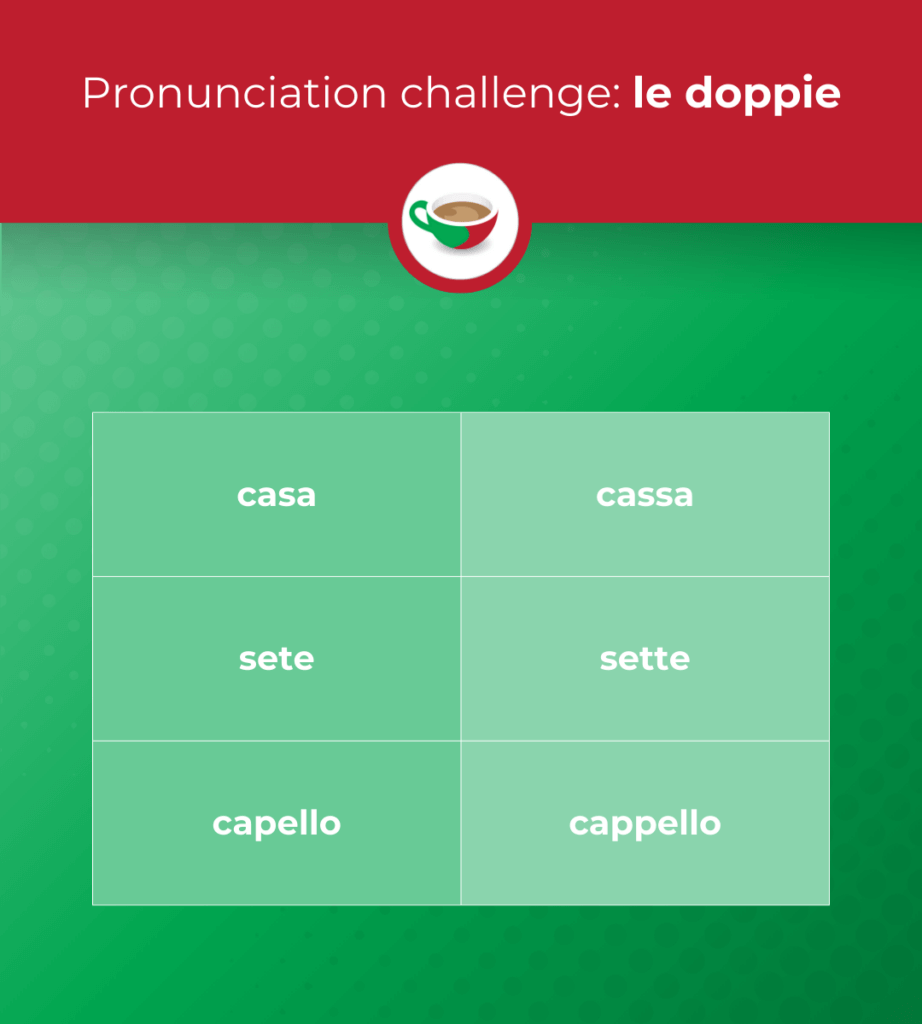
A pronunciation challenge

Let’s take a look at some common examples of how double consonants can change the meaning of words. Try to pronounce the following words, then listen to the podcast episode or watch the video to check how Maurizio pronounces each of them.

casa
house

cassa
till, cash desk

papa
pope

papà
dad

pappa
baby food

sete
thirst


sette
seven

cappello
hat

capello
hair

È tutto per oggi!

Keep practising your Italian pronunciation, paying attention to those double consonant sounds, and you will be well on your way to sounding more like a native speaker!

If you found this post interesting, make sure to listen to the full episode with Mark and Maurizio on The Coffee Break Italian Show. This is the series in which we look at a range of topics for Italian learners, so make sure to subscribe to our podcast feed or our channel on YouTube.

Plus! To get regular free Italian lessons in your inbox, you can sign up for our short (coffee-break-sized) email lessons that will help you improve your Italian. You will also hear from Mark, the founder of Coffee Break Languages, giving advice for language learners at any level. Sign up below!

Your pronunciation will improve with practice, so keep listening to Italian songs, watching TV and films, and trying to speak it whenever you can. We’ll be back soon with more interesting discussions about learning Italian.

Happy Coffee Breaking!

Listen to the podcast

Understanding adjective placement in French: when do adjectives go before a noun?

Adjectives play a crucial role in adding depth to your French conversations. However, understanding where to place them in a sentence can be tricky for learners.

In most cases, adjectives in French come after the noun they modify, but there are some exceptions which can make this rule seem more like a guideline.

The Coffee Break French Show is a podcast series of bite-sized, friendly conversations that demystify tricky French language topics. In the latest episode, Mark and Max discuss how to get your head around adjective placement.

Let’s dive into the world of adjectives in French and explore when and why some go before the noun.

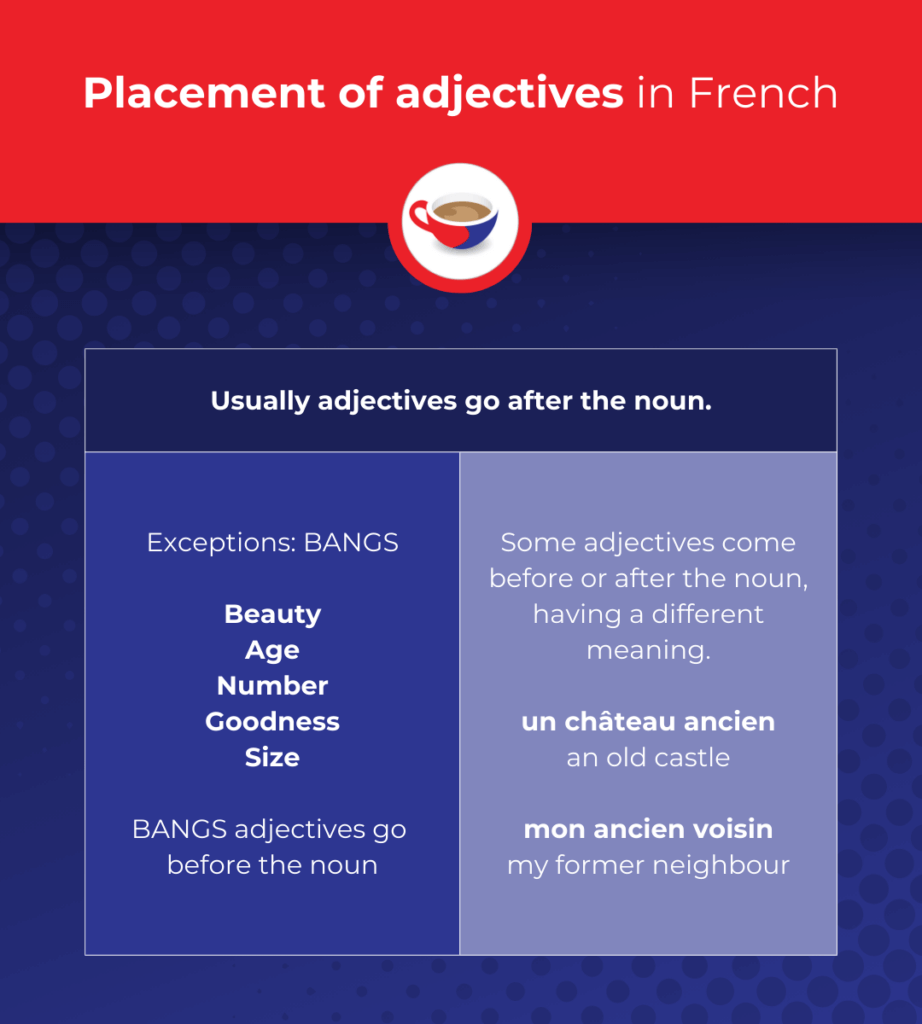
B.A.N.G.S.

To help you remember which adjectives go before the noun, you can use the acronym BANGS, which stands for Beauty, Age, Number, Goodness and Size.

Beauty

In French, adjectives that convey the idea of beauty come before nouns. For example:

un beau livre
a beautiful book

une belle armoire
a beautiful wardrobe

un bel oiseau
a beautiful bird

une jolie maison
a pretty house

Age

When discussing age, adjectives like vieux / vieille (“old”) come before the noun, as in:

un vieux château
an old castle

une vieille maison
an old house

Number

Adjectives related to numbers, such as premier / première (“first”) and deuxième (“second”), are placed before the noun. For instance:

le premier jour
the first day

la deuxième fois
the second time

Goodness

Adjectives like bon / bonne (“good”) and mauvais(e) (“bad”) are positioned before nouns. For example:

le bon gâteau
the good cake

la mauvaise nouvelle
the bad piece of news

Size

Adjectives describing size, such as grand(e) (“large”) and petit(e) (“small”), also go before the noun. For instance:

un grand canapé
a large sofa

une petite table
a little table

Adjectives with two possibilities

Now, here’s where it gets interesting. Some adjectives can be placed before or after the noun – and their placement alters the meaning. Here are some of them. In each pair of examples, notice how the meaning of the adjective changes, depending on whether it comes before or after the noun.

ancien / ancienne

mon ancienne maison
my former house

la maison ancienne
the old house

cher / chère

Cher Mark …
Dear Mark …

un canapé cher
an expensive sofa

curieux / curieuse

une curieuse recette
a strange recipe

mon ami curieux
my curious friend

dernier / dernière

le dernier mois de l’année
the last month of the year

le mois dernier
last month

vrai / vraie

C’est une vraie Rolex ?
Is it an actual Rolex?

C’est une histoire vraie.
It’s a true story.

propre

C’est ma propre chambre.
It’s my own bedroom.

ma chambre propre
my tidy bedroom

A visual summary

In conclusion

Understanding these exceptions and nuances in adjective placement can be a huge boost in your French fluency and allow you to express your ideas more precisely.

So, whether you’re describing a beautiful landscape or discussing your dear friend, mastering the placement of adjectives will help you convey your thoughts and opinions effectively.

If you found this post interesting, make sure to listen to the full episode with Mark and Max on The Coffee Break French Show. In this series of chats between our language experts, we look at a range of topics for French learners, so make sure to subscribe to our podcast feed and our channel on YouTube.

Plus! To get regular free French lessons in your inbox, you can sign up for our short (coffee-break-sized) email lessons that will help you improve your French. You will also hear from Mark, the founder of Coffee Break Languages, giving advice for language learners at any level. Sign up below!

Happy Coffee Breaking!

Listen to the podcast

How to pronounce the R in Spanish

The Spanish R is one of the most distinctive sounds when you listen to a native speaker.

For a learner, getting your mouth around the R might not only be challenging, but it can also be tough to know how and when to use it.

The Coffee Break Spanish Show is a podcast series of bite-sized, friendly conversations that demystify tricky Spanish language topics. In the latest episode, Mark and Anabel dive into Spanish pronunciation and chat about how to say the letter R.

Anabel shares valuable tips on how to achieve the correct pronunciation of the Spanish R – both when simple and when rolled – and gives us some creative ways to practise it.

Continue reading to find out more and why not listen to the podcast as you go?

The simple R – R you ready?

To pronounce the simple R sound in Spanish, you need to place the tip of your tongue above the back of your teeth, on the roof of your mouth. It’s the same place where you place it to pronounce a D. While you gently touch that point with the tip of your tongue to make a D sound, you have to “caress” it in order to pronounce the R.

If you are good at accents, Mark’s tip is to try saying words like “city”, “bottle” or “letter” in a New York accent. The sound made to pronounce the T in those words is very close to the Spanish R!

Now that you know how to say it, it’s important to practise. Here are some drills that will help you to master this sound:

ara – are – ari – aro – aru

era – ere – eri – ero – eru

ira – ire – iri – iro – iru

ora – ore – ori – oro – oru

ura – ure – uri – uro – uru

Once you have these, you can start practising with real words in Spanish, like:

caro
expensive

era
I was

giro
turn

huerto
vegetable garden

Pay attention to the letter combinations in the sounds and words we’ve seen so far, as this will help you to recognise when to make the simple R sound, as opposed to the strong R. When the R comes between two vowels (for example in caro) or at the end of a syllable (for example in huerto, the sound will be a simple R, rather than a strong R. We also pronounce a simple R when an R appears after a consonant, unless it’s an L, S or N (e.g brazo – “arm”).

The strong R – roll with it!

Now that we know where to place the tip of our tongue, we are going to keep it there, relax the tongue and exhale air strongly. With time and practice, the tip will move creating that double R sound. One shortcut is to try to say PR, placing your tongue in the right spot above your teeth. Then, try extending the R sound and saying prrr and brrr.

It can be tricky at first, but ¡no te preocupes! Practise as much as possible and soon you’ll have mastered the sound!

When you are able to say prrr and brrr, it’s time to practise with other drills. Try working your way through the following sounds:

ra – re – ri – ro – ru

arra – arre – arri – arro – arru
erra – erre – erri – erro – erru
ira – irre – irri – irro – irru
orra – orre – orri – orro – orru
urra – urre – urri – urro – urru

pra – pre – pri – pro – pru
bra – bre – bri – bro – bru
cra – cre – cri – cro – cru
tra – tre – tri – tro – tru
fra – fre – fri – fro – fru
dra – dre – dri – dro – dru
gra – gre – gri – gro – gru

As you may have noticed, this sound appears in Spanish when you have two Rs between vowels (e.g. perro – “dog”) or a single R at the beginning of a word (e.g. rápido – “fast”). We pronounce a rolled R when we find an L, S, or N before the R (e.g. alrededor – “around” or enriquecer – “enrich”). Note that when an R comes after any other consonant, we pronounce a simple R, rather than a rolled R.

Let’s practise!

One challenging word to practise is carretera, “road”, which contains both sounds – the simple and double R. A tip is to split it up and practise saying carre- and -tera as if they were two separate words.

Here are some trabalenguas, “tongue twisters”, to challenge yourself. You can hear Anabel pronounce these in the podcast episode. 

Like tongue twisters in any language, these are nonsense phrases! Still, in case you’re wondering, we’ve included the English translations:

Tres tristes tigres tragan trigo en un trigal.
Three sad tigers swallow wheat in a wheat field.

El carril del tren es rápido, caro y raro.
The train line is fast, expensive and rare.

El perro de Pedro rasca a la rata.
Pedro’s dog scratches the rat.

Enrico enriquece el rico arroz.
Enrico enhances the delicious rice.

Keep your Rs up!

If you found this post interesting, make sure to listen to the full episode with Mark and Anabel on The Coffee Break Spanish Show. In this series of chats between our language experts, we look at a range of topics for Spanish learners, so make sure to subscribe to our podcast feed and our channel on YouTube.

Plus! To get regular free Spanish lessons in your inbox, you can sign up for our short (coffee-break-sized) email lessons that will help you improve your Spanish. You will also hear from Mark, the founder of Coffee Break Languages, giving advice for language learners at any level. Sign up below!

Remember to be patient and keep on practising – ¡Recuerda ser paciente y practicar!

Happy Coffee Breaking!

Listen to the podcast

Unravelling word order in German multi-verb sentences

Word order in German can seem unusual, especially when there is more than one verb in a sentence. However, you’ll soon find that there are some straightforward rules to follow and constructing sentences with confidence will be well within your grasp.

The Coffee Break German Show is a podcast series of bite-sized, friendly conversations in which we demystify tricky German language topics. In the latest episode, Mark and Thomas discuss some rules to follow when using more than one verb in a sentence.

This short but thorough conversation clarifies how to form multi-verb sentences with certainty.

Continue reading to find out more and why not listen to the podcast as you go?

The basics of word order

Let’s look at the basics to get a clear starting point. As you may already know, the verb in a German sentence occupies the second position.

The verb may follow the subject of the sentence or an adverb of time. When after an adverb, the subject is moved into third position.

What happens with two verbs?

When there are two verbs in a sentence, one is conjugated and the other may be in the infinitive form or be a past participle.

What do we do in this case? The conjugated, auxiliary verb takes the second position. Just as its name suggests, an auxiliary verb helps out by forming part of a tense with another main verb. The main verb goes to the end of the clause or sentence.

Let’s look at this situation in more depth.

Types of auxiliary verbs

The first type of auxiliary verb Mark and Thomas mention is werden. It works together with a main verb, in the infinitive, to form the future tense.

The other auxiliary verbs they mention are haben and sein. These are conjugated in the present tense and work together with a past participle of a main verb to form the perfect tense.

The last type of auxiliary verbs Mark and Thomas look at in this podcast are modal verbs. They, too, are conjugated and placed in second position with the infinitive being placed at the end of the sentence or clause.

Examples with two verbs in a sentence

Here is an example of the future tense:

Wir werden morgen mit dem Boot nach Korsika fahren.
Tomorrow, we will travel to Corsica by boat.

This construction uses the conjugated present tense of werden in second position and the infinitive form of the main verb, fahren.

In the podcast, Mark mentions all the information given between the two verbs. There’s the time phrase, morgen. Then there’s a mode of transport, mit dem Boot. Next, there’s a location, nach Korsika, before the main verb. This is a good reminder of the word order of other parts of a sentence, i.e. time, manner, place. However, that’s a whole other video in itself!

Our second example also shows two verbs in one sentence, but this time one is a modal verb in the present tense and the other is an infinitive.

Du sollst nach dem Essen deine Hände waschen.
You should wash your hands after eating.

Sollst, the modal verb, is in the present tense, and the other, waschen, is in the infinitive. The modal verb is conjugated and takes second position, while the main verb is placed at the end of the sentence.

Our third example is in the perfect tense.

Mein Vater hat gestern Abend für uns gekocht.
My father cooked for us last night.

The auxiliary verb here is the conjugated, present tense of haben, which is paired with the past participle of the main verb, gekocht, forming the perfect tense. The past participle is at the end of the sentence or clause.

It can seem as though there’s a lot between the auxiliary verb and the main verb at the end of the clause or sentence.

Thomas gives a top tip: if you are reading in German, first look at the end of the clause or sentence to see the main verb. This helps you find out what the sentence is about.

Negation of a sentence with two verbs

Where do we place nicht if we want to make the sentence negative?

The nicht goes directly before the main verb at the end. This way it negates the whole sentence, not just one part of it. For example:

Sie werden dieses Spiel nicht gewinnen.
You (formal) will not win this game. / They will not win this game.

This sentence is in the future tense, using werden as the auxiliary verb. (By the way, gewinnen means “to win”, despite looking like a past participle since the infinitive begins with ge-. The past participle of gewinnen is gewonnen.) As you can see, the nicht is right before the infinitive, making the sentence negative.

Beginning with an adverb

Commonly, sentences begin with something other than the subject of the sentence. For example, an adverb of time can begin a sentence or clause, as we see in the example below.

Letztes Jahr sind sie mit dem Auto in den Urlaub gefahren.
Last year, they travelled on holiday by car.

The important thing to remember in this situation is that the conjugated verb, sind, still has to be in the second position, after the adverb of time, letztes Jahr. It is the subject of the sentence, sie, that moves into third position when something else comes before the first verb. The main verb, gefahren, still remains in last position at the end of the clause or sentence.

Subordinate clauses

The last construction Mark and Thomas look at is when there are two verbs in a subordinate clause, rather than a main clause. Let’s look at a final example:

Wenn du morgen arbeiten musst, dann können wir auch übermorgen schwimmen gehen.
If you have to work tomorrow, then we can go swimming the day after tomorrow.

A nice way to remember which is the subordinate clause is to think of it as the one that cannot stand alone and make sense on its own. In this example, it begins with wenn. Wenn is a subordinating conjunction and sends the verb to the end. This turns the rules we’ve learned so far on their head, as the conjugated verb, musst, is sent to the end of that clause, immediately after the main verb, arbeiten.

The other part of the sentence is a main clause and the verbs appear in the “normal” way – können is in second position and gehen is at the very end of the clause and sentence.

All in order?

Here’s a visual summary of how word order works in sentences with two verbs.

Be conscious of word order the next time you read something in German. Gradually, you will become more familiar with the rules, and correct word order will feel increasingly natural when you’re speaking German.

If you found this post interesting, make sure to listen to the full episode with Mark and Thomas on The Coffee Break German Show. In this series of chats between our language experts, we look at a range of topics for German learners, so make sure to subscribe to our podcast feed and our channel on YouTube.

Plus! To get regular free German lessons in your inbox, you can sign up for our short (coffee-break-sized) email lessons that will help you improve your German. You will also hear from Mark, the founder of Coffee Break Languages, giving advice for language learners at any level. Sign up below!

Happy Coffee Breaking!

Listen to the podcast

Mastering French vowel sounds: ‘ou’ and ‘u’ made easy

French pronunciation can be both fascinating and tricky, especially when it comes to vowel sounds like ou and u.

These two sounds might seem similar at first, but being able to distinguish between them will greatly help to improve your French pronunciation and comprehension, as well as your spelling.

The Coffee Break French Show is a podcast series of bite-sized, friendly conversations in which we demystify tricky French language topics. In the latest episode, Mark and Max break down how to pronounce ou and u in simple terms.

In this article, we are going to look at the tips they give us to be able to produce these sounds accurately, and we will also provide some words and exercises to practise.

Continue reading to find out more.

How to say ‘ou’

Max gives his tips for pronouncing ou:

Lips slightly forward

Begin by pushing your lips slightly forward.

Round your mouth

Keep your mouth in a rounded shape.

Tongue placement

Place your tongue towards the back of your mouth, but don’t let it touch your teeth.

Here are some examples of words that have this sound:

nous
we / us

vous
you (formal / plural)

bonjour
hello

How to say ‘u’

Max’s tips for pronouncing u are:

Lips slightly forward

Like ou, push your lips slightly forward.

Round your mouth

Maintain the rounded shape of your mouth.

Tongue placement

Unlike ou, this time let your tongue gently touch your bottom teeth while making the sound.

Some examples of words that have this sound:

tu
you (informal singular)

j’ai lu
I read / I have read

j’ai vu
I saw / I have seen

j’ai bu
I drank / I have drunk

Let’s practise!

Now that you know the basics, let’s practise to improve your pronunciation. In the podcast episode, Max tells us four top tips for you to get a good grasp of this pronunciation:

  1. Repeat the sounds

    Start by saying ou and u separately, repeating each sound five times. Pay close attention to your lip and tongue positions.

  2. Spelling matters

    Get familiar with how these sounds are spelled in French. This is one example of where French spelling makes perfect sense – you’ll always find ou and u representing these sounds. The pronunciation of these two sounds is the same even if there is an accent in the word, for example (“where”) and (the past participle of devoir). The only small additional detail to watch out for is one word that sounds exactly like u: eu, the past participle of avoir. This is used in compound tenses like the passé composé, such as in j’ai eu (“I have had”).

  3. Use them in sentences

    Try incorporating these sounds into everyday phrases and sentences. For example, try saying:

    nourriture
    food

    tout va bien
    everything is going well

    tu vas bien
    you are well

    Tu l’as lu ?
    Have you read it?

    Manges-tu du mangetout ?
    Do you eat mangetout / snow peas?

    This will help you practise using these sounds naturally.

  4. Spot the difference

    To really grasp the nuances, work with minimal pairs – these are words that differ by just one sound. Here are some examples to practise with:

    hutte / août
    Hutte
    means “hut”, while août means “August”.

    du / doux
    Du
    means “of the” / “some” / “from the” / “any”, while doux means “sweet”.

    puce / pouce
    Puce
    means “flea” / “computer chip”, while pouce means “thumb”.

    bulle / boule
    Bulle
    means “bubble”, while boule means “ball”.

    tu le jures / tout le jour
    Tu le jures
    means “you swear it”, while tout le jour means “all day”.

    la mûre / l’amour
    La mûre means “the blackberry”, while l’amour means “love”.

A visual summary


In conclusion

Mastering the pronunciation of ou and u in French is a journey that gets easier with practice. By understanding the basics of lip and tongue positions, using these sounds in sentences, and practising with minimal pairs, you’ll soon find yourself speaking French with more confidence.

If you found this post interesting, make sure to listen to the full episode with Mark and Max on The Coffee Break French Show. In this series of chats between our language experts, we look at a range of topics for French learners, so make sure to subscribe to our podcast feed and our channel on YouTube.

Plus! To get regular free French lessons in your inbox, you can sign up for our short (coffee-break-sized) email lessons that will help you improve your French. You will also hear from Mark, the founder of Coffee Break Languages, giving advice for language learners at any level. Sign up below!

So, embrace the charm of French pronunciation, one vowel sound at a time.

Bonne chance and happy Coffee Breaking!

Listen to the podcast

8 German songs for learners

A phone and headphones resting on a dark table

Listening to songs when learning German is an effective and enjoyable way to practise your language skills. German songs can help improve your listening comprehension and your pronunciation and, on top of this, music is catchy! This means that the new words, phrases and structures that you hear within a song may be easier to remember and reuse in your own speaking or writing.

Thousands and thousands of songs exist throughout the German-speaking world – where do you start with finding ones to listen to which will help you practise your German? In this article, we’ve done the hard work for you! 

Read on to discover 8 German songs we recommend to help your learning.

1. Griechischer Wein – Udo Jürgens, 1974

As mentioned before, using music to learn a new language is an interesting and fun way to practise your skills. So, without further ado, let’s talk about our first suggestion on this list of German songs for learners:  Griechischer Wein, by Udo Jürgens.

He was an Austrian-Swiss singer and composer who is partly remembered for winning the Eurovision Song Contest for Austria in 1966 with the song Merci, chérie. Many consider him to have played a large role in expanding German-language pop music by bringing in influences from other genres, such as French chanson.

Griechischer Wein is one of his most popular songs and versions in a number of different languages have since been recorded, including Bing Crosby’s version which he recorded during one of his last sessions, titled Come Share the Wine.

LINK: Lyrics

2. Ein bißchen Frieden – Nicole, 1982

If you are a Eurovision fan, perhaps you’ll remember Germany’s winning song from 1982, Ein bißchen Frieden, performed by 17-year-old school student, Nicole. In 2005, the European Broadcasting Union announced Ein bißchen Frieden as one of the 14 most popular Eurovision songs ever, according to the results of their Internet poll. 

The song was written by Ralph Siegel and Bernd Meinunger and its success led to the recording of versions of it in many different languages. The English version, A Little Peace, reached Number 1 in the UK Charts.

Listen out for similes in this song’s first verse, as they are great examples of phrases of comparison in German. Just consider “wie eine Blume” or “wie ein Feuer” and you can spot the common construction introduced by the adverb “wie”. Another grammatical feature to look out for is the recurrence of embedded clauses beginning with the word “dass”.

LINK: Lyrics

99 Luftballons – Nena, 1983

In our look at German songs, this one is very popular and we’re sure may have heard the 80s hit 99 Red Balloons, which reached Number 1 in the UK and the US Charts, but have you tried listening to its original version in German? It was released in 1983 by German band, Nena, who were together between 1981 and 1987. 

The band is very important to German musical culture, as it was part of the forming of the German New Wave scene (Neue Deutsche Welle). 99 Luftballons was a huge success across Europe, leading to the writing of the English version the year after. 

Unfortunately, Nena never managed to match the success of 99 Luftballons and the band broke up after the release of its fourth, final and least successful album in 1986. They reunited in 2017 for a public performance of their debut single, Nur geträumt, to mark the 40th anniversary of the band’s first appearance on stage.

The lyrics to 99 Luftballons tell the story of the release of 99 balloons. These are mistaken for UFOs and the reactions of different nations result in a destructive war breaking out. The lyrics to 99 Red Balloons aren’t an exact translation but carry the same anti-war message.

Like many German songs, this one contains several interesting language points that you may recognise. For instance, it demonstrates the differences in building the plural form of nouns. For example, the words “Kriegsminister” and “Düsenjäger” remain in the same form when made plural. 

On the other hand, the nouns “Luftballons” and “Jahre” change in their plural form. Something else to note is the omission of the personal pronoun in sentences like “Hab’ nen Luftballon gefunden”. This song is also good practice for your numbers in German! Before you look at the lyrics, see if you can count how many times you hear her sing “neunundneunzig” (“ninety-nine”). 

LINK: Lyrics

4. Mensch – Herbert Grönemeyer, 2002

When talking about German songs, we could not leave out the title track of Germany’s best-selling album of all time. Mensch sold over 3 million copies in Germany and thanks to this success and the popularity of his fifth album, 4630 Bochum (1984), Herbert Grönemeyer is often considered one of the most successful German artists.

One prominent language feature of this song is the frequent use of the conjunction “und”. In German, this word is often added to form sentences with multiple dependent clauses. Also, listen out for examples of compound words, such as “Sonnenzeit” or “ozeanblau”.

LINK: Lyrics

5. Der perfekte Moment… wird heut verpennt – Max Raabe, 2017

The fifth recommendation in this article about German songs comes from an artist with a very interesting musical style. Max Raabe founded his Berlin-based Palast Orchester with fellow students in the mid-1980s while studying opera in Berlin. 

Together, Raabe and Palast Orchester perform covers of cabaret songs from the Weimar period as well as original songs that merge 1920s and 30s melodies with modern lyrics. As well as this, they have recorded some covers of modern pop songs in a 1920-30s style, including Britney Spears’ Oops!… I Did It Again

The title track of their most recent album, Der perfekte Moment… wird heut verpennt, is among the list of good German songs for learners as it allows you to practise your listening comprehension, where Raabe sings in nice, clear German. As you’re listening, it is particularly interesting to take a look at all the idioms the song contains. 

Most of them are used to describe that the singer will not do anything today, for example, “Heut’ mach’ ich gar nichts/Keinen Finger krumm”. “Was ich heut’ besorgen kann” is especially interesting, because it is a play on the original saying “Was ich heut’ kann besorgen, verschieb’ ich nicht auf morgen”.

LINK: Lyrics

6. Sowieso – Mark Forster, 2016

The sixth recommendation in our list of German songs is Sowieso by Mark Forster. This track is an upbeat song that talks about embracing life’s uncertainties. Mark Forster, a well-known figure in the German pop music scene, released this song in 2016, and it quickly became a hit.

Sowieso is perfect for German learners because the lyrics are clear and easy to follow, making it a great choice for practising listening comprehension. As you listen, pay attention to phrases like “Egal, was kommt, es wird gut, sowieso” and other interesting expressions.

LINK: Lyrics  

7. Barfuß am Klavier – AnnenMayKantereit, 2013

Released in 2013, this song by the German rock band AnnenMayKantereit is a beautiful ballad. The band’s distinctive sound is characterised by the deep voice of the lead singer Henning May, which adds a unique touch to their music. 

Barfuß am Klavier is part of this German songs list due to its poetic lyrics, offering listeners a glimpse into the band’s heartfelt storytelling. 

LINK: Lyrics

8. Auseinandergehen ist schwer – Wanda, 2014

The last on our list of German songs is “Auseinandergehen ist schwer” by the Austrian band Wanda. The band is known for their catchy melodies and honest lyrics.

The song is sung in clear German, making it an excellent choice for learners who want to practise their listening skills and expand their vocabulary relating to relationships and emotions.

LINK: Lyrics 

We hope this article has given you a useful introduction to just a tiny proportion of the huge variety of German songs which are out there. In our special Tune for Tuesday – German playlist you can find some more examples to learn the language with some catchy rimes. Don’t forget to save it.

If you want to get access to more interesting content like this, make sure to subscribe to our Coffee Break German newsletter!


8 Spanish Songs For Learners

A cozy flat lay featuring a red coffee mug filled with black coffee, a pair of white over-ear headphones, and two books

Any learner wanting to have more contact with the language that they are learning should try to listen to music. That is why we ask you “do you know any songs for learning Spanish”? 

There are so many different songs available that it might be hard to find a playlist at a beginner level for the Spanish-speaking world. But, don’t worry! In this article, we’ve done the hard work for you and selected 8 songs in Spanish specifically for that purpose!

1. ¡Y viva España! – Manolo Escobar, 1973

The first music on our list of Spanish songs for learners was actually written by a Belgian composer and Belgian lyricist, Leo Caerts and Leo Rozenstraten. It started out as Eviva España, a song about holidaying in Spain, imitating the Spanish pasodoble musical style (the name given to a style of Spanish dance and music often played during bullfights). 

It seems that the meaning behind “Eviva” in the title is unknown, but when the song was translated into Spanish, this became “Y viva”. Manolo Escobar’s 1973 recording of the Spanish version of the song was extremely successful.

Escobar was a very well-known singer, actor and performer of Andalusian copla, a style of Spanish popular song. He began his career in a band with four of his brothers, called Manolo Escobar y sus guitarras.

There are many interesting language points to listen out for in this song. Don’t worry if there are some words you don’t recognise, as there are a few unusual pieces of vocabulary, for example, “fandanguillos y alegrías” are styles of Spanish music and dance.

Listen out for the many different verb tenses used in the lyrics, including the line which uses both the present perfect and the future tense, “España siempre ha sido y será…” (“Spain has always been and always will be…”). And, of course, you may quickly notice the repeated Spanish subjunctive in the chorus “Que viva España” (“Long live Spain”), as this is expressing a desire that something will happen

LINKS: Lyrics | English translation

2. La Puerta de Alcalá – Ana Belén & Víctor Manuel, 1986 

If you have ever visited Madrid, it is likely that the title of this next song will conjure up images of Madrid’s famous monument of the same name. Inaugurated in 1769, La Puerta de Alcalá is often associated with similar Roman arches such as the Arc de Triomphe and the Brandenburg Gate.

Over 200 years later, La Puerta de Alcalá, the song, was written by Bernardo Fuster, Luis Mendo, Miguel Ángel Campos and Francisco Villar, to be performed by Ana Belén and Víctor Manuel. These two Spanish singers were married in 1972 and are often considered symbols of the Spanish Transition to Democracy, with many of their songs expressing strong social and political opinions. 

Their recording of La Puerta de Alcalá stayed at Number 1 in the Spanish charts for seven weeks and it remains an important song for many Madrileños because of its link with the monument. In our list of songs for learning Spanish, this one has interesting lyrics as it contains several more complex phrases, and each verse of the song refers to a different socio-political event that has affected Madrid and its famous monument.

Amongst the many language points to look out for within the lyrics, listen out for the refrain “Ahí está, la Puerta de Alcalá” (“There it is, La Puerta de Alcalá”). You can remember this line as a good example of when to use ser or estar in Spanish to describe the position of something.

LINKS: Lyrics | English translation

3. En el muelle de San Blás – Maná, 1997

Our next song comes from a Mexican pop-rock group formed in 1986, whose name, Maná, comes from the Polynesian term for supernatural energy. They have won 4 Grammy Awards and are extremely popular throughout Latin America and further afield.

Their song En el muelle de San Blás tells the story of Rebeca Méndez Jiménez, who is said to have waited at the pier of San Blás, on the Pacific coast of Mexico, for 41 years for her husband to return from a fishing trip. It is thought that he tragically got caught in a storm out at sea and never returned. One day, she was noticed by Fher Olvera, the lead singer of Maná, who listened to her story and decided to write the song. 

The lyrics are a good challenge for your Spanish comprehension, so we recommend reading them as you listen to the song another time so that you can fully understand the story being told. They also contain many examples of the preterite and the imperfect tenses in Spanish.

LINKS: Lyrics | English translation

4. Color esperanza – Diego Torres, 2001

Born in Buenos Aires, Diego Torres is a singer, songwriter, actor and musician who is well-known throughout Latin America, the United States and Spain. He is also known for being the son of famous Argentinian film actress, Lolita Torres. His uplifting song, Color esperanza, focuses on hope. In 2003, Torres gave a special performance of it in order to welcome Pope John Paul II to Cuatro Vientos Airport in Madrid. 

Torres sings quite clearly and the lyrics aren’t too complex and, of course, contain many examples of language points you have been learning about. For example, note the interesting phrase in the chorus, “Saber que se puede, querer que se pueda”, which can be used to compare the use of the indicative and the subjunctive. 

This would be a good example to memorise, to help you remember the structures “saber que + infinitive” and “querer que + subjunctive”. For sure music that deserves to be on the list of songs for learning Spanish!

LINKS: Lyrics | English translation

5. El mismo sol – Alvaro Soler, 2015

The fifth tune on our suggestion of songs for learning Spanish was one of the hits of the summer of 2015 in Spain and across Europe. El mismo sol is the debut single of Spanish-German singer, Alvaro Soler. Following the success of the song, there are now various recordings of it. Soler collaborated with Jennifer Lopez to create a version with the addition of her vocals, and a version in Spanglish, El Mismo Sol (Under The Same Sun), with some lyrics in English. 

The lyrics to this positive, upbeat song focus on the idea of a united world where “no hay fronteras” (“there are no borders”) and where “todos estamos bajo el mismo sol” (“we are all under the same sun”). And also, luckily for us, they are sung nicely and clearly! 

We recommend reading the lyrics and trying to find some useful examples of the language points you have been studying. For example, note the double subjunctive in the first line of the chorus, “Yo quiero que este sea el mundo que conteste”. 

We’d also like to take a moment to admire Soler’s impressive number of languages. It is said that he speaks Catalan, Spanish, German, English, Italian, French and Japanese!

LINKS: Lyrics | English translation

6. Todo se transforma – Jorge Drexler, 2015

Jorge Drexler’s “Todo se transforma” released 14 years ago, is a timeless classic that talks about the interconnectedness of all things. As the Uruguayan artist says:

Nada es más simple
No hay otra norma
Nada se pierde
Todo se transforma

Nothing is simpler
There is no other rule
Nothing is lost
Everything transforms

The song lyrics are an excellent resource for learners looking to expand their vocabulary. The way Drexler plays with words and ideas offers a unique opportunity to understand deeper, more abstract concepts in Spanish. 

LINKS: Lyrics | English translation

6. Cuando te mueras –  Jósean Log, 2020

Jósean Log’s “Cuando te mueras” is a very emotional song that brings to light themes of ageing and companionship. Its lyrics are a great example of Spanish songs with subjunctive, a crucial aspect of grammar. 

Although the song’s theme might be intense, it offers a profound learning experience, illustrating the depth of Spanish linguistic and emotional expression.

LINKS: Lyrics | English translation

7. Te guardo – Silvana Estrada, 2022

Released in 2022, this song stands out as a captivating piece that blends traditional Mexican folk elements with contemporary influences. The lyrics are poetic and talk about personal experiences and universal emotions.

The release of “Te guardo” in 2022 marked another milestone in Silvana Estrada’s career. As a rising star in the Latin music scene, Estrada continues to enchant listeners with her unique sound and storytelling, solidifying her place as a significant voice in contemporary music.

LINKS: Lyrics | English translation

8. Si no estás – Íñigo Quintero, 2024 

If you are an active user on TikTok you might have come across this trendy song. The lyrics of “Si no estás” are poetic and relatable, painting a vivid picture of the void left by a loved one’s absence. 

Lines like El tiempo pasa lento sin tu sonrisa Time passes slowly without your smile and Mis días son oscuros si no estás My days are dark if you’re not here showcase the artist’s ability to express complex emotions with simplicity and grace. 

LINKS: Lyrics | English translation

We hope this article has given you a useful introduction to just a tiny proportion of the huge variety of Spanish-language music which is out there, across the whole Spanish-speaking world. 

Two of the songs we have chosen, La Puerta de Alcalá and En el muelle de San Blás, are already included in our Tune for Tuesday on our Spotify playlist

Now, how about understanding more about how you can use songs to improve your language learning? Check our blog post on the subject and make the most of your journey!

10 French songs for learners

Close-up of a laptop keyboard with a pair of white over-ear headphones resting on it, alongside a cup of espresso on a white wooden desk.

Listening to songs in the language you’re learning is an effective and enjoyable way to practise your language skills. It can help improve your listening comprehension and your pronunciation, and on top of this, music is catchy! When you listen to French songs, you might find that the new words, phrases, and structures stick in your mind more easily, making it simpler to use them in your own speaking or writing.

But there are thousands of songs throughout the French-speaking world—where do you start with finding ones that will help you practise your French? In this article, we’ve done the hard work for you! Read on to discover our ten recommended songs for learning French.

1. À la claire fontaine – traditional French song

We’ll start our list of French songs for learners with one that may be the first that many French children have ever heard. À la claire fontaine is a very well-known traditional French song. This classic nursery rhyme is thought to date back to the early 17th Century when it was sung both in France and in what was later to become Quebec, as French settlers were arriving in Canada. 

To make the most of your language learning using music, you must listen to the song a few times without looking at the lyrics and then add the lyrics in! À la claire fontaine is very useful for French learners, as it contains many different verb tenses, including the passé composé, the imperfect, the future and even the imperfect subjunctive – fût in the final verse is the third person singular form of être in the imperfect subjunctive. 

We recommend trying to spot all the tenses you know while reading the lyrics. To help you with any comprehension problems, you can also look at an English translation of the text. 

LINKS: Lyrics | English translation

2. La mer – Charles Trenet, 1946

We’re sure that many of you will be familiar with this very famous song, originally recorded by Roland Gerbeau in 1945 but made famous by the great Charles Trenet in 1946. Trenet was a very popular French singer-songwriter whose career lasted from the 1930s to the 1990s. Following his recording of La mer, it was translated into many different languages, including, as many of you will know, English (titled Beyond the Sea).

Again, study the lyrics like you would if they were any other reading text: look up new words you don’t know and try to spot specific language points you have been studying. La mer is one of the best French songs for practising adjectives. 

Take a moment to consider which adjectives precede the noun and which come after it, and note how the adjectives change depending on whether the noun it’s describing is masculine or feminine and singular or plural. For example, compare ces grands roseaux mouillés and ces maisons rouillées. If you’d like to recap adjective agreement and positioning, join Mark and Anna in Coffee Break French Season 2 Episode 9

LINKS: Lyrics | English translation

3. Tous les garçons et les filles – Françoise Hardy, 1962

It is generally thought that Françoise Hardy stood out from the crowd among the 1960s French yé-yé pop singers because she wrote her own songs and went on to influence the likes of Mick Jagger and Bob Dylan. She rose straight to the top of the charts at the age of 18 with her first record, Tous les garçons et les filles, which describes a young person watching with envy the couples around her when she has never known love herself. Hardy later recorded the song in Italian (Quelli della mia età) and in English (Find Me a Boy). 

And luckily for us, this is one of the French songs in which the vocabulary used isn’t too tricky, so have a listen and see how much you can understand. As always, listen out for examples of the language points you have been learning about. For example, if you are familiar with the word personne, which can mean no one, listen out for the repeated phrase personne ne m’aime no one loves me.

LINKS: Lyrics | English translation

4. Je reviendrai à Montréal – Robert Charlebois, 1976

The fourth song on our list of French songs for learners is Je reviendrai à Montréal, one of the most famous songs by musician, composer, author, and actor Robert Charlebois. Originally from Montreal, Quebec, he is thought to have been hugely influential in the development of music in Quebec and throughout the francophone world. In 1999, he was made an Officer of the Order of Canada.

The lyrics of some of his songs include many, specifically québécois words, which makes them very interesting, but if you try listening to them, don’t worry if you struggle to understand what he is singing about! 

However, the lyrics of Je reviendrai à Montréal, are in a much more standard, universal French. Look out for the example of the future tense in the title and repeated throughout the song, je reviendrai, meaning I will come back. There are also several uses of avoir besoin de + infinitive/noun, for example, j’ai besoin de sentir le froid  I need to feel the cold and j’ai besoin de cette lumière I need that light and an example of the subjunctive trigger sans que + subjunctive. 

To learn more about the subjunctive and other subjunctive triggers, listen to Coffee Break French Season 3 Episode 16.

LINKS: Lyrics | English translation

5. Papaoutai – Stromae, 2013

We’re sure that many of you already know Stromae, a Belgian rapper and singer-songwriter whose songs have been huge successes across much of Europe. Paul Van Haver originally chose Opsmaestro as his stage name but then changed it to Stromae. 

This name comes from the word maestro and is an example of verlan, a type of French slang involving swapping around a word’s syllables (mae-stro stro-mae). His song Papaoutai, Belgium’s best-selling single of 2013, refers to the absence of Stromae’s father during his childhood. The title comes from Papa où t’es ? Dad, where are you?

The lyrics contain many examples of different verb tenses, the use of the pronouns y and en and many more language points you can look out for. Also, note how the repeated question in the chorus où t’es ? combines tu and es to make t’es, which is very common in informal, spoken French. 

LINKS: Lyrics | English translation

6. Et si tu n’existais pas –  Joe Dassin, 1975

A true classic when it comes to French songs, Et si tu n’existais pas by Joe Dassin is a poetic love song. Released in 1975, this music is one of Dassin’s most well-known songs. The lyrics explore a world in which the singer’s beloved does not exist.

One of the key grammar points found in this song is the use of si clauses (if clauses) combined with the conditional tense – a fundamental structure in French grammar. In particular, this music features a Type 2 si clause, which follows this pattern:

  • Et si tu n’existais pas, dis-moi pourquoi j’existerais ? And if you didn’t exist, tell me why I would exist?

LINKS: Lyrics | English translation

7. J’irai où tu iras – Céline Dion, 1995

If you’re looking for French songs that beautifully showcase the future tense and the conditional, J’irai où tu iras is a perfect choice. This upbeat and emotional duet was released in 1995 on Céline Dion’s album D’eux, which remains the best-selling French-language album of all time.

The title itself, J’irai où tu iras I will go where you will go, gives us a great example of the future tense in French j’irai I will go and how it is used to express determination and certainty about the future. Throughout the song, the singers talk about following each other wherever life takes them, using different conjugations of the future tense (je ferai, tu verras) and the conditional (je voudrais, tu aimerais) to express both certainty and possibilities.

LINKS: Lyrics | English translation

8. Hier Encore – Charles Aznavour, 1964

This 1964 song reflects on the passage of time, lost youth, and past mistakes. Aznavour, one of the most celebrated French singers, is known for his deeply emotional lyrics and expressive storytelling. But beyond its moving message, this is one of the best French songs for learners to practise the contrast between the imparfait and passé composé, two essential past tenses in French.

These two tenses play different roles in French narration, and this song provides a perfect example of how they are used in real-life contexts.

LINKS: Lyrics | English translation

9. Je te promets – Johnny Hallyday, 1986

Johnny Hallyday, often referred to as the French Elvis, was a legendary rock star in France with a career spanning over five decades. Je te promets is one of his most beloved songs. Its romantic lyrics are filled with promises for the future, making it one of the best French songs for learners to study the future simple tense in action.

Throughout the lyrics, Johnny Hallyday makes various promises about what will happen in the future, using the futur simple tense. Here are some examples from the song:

  • Je te promets des histoires différentes des autres. I promise you stories different from others
  • Je te promets du feu à la place des armes. I promise you fire instead of weapons.

LINKS: Lyrics | English translation

10. Francis – Cœur de Pirate, 2008

Finally, on our list of French songs is one to help you master negation in French. Francis by Cœur de Pirate is a perfect choice. Released in 2008 as part of her debut album, this song showcases Béatrice Martin’s signature melancholic storytelling and delicate piano melodies. 

One of the most interesting aspects of the lyrics is how they feature different forms of negation, offering learners a chance to hear how negation is used in French. The song uses ne… plus no longer and ne… jamais never instead of the typical ne… pas not, providing a more nuanced way to express negation beyond the basics.

LINKS: Lyrics | English translation

And there you have it – ten fantastic French songs that will not only introduce you to a variety of musical styles, but also help you improve your vocabulary, grammar, and pronunciation. By listening to these songs, reading the lyrics, and singing along, you can boost your comprehension skills while enjoying some of the best music the francophone world offers. So why not start incorporating French songs into your language-learning routine today?

If you would like to see some French movies to help you improve your learning routine even further, check out the article we prepared with eight great suggestions!

10 best songs to learn Italian

A book with white over-ear headphones resting on top, next to a cup of coffee with foam on a dark textured surface

Integrating music into your Italian study routine can make it an enjoyable and effective process. Songs provide a rich resource of vocabulary, grammar, and cultural context, making them an excellent tool for language learners. With that in mind, we prepared this article with some of the best songs to learn Italian!

So, grab your headphones, turn up the volume and get ready to listen to some amazing tunes!

1. Piove (Ciao, ciao bambina) – Domenico Modugno, 1959

Being able to use your favourite songs to learn a new language is amazing, isn’t it? The first tune to make the list of best songs to learn Italian is by a very important figure in Italian music. 

Originally from Puglia in Southern Italy, Domenico Modugno is often considered the first Italian cantautore (singer-songwriter). Later in his life, he suffered a severe stroke and was forced to abandon his musical career. 

He devoted himself to politics and became a member of the Italian Parliament before returning to the music scene for the final few years of his life. Piove (Ciao, ciao bambina) won first prize in the 1959 Festival della Canzone Italiana di Sanremo (Italy’s most popular song contest) and was chosen as Italy’s entry for the Eurovision Song Contest in the same year.

Piove (Ciao, ciao bambina) is a love ballad in which he is saying goodbye to his lover as their relationship comes to an end. After listening to the song a few times without reading the lyrics, we recommend checking the lyrics and finally looking for the English translation.  

In this song, there are many interesting language points to listen out for within the lyrics. For example, there are many different tenses used throughout the song, including one phrase which uses c’è, both in the imperfect and the present: “c’era una volta poi non c’è più”. Why not read through the lyrics and try to spot all the tenses you know?

LINKS: Lyrics | English translation

2. Ma il cielo è sempre più blu – Rino Gaetano, 1975

The next piece of music on the best songs to learn Italian list is by another well-known cantautore, Rino Gaetano, who is often remembered for his satirical songs and ironic humour. Ma il cielo è sempre più blu was one of his most successful songs.

In this one, Gaetano satirically describes Italian society, concluding that despite the diverse ways of life of different social groups and the inequality which exists between them, the sky is always the same for everyone. The lyrics follow the same structure throughout the whole song: chi + verb in the third-person singular (lui/lei) form. 

We’d recommend trying to figure out the infinitive of each of these verbs and looking up those you don’t know. To learn more about how to use the word chi, listen to Coffee Break Italian Season 2 Episode 25.

LINKS: Lyrics | English translation

3. L’isola che non c’è – Edoardo Bennato, 1980

L’isola che non c’è translates literally into English as ‘the island that isn’t there’, but is known amongst Italian speakers as the name of the home of Peter Pan – known by English speakers as Neverland. Edoardo Bennato’s song of this name comes from his very successful 1980 concept album, Sono solo canzonette, based on the world of J. M. Barrie’s Peter Pan

Bennato is a very popular and influential Italian singer-songwriter whose music is often considered a creative fusion of various genres – including folk, rock, blues and sometimes even opera elements. While Bennato is well known for his songs with satirical, ironic lyrics, he has also written several concept albums, including one based on the world of Pinocchio and another based on the Pied Piper of Hamelin.

L’isola che non c’è is about believing in a better world without wars or violence. This tune has interesting lyrics, which makes it a perfect addition to the list of Italian songs for beginners, as it has many language points to listen out for. There are a couple of examples of the use of the pronoun ci with the verbs pensare and credere: “E a pensarci” would translate as “And thinking about it” and “Se ci credi” would translate as “If you believe it”. 

If you’d like to learn more about the pronoun ci you can listen to Coffee Break Italian Season 2 Episode 36, where it is discussed in more detail. 

LINKS: Lyrics | English translation

4. La cura – Franco Battiato, 1996

La cura is another song which is a great addition to the list of best songs to learn Italian, as the lyrics are sung very clearly. The song was a collaboration between Sicilian philosopher Manlio Sgalambro, who wrote the lyrics, and Sicilian musician, filmmaker and painter, Franco Battiato. 

Battiato’s experimental musical style – a fusion of various genres – and his collaboration with Sgalambro on numerous albums made him one of Italy’s most popular artists from the 1970s until today. In 1984, he represented Italy in the Eurovision Song Contest, performing with Italian singer, Alice.

La cura is one of Coffee Break Italian Francesca’s favourite songs because of the beautiful poetry of the lyrics. They also contain many different examples to help you remember how to use the verb proteggere with the structure proteggere qualcuno di qualcosa

Also note how di is combined with each definite article: for example, in the first line, Battiato sings “Ti proteggerò dalle paure delle ipocondrie”. If you’d like to revise this language point, listen to Coffee Break Italian Season 2 Episode 14.

LINKS: Lyrics | English translation

5. A me piace lei – Dente, 2009

Fifth on the list of best songs to learn Italian is A me piace lei. It is great music for any Italian learners who find the verb piacere a bit tricky to use, as it contains some great examples to help you. 

A me piace lei is a song by the ‘Italian king of indie rock’, as he is sometimes called. Giuseppe Peveri, known by his stage name, Dente (Italian for ‘tooth’) started his solo career in 2006 and has since become one of Italy’s most popular independent artists.

Why not use some of Dente’s lyrics to help you remember how to use the verb piacere? Notice how the verb changes depending on whether what he likes is singular (eg. “mi piace anche la pausa pranzo”) or plural (eg. “mi piacciono le risate e le stelle filanti”), or whether he’s talking about what the girl he’s singing about likes (eg. “le piace cucinare”). 

For help with the verb piacere, listen to Coffee Break Italian Season 1 Episode 13.

LINKS: Lyrics | English translation 

6. E più ti penso – Andrea Bocelli and Ariana Grande, 2015

Next on our list of best songs to learn Italian is E più ti penso, a beautiful duet by the renowned Italian tenor Andrea Bocelli and pop sensation Ariana Grande. Released in 2015, this song combines the talents of both artists to create a powerful and emotional piece.

The tune was originally written by Ennio Morricone for the movie ‘Once Upon a Time in America’. The song’s lyrics speak of longing and love, making it a perfect choice for language learners who want to dive deep into Italian expressions of emotion.

For example, the line E più ti penso e più mi manchi The more I think of you, the more I miss you showcases the use of comparative structures and reflexive verbs. Another beautiful line to note is In questo cuore non c’è niente di nuovo In this heart, there is nothing new, which helps learners understand negation and simple sentence structure in Italian.

LINKS: Lyrics | English translation

7. Sinceramente – Annalisa, 2023

Sinceramente by Annalisa is a perfect addition to the list of best songs to learn Italian, especially for those looking to grasp contemporary Italian expressions. Annalisa, a well-known figure in the Italian music scene, brings pop lyrics to her music, making it accessible and relatable for learners.

Listening to Sinceramente multiple times and reading along with the lyrics will help reinforce your understanding and pronunciation of many key expressions.

LINKS: Lyrics | English translation

8. Domenica – Coez, 2019

This song is another excellent choice for learners wanting to know more about modern Italian music. The duo is known for their unique blend of hip-hop and pop, delivering relatable and engaging lyrics that are perfect for expanding your Italian vocabulary.

Domenica, which translates to Sunday, is a song that captures the essence of a lazy day. Pay special attention to the colloquial phrases and everyday vocabulary used throughout the song. For example, listen for phrases like Vorrei fosse domenica I wish it were Sunday where the structure can be used for expressing wishes. 

LINKS: Lyrics | English translation

9. La prima cosa bella – Malika Ayane, 2010

The title of this song translates to The First Beautiful Thing and the lyrics are filled with sentimental reflections. You can pay attention to the use of adjectives and phrases that describe emotions and memories. 

For instance, phrases like La prima cosa bella che ho avuto dalla vita The first good thing I had in life provide excellent examples of how to structure sentences with a more descriptive language.

LINKS: Lyrics | English translation

10. Soldi – Mahmood, 2019

This tune deserves a place on the list of best songs to learn Italian as it was part of the 2019 finals at the Eurovision Song Contest. In this song, Mahmood addresses complex themes such as family dynamics and the influence of money on relationships, providing an interesting context for learners to explore new vocabulary. 

Mahmood’s unique blend of pop and urban music, combined with his distinct vocal style, makes Soldi an engaging track. The song is filled with colloquialisms and idiomatic expressions that are essential for understanding contemporary Italian.

LINKS: Lyrics | English translation 


We hope this article has given you a useful introduction to the best songs to learn Italian. Two of the songs we have chosen, La cura and A me piace lei, are already included in our Spotify

What songs in Italian do you already know and love? Feel free to share some of your favourites with us in the comments to help other Italian learners discover them! And if you would like to get access to more content like this, subscribe to our Coffee Break Italian newsletter!

What is one way to make learning fun? Learn a language through laughter!

Coffee cup with a notebook beside it.

Every July, the province of Quebec, Canada, becomes the hub of laughter as the largest international comedy festival in the world, Juste Pour Rire Just for Laughs, takes over Montreal. What started in 1983 as a two-day comedy event is now a huge platform for both francophone and other comedians from all over the world. But have you ever considered what is one way to make learning fun? Or how comedy could help you learn a language?

As language learners, we can gain a lot from watching comedy in the language we’re learning. Humour is a huge part of everyday life all over the world, and being able to understand and make jokes in another language requires a good understanding of both the language and the culture.

We prepared this text to help you understand the benefit of laughing when learning and share some jokes with you in the languages you’re learning. Keep reading to find out more!

Why is humour great for language learning? 

Humour is deeply embedded in every culture and is often one of the most challenging yet rewarding aspects of learning a new language. To understand a joke, you need more than vocabulary – you need to grasp the cultural references, idiomatic expressions, and double meanings that make it funny.

Related topic: Get your ducks in a row with these 10 interesting international idioms

That is why this level of comprehension often feels like a milestone. For many language learners, the first time they understand a joke or wordplay in a foreign language is a moment of true accomplishment. It means they’ve memorised words and grammar and begun to think like a native speaker! 

Another benefit? Laughter and positive emotions improve memory retention. Studies have shown that when you’re having fun, your brain is more receptive to learning. Incorporating humour into your language study sessions helps you stay motivated, making it more likely that you’ll stick with it in the long run.

What is one way to make learning fun? Simply put, add a dash of laughter to the mix.

Examples of language learning through jokes

In a more practical way, what is one way to make learning fun? With jokes! Usually, they demonstrate how playing with words can reinforce your understanding of grammar, double meanings, and cultural nuances:

A Spanish chiste

We’ll begin with un chiste in Spanish:

  • ¿Qué hace el tiburón perezoso que tiene que atrapar la cena? What does the lazy shark do when he has to catch his dinner?

La respuesta es… The answer is…: ¡Nada!

Remember that nada has a double meaning, un doble significado. Nada can be translated as:

  1. ‘nothing’
  2. ‘he/she/it swims’ (from the verb nadar)

A French blague

Next, we have une blague in French:

  • Pourquoi le hibou est-il l’animal le plus heureux ? Why is the owl the happiest animal?

La réponse, c’est… The answer is…

  • Car sa femme est chouette ! Because his wife is chouette!

Une chouette is another word for owl, but the adjective chouette translates as great.

An Italian barzelletta

Now, are you ready for an Italian barzelletta?

  • Che cosa deve avere un musicista disorientato? What does a confused musician need?

La risposta è… The answer is…

  • Un piano!

Un piano also has more than one meaning:

  1. ‘a plan’
  2.  the musical instrument

A German Witz

And unfortunately, we decided not to include a German Witz …

… because German jokes are the Wurst!

Wurst (f) = sausage

We hope you’ve enjoyed these chistes, blagues, barzellette, Witze and can see how jokes can really test your knowledge of a language, and are therefore a great way to practise!

So, next time you’re struggling to stay motivated, remember that one way to make learning fun is by letting humour guide your journey. Start with a joke, watch a comedy show, or challenge yourself to come up with a clever pun. 

And if you would like to learn a language by using your favourite songs, check out the blog post we prepared with some amazing tips to help you with that!

Music and studying: language learning using your favourite songs!

Vinyl record playing

Do you enjoy listening to music? It’s something you can do which doesn’t have to take any time out of your day – you can listen while you’re walking to work or washing the dishes. Wouldn’t it be great, then, if you could combine music and studying to help you with your language learning?

If you’ve already tried listening to songs in the language you’re learning, as good as the song may be, you may have found this a slightly demoralising experience if you’re struggling to understand what the song is about. However, understanding a language in song form can be more challenging because the pronunciation and phrasing are often altered to fit the music. 

So don’t be disheartened! Remember that even when listening to songs in English, it isn’t always easy to pick out every word. This is why songs are a great test for your listening comprehension and good for your pronunciation.

How exactly, then, can you make the most out of a song to benefit your language skills? Read on to find out our top 8 tips!

1. Just listen, with no peeking!

To combine music and studying, try listening to the song a few times without looking at the lyrics. Even if you can only pick out the odd word at first, this is a great start, as getting used to the sounds you’re hearing is good practice for your listening skills.

2. Now add the lyrics!

Look up the lyrics online (in the original language, not the English translation!) and listen to the song again while reading through them. This will help you associate the sounds you’ve heard in the song with written words you may already be familiar with, making the most of the combination of music and studying.

This stage is usually quite reassuring, as you realise that you actually do know a lot of the words being sung, making learning a language through music much easier.

3. Compare with an English translation

For many songs, you can find an English translation of the lyrics by searching online. Compare this to the original lyrics and note down any new vocabulary. 

The new words you are learning are within context and attached to a tune, often making them easier to remember! If you can’t find a translation of the lyrics, try running them through an online translator – just remember that this often can’t provide a perfect translation, but it should help to give you a rough understanding of the text.

4. Use the lyrics as a reading text

Now, to make the most of the experience of using music and studying, you can look through the original lyrics as if it were any other reading text, looking for examples of language points you have been learning about.

Try noting them down so you can remember examples of these grammar points being used in context!

5. Cultural knowledge

Look up the artist online to expand your cultural knowledge. When you get the chance to practise your language with native speakers, it is important to understand not only their language but also their culture. 

Knowledge of other cultures helps to connect with people better and gives you something interesting to talk about too!

6. Singing along for pronunciation practice

Singing along to songs is one of the best ways to improve pronunciation. Since you’re mimicking a native speaker, you’ll naturally improve your intonation and rhythm.

Plus, music repetition helps engrain phrases into your memory.

7. Enjoy your listening!

Add the song to your regular listening playlist and enjoy combining music and studying. Over time, you’ll naturally remember the lyrics, reinforcing the words and phrases. And before you know it, you’ll have improved your vocabulary and pronunciation without even realising it!

Combining music and studying can make language learning more enjoyable and effective! It immerses you in the sounds and cultural nuances of the language, complementing traditional study techniques like grammar exercises and flashcards.

If you’re excited about expanding your language skills further, you should consider exploring idiomatic expressions from other cultures. These idioms often reveal unique insights into the way different languages convey ideas and emotions. 

Would you like to get to know idioms from different languages? If so, check out our blog post that features a list of ten curious ones!

Canadian French: An introduction to the French of Quebec

Did you know that Canadian French is spoken by more than 84% of the population of Quebec, according to data from the 2021 Census of Canada? That is true, and although many Quebecers or Québécois are bilingual in English and French (or speak another language as their mother tongue), more than 7.07 million people still speak French as their first language.

While Quebec City (la Ville de Québec) is the province’s capital, Montreal (Montréal) is its largest city. Behind Paris, Kinshasa (Republic of Congo), and Abidjan (Ivory Coast), Montreal is the fourth-largest French-speaking city in the world. So, when planning a trip to practise your French, why not consider crossing the Atlantic to discover French-speaking Canada? 

If you do, not only will you get the chance to discover the beautiful old town of Quebec and have a taste of some poutine, but you’ll also be greeted by a new accent and many differences in vocabulary from the standard French you may have been learning. Here are four aspects of Canadian French which prove that learning another dialect of a language can be a wonderfully enriching experience!

1. Je prends mon déjeuner à 8 h et mon dîner à 12 h 30

Surprised? Here’s difference number one between French in France and Canadian French:

For the French, their breakfast is le petit déjeuner, lunch is called le déjeuner and dinner is le dîner. French Canadians, however, opt for:

  • breakfast le déjeuner
  • lunch le dîner
  •   dinner le souper

So don’t be confused if you understand someone as saying they have lunch as soon as they get out of bed! Note that these words can also be heard in Belgium and Switzerland.

2. Your boyfriend is your buddy and your girlfriend is your blonde!

You may have learned that mon petit-ami means my boyfriend and ma petite-amie means my girlfriend. However, in Canadian French, your boyfriend is your chum, and your girlfriend is your blonde, regardless of her hair colour!

For example:

  • Voici mon nouveau chum. This is my new boyfriend.
  • Voici ma nouvelle blonde. This is my new girlfriend.

While the word blonde doesn’t necessarily have derogatory connotations, it is slang and should only be used in informal, conversational contexts.

3. C’est là là !

As you may already know, can be translated as there and is used in standard French in contexts such as je l’ai trouvé là I found it there. However, in informal, spoken québécois or Canadian French, this two-letter word is found at the end of many sentences, often without a translatable meaning!

It is often used for emphasis or to add more emotion to a statement. For example, if you’re getting frustrated at a person who is looking for something which is right in front of their nose, you might say regarde, c’est là là ! While the first would explain the position of the object, the second one is almost like a spoken exclamation mark, expressing the speaker’s impatience.

4. Les anglicismes

Finally, in case you’re starting to worry about having to learn a whole new language when travelling to French-speaking Canada, don’t panic – many English words are used too!

In larger cities like Montreal, French and English merge together and influence one another, sometimes referred to as franglais. Some young Québécois will even start a conversation in French ,then suddenly change into English and back into French again within a few sentences.

This means that Canadian French borrows and adapts many words from English.

Here are some of the most common ones (English / standard French / québécois French):

  • to check / vérifier / checker
  • to direct or “be the boss of” / diriger / bosser
  • cute / mignon / cute (English pronunciation)
  • anyway / de toute façon / anyway (English pronunciation)
  • a joke / une blague / une joke (English pronunciation)

Sometimes, it’s almost easier for English speakers to understand what a québécois person is saying than it is for people who speak standard French!

5. À tantôt

In québecois or Canadian French, the phrase à tantôt is a charming way to say see you later which in standard French would be à tout à l’heure. This sentence is widely used in Quebec as an informal farewell among friends and family.

Interestingly, the use of à tantôt demonstrates how Québecois French often preserves linguistic elements that have fallen out of common usage in France. Historically, tantôt was used more broadly in European French to signify a near-future time. In Quebec, it has endured as part of a living language, reflecting the province’s rich linguistic heritage.

Embracing Canadian French

Of course, the idea of travelling to a place with an unfamiliar accent and new vocabulary that you haven’t learned may seem daunting, but we hope you can see how interesting and fun it can be visiting many different countries where the language you’re learning is spoken.

Have you had any experience travelling to a country where the language you’re learning is spoken with an unfamiliar accent and vocabulary, such as Canadian French? If you would like to hear different French accents in the comfort of your home, check out the blog post we prepared with the best movies for French learners!