On Location German – 7 May 2013

130507-hollyHallo zusammen! I have really enjoyed my time here in Deutschland and I am here with my very last blog post. I have loved sharing all of my experiences with you and have learnt so much about the German language and culture!

As I leave Germany in the next few weeks I will definitely miss my host family as they have been so nice to me and I have learnt so much. Even in my final days I’m learning all the time: at the weekend I learnt that in addition to meaning “the bag”, the word die Tüte can also mean a joint (drugs)! I also heard one of the pupils at my school saying Halt die Klappe! (Put a sock in it!).

Living with young people has been very interesting as I have noticed the different types of language used by young people and adults. The kids have taught me things like Mein Handy ist leer which can mean both “my mobile has no charge and my mobile has no credit and jmdm. auf den Keks gehen means to get on somebody’s nerves. One particular aspect of the German language which I’ve always found tricky is the difference between Dasselbe and Das Gleiche. Both of these mean “the same” but in different ways. If you went to a café and your friend ordered a sandwich and you wanted the same type of sandwich you would use Das Gleiche because if you asked for Dasselbe it would mean that you wanted the specific sandwich that your friend is about to bite into!

I hope that you have all enjoyed following me on my year abroad and that you have taken something from these blog posts. I hope you all continue your German learning journey, and if you ever get the chance to live there, go for it!

Holly

Coffee Break Spanish Magazine – Episode 202

We’re back with a new season of the Coffee Break Spanish Magazine. In this episode:

  • Alba asks, ¿qué te llevarías a una isla desierta? – what would you take to a desert island?
  • Fernanda tells Mark all about the the city of Buenos Aires;
  • and JP and Nahyeli answer an interesting question about a word which listener Rodney has come across in a Mexican soap opera!

The CBF Verb Fix 102 – FINIR

In this lesson we’re looking at the verb finir meaning “to finish” or “to end”. Finir is an example of a regular -ir verb. This means that with this lesson not only will you learn to conjugate finir in the present, perfect, imperfect and future tenses, you’ll also learn to conjugate hundreds of other regular -ir verbs!

CBF Community Show – 2 May 2013

Introduction

Introducing our new Community Show where we hand it over to our worldwide community of learners. In this episode our listeners provide their sentences featuring the verb parler, which was this week’s verb in our Verb Fix show. We also share some feedback from Facebook and iTunes.

Listen to the show

Use the audio player above to listen to the lesson, or make sure you’re subscribed to Coffee Break French in iTunes to receive this lesson and all future lessons automatically.

More tenses, exercises and bonus materials?

The premium version of The Coffee Break French Verb Fix provides additional materials which will help you build your knowledge of French verbs more effectively with your mastery of French verbs. The premium version is in the form of downloadable pdf lesson notes which include the following additional elements:

  • Verb tables: each verb is listed in the four tenses covered in the main lesson (present, perfect, imperfect and conditional) so that you can see the written form of the verbs and learn the structures and patterns more effectively;
  • Bonus verb tables: in addition to the main tenses we’ve also included the conjugations for the conditional, present subjunctive, past historic, pluperfect, future perfect and conditional perfect tenses;
  • Exercises: test your understanding with our translation quizzes – full answer key provided!
  • Bonus Audio: don’t want to listen to the whole show again? We’ve included the “Big Four” audio which extracts just the four main tenses of each verb in the members’ version.

The members’ version can be accessed through our membership system. You can purchase the course using the links below. Please note that the lessons are published from April 2013 onwards and you will have access to the materials as soon as they are published. Think of this as a “Season Pass”.

Subscribe links

Please note – if you’re already subscribed to Coffee Break French then you’ll receive the Verb Fix automatically – you don’t need to do anything! If you’re not already subscribed to Coffee Break French you can use the links below:

Purchase Membership | Access Members’ Materials | iTunes link | RSS feed

Ordering food in German: a quick guide for eating out in a café

CBG 1-12

Ordering food in German can be a fun and practical way to practise your language skills. In this blog post, we’ll cover essential phrases and vocabulary that will help you place your order in a café with confidence. 

Whether you’re craving something savoury or have a sweet tooth, these tips will guide you to sample all sorts on the menu! As always, you can listen to the podcast while reading the article to improve your pronunciation skills!


Ordering food in German: how to place your order

Ich möchte… This means “I would like…” and is a polite way to express what you want. For example: Ich möchte einen Döner I would like a döner kebab.

Another common way to order is by saying Ich nehme..., which means I’ll take…. Check out this example: Ich nehme ein Sandwich mit Käse I’ll take a sandwich with cheese.

The server might ask you the question Was möchten Sie?, which means What would you like?. For example: Was möchten Sie essen? What would you like to eat?

Was möchtest du? is the informal version of the question above, used when talking to someone you know well. You could say: Was möchtest du trinken? What would you like to drink?

More ways of ordering food in German

There are, of course, more ways than the ones we have already looked at to say what you want to eat and drink. Here are a couple of other options for ordering food in German:

  • Zum Essen nehme ich eine Bratwurst. For food/To eat, I’ll take a fried sausage.

Just as you’d hear Was möchten Sie essen? you’d be asked Was möchten Sie trinken? What would you like to drink?

You could answer the question above using the construction Zum Trinken

  • Zum Trinken möchte ich ein Wasser. To drink, I would like a water.

What you might see on the menu

Here is some German food vocabulary you might find in a café in a German-speaking place. There may be a variety of types of sausage available:

  • eine Wurst (f) a sausage
  • eine Currywurst (f) a curry sausage
  • eine Bratwurst (f) a fried sausage
  • eine Bockwurst (f) a bockwurst, a type of sausage
  • ein Salat (m) a salad

Ich möchte einen kleinen Salat. I would like a small salad.

It’s worth noting the change here in the word for “a”. This is because for masculine nouns the indefinite article, the word for “a”,  changes from ein to einen in the accusative case. We will go into greater detail what the different cases are and when we need to use which one in future lessons.  For now just remember the just mentioned change when ordering food or drinks using Ich möchte… or Ich nehme… . You might have noticed already that the adjective klein small, also had the added ending -en.

Again, this is because of the accusative case.

  • Ich möchte einen großen Salat. I would like a large salad.

Ich nehme ein Sandwich. I’ll take a sandwich.

There are many possible sandwich fillings, of course. We’ve listed a few popular ones. The good news is that you don’t need to remember a gender for each filling. They simply follow the word mit.

  • …mit Käse with cheese
  • …mit Hähnchen with chicken
  • …mit Schinken with ham
  • …mit Pute with turkey

ein Stück (n) Pizza a slice of pizza

Pizza can be found everywhere and in German, you don’t need to say “a slice/piece of pizza”. This makes it more straightforward. Literally, it’s “a piece pizza/cake”. Have a look at some different types of cakes you might see below:

  • ein Stück Kuchen a piece of cake
  • ein Stück Apfelkuchen a piece of apple cake
  • ein Stück Apfelstrudel a piece of apple strudel
  • ein Stück Käsekuchen a piece of cheesecake

Are you ready to order? Practise with this example

Let’s see how a typical conversation might go when ordering food in German in a café:

  • Server: Was möchten Sie essen?
  • You: Ich möchte eine Currywurst und einen großen Salat.
  • Server: Was möchten Sie trinken?
  • You: Zum Trinken nehme ich ein Wasser, bitte.

Or with something sweet:

  • Server: Was möchten Sie essen?
  • You: Ich nehme ein Stück Apfelkuchen und ein Eis.
  • Server: Und zum Trinken?
  • You: Eine Cola, bitte.

By practising these phrases and familiarising yourself with the vocabulary for ordering food in German, you’ll be able to enjoy your café experience and hopefully get what you want to eat with no problem. Guten Appetit!

And how about going out for a meal in a restaurant? Do you have any idea how to order food in a German restaurant? If you need some help with key vocabulary, check out the blog post we prepared on the subject, and feel even more confident in your next holiday!

Coffee Break Spanish Magazine – Episode 201

We’re back with a new season of the Coffee Break Spanish Magazine! In this episode:

  • Alba asks the question, ¿cuál es tu forma favorita de ligar? – what’s your best chat-up line?
  • JP and Nahyeli answer a question from listener Jess about using quantities in Spanish;
  • and we’re introducing a new member of the team – Mark is joined by Fernanda from Chile for the first leg of a journey around the tourist highlights of Latin America.

The CBF Verb Fix 101 – PARLER

In this lesson we’re looking at the verb parler meaning “to speak” or “to talk”. Parler is an example of a regular -er verb. This means that with this lesson not only will you learn to conjugate parler in the present, perfect, imperfect and future tenses, you’ll also learn to conjugate hundreds, if not thousands of other regular -er verbs!

The CBF Verb Fix – Introduction

Welcome to this introductory episode of the Coffee Break French Verb Fix in which we explain the concepts behind this course and offer an introduction to the whole idea of French verbs: how they work, what it means to conjugate a verb, and the meanings of the four main tenses we’re covering in the course. This show is your weekly fix of Coffee Break French, and through the weekly episodes we’ll help you “fix” your French verbs. We believe that mastering your verbs is the key to developing confidence in written and spoken French. The Verb Fix will help you to learn the conjugations of each verb in the present, perfect, imperfect and future tenses. With the help of repetition, interactive quizzes and even musical backing tracks, you’ll be building your confidence in verbs in no time!

How to order drinks in German in a café?

CBG 1-11

Ordering drinks in German is a useful skill to have during any visit to a German-speaking place. Indeed, Kaffeekultur allegedly stems from the cafés in Vienna. It can be such a lovely part of a stay, to take a coffee break and experience local coffees and cakes. 

In this blog post, you will find a guide to help you make the most of this cultural experience and to help you practise your German at the same time. It features essential vocabulary and phrases.

Don’t forget to press play and listen to the podcast while reading to gain some useful insight into the German pronunciation of this new vocabulary. 


Drinks in German: Kaffee oder Tee?

If you’re a coffee lover, you’ll be pleased to know there is a great variety of options available. Let’s have a look at the names of some popular drinks in German:

  • der Kaffee / ein Kaffee a coffee – note that the word for “coffee” is a masculine noun. You’ll see what happens to the word for “a” or “the” when it’s not the subject of a sentence.
  • ein Kaffee mit Milch a coffee with milk – you’ll see here, we don’t need to include any article before the word for “milk”.
  • ein Espresso (m) an espresso –  the words for some types of coffee are taken from other languages, in this case, Italian.
  • ein Kaffee mit Sahne a coffee with cream – again, no article is needed before the word for “cream”.
  • ein Milchkaffee (m) a milky coffee (similar to a latte) – as is typical in German, you can join 2 nouns together to make a compound word to describe something.

And for tea enthusiasts, here are the menu basics:

  • der Tee / ein Tee a tea -like the word for “coffee” the word for “tea” is masculine. 
  • ein Tee mit Milch a tea with milk
  • ein Tee mit Zitrone a tea with lemon
  • ein Zitronentee (m) a lemon tea – we see all the same combinations and similar compound words can be created when ordering these drinks too.

Other hot drinks in German
If you would like to order another type of drink, such as  something with chocolate, this vocabulary might come in handy: 

  • die heiße Schokolade / eine heiße Schokolade a hot chocolate – interestingly, though we might expect it, “hot chocolate” does not become a compound word in German. We can also see it’s feminine and therefore the indefinite article changes to eine. eine heiße Schokolade mit Sahne a hot chocolate with cream

Cold drinks

When it comes to ordering drinks that are cold, there is a huge number of options. We’ve included just a few to get you started.  You will see many fruit flavours with the suffix -saft. That means “juice” and can be combined with most types of fruit just before it, like Apfelsaft apple juice.  

  • ein Apfelsaft (m)  an apple juice
  • ein Orangensaft (m) an orange juice
  • eine Limonade (f) a lemonade
  • ein Wasser (n) a water
  • ein Wasser ohne Kohlensäure literally “a water without bubbles” or ein stilles Wasser a still water (non-carbonated)

Something from the bar?

If you are ordering drinks in German and want to sample local beer or wine from an area, here are some popular choices:

  • ein Bier (n) a beer –this does not give details about a specific type of beer. On a menu, you will often find other words in front of the word for “beer” giving you more details. such as ein Weißbier, a wheat beer, ein Starkbier a stout.
  • dein Wein (m) a wine
  • ein Weißwein (m) a white wine – the same goes for wine as we saw for beer. The adjective can be added before it, making a compound word. Note that wine is masculine, whereas beer is neuter. 
  • ein Rotwein (m) a red wine
  • ein Glas (n) Weißwein a glass of white wine – note that when you are ordering drinks in German by the glass, you don’t need the word for “of” before “white wine”, “red wine” or “beer”.
  • ein Glas (n) Bier a glass of beer
  • ein Glas (n) Limonade a glass of lemonade
  • eine Flasche (f) Limonade a bottle of lemonade – if you’re ordering drinks in German by the bottle, it’s the same rule as ordering by the glass. There is no need in German to include the word for “of” in “a bottle of lemonade”. 
  • eine Flasche (f) Rotwein a bottle of red wine
  • eine Flasche (f) Bier a bottle of beer

How to say ‘I would like’ in German

If you’re moving on from only saying the drink, ein Bier, bitte / ein Weißwein, bitte, to ordering drinks in German by adding “I would like …”, you are ready to use your choice of the constructions below. However, this also means we have to start using the accusative case, meaning that our words for the “the” or “a” for masculine drinks change from der >den and ein >einen:

  • Ich möchte… I would like…
  • Ich möchte einen Kaffee. I would like a coffee.
  • für mich… for me…
  • für meinen Vater… for my father…
  • für meine Frau… for my wife…
  • für meine Frau eine heiße Schokolade. A hot chocolate for my wife.
  • für meine Schwester… for my sister…

Example orders

Here are some example orders to illustrate:

  • Ich möchte einen Kaffee mit Milch, bitte. I would like a coffee with milk, please. Note that this request ends with bitte, meaning please when ordering drinks in German. It’s always best to be polite when placing your order. 
  • Für mich einen Espresso und für meine Frau eine heiße Schokolade mit Sahne, bitte. For me, an espresso and for my wife, a hot chocolate with cream please.
  • Für meinen Vater ein Glas Bier und für meine Schwester einen Apfelsaft. For my father, a glass of beer, and for my sister, an apple juice.

We hope you find these phrases for ordering drinks in German useful. Practising these before you go to a German-speaking place will equip you well to make the most of your time there. Prost!

Ok… And what if you are hungry and want to grab a bite? Do you know how to say that in German? If not, don’t worry! Just check our blog post on how to order food in German to learn this important vocabulary!

How hard is it to learn German? Look at what you know already!

CBG 1-10

If you are wondering ‘how hard is it to learn German?’, we can prove to you that it is easier than you imagine. Why? If you’ve completed your first few lessons of the Coffee Break German, you’ve already learned a lot! 

Take a moment and reflect on what great progress you have already made. In this blog post, we’ll recap some essential phrases and topics you’ve likely encountered so far to help you answer the question ‘how hard is it to learn German’ on your own!  

Don’t forget to listen to the episode to make your retention even better!

Introducing yourself and saying hello and how you’re feeling

If you are wondering how hard it is to learn German, we are sure you already know what to say when you meet someone for the first time – so the answer would be ‘not that hard!’. Let’s recap some of this knowledge on how to greet people in German:

  • Hello! Hello!
  • Guten Morgen! Good morning!
  • Guten Tag! Good day!
  • Guten Abend! Good evening!
  • Gute Nacht! Goodnight!
  • Auf Wiedersehen! Goodbye!

When introducing yourself, you can say:

  • Ich heiße [Your Name]. My name is [your name].
  • Wie heißt du? What is your name?
  • Ich komme aus [Country/City]. I come from [country/city].
  • Ich wurde in [Place] geboren. I was born in [place].

If you want to ask someone how they feel and say how you are feeling:

  • Wie geht es Ihnen? / Wie geht’s(dir)? How are you?
  • Mir geht’s gut. I’m fine.
  • Mir geht’s schlecht. I don’t feel fine.

Talking about your family

Talking about your family members in German is another common topic. Here are some useful phrases:

  • Hier ist meine Familie. Here is my family.
  • Meine Frau und mein Sohn sind auch hier. My wife and my son are also here.
    • Wie heißt Ihre Frau? What is your wife’s name?
    • Meine Frau heißtMy wife is called…
  • Sind Sie hier mit Ihrer Familie? Are you here with your family?

So, what do you think so far? If the question is how hard is it to learn German, you are definitely doing a good job as you already know much about this topic as well!

Communicating your language skills

When learning a new language, it’s helpful to express how much you can speak and understand:

  • Ich spreche ein bisschen Deutsch. I speak a little German.
    • Leider spreche ich kein Englisch. Unfortunately, I don’t speak English.
  • Sie sprechen perfektes Deutsch. You speak perfect German.
  • Auf Englisch, bitte. In English, please.

Useful everyday phrases

Here are some additional everyday phrases that always come in handy:

  • Sind Sie zum ersten Mal hier? Is this your first time here?
  • [Place name] ist sehr schön. [Place name] is very beautiful.
  • Es hat mich sehr gefreut. It was very nice to meet you.
  • Viel Glück! Good luck!
  • Alles Gute zum Geburtstag! Happy Birthday!
  • Frohe Weihnachten! Merry Christmas!
  • Gutes neues Jahr! Happy New Year!
  • Ich liebe dich. I love you.

Remember, the key to learning any language is practice and patience. Try using these phrases in conversations as much as possible. Little and often, step by step, you’ll see patterns becoming clearer in the language. Don’t worry about making mistakes; it’s all part of the learning process. 

Did we answer the question ‘how hard is it to learn German?’, proving to you that you already know a lot? We hope we did! Keep practising, and soon you’ll find yourself more comfortable and confident in speaking the language! 

To continue learning new vocabulary, check out our blog post on how to order drinks in German and make your next travel experience even better!

On Location Swedish – 29 Mar 2013

130329-ailieHej där! Well, this week the big excitement in Uppsala (and in other places too) was over some amazing sightings of the Norrsken, or Northern Lights, which lit up the sky with ribbons of amazing electric green – the photo is courtesy of my friend and very talented photographer James, who kindly let me use his photos, as they do the Lights a bit more justice than my camera could ever do! (He has more on Flickr, if you’re interested!) Seeing the Lights was an incredibly magical experience, and not something I was expecting to see in Uppsala given the number of people who had said I would have to go properly north – as in, Arctic Circle north – to see them.

Anyway, the linguistic subject for this week’s post is talking about the future in Swedish, because there are several ways of doing this and it wasn’t until I arrived in Sweden that I discovered that I had sort of been doing it wrongly, and sounding overly sure of things definitely happening when really, that was not how I wanted to sound. The first and most simple way of expressing the future is in using some kind of time marker with the present tense, e.g. “Imorgon åker jag till Stockholm”, literally “Tomorrow I go to Stockholm”, which sounds a little strange to English ears, but meaning “Tomorrow I’ll go to Stockholm”, or “Ikväll läser jag inte boken” (I’ll not read the book this evening).

The method I used far too much on arriving in Sweden was to use the modal verb “ska” followed by an infinitive, because of its similarity to the English “shall”. However, it more accurately equates to the English “will”, meaning that something is not only going to happen but it is decided upon and set in stone, no two ways about it, and so clearly much more definite in its use. For example, one might say “Jag ska åka till Stockholm på fredag” (I will travel to Stockholm on Friday) – and no snowstorms or delayed trains are going to stop me! A good comparison to demonstrate the use of ska comes in situations requiring real willpower; for example, “Nästa år ska jag göra den Stockholmska halvmaratonen” (“Next year I will do the Stockholm half marathon”) or “Nästa år gör jag den Stockholmska halvmaratonen” (“I’ll do the Stockholm half marathon next year (implied… or maybe the year after)”). So essentially, the trick is to be aware of using “ska” too much, as I did, and sounding like you are definitely very sure of a lot of things happening in the future, when really, your plans might well change.

“Komma att” plus an infinitive was really the way I should have been expressing my future ambitions, as it better expresses things which are essentially predictions; examples being “Det kommer att regna på tisdag” (It’s going to rain on Tuesday) or, “Jag kommer att vara jättetrött imorgon om jag inte lägger mig nu” (I’m going to be really tired tomorrow if I don’t go to bed now). As you can see, there is a lot less certainty involved, the actions can only really be expected to happen. And in fact, on that note, I probably will actually be very tired if I don’t go to bed now, all of this excitement over Norrskenen and Swedish future tenses is wearing my brain out! So, for now, godnatt och hej då!

On Location Italian – 28 Mar 2013

130328-nicoleBuongiorno a tutti and welcome once again to On Location Italian. Being a language student means that I have many friends from back home who, like me, are currently undertaking their year abroad in some great European city and I have spent the past week taking full advantage of this!

First stop was a trip to Bologna to stay with my friend who is studying there. Bologna is situated in the Northern Italian region of Emilia-Romagna and is definitely worth a visit even for the food alone. The city is famous for its tortellini (a type of pasta usually filled with cheese, or sometimes meat) and is of course home to the world famous Bolognese sauce, known as ragù in Italy. The tagliatelle al ragù I tried whilst in Bologna is up there with one of the best pasta dishes I have ever had (this is a bold statement for someone brought up in an Italian household of food lovers). The city also has a great student atmosphere, the University of Bologna, founded in 1088,being the oldest existing university in the world. Whilst I was there my friend invited me to a student party. It was a good opportunity to practice some Italian and I managed to pick up a handy new expression: braccino corto. Braccio is the Italian word for “arm” and corto means “short”, however the colloquial expression is used to describe a person who is “tight fisted” or “stingy”.

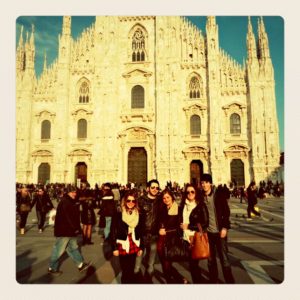
For the second half of the week, it was the turn of my friends studying in Rome to visit me and we took a short trip to Milan, Italy’s second biggest city and one of the fashion capitals of the world. In addition to visiting the breath-taking Cathedral, we browsed around some of the city’s most prestigious shopping streets, visiting the shops of such major brands as Prada, Armani and Gucci. Amongst some incredible pieces of fashion, there was a rather distasteful dress with a very steep price tag to match. This made me think back to an expression used by a friend back in Verona:  chi ha i denti non ha il pane. This is an idiomatic expression meaning “to have the means but not the know-how” and was used by my friend to describe a person with lots of money but no taste.

This week has yet again demonstrated to me the vast number of incredible Italian cities and I am so glad my friends are enjoying living la vita bella (“the good life”) just as much as I am. I have you have enjoyed On Location Italian for this week and I will be back soon. A presto!

Ich spreche ein bisschen Deutsch: tips for navigating the German language

CBG 1-09

Learning German is exciting and challenging. When you try out a few phrases for the first time with a native speaker of German, you will hear bits and pieces you understand in the reply you receive. So, it’s useful to be able to say ‘Ich spreche ein bisschen Deutsch’, meaning that you only speak a little German.

In this blog post, we will uncover some useful phrases and give you some tips for navigating the language, like asking native speakers to repeat or speak more slowly. Listen to the episode while reading the text to get the most out of the pronunciation tips! 

Essential phrase – Ich spreche ein bisschen Deutsch

If you feel like you can get by with your German skills, saying ‘Ich spreche ein bisschen Deutsch’ is a great way to explain that you can speak and understand a little. The sentence ‘Ich spreche Deutsch’, however, makes you sound more confident. You can use either of these phrases to let someone know that you speak German.

  • Example 1: Ich spreche Deutsch. Können Sie mir helfen? I speak German. Can you help me?
  • Example 2: Ich spreche ein bisschen Deutsch. Können Sie mir helfen? I speak a little German. Can you help me?

Checking who speaks German

To be polite and find out if someone speaks German, we’d use the polite form: Sprechen Sie Deutsch? Do you speak German?. Adding the word “excuse me” makes your question even more polite:

  • Entschuldigung, sprechen Sie Deutsch? Excuse me, do you speak German?

Being informal 

If you wanted to ask someone younger (or your own age) if they speak German, you could say: Sprichst du Deutsch? Do you speak German? This uses the informal form of “you”, du and the form of the verb that conjugates with that, ending in -st

  • Example 1: Hallo, sprichst du Deutsch? Hi, do you speak German?
  • Example 2 : Entschuldigung, sprichst du Englisch? Excuse me, do you speak English?Ja, ich spreche Deutsch/Englisch Yes, I speak German/English.

Finding out about other languages

Knowing which language(s) someone speaks may be helpful to make your conversation go more smoothly. In order to do that, we need to be sure of how to ask or talk about other languages. We’ve already covered the word for German. Let’s look at some other languages that may come up: 

  • Ich spreche (kein) Deutsch/Französisch/Spanisch/Italienisch/Chinesisch/Japanisch –  I (don’t) speak German/French/Spanish/Italian/Chinese/Japanese. I speak no German…

The addition of the word kein after the verb lets people know that you don’t speak that language—I speak no German / French

Taking it slowly

If you want to ask someone to slow down or repeat what they have said a little more slowly so you may understand more fully, the next phrase is incredibly useful:

  • Ich spreche ein bisschen Deutsch. Können Sie langsamer sprechen? I speak a little German. Can you speak more slowly?

This is the comparative form of the adjective langsam, formed by adding -er to the end of the word. If you feel you want to say that you don’t speak any German, as we saw earlier, we can say Ich spreche kein Deutsch. I don’t speak German.

Being polite and explaining

If you feel that your German might not hold up to what you want to say, when asked, Sprechen Sie German? you can reply, leider nicht unfortunately not, a native speaker will appreciate your effort and manners. 

If you wanted to emphasise that you don’t speak any German at all, you might use, gar nicht meaning not at all. Example:

  • Sprichst du Chinesisch? Do you speak Chinese? Gar nicht. Not at all.

If you were asked about another language and you don’t speak it, you might want to say auch nicht also not. Example:

  • Sprichst du Spanisch? Do you speak Spanish? Leider nicht. Unfortunately not.
  • Sprichst du Französisch? Do you speak French? Auch nicht. Also not. 

Managing expectations

It is useful to say that you can speak German, but you might want to let people know how much you can handle and understand: Ich spreche nur ein bisschen I only speak a little. That little word nur, meaning “only”, combined with bisschen can convey a lot! Example:

  • Ich spreche nur ein bisschen Deutsch. I only speak a little German.

If you want, you can use just part of the phrase as the answer to the question:

  • Sprechen Sie Deutsch?  Do you speak German?
  • Nur wenige Worte. Only a few words.

Try again

If you’ve let someone know that you speak a little German, but feel you might understand better if you heard the phrase again, the next phrase is super useful: Noch einmal bitte Once more, please. This phrase asks someone to repeat what they said, literally “another one time, please”. 

Example:

  • Noch einmal bitte, ich habe es nicht verstanden. Once more, please, I didn’t understand.

The last part of this phrase adds a little extra to your request.

Putting it into practice

Imagine you are in Germany and need directions. Here’s a possible conversation:

  • You: Entschuldigung, sprechen Sie Deutsch? Excuse me, do you speak German? 
  • Native German speaker: Ja, ich spreche Deutsch. Yes, I speak German.
  • You: Ich spreche nur ein bisschen Deutsch. Können Sie langsamer sprechen, bitte? I only speak a little German. Can you speak more slowly, please?
  • Native German speaker: Natürlich. Wo möchten Sie hin? Of course. Where do you want to go?
  • You: Zum Bahnhof, bitte. To the train station, please.
  • Native German speaker: Gehen Sie geradeaus und dann links. Go straight ahead and then left.
  • You: Noch einmal bitte, langsamer. Once more, please, more slowly.

From Ich spreche ein bisschen Deutsch to Noch einmal bitte, you are definitely able to navigate the German language with ease. Isn’t it great to see how much German you can use and understand, even when you speak a little German?

Keep practising, and you’ll find yourself becoming more confident in your ability to navigate conversations in German. To discover more reasons why learning German is not as hard as it looks, check out the article we prepared on this topic! 

 

On Location German – 27 Mar 2013

130327-danielHallo zusammen! Hey, everyone!

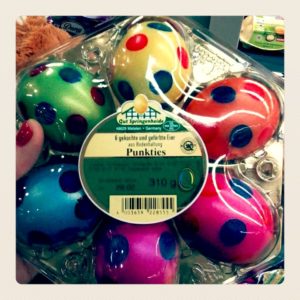
As we approach the end of March, that means that Easter is nearly here! I have fond memories of when I was younger when my brothers and I used to paint hard-boiled eggs at Easter time. It turns out that this custom of boiling and painting Ostereier (“Easter eggs”) began in Germany! As well as the shared custom of the Ostereier, Germany shares the custom of der Osterhase (the Easter bunny) with us, too! I say share, but we take these customs from the Germans: apparently the first chocolate Easter bunny came from Germany too! (Schokolade (“chocolate”) being my favourite part of Easter, of course!)

Also, at this time of year we start to see the first signs of der Frühling (“Spring”). Blumen (“flowers”) start to come up and der Schnee (“the snow”) from Winter finally disappears. Apart from this year! Leider ist der Schnee noch nicht weggetaut! (“Unfortunately the snow hasn’t melted yet!”) Then again, coming from Scotland I’m used to the weather being less-than-Mediterranean. I can only hope that, come April/May, the weather will improve. I hope that the weather is better wherever you are and that you all have a fantastic Easter!

Frohe Ostern! Happy Easter!

Daniel.

Episode 307 – Q&A Spanish

In this week’s episode of Q&A Spanish we answer questions from listeners Kitty and Neil. Topics include the personal ‘a’ and the expression ‘a tenor de…”. As usual our experts JP and Nahyeli are on hand to answer these questions.

Use the player below to listen to this week’s episode:

If you have a question for our experts, you can get in touch with the Q&A Spanish team at the Q&A Spanish page. Remember that we welcome all questions, even if you’re just starting out with Spanish! Don’t forget too that you can leave us voicemail by clicking on the tab at the right of this page!

iTunes link | RSS feed

On Location Spanish – 26 Mar 2013

130326-iain¡Hola y bienvenidos! Welcome to another installment of On Location Spanish, once again coming to you from Iain in the University town of Salamanca.
Salamanca has recently been doing its finest impression of the Scottish climate – over the past week, we have been experiencing all four seasons in one day, with a fair amount of rain and snow for good measure. This has been an excellent opportunity to push my weather vocabulary beyond the basics, adding new phrases such as:

hay un vendaval and hay lloviznas
“it’s blowing a gale” and “it’s drizzling”

Looking back on my preconceptions of living in Spain for a year, I certainly didn’t think I’d still be tramping about Salamanca wearing a ski jacket, jumper, a scarf and gloves mid-March, so therefore I’m hoping this weather is short-lived. In typical Spanish humour, my classmate Carlos introduced me to another phrase to describe something that is short-lived, hopefully like this changeable weather:

pasa como una nube de verano
“it passes by like a cloud in the summer sky”

Oh, what I would give for a cloudless blue sky right now… On perhaps a lighter note, the vibrant Irish community here in Salamanca made sure that the recent celebrations for el día de San Patricio (of course, “St. Patrick’s Day”) were well attended. The lights in the Plaza Mayor were turned green for the weekend in honour of the Irish patron saint, and I can confirm that a few pints of Guinness were consumed by both Spanish and Erasmus students alike.

As March passes, thoughts turn towards the Easter celebrations here in Spain – which I’m very much looking forward to. However, after Easter it’s just a few short weeks until my Erasmus exchange period is over, which is a frightening thought…

Bueno, ¡hasta la próxima!

On Location French – 25 Mar 2013

130325-roseBonjour tout le monde, it’s Rose here. I’m not long back from a few weeks’ holidays from school for les vacances d’hiver, the winter holidays. It feels like I’m always on holiday!
In the same theme as my last article, I decided to put my two weeks off school to good use and travel around the south of France, and cross the French/Spanish border to spend a few days in Barcelona. My first stop was Bordeaux, in the Aquitaine region. Here I tried some canelé pastries, a regional speciality. We also had the chance to sample some wine, Bordeaux being known as the best wine-making region in France. Being on a bit of a budget, on a fait du lèche-vitrine, we went window shopping, as Rue Sainte Catherine in Bordeaux is the longest shopping street in Europe, and quite a sight! From Bordeaux we took an overnight bus to Barcelona, the Catalonian capital. This was a bit of a shock to the system at first, after trying to reply to people in French in restaurants etc! I had a great time in Barcelona sightseeing around the Sagrada Familia church, the Picasso museum and a trip to Gaudi’s Parc Guell. We also found some fleamarkets and vintage shops and went to a mini music festival on Saturday night with some British bands. I then hopped back over the border to France for a few days in Toulouse. I was much more confident about my language abilities once I was back on French soil! I was able to meet up with fellow Radio Lingua blogger Scott and go for some cassoulet together. This is the regional dish of Toulouse, a sort of casserole filled with duck, pork and kidney beans. Maybe more suited to a cold winter’s night instead of a mild March day but it was nice to try. It was interesting to see other regions in France with different customs and traditions from Brittany. In Toulouse especially I picked up on the very different accent to that here in Brittany!

In contrast to the sunny south, we stepped off the train in St Brieuc to flurries of snow. Overnight it got much worse, meaning my first two days back after the holidays were written off as jours de neige – snow days, yes, in March! Luckily it was mostly la neige mouillée – slushy snow, with only a little bit of verglas – ice. Once I was back at school, my pupils happily told me stories about how they made des bonhommes de neige, snowmen, during their time off. Personally I preferred to stay at home in the warmth! I hope you enjoyed reading about my holidays, and à la prochaine!

Coffee Break French wins European Podcast Award!

epa-banner

We’re delighted to announce that Coffee Break French has won Best Professional Podcast UK in this year’s European Podcast Awards. The shortlist of podcasts for each category was originally generated by listener votes, so we’d like to thank everyone who voted! A jury then considered each of the podcasts on the shortlist and Coffee Break French was voted Best Professional Podcast in the UK. Coffee Break Spanish came fifth in the rankings!

We’ve also just discovered that Coffee Break French was the runner-up in the European Professional Podcast category, coming in second place after Detektor.fm – congratulations to them and all other European and national winners!

Directions in German: essential phrases and vocabulary

CBG 1-08

Exploring a new town can be great fun, especially when you’re learning a new language. This guide will help you understand and use essential phrases in asking for and understanding directions in German. 

Listen to the episode while reading the text to gain further insight into the pronunciation!

Key Places in Town

You already know what some places in town are called in German, but we thought it might be useful to add some more vocabulary to your repertoire. They’re given with their gender in the nominative case, as you would find them listed in the dictionary:

  • der Park (m) park
  • der Dom  (m) cathedral
  • die Post (f) post office
  • die Schule (f) school
  • das Kino (n) cinema
  • das Schwimmbad (n) swimming pool
  • das Museum (n) museum
  • das Krankenhaus (n) hospital

Knowing these words will help you ask for and understand directions in German more easily.

Knowing your directions in German

Of course, when someone gives you directions in German, it’s important to know your left from your right:

  • geradeaus straight ahead
  • links left
  • rechts right

Asking for more help

There is always the possibility that you understand most of what is said to you when you ask for directions, but it would be helpful if the person could repeat what they told you. Here’s an easy way to ask them to do that:

  • noch einmal, bitte one more time, please

Directions in German: more essential phrases

Here are some more essential phrases for navigating around town and understanding directions in German:

  • Ich habe mich verlaufen. I’m lost.
  • Entschuldigen Sie, bitte. Excuse me, please.

It’s always important to be polite, so we use the formal form of “you”, Sie

Judging distances

Now, the next one might be important to know in case you need public transport to get where you want to go: Ist es weit? Is it far? Of course, you may hear: Ja, es ist weit. Yes, it is far. However, you may be lucky and be told: Nein, es ist nicht weit. No, it is not far.

A summary of asking for and understanding directions

Now let’s combine these phrases and places for clear directions:

  • Gehen Sie… go…
  • Nehmen Sie… take…

Again, the polite form is used, because we would be talking to people we don’t know. We can put them together with the directions for “left” and “right” etc to give directions:

  • Gehen Sie geradeaus. Go straight ahead.
  • Nehmen Sie die erste/zweite/dritte Straße rechts. Take the first/second/third street on the right.
  • Nehmen Sie die erste/zweite/dritte Straße links. Take the first/second/third street on the left.

Of course, we may hear them used with places in the town to give directions:

  • Gehen Sie über die Brücke. Go over the bridge.
  • Gehen Sie über die Kreuzung. Go across the junction.
  • Gehen Sie über den Platz. Go across the square. 

Note the word for “the” changes in the last example above. This is because der changes to den in the accusative case. This happens because the preposition über takes the accusative when indicating movement to a place, such as “over the bridge”. There is no change in the feminine word for “the”, die, in the accusative case.

Let’s see these phrases in action with a few example conversations:

1) Entschuldigen Sie, bitte. Ich habe mich verlaufen. Wo ist das Krankenhaus? Excuse me, please. I’m lost. Where is the hospital?

Gehen Sie geradeaus und nehmen Sie die zweite Straße links. Go straight ahead and take the second street on the left.

2) Entschuldigen Sie, bitte. Wo ist der Dom? Excuse me, please. Where is the cathedral?

Gehen Sie über die Brücke und dann die erste Straße rechts. Go over the bridge and then the first street on the right.

3) Ist es weit zum Park? Is it far to the park?

Nein, es ist nicht weit. Gehen Sie geradeaus und dann die dritte Straße links. No, it is not far. Go straight ahead and then the third street on the left.

4) Wo ist das Museum? Where is the museum?

Nehmen Sie die erste Straße rechts und dann über den Platz. Take the first street on the right and then across the square.

Practice makes perfect

Understanding and giving directions in German is such a useful skill and the more you practise, the easier it becomes. Use these phrases and place names to practise with a partner or even by yourself. Remember, repetition is a useful tool in building confidence in any new language skill.

And, since walking around town can build up an appetite, how about learning how to order food in German? Check the blog post we prepared with some essential tips and vocabulary! 

French WOTD Review – 8 March 2013

Apologies for the delay with this episode! Mark has been a bit under the weather and we’ve only just managed to get it finalised.

As usual, we’ve been publishing a daily word on Facebook and Twitter and each day we’ve asked our Facebook friends and Twitter followers to post a comment using the word of the day, thereby practising their language skills. This week we’ve been focusing on shopping vocabulary. Our words have been acheter – to buy, la taille – the size, le prix – the price, faire les courses – to do the shopping, and faire un échange, to make an exchange. Our listeners have been coming up with some interesting uses of these words and this review show highlights some of our favourites.

Follow us on Twitter | iTunes link