Coffee Break Spanish Magazine – Episode 205

Welcome to this latest edition of the Coffee Break Spanish Magazine. In this episode:

  • Alba asks, ¿qué ves cuando miras en el espejo? – what do you see when you look in the mirror?
  • Mark joins Fernanda on a virtual tour of Bogotá, Colombia;
  • and JP and Nahyeli answer a question from listener Georgie about the pronunciation of ‘b’ and ‘v’.

Using modal verbs in German when going shopping

CBG 1-16

Mastering modal verbs is a crucial step in learning German, as they allow you to express abilities, desires, and preferences. In this post, we’ll explore three important modal verbs: können can, wollen want, and mögen like and show you how to use them when you are shopping in German. 

By the end of this guide, you’ll feel more confident using these verbs in various contexts, from asking for help to expressing what you would like. Remember that for more in-depth practice, you can listen to the related podcast episode where you can hear these verbs in action.

The modal verb können

Können is a modal verb used to express ability or possibility, equivalent to can or to be able to in English. One thing to note about können is the vowel change that occurs in the singular forms. Here’s how it’s conjugated:

ich kann I can wir können we can
du kannst you can (informal) ihr könnt you can (informal plural)
er/sie/es kann he/she/it can sie können they can / you can (formal)

Here are some examples to see können in action. 

  • Können Sie mir bitte helfen? Can you help me, please?
  • Wo kann ich eine Briefmarke kaufen? Where can I buy a stamp?

In these examples, notice how the infinitive verb (kaufen, helfen) is placed at the end of the sentence. When using modal verbs in German, the modal verb takes the role of the main verb, meaning it has to be conjugated and is (normally) placed in the second position. The infinitive verb is placed at the end of the clause or sentence. 

The modal verb wollen

The verb wollen is used to express a strong desire or intention, meaning to want. It’s important to remember that ich will translates to I want and NOT I will, which is a common mistake among learners. Here’s the conjugation of wollen:

ich will I want wir wollen we want
du willst you want (informal) ihr wollt you want (informal plural)
er/sie/es will he/she/it wants sie wollen they want / you want (formal)

Here are some sentences you might use when going shopping. 

  • Ich will das anprobieren. I want to try that on.
  • Willst du ein Souvenir kaufen? Do you want to buy a souvenir? 

Wollen can come across as quite direct, so it’s useful to know möchten would like, which is a more polite way of expressing desire.

Expressing preferences with mögen and möchten

Mögen is a versatile verb that can mean to like, but in this lesson, we focus on its conditional form möchten, which is used to express polite requests or desires. Here’s how it’s conjugated:

ich möchte I would like wir möchten we would like
du möchtest you would like (informal) ihr möchtet you would like (informal plural)
er/sie/es möchte he/she/it would like sie möchten they would like / you would like (formal)

Let’s have a look at how to use möchten to form polite requests. 

  • Ich möchte bitte das grüne T-Shirt anprobieren. I would like to try on the green t-shirt. 
  • Wo möchtest du morgen einkaufen gehen? Where do you like to go shopping tomorrow? 

Using möchten softens your requests and makes your German sound more polite and natural.

Practical examples using modal verbs

Now that we’ve covered the basics of these modal verbs, let’s put them into practice with a few more shopping examples and see if you can translate them into English. 

  • Können Sie mir das bitte eine Nummer größer bringen? 
  • Meine Eltern möchten jetzt eine Kaffee trinken gehen. 
  • Willst du die Postkarte heute oder morgen kaufen? 

Fantastisch! Modal verbs like können, wollen, and mögen are incredibly useful and are essential tools for expressing yourself in German. Whether you’re asking for help, expressing a desire, or making polite requests, mastering these verbs will greatly enhance your communication skills. Remember to practise regularly and try using these verbs in different contexts to build your confidence.

Don’t forget you can also listen to the podcast episode with many more example sentences and further explanations. If you are looking to expand your knowledge of German place names and what preposition to use with them, have a look at this blog post.

Coffee Break Spanish Magazine – Episode 204

Welcome to this latest edition of the Coffee Break Spanish Magazine. In this episode:

  • Alba asks, ¿cómo te describiría tu mejor amigo o amiga? – how would your best friend describe you?
  • Mark joins Fernanda on a virtual tour of Machu Picchu in Peru;
  • and JP and Nahyeli answer a question from listener Ezgi who is curious about how best to translate “to love” in its many uses into Spanish.

The CBF Verb Fix 105 – ÊTRE

In this lesson we’re looking at the irregular verb être meaning “to be”. Like avoir, être is also irregular so we need to learn each part of the verb as it does not follow the regular patterns.

Counting in German: how to write and say numbers

CBG 1-15

When learning a new language, mastering Zahlen numbers, is a crucial step that can make everyday interactions much smoother. Whether you’re shopping, making a hotel reservation, or simply trying to understand prices, knowing how to count and write numbers in German is essential. 

In this guide, we’ll walk you through the basics of counting from 11 to 1000 in German, providing you with the tools you need to use numbers confidently in any situation. Don’t forget to press play and listen to the podcast to help your pronunciation of the bigger numbers.


The basics of counting in German

Before moving on to the bigger numbers, let’s quickly review the foundations. In German, numbers from 1 to 10 are pretty straightforward, with each number having its own distinct word. Going beyond ten is still similar to English, however once you make it past 20, you need to be ready to count differently. 

But let’s take things slow and only count to 20 for now. 

  • elf eleven
  • zwölf twelve 
  • dreizehn thirteen 
  • vierzehn fourteen 
  • fünfzehn fifteen
  • sechzehn sixteen (note the difference here to sechs)
  • siebzehn seventeen (note the difference here to sieben)
  • achtzehn eighteen 
  • neunzehn nineteen 
  • zwanzig twenty

Counting in German past 20 and all the way to 100

Now that you can order up to zwanzig Brezen at a time, you are well prepared for all food or drink situations. Unfortunately, prices don’t stop here, so let’s have a look at numbers beyond twenty. 

To say 21 in German you have to go back to front – einundzwanzig (literally one and twenty). Once you get to grips with this way of counting all that’s left to learn is how to say 30, 40… And you can count in German all the way to neunundneunzig ninety-nine

  • vierundzwanzig twenty-four
  • neunundzwanzig twenty-nine
  • dreißig thirty
  • zweiunddreißig thirty-two
  • vierzig forty
  • fünfzig fifty
  • sechzig sixty (note the difference again)
  • siebzig seventy (note the difference again)
  • achtzig eighty
  • neunzig ninety
  • einhundert one hundred 

Writing numbers in German higher than 100

When dealing with numbers larger than 100, the pattern remains consistent. You simply combine the numbers you’ve learned so far. Let’s break down a few examples to understand the pattern once more. 

  • einhundertdreiundvierzig143 (literally one hundred three and forty)
  • dreihundertzwölf 312 
  • sechshundertfünfundsiebzig 675

As you can see, mastering this pattern is key to accurately forming larger numbers in German. With a bit of practice, this will become second nature.

Practice makes perfect

The best way to consolidate your understanding of numbers in German is through practice. Try writing out different numbers and saying them aloud. Start with smaller numbers and gradually work your way up to larger ones. Understanding numbers is equally important to saying and writing numbers in German, so have a look at these example sentences to test your comprehension skills. 

  • Das Doppelzimmer für 4 Nächte kostet dreihundertachtundsiebzig Euro. 
  • Drei Kaffee, zwei Apfelkuchen und ein Stück Käsekuchen kosten zusammen vierzehn Euro. 

Counting in German might seem tricky at first, but with practice, it becomes much easier. The key is to remember the pattern of reversing the units and tens and to practise as much as possible. Whether you’re preparing for a trip to a German-speaking country or simply expanding your language skills, mastering numbers is a fundamental part of your journey.

For more practice, be sure to listen to the podcast episode, where you can perfect your pronunciation and hear these numbers in action. Also why don’t you continue and learn some German shopping vocabulary and phrases now that you mastered the numbers.

The CBF Verb Fix 104 – AVOIR

In this lesson we’re looking at the irregular verb avoir meaning “to have”. Avoir is the first irregular verb we’ve discussed here on the Verb Fix. This means that this verb follows slightly different patterns than the regular verbs we’ve covered so far.

Coffee Break Spanish Magazine – Episode 203

After a short delay we’re back with a new episode of the Coffee Break Spanish Magazine. In this episode:

  • Alba asks, ¿qué es lo primero que has pensado esta mañana? – what was the first thing you thought about this morning?
  • Mark joins Fernanda on a virtual tour of Easter Island;
  • and JP and Nahyeli answer a question from listener Iván who wants to know about the nuances of using the immediate future tense (voy a mandar una carta) or the simple future tense (mandaré una carta).

How to say ‘hotel’ in German? Essential vocabulary for checking into a hotel in German

CBG 1-14

One essential topic to master before going on a holiday to a German-speaking country is how to check into a hotel in German. For this, we first need to learn how to say ‘hotel’ in German and ask for a Einzelzimmer single room or Doppelzimmer double room for example, as well as master some phrases using the verb haben

In this blog post, we’ll explore the necessary vocabulary and grammatical constructions to make your hotel check-in easier. Don’t forget to press play to listen to the podcast while or after reading the article to improve your pronunciation.  

How to say ‘room’ or ‘hotel’ in German

Let’s dive right in and start with some basic vocabulary you need to know when starting your holiday: how to say ‘room’ and ‘hotel’ in German. 

  • Hotel (n) hotel
  • Reservierung (f) reservation
  • Zimmer (n) room

Most of these words are straightforward and once we start combining them with the verb haben to have and for example our name, we can start forming sentences to check in to a hotel in German. 

  • Guten Tag, mein Name ist Samuel Smith und ich habe eine Reservierung. Good day, my name is Samuel Smith and I have a reservation. 

Answering questions when checking into a hotel in German 

Now that you know how to say ‘hotel’ in German and the words for “room” and “reservation”, you are ready to move forward. Whether you were prepared and booked in advance or just walked into a hotel, once you walk up to reception, there are normally a few questions you will be asked in German. 

Let’s have a look at what those might be and how you can answer them. 

Guten Tag, kann ich Ihnen helfen? Good day, can I help you? – This question is the first phrase you will hear most likely when walking up to the reception. 

  • Auf welchen Namen? In what name? 
  • Haben Sie eine Reservierung? Do you have a reservation? – Here, your answer could be the sentence we saw above, or if your visit is more spontaneous, you could also answer Nein, ich habe keine Reservierung. No, I don’t have a reservation.

How to check in and ask for a room with ….

Now that we have covered the basic vocabulary for checking into a hotel, let’s have a look at some room specifications. To ask for these you can either use the expression we already learned Ich möchte gern(e) I would like, or you can form a question by putting the verb at the start Haben Sie … ? Do you have … ?

Here are some suggestions:

  • ein Einzelzimmer / Doppelzimmer … a single room / double room 
    • mit Bad with a bath
    • mit Dusche with a shower
    • mit Balkon with a balcony 
    • mit Meerblick/Bergblick with a sea view / with a mountain view

That’s you! You know all the German you need to check into a hotel during your next stay in a German-speaking country. To finish things off, let’s have a look at a complete hotel conversation. Can you understand everything?

  • Rezeptionist: Guten Abend, kann ich Ihnen helfen?
  • Frau Siebert: Hallo, mein Name ist Frau Siebert. Ich möchte gerne ein Einzelzimmer
    mit Bergblick.
  • Rezeptionist: Okay, haben Sie eine Reservierung.
  • Frau Siebert: Nein, ich habe keine Reservierung.
  • Rezeptionist: Okay, ich habe ein Einzelzimmer mit Balkon und Bergblick für 78€.
  • Frau Siebert: Das ist perfekt, danke. 

Großartig! If you saw the price for the hotel room and weren’t quite sure how you would say that number in German, have a look at our lesson about mastering higher numbers in German.

On Location Swedish – 17 May 2013

130517-ailieHej! So, it saddens me to say that as I will be leaving Sweden soon, this will be my last blog post from Uppsala. That said, to not bring the mood down too much, my subject for today is Uppsala’s biggest yearly party, Valborg (also known as Sista April, or ‘last of April’), the anticipation of which literally puts a smile on everyone’s face and a spring in their step. It descends from the celebration of Walpurgis on the 30th April, which to this day remains a day of festivities all across Sweden, with large bonfires being organised up and down the country, reminding everyone of their Viking heritage. It celebrates the arrival of Spring in Sweden, and is accompanied by general merriment and frolicking amongst the student population of Uppsala.

The day kicks off as early as 8am (although depending on how hard you’ve partied on Kvalborg, or ‘Valborg Eve’, possibly later), with a traditional champagne breakfast in Ekonomikumparken, a large park next to one of the university buildings (Ekonomikum) and a large student housing area. 10am sees the start of the boat race or Forsränning down the Fyris river, done by groups of students in handmade styrofoam rafts; some of which survive the rapids, some of which, well, let’s just say I’ve never seen someone cling to a giant styrofoam mushroom to save them from falling into the water so desperately before. Following tradition, this would be followed by a sillunch (herring lunch) – although, my experience was more, back to Ekonomikumparken for hot dogs and Swedish cider, and trying very hard to get through to friends who I knew were in the park, but when just about the entire population of Uppsala was also there, trying to find them was easier said than done.

The next big events happen almost simultaneously: the champagnegalopp held at some of the nations, and the mösspåtagning at the Carolina Rediviva library. The mösspåtagning is the traditional donning of the white naval caps all Swedish students have, and happens at precisely 15:00. 15:15 sees the start of the champagnegalopp – the name originates from when after the mösspåtagning, students would race down the hill from the library to the nations to drink champagne. Nowadays, the champagnegalopp more takes the form of spraying copious amounts of fizzy wine over your friends and strangers – great fun, by all accounts, but very messy! Thus ends the ‘traditional’ organised parts of Valborg; what follows next was, in my case, a nap, a barbeque, and then dancing at my nation with my best friend until the wee small hours of the morning.

Valborg was the first time since the winter that I had really seen Uppsala come alive, and the buzz in the air that it brings definitely gives it the feeling that Spring really has arrived. It has made me realise how much I need to appreciate the rest of my time here, because I know I will miss it so much when I leave; it has definitely been the most incredible experience. I hope you’ve enjoyed following my posts, and that some of my enthusiasm for Sweden and Swedish might have passed on to you. And with that – lycka till, och hej då!

On Location Italian – 16 May 2013

130509-nicoleBuongiorno a tutti and welcome to On Location Italian. This week I have felt as if I was back in Scotland, having to endure four seasons in one. At the start of the week, primavera (Spring) was in full bloom in Verona. With the sun shining and temperatures sweltering, I jumped on a train to Lago di Garda (“Lake Garda”), the largest lake in Italy. There are various towns situated on the lake, all of which have become a major attraction for tourists, and being just a stone’s throw away from Verona I am fortunate enough to be able to spend sunny days there.

However, I didn’t get too carried away with planning all my future day trips to Lago di Garda since the sunshine was short-lived. In fact, I faced my first tempesta (“thunderstorm”) since living in Italy. Whilst taking shelter from the tuoni e fulmini (“thunder and lightning”) at my friend’s house, I took the opportunity to ask her about some common phrases in Italian relating to weather. She told me that the Italian equivalent of the expression “it’s raining cat and dogs” would be pioggia a catinelle. She also taught me the expression piove che Dio la manda (literally, it’s raining as if God sends it) translated as “it’s pouring”.

Following the tempesta, the unpredictable weather changed from torrido (“roasting hot”) to raining and back again. With my friend from back home visiting, I was taking her to see Venice, come rain or shine! Fortunately there were only a few nuvole (“clouds”) in the sky on the day. On returning from our day trip and describing the weather to my Italian friend, she taught another expression , this time for cloudy weather – c’é un cielo a pecorelle. Pecore are “sheep” and pecorelle are “little sheep”. This translates literally as “there is a sky of little sheep”.

I guess it just goes to show that it isn’t just us Scots who have to deal with il tempo imprevedibile (“the unpredictable weather”). Hopefully the weather will pick up before I have to leave at the end of June.  I have loved my time in Verona and I hope you have all enjoyed having a little insight into my life here, as much as I have enjoyed sharing it with you all. So for one last time, a presto!

The CBF Verb Fix 103 – VENDRE

In this lesson we’re looking at the verb vendre meaning “to sell”. Vendre is an example of a regular -re verb. This means that with this lesson not only will you learn to conjugate vendre in the present, perfect, imperfect and future tenses, you’ll also learn to conjugate all other regular -re verbs!

On Location German – 15 May 2013

130514-danielHallo zusammen! Welcome to my last On Location German post. The year has flown by and I have really enjoyed sharing my experiences with you! Wie die Zeit vergeht! (‘How time flies!’)
During my time in Deutschland, I have had lots of new Erlebnisse (‘experiences’), learned lots of new Wörter (‘words’) and visited lots of new Orte (‘places’). One important word which I would use to describe how I feel about my time here is genießen. (‘to enjoy’) I have enjoyed every part of the last few months here and I hope that you have all enjoyed sharing my experiences! I now know the town of Herford and the surrounding area like the back of my hand; Ich kenne Herford wie meine Westentasche (literally, ‘I know Herford like my waistcoat pocket’!)

I remember when I first arrived in Germany and it seemed like everybody was on a completely different wave-length! (‘nicht auf derselben Wellenlänge sein’ means ‘to be on a different wave-length’) However, after 8 months of living here, I don’t even bat an eyelid when someone speaks to me in German. Last week I learned that ‘mit keiner Wimper zucken’ is German for ‘not to bat an eyelid’.

All in all, the most important thing I have learned in the last year is that, no matter how difficult it can sometimes seem, es lohnt sich, eine weitere Sprache zu lernen! (‘It is worth it to learn another language!’) I wish you all the very best in your future language learning endeavours and hope that you have enjoyed my regular blog posts! Mach’s gut! (‘So long!/Take care!’) Daniel.

On Location Spanish – 14 May 2013

130514-iain¡Hola y bienvenidos a mi blog! Once again, it’s Iain here in Salamanca with an update on my year abroad learning Spanish.

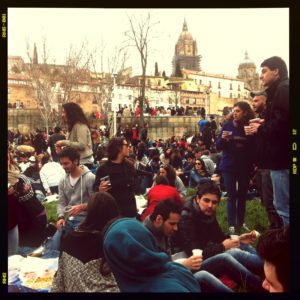
Salamanca has gone fiesta crazy since my last update, with the celebrations of Semana Santa (“Holy Week”, culminating in Easter Sunday) followed closely by the local festival of Lunes de Aguas (literally “Waters Monday”, however I’ll explain more of this in a moment) and El Día de Castilla y León (“Castilla y León Day”, a region-wide holiday in this part of Spain).

Lunes de Aguas is unique to Salamanca, and especially the University students. It’s a slightly bizarre festival in which the vast majority of the student population head down to the banks of the River Tormes for a day-long party to celebrate the end of the Holy Week and the lifting of the prohibitions that this used to bring. The festival has its roots in centuries past, and is marked by the consumption of Hornazo, a delicious meat pie filled with pork loin, chorizo sausage and hard-boiled eggs. The University shuts for the day to allow the students to take part; to me, it shows that Salamanca’s fun side is just as well-developed as its studious side!

As the exams and deadlines roll ever closer, I’ve been spending time working in various groups for assignments. It’s an excellent way to learn some colloquial Spanish. For example, when I asked one of my classmates if he was ready for a presentation, he replied:

estoy preparado a tope (“I’m prepared to the maximum”)

A tope comes from the English “top”, and is one of the many words that the Spanish call préstamos (“borrowings”) from other languages.

Another phrase I’ve been hearing a lot of lately is:

es la leche (literally “it’s the milk”)

This cropped up in conversation with some friends, and I was stumped – I had to ask for an explanation. It transpires that the phrase can be used much like groups of younger people at home would use phrases like “it’s cool” to describe something positively.

As I’ve mentioned, the exams are looming for me, and afterwards my time in Salamanca is unfortunately at an end – which also means that this is my last OnLocation Spanish update. It’s been an absolutely incredible journey, and I can’t quite believe how quickly the year has passed. I hope you have enjoyed my blog as much as I have enjoyed sharing my experiences with you!

¡Gracias a todos, y adiós!

On Location French – 13 May 2013

130513-roseBonjour tout le monde! Welcome to my last blog post about my year abroad here in St Brieuc.  I can’t believe how quickly this year has passed – it’s flown in!  I’ve just finished my last week at school, and it was so nice to see my pupils’ reactions when they found out I was leaving.  An expression I’ve been hearing everywhere is est-ce que tu as hâte pour rentrer? Avoir hâte is to look forward or be excited about something, so this phrase means ‘are you excited to be going home?’  You could use this in lots of situations, such as j’ai hâte pour le weekend, I can’t wait for the weekend.


Even though I’m down to my last few days in France, I’m still learning so many new French words and phrases; it’s like the final rush to learn everything before I go back to Scotland! In particular, I’ve been discovering lots of new expressions connected to food.  I recently visited a teacher’s house for lunch and to meet her family.  We had a lovely afternoon speaking French, and I learned the expression ‘aller avec le dos de la cuillère.’ This means to go about something in a backwards manner, or even ‘to beat about the bush.’  You can also reverse it by saying ‘ne pas y aller avec le dos de la cuillère,’ to signify the reverse, someone who rushes into things.  Another food-related expression is ‘avoir une bonne fourchette,’ literally meaning, ‘I have a good fork.’  You can use this to say you have a big appetite, a good alternative to ‘j’ai faim,’ I am hungry.  One of my favourite phrases I’ve learned recently is ‘avoir du pain sur la planche,’ which means there is a lot of work left to do, or you have a lot on your plate.

It’s now time for me to say goodbye to St Brieuc. I know I will definitely miss living here and miss la vie française, the French life. It’s also time to say goodbye to you, my readers here on this blog.  I hope you’ve enjoyed reading about my time in France and have picked up some French along the way. Bonne continuation et au revoir!

Coffee Break Spanish Magazine Update

cbsmag-banner

Based on listener feedback, we have decided to add the Coffee Break Spanish Magazine free episodes to the main Coffee Break Spanish feed to ensure that our Coffee Break Spanish community is not missing the episodes. From now on, anyone subscribed to Coffee Break Spanish in iTunes or on any other podcast app or aggregator will automatically pick up the free episodes of the Magazine. We’ve backdated this to include episode 1, and this post will ensure that episode 2 reaches the feed too.

Episode 3 will be updated on Monday 13th May, with episode 4 coming next weekend. We hope that you find this useful!

CBF Community Show – 10 May 2013

Introduction

Welcome to this week’s Coffee Break French Community Show where we hand it over to our worldwide community of learners. In this episode our listeners provide their sentences featuring the verb finir, which was this week’s verb in our Verb Fix show. We also share some news about a new development for French learners from Radio Lingua.

Listen to the show

Use the audio player above to listen to the lesson, or make sure you’re subscribed to Coffee Break French in iTunes to receive this lesson and all future lessons automatically.

More tenses, exercises and bonus materials?

The premium version of The Coffee Break French Verb Fix provides additional materials which will help you build your knowledge of French verbs more effectively with your mastery of French verbs. The premium version is in the form of downloadable pdf lesson notes which include the following additional elements:

  • Verb tables: each verb is listed in the four tenses covered in the main lesson (present, perfect, imperfect and conditional) so that you can see the written form of the verbs and learn the structures and patterns more effectively;
  • Bonus verb tables: in addition to the main tenses we’ve also included the conjugations for the conditional, present subjunctive, past historic, pluperfect, future perfect and conditional perfect tenses;
  • Exercises: test your understanding with our translation quizzes – full answer key provided!
  • Bonus Audio: don’t want to listen to the whole show again? We’ve included the “Big Four” audio which extracts just the four main tenses of each verb in the members’ version.

The members’ version can be accessed through our membership system. You can purchase the course using the links below. Please note that the lessons are published from April 2013 onwards and you will have access to the materials as soon as they are published. Think of this as a “Season Pass”.

Subscribe links

Please note – if you’re already subscribed to Coffee Break French then you’ll receive the Verb Fix automatically – you don’t need to do anything! If you’re not already subscribed to Coffee Break French you can use the links below:

Purchase Membership | Access Members’ Materials | iTunes link | RSS feed

German restaurant vocabulary – Selecting things from the menu

CBG 1-13

Enjoying food and drink in a German restaurant is a great way to immerse yourself in the language and culture. After you’ve browsed the menu, having a few useful German restaurant vocabulary phrases can make your time eating out a bit more special and memorable. 

In this blog post, we’ll cover some essential language to help you dine out in Austria, Germany or Switzerland. Listen to the podcast to get some more insight into the pronunciation of these new words!

German restaurant vocabulary: expressing how hungry or thirsty you are

Before you order, you might want to express how hungry or thirsty you are. To do that, you can use the following phrases:

  • Hunger haben to be hungry or literally “to have hunger”.
  • Durst haben, “to have thirst” or to be thirsty.

If you want to say that someone else in your party with you has a rumbling tummy you would say:

  • Sie/Er hat Hunger she/he is hungry. It is a matter of conjugating the verb haben depending on who you are talking about when you’re eating out. It’s the same again for expressing someone else’s thirst:
  • Sie/Wir haben Durst They/We are thirsty.

Ordering and enjoying your food at the restaurant

When you’re ready to order, here are some phrases to help you: Ich hätte gern(e)… I would like. This is a polite way to order food or drinks. It literally means “I would like to have…”. For example:

  • Ich hätte gern(e) dasVanilleeis. I would like the vanilla ice cream.

Once the food arrives, you can wish everyone a good meal using this important German restaurant vocabulary: Guten Appetit! Enjoy your meal! You may also hear Mahlzeit! in Austria or southern Germany.

If you’re having a drink, it’s common to toast by saying Prost! Cheers!

What to choose from the menu?

Here are some popular flavours you may see when ordering desserts or drinks:

  • die Vanille vanilla If you were putting it into a sentence to order your dessert, it might go something like this: Ich hätte gern(e) das Vanilleeis. I would like the vanilla ice cream.
  • die Erdbeere strawberry If you fancied an ice cream of that flavour, you could say:  Ich hätte gern(e) das Erdbeereis. I would like the strawberry ice cream.
  • die Schokolade chocolate If this flavour is your favourite for a dessert you might order: Ich hätte gern(e) die Schokoladentorte. I would like the chocolate cake.

Sample conversation in a restaurant

Let’s imagine you’re at a restaurant and ready to order:

  • Server: Was möchten Sie bestellen?
  • You: Ich hätte gern die Erdbeertorte und ein Glas Wasser, bitter.
  • Server: Kommt sofort. Guten Appetit!
  • You: Danke! Prost!

In this conversation, did you work out what was ordered? And what customary greetings were used?

We hope practising this German restaurant vocabulary helps you build confidence for when you’re ordering in a German restaurant. Whether you’re enjoying food or drinks, knowing these phrases will make eating out a more memorable experience when you can put your learning into practice.

You already know your way around eating out, but how about finding a hotel or communicating a problem with your room? Can you explain the situation in German? In case you need a hand with that, don’t miss out on the blog post and episode where we give you some useful phrases for a hotel stay in a German-speaking country!


On Location Swedish – 10 May 2013

130510-ailieHej där! Well, the snow has melted…which means, combined with a lot of rain, the Fyrisån (Fyris River which runs through Uppsala) has started flooding quite dramatically! There were people kayaking down it the other day, which certainly didn’t look like it was for the faint-hearted. That said, throwing yourself down the river in unsuitable boats seems to be something of an Uppsala tradition (that and throwing bikes into the river), and marks the start of a kind of spring fever.  The end of this month is Walpurgis Night, more commonly known in Uppsala as Valborg or Sista April, essentially a huge party which takes places throughout the whole of Uppsala… but expect more on that later!

You may remember my first post was about the great Swedish habit of fika. Well, this week’s post is about another such “habit”, which shocked me that I hadn’t already written about – fredagsmys (partly because the word itself is one of these amazingly cute Swedish words that just fits perfectly to what it describes). Fredagsmys is essentially the act of snuggling up somewhere on a Friday – att mysa meaning, “To snuggle, cuddle, cozy up”, with fredagsmys translating literally then as “Cosy Friday”…which I think is definitely something I will be bringing back with me to Edinburgh after summer!

A fredagsmys is really just a way of relaxing at the end of the week, more often than not at home, although whether or not it is a solo activity is up to you. It  could be watching “How I Met Your Mother” (with Swedish subtitles, of course) on the sofa with your flatmates eating smågodis (sweeties, often from the Pick-and-Mix sections which exist in every Swedish supermarket); cosying with a good book into one’s favourite fåtöljen (armchair); or even having a few close friends round for a chilled out dinner. Naturally, not everyone is always a fan of fredagsmys, preferring to go out and party, and you know generally Friday nights are good party nights – but sometimes it is nice just to take a break from the busy week, grab a blanket (filt), a DVD and some cookies, just for good measure, and snuggle down with someone you like. When the country that gave us IKEA, Volvo and ABBA has this as an integral part of both their weeks and their culture, you’ve got to think they’re doing something right. And so, as this post comes out on a Friday, I hope it’s inspired you to go mysa someone! Hej då!

On Location Italian – 9 May 2013

Buongiorno a tutti and welcome once again to On Location Italian. After a (very) short visit back home for Pasqua (“Easter”) which flew past in a blur of family, friends, food and laughter, I have since arrived back to the welcoming sunshine of Verona.

With exams just around the corner, I have spent the past week organising myself in preparation. This involved visiting my lecturer during his orario di ricevimento (“consultation hour”, ie. the hour in which the students can meet with the lecturer). Typical of the laid back manner possessed by many Italians, my lecturer left me waiting as he popped out for a coffee. Whist I waited, I began chatting to another Italian student. She was from il Sud d’Italia (“the South of Italy”) and filled me in on what it was like for her moving to the northern city of Verona. She said that whilst she has adapted quite easily, the move has been harder on her mother, for whom she used the term mamma chioccia. This can be translated as “mother hen”. As she explained to me, her mum liked having her close by and looking after her (she used the verb badare, meaning “to look after”). She told me that this is typical of the South, where family is very important. We then moved on to discuss some of the differences between the North and South of Italy. There are a whole host of such differences including la lingua (language), il dialetto (dialect), il cibo (food), i politici (politics) and la cultura (culture). In fact, since living here I have come to notice that there is most definitely something of a North-South divide.

One of the main differences we discussed was the contrast in the industrial economies of both areas. Whilst the North has wide ranging manufacturing industries including fashion, computers and car manufacturing, and is home to the industrial triangle of Turin, Genoa and Milan, the South relies more on its agriculture. With little industry to generate employment, the student told me that many of her friends from the meridione (“south”) have had to migrate to the settentrione (“north”) in search of jobs. It turned out to be a very interesting conversation and in the end my only wish was that my lecturer had kept me waiting in la sala d’attesa (“waiting room”) a little longer. I hope you have all enjoyed On Location Italian for this week and I will be back soon. A presto!

On Location Spanish – 8 May 2013

130508-graceQueridos lectores, it is with this ¡Hola! that I welcome you to what will be Grace’s final installment of On Location Spanish. With my days numbered here in sunny Valencia, time has certainly flown and it has been a lot of fun. The experience has afforded me the invaluable opportunity to develop my everyday jerga (“slang”) and what’s more is that I’ve learned a thing or two about how Spaniards throw a party. With that I’d like to tell you about what has been going on in Valencia since we last spoke. The event I’m going to write about happened a couple of months ago, but I’ve not had the chance to write about it until now.
Exclusive to Valencia, Las Fallas is a festival held very dearly to the hearts of many natives, which marks the coming of spring. For those of us trying in earnest to conquer the White Whale that is Castilian Spanish, the language aspect – being in the regional valenciano – might be lost on us. Nonetheless, both tourists and natives alike will tell you that the event is an unmissable celebration of light and sound.

Kicking off the celebrations in the last week of February is La Crida, which boasts a lights and fireworks show to set the tone for the weeks to come. If fireworks and la música en directo (“live music”) are to your taste, in addition to Las Torres de Sorrano where La Crida is celebrated, La Plaza del Ayuntamiento is the place to be. Here, amid the installation of gigantic caricature-like sculptures or fallas, La Mascletà is celebrated everyday, covering the city centre in a blanket of smoke from the daily firework display and sending shudders through the walls and windows of buildings for miles around. Coming to a close on the 19th of March with La Cremà, the week’s celebrations are brought to an end with the burning of the satirically flavoured fallas sculptures.

While the magnitude of the cost and community spirit poured into this festival is not to be sneered at, having enjoyed the experience first-hand, my top tip is that only morning people and the fearless need apply. Expect to be woken up by the marching band music and firework-throwing of La Despertà every morning at 8am and don’t be alarmed to see children swarm the streets with firecrackers in hand.

Con pilas cargadas (“with my batteries recharged”) after Fallas celebrations and a short Easter break, I begin the hard slog towards final exams. I won’t ask for much sympathy. If there is one place in this world to study Taxation Law, it’s the beach.  Be it on location or on more familiar territory, I wish you all the best in learning Spanish. For now, tengo que irme, adiós.