
We’re back with a new episode of Coffee Break Spanish, catching up with our story featuring Scottish student Rory who’s spending the summer in Mallorca with his Spanish girlfriend María and their friend Alejandro. Things have moved on, and María is now keen to be involved in the plan to search for sunken treasure, revealing a surprise to Rory about how she can help them in their adventure.
Episode 20 – Season 4 – Coffee Break Spanish

In this lesson we join María for a diary entry in which she talks about Rory’s plans to go searching for the sunken treasure. The dialogue features many complex grammar points and interesting idiomatic expressions, and these are discussed by our hosts.
Episode 19 – Season 4 – Coffee Break Spanish
Alejandro has arrived on the island of Mallorca and in this episode we join Rory as he goes to meet his friend at the airport. They catch up while waiting for María to pick them up, and Rory tells Alejandro his exciting news about the mysterious treasure. As usual, the episode is rich in grammar points and idiomatic expressions, and these are discussed by Carmen and Mark.
How to describe people and things using Italian adjectives
Learning Italian adjectives is a fundamental step in mastering the Italian language. After all, adjectives help you bring phrases to life, allowing you to describe people, objects, and situations. It doesn’t matter if you are describing someone’s appearance, talking about clothing or discussing colours, these little words are essential to your communication.
In this blog post, we’ll explore how to use Italian adjectives. We’ll focus on how they agree with nouns in gender and number and provide practical examples of how to incorporate them into everyday conversations. To hear some key examples and also practise what you just learned, make sure to listen to the podcast below!
Understanding how to use Italian adjectives
In Italian, adjectives must agree in gender (masculine or feminine) and number (singular or plural) with the nouns they modify. This is one of the most important rules to remember when using them.
For example:
- Mio fratello è alto. My brother is tall. (alto is masculine singular to match fratello.)
- Mia sorella è alta. My sister is tall. (alta is feminine singular to match sorella.)
- I miei fratelli sono alti. My brothers are tall. (alti is the masculine plural to match fratelli.)
- Le mie sorelle sono alte. My sisters are tall. (alte is feminine plural to match sorelle.)
Common Italian adjectives for descriptions
Adjectives are invaluable when describing people, objects, or situations. Here are some of the most commonly used Italian adjectives:
Physical descriptions
Besides saying someone is alto/a tall as we saw in the previous example, you could use other basic Italian adjectives to describe physical characteristics. Let’s have a closer look:
- basso/a short/small
- magra/o slim
- muscoloso/a muscular
- bello/a beautiful/handsome
- brutto/a ugly
- barbuto/a bearded
- abbronzato/a tanned
- capelli biondi blonde hair
- capelli castani brown hair
To describe hair, you can use several other adjectives in Italian, like:
- lunghi long
- corti short
- lisci straight
- ricci curly
- calvo/a bald (this adjective is not used to refer to hair but to the person)
It is important to remember that in Italian, the masculine plural is used for adjectives. Here are some examples used in context:
- È bassa e bella. She is short and beautiful.
- Lui è calvo ma molto muscoloso. He is bald but very muscular.
Colours
Knowing how to use colours as adjectives is also essential when going shopping in Italy, as it helps you describe the clothing item you are interested in. Moreover, it helps you talk about how someone looks.
It is important to notice that some colours, like rosa, don’t change forms regardless of the noun they modify.
- nero/a black
- bianco/a white
- rosso/a red
- azzurro/a light blue
- giallo/a yellow
- marrone brown
- verde green
- arancione orange (invariable)
- rosa pink (invariable)
- viola purple (invariable)
With these colours in hand, let’s check some example sentences:
- Le scarpe sono blu. The shoes are blue.
- Mia sorella ha gli occhi verdi. My sister has green eyes.
Age
To talk about the age someone or something has, you can use one of the following words:
- vecchio/a old
- giovane young
- anziano/a elderly (only for people)
- adulto/a adult (except for people)
Examples:
- Mia nonna è anziana ma piena di energia. My grandmother is elderly but full of energy.
- Il ragazzo giovane è molto magro. The young boy is very skinny.
There you have it! More than a handful of Italian adjectives to help you describe someone or something! It is nice to think about how they add depth and detail to your conversations, enabling you to express yourself more clearly and accurately.
Ready to take your Italian to the next level? Practise using these adjectives in real-life conversations or with friends, and don’t forget to experiment with different combinations. If you would like to combine these adjectives with some travel vocabulary in Italian, read the article we prepared that focuses on this theme!
Possessive adjectives in Italian: what are they and how to use them
Learning to use possessive adjectives in Italian is an essential part of building meaningful sentences. Whether you’re describing your family, talking about your belongings, or sharing details about yourself, possessive adjectives help you express ownership and relationships clearly and accurately.
In this blog post, we’ll explore possessive adjectives in Italian, with practical examples, gender agreements, and tips to master their use in everyday conversation! As always, listen to the podcast to master the pronunciation of this newly found vocabulary!
What are possessive adjectives?
Possessive adjectives in Italian help you show ownership or belonging. Unlike English, where the possessive adjective depends solely on the owner, Italian possessive adjectives must agree in gender and number with the noun they describe.
Let’s have a look at this table chart:
| Singular | Plural |
| Masculine Singular | Masculine Plural |
| il mio my | i miei my |
| il tuo your | i tuoi your |
| il suo his/her | i suoi his/her |
| Feminine Singular | Feminine Plural |
| la mia my | le mie my |
| la tua your | le tue your |
| la sua his/her | le sue his/her |
As you can notice, the gender of the possessive adjective matches the noun, not the owner. For example:
- Il mio libro My book (masculine singular)
- La mia penna My pen (feminine singular)
Using possessive adjectives in Italian in context
Possessive adjectives in Italian are most impactful when applied in real-world contexts. By practising their use in context, you’ll not only enhance your grammar but also bring authenticity to your conversations.
Let’s explore how possessive adjectives can be used effectively in different everyday situations.
Family members
When referring to singular family members in Italian, the definite article (il, la) is usually omitted. However, for plural family members, the article is retained.
Examples:
- Mio fratello è alto. My brother is tall.
- Mia sorella è alta. My sister is tall.
- I miei genitori sono gentili. My parents are kind.
- Le mie cugine sono simpatiche. My cousins (female) are nice.
Describing physical features
Additionally, possessive adjectives are frequently used to describe physical features such as hair and eyes. In Italian, the word for hair i capelli is plural, so the adjective must agree with it:
- Ho i capelli castani. I have light brown hair.
- Mia sorella ha i capelli ricci. My sister has curly hair.
- Mio fratello ha i capelli biondi. My brother has blonde hair.
Expressing likes and preferences with possessive adjectives
You can also use likes and dislikes in Italian with possessive adjectives as they allow you to share your preferences and describe relationships.
- Mi piace il mio lavoro. I like my job.
- Adoro i miei amici. I love my friends.
Common mistakes to avoid
When using possessive adjectives in Italian, there are a few common mistakes to watch out for. First, ensure that the gender of the adjective matches the noun it describes. For example, saying Il mia penna è rossa is incorrect because the feminine noun penna requires the feminine possessive adjective mia. The correct form is La mia penna è rossa.
Another frequent mistake involves using articles incorrectly with singular family members. In Italian, the definite article is typically omitted before singular family members, so La mia madre è gentile is incorrect. The correct form is Mia madre è gentile.
Finally, be careful not to confuse singular and plural forms. For instance, saying il mio amici sono gentili is incorrect because amici is plural, requiring the plural possessive adjective miei. The correct sentence is I miei amici sono gentili. Paying attention to these details will help ensure that your sentences are both grammatically accurate and natural.
By using possessive adjectives in Italian, you can express ownership and relationships naturally. By understanding gender and number agreements and practising regularly, you’ll gain confidence in using them in conversation!
If you would like to review your Italian vocabulary, check out the blog post we prepared especially to help you continue moving forward in your language learning!
Episode 18 – Season 4 – Coffee Break Spanish
In this lesson we join María and Rory as they discuss the letters between Carmen and Jesús which they found in the attic. The dialogue features many complex grammar points and interesting idiomatic expressions, and these are discussed by our hosts.
Understanding ‘mi piace’ in Italian: learn to express likes and dislikes
Do you know how useful the expression ‘mi piace’ in Italian is? If you’re learning the language, this phrase is one of the first you’ll want to master, as it’s an easy way to express likes and dislikes.
Whether you want to talk about your favourite activities, discuss your job, or share your feelings, mi piace in Italian can help you communicate effectively. In this blog post, we’ll explore the various ways you can use this expression and related phrases. Additionally, we’ll provide practical examples and tips to boost your confidence when using them in conversation.
As always, make sure to listen to the podcast below to perfect your pronunciation of this new vocabulary!
What does ‘mi piace’ in Italian mean and how to use it?
‘Mi piace’ in Italian translates to I like but its literal meaning is it pleases me. This structure is an important one for talking about yourself in Italian, as it helps you explain things you like and dislike.
It might feel a little different if you’re coming from English, but it’s straightforward once you get the hang of it. Here’s how it works:
- mi – refers to me, indicating who likes something.
- piace – means pleases and agrees with the thing being liked.
Let’s have a look at some examples:
- Mi piace la pizza. I like pizza.
- Mi piace nuotare. I like swimming.
If you dislike something, you can simply add non at the start of the phrase. Easy, right?
- Non mi piace nuotare. I don’t like swimming.
Using ‘mi piace’ for singular and plural nouns
When the thing you like is singular, you use mi piace, which means I like in Italian. If it’s plural, you must use mi piacciono they please me:
- Mi piace il gelato. I like ice cream.
- Mi piacciono i gelati. I like ice cream.
Asking and agreeing with others
If you want to ask someone about their likes and preferences, you can say ti piace when speaking informally, or le piace when you want to be a bit more formal. It’s a great way to connect with people!
- Ti piace il tuo lavoro? Do you like your job?
- Le piace la sua azienda? Do you like your company? (formal)
Different levels of preference
Italian offers various ways to express different levels of preference. For strong likes, you might say adoro il mio lavoro, which means I love my job. To express moderate likes, you could use mi piace abbastanza il mio lavoro, meaning I quite like my job, or mi piace un po’ il mio lavoro, which translates to I like my job a little.
Conversely, when conveying dislikes, you can say non mi piace il mio lavoro, meaning I don’t like my job. For strong dislikes, you could express it as odio il traffico, which means I hate traffic.
The phrase mi piace in Italian is incredibly versatile and essential for expressing your likes, dislikes, and preferences. Whether you’re discussing your favourite foods, activities, or opinions about your job, mastering mi piace will help you connect with others and make your Italian conversations more engaging. So, next time you want to share what you enjoy, confidently use it and let the conversation flow.
To continue enhancing your skills, consider reviewing how to use possessive adjectives in Italian. Check out the article we prepared on this subject and keep progressing!
Italian jobs: talking about your profession in Italian
One fun and important part of introducing yourself in a new language is chatting about your work life! In this blog post, we’re going to dive into the world of “Italian jobs” and explore how Italians and other Italian speakers talk about their professions.
We’ll also share some handy vocabulary and phrases that will help you discuss your own career and connect with others. As usual, don’t forget to listen to the podcast episode to learn how to pronounce this new vocabulary!
Talking about what you do in Italian
The most common way to start a conversation about Italian jobs with someone is by asking Che lavoro fai? which translates to What work do you do? and is the informal way to ask. For formal situations, you would use Che lavoro fa? addressing someone with Lei, the formal you.
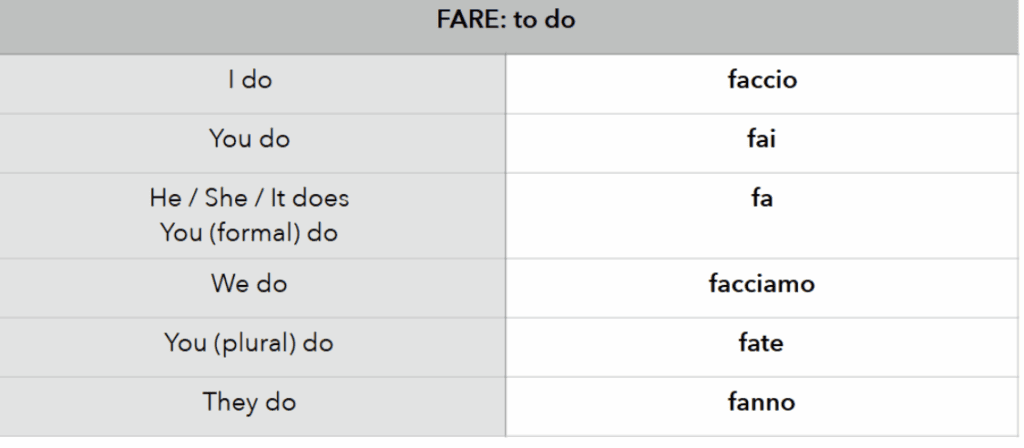
The verb fare to do is crucial here. Let’s look at its conjugation in the present tense:
In addition, you could use the verb lavorare to work, which is fundamental for discussing what you do for a living, especially if you want to specify your workplace. To ask Where do you work? you say Dove lavori? (informal) or Dove lavora? (formal).
Let’s have a look at the present tense conjugation of the verb lavorare:
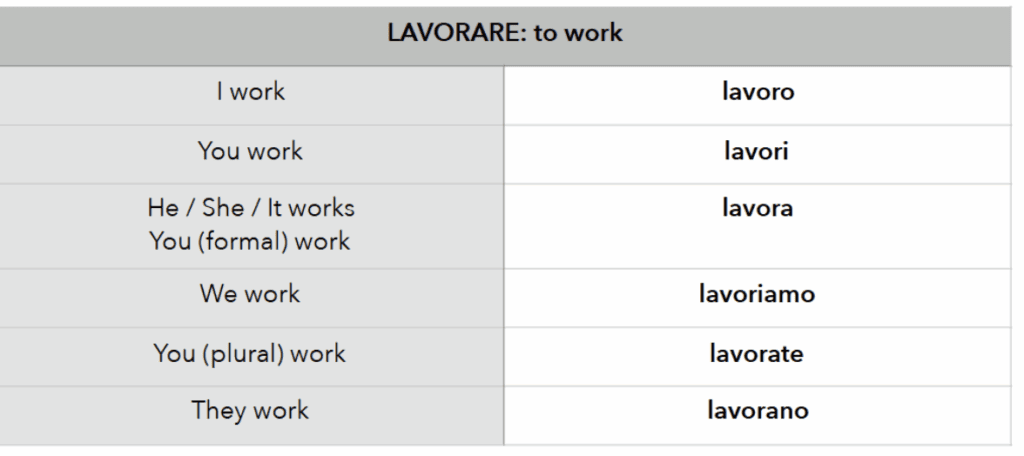
Once you know these verbs, you can express where you work or what you do for a living. For example:
- faccio il cameriere / la cameriera I am a waiter / I am a waitress
- faccio il dottore / faccio la dottoressa I am a (male) doctor / I am a (female) doctor
- lavoro in un ufficio I work in an office
- loro lavorano in un ospedale they work in a hospital
Finally, when discussing Italian jobs, you can use the verb essere to be. This is a simpler structure, translating directly to “I am a [job]”. You can use the indefinite article (a/an) or omit it:
- sono insegnante or sono un insegnante I am a teacher
Common Italian job titles
To expand your “Italian jobs” vocabulary, here’s a list of common professions:
- l’avvocato/l’avvocata lawyer
- il panettiere/la panettiera baker
- il meccanico/la meccanica mechanic
- l’architetto/l’architetta architect
- l’ingegnere/l’ingegnera engineer
- il giornalista/la giornalista journalist
- l’artista/l’artista artist
- il farmacista/la farmacista pharmacist
This list provides a good starting point for discussing various professions in Italian. Remember to pay attention to the masculine and feminine forms, as they are an important aspect of Italian grammar.
By mastering these phrases and vocabulary, you’ll be well-equipped to discuss “Italian jobs” and engage in conversations about work in Italian. This not only enhances your language skills but also provides valuable insight into Italian culture.
But would you know how to say you like your job in Italian? Or would you know how to talk about your likes in the language? If not, make sure to check the blog post we prepared on how to say ‘I like in Italian’!
Episode 17 – Season 4 – Coffee Break Spanish
In the latest lesson of our course, we join Carmen and read her letter which includes further details of the dramatic events which occurred in the Bay of Portals in 1949. As usual the text features many complex grammar points and interesting idiomatic expressions, and these are discussed by our hosts.
Learn how to introduce yourself in Italian and talk about yourself
Learning how to introduce yourself in Italian is a fundamental step when starting your language journey. Whether you’re travelling to Italy, meeting Italian-speaking friends or just exploring a new language, knowing how to confidently say who you are, where you’re from, and a little about yourself is essential.
In this lesson, we will explore how to introduce yourself in Italian. This is based on a structured lesson from Coffee Break Italian, which you can listen to for more insight into pronunciation and additional tips by pressing play on the button below!
How to introduce yourself in Italian – the basics!
The first step in introducing yourself is by greeting someone in Italian. If you want to make it more personal, follow up with your name using the structure Sono [name]. I am [name]. Once you’ve introduced yourself, it’s polite to ask for the other person’s name using the formal or informal version of the question:
- Come ti chiami? What is your name? (informal)
- Come si chiama? What is your name? (formal)
After that, you might want to ask or add a question to the person you are speaking to. Doing that is simple; you can just use the structure Sono di [place]. E tu? I am from [place]. And you?. If you’re visiting temporarily, you might say:
- Sono qui in vacanza. I am here on holiday.
- Sono qui per lavoro. I am here for work.
Talking about your family
Now that you know the basics of how to introduce yourself in Italian, we can move on to talking about yourself and talking more about your family is a natural extension of introducing yourself. To do that, here are a couple of useful phrases:
- Hai fratelli o sorelle? Do you have brothers or sisters? (informal)
- Sì, ho due fratelli. Yes, I have two brothers.
- Ho tre figli: due figli e una figlia. I have three children: two sons and a daughter.
- Mio figlio ha quattordici anni e mia figlia ha dieci anni. My son is 14 and my daughter is 10.
Talking more about your Italian learning
In Italian, you can use the present continuous form to describe temporary actions. For example:
- Sto imparando l’italiano da nove mesi. I have been learning Italian for nine months.
- Sto cercando un giornale. I am looking for a newspaper
Sharing what you do
When introducing yourself, one common topic of conversation is discussing your work or studies. In Italian, you can effectively convey this information by mentioning your current job or, if you are a student:
- Che lavoro fai? What work do you do? (informal)
- Lavoro come [profession]. I work as a [profession].
- Sto lavorando in Italia. I am working in Italy.
- Sono qui per studio. I am here for my studies.
And there you have it! You now know how to introduce yourself in Italian! By practising the phrases and tips in this blog post, you’ll not only feel more confident but also build meaningful connections with Italian speakers.
To learn more professions in Italian, read the blog post and listen to the episode we prepared on the subject!
Newsletter Activity 9 – Queridos Reyes Magos…

¡Hola amigos y amigas!
In Spain and some other Spanish-speaking countries it’s traditionally los Reyes Magos (Baltasar, Melchor and Gaspar), who bring presents to children. This usually happens on the night of el 5 de enero.
In order to practise your Spanish, we thought it would be a good idea for you to write una carta a los Reyes Magos, telling us what you’d like for Christmas this year or what you’d like to do over the holidays. Or perhaps you’re writing a wish-list for your partner or children!
You could simply use the conditional tense of gustar followed by an infinitive or a noun:
- este año me gustaría una guitarra acústica
- me gustaría salir con mis amigos
Or you could really set yourself a challenge by saying me gustaría que followed by a change of subject and the imperfect subjunctive in the second clause:
- me gustaría que cocinases más a menudo
- me gustaría que me trajerais un juego de tablero para que mi familia y yo podamos jugar todos juntos
- me gustaría que ordenarais vuestras habitaciones
Now it’s over to you!
Newsletter Activity 9 – word origins

Many words of French origin have become common place in the English language but in many cases the original meaning gets changed or lost along the way.
Which words can you think of that are used in English but were originally French? Is the meaning the same in both languages? If you want to go a stage further, we’d love for you to do un peu de recherches about the origins of one of the words you’ve chosen and then partager ce que vous avez trouvé with the rest of the Coffee Break French community by posting it in a comment here.
To start you off, you may want to think about cuisine, rendez-vous or chic.
On vous laisse y réfléchir mais n’oubliez pas de nous laisser un commentaire avec votre réponse!
Episode 16 – Season 4 – Coffee Break Spanish
In this lesson of Coffee Break Spanish we listen to the response from Jesús to Carmen’s latest email. As usual the episode is rich in idiomatic expressions and complex grammar points. Mark and Carmen are on hand to discuss the Spanish used in this episode.
Learn how to answer the phone in Italian
Do you know how to answer the phone in Italian? Booking a table or calling the receptionist at your hotel stay can be an amazing way to put this vocabulary into practice and improve your language skills.
In this blog post, we’ll cover the basics of answering the phone in Italian, including common phrases, etiquette tips and practice scenarios. Press play and listen to the podcast to get the nuances of pronunciation!
How to answer the phone in Italian? – Common phrases
If you are wondering how to answer the phone in Italian, here are some common phrases you might use:
- Pronto? Hello? – This is the most common way
- Ciao! Hi/Hello! – You can use this one as an informal greeting when answering calls from friends or family. Use it only when you know in advance the identity of the caller.
Moreover, you can use the basic greetings in Italian – like buongiorno/buon giorno and buonasera/buona sera.
Introducing yourself over the phone
After the initial greeting, it’s usually a good idea to introduce yourself. This helps the caller know who they are speaking with. Here are some examples:
- Sono … This is…
If you don’t recognise the caller’s voice, asking who is calling is polite. The most common way of doing this is:
- Chi parla? Who is speaking?
You can ask then ‘disturbo?’ as in ‘Am I disturbing you?’. If the person says no, non disturba affatto no, you are (formal) not disturbing at all, then you can say ‘vorrei parlare con …’ and add the name of the person.
If you want to talk to someone specifically but they are not there, you are likely to hear something like mi dispiace non c’è I’m sorry s/he’s not here or non è disponibile al moment she’s/he’s not available at the moment.
Saying goodbye on the phone
Now that you know how to answer the phone in Italian, how about learning how to say goodbye and end the call? Let’s check some common phrases:
- Arrivederci. Goodbye.
- Buona giornata. Have a good day.
- Ci sentiamo presto. We’ll talk soon.
- A presto. See you soon.
Knowing how to answer the phone in Italian may seem daunting at first, but with practice and the right phrases, you can handle any call with confidence. From common greetings and introductions to polite endings, this quick guide provides you with the tools you need to master phone etiquette in Italian.
So, next time your phone rings, pick it up with confidence and say, ‘Pronto?’! If you want to learn how to talk more about yourself in Italian, check you the article we prepared on the theme for you!
Alphabet in Italian and the present tense: a beginner’s guide
Learning a new language is such an exciting adventure, and Italian is definitely no exception! If you’re just starting out, two key things to focus on are the alphabet in Italian and the present tense of regular verbs.
In this post, we will explore the Italian alphabet and dive into conjugating regular -are verbs in the present tense. Plus, we’ll touch on some useful grammar points to help you get started. As always, be sure to check out the podcast episode to hear how everything is pronounced.
The alphabet in Italian
The alphabet in Italian derives from the Latin alphabet and consists of 21 letters with some additional letters borrowed from foreign words. But what does that mean? Well, unlike English, it does not include the letters J, K, W, X, and Y as part of its core alphabet.
Let’s take a closer look at the pronunciation of the letters:
- A (a)
- B (bi)
- C (ci)
- D (di)
- E (e)
- F (effe)
- G (gi)
- H (acca)
- I (i)
- L (elle)
- M (emme)
- N (enne)
- O (o)
- P (pi)
- Q (cu)
- R (erre)
- S (esse)
- T (ti)
- U (u)
- V (vu/vi)
- Z (zeta)
Foreign Letters:
- J (i lunga)
- K (kappa)
- W (vu doppia, doppia vu, or vi doppia, doppia vi)
- X (ics)
- Y (ipsilon or i greca)
It is important to note that foreign letters are usually found in proper nouns, foreign loanwords, and abbreviations.
Spelling words in Italian becomes straightforward once you become familiar with the pronunciation of each letter. You can practise this skill by spelling your name, numbers, body parts in Italian – or anything really.
Common phrases using the alphabet in Italian
Learning the alphabet in Italian opens up a world of possibilities for asking and answering questions about spelling. Here are some examples of phrases you might need:
- Come si scrive? How do you spell it?
- Si scrive… It’s spelt…
- E poi? And then?
Conjugating verbs in the Italian present tense
Now that we’ve explored the alphabet, let’s move on to verbs. In Italian, verbs are divided into three groups based on their endings: -are, -ere, and -ire. For this lesson, we’ll focus on -are verbs, which are among the most common and versatile.
Conjugating a verb in Italian means modifying its ending to match the subject. Here’s the pattern for regular –are verbs in the present tense:
Let’s take a closer look at some examples that illustrate the use of verbs ending in -are. These verbs are commonly found in Italian and are essential for constructing sentences that convey various actions and states.
- Parlo un po’ di italiano. I speak a little Italian.
- Parli francese? Do you speak French?
- Mio padre mangia pasta. My father eats pasta.
- Cantano una canzone. They sing a song.
Practical applications of learning the alphabet in Italian and the present tense
Learning the alphabet in Italian and present tense verbs opens the door to various practical applications. For example, with this knowledge and the knowledge you’ve been building, you will be able to introduce yourself in Italian, describe your activities and ask questions!
Additionally, these skills not only help with pronunciation and communication but also lay the groundwork for more advanced topics in Italian grammar. As you continue your language journey, remember to practice regularly and incorporate these basics into your daily conversations, like chatting on the phone.
To learn vocabulary, especially for talking on the phone in Italian, check out the blog post and episode we prepared on the subject!
Key vocabulary for asking for advice at an Italian pharmacy
Visiting a pharmacy in a foreign country can feel intimidating, especially if you’re not confident in the language. Whether you need medicine for a fever, a rash, or just some advice, knowing how to navigate an Italian pharmacy can make all the difference in your next adventure.
In this blog post, we’re going to have a look at seven handy phrases that will help you chat with pharmacists and get the assistance you need. And remember to check out the podcast for tips on how to pronounce those new words! Let’s make your next adventure a little easier together!
1. Dov’è la farmacia?
Before you head out to the pharmacy, you’ll want to find one nearby! A great way to ask for directions in Italian is by using the structure dov’è. To ask where the pharmacy is, you can say Dov’è la farmacia? Where is the pharmacy?.
If you want to be more specific, you can always ask:
- C’è una farmacia qui vicino? Is there a pharmacy nearby?
2. Non mi sento bene.
After you find the Italian pharmacy, the next step is to say that you are not feeling well. You can do that by saying ‘non mi sento bene’. It’s a straightforward way to communicate that something is wrong.
To emphasise your discomfort, you can say:
- Non mi sento molto bene. I don’t feel very well.
- Mi sento male. I feel bad/unwell.
3. Ho…
Following expressing that you are not feeling great, you then have to describe your symptoms using body parts in Italian or other useful words, like:
- febbre fever
- raffreddore cold
- tosse cough
- una vescica a blister
Just as a refresher, here is how you would talk about your aches and pains to a pharmacist using this structure:
- Ho mal di schiena. I have a sore back.
- Ho la febbre. I have a fever.
- Ho una brutta tosse. I have a bad cough.
4. Può consigliarmi qualcosa?
If you’re looking for some friendly advice from the pharmacist at an Italian pharmacy, just ask, ‘Può consigliarmi qualcosa?’. It’s a polite and cheerful way to seek their guidance. For example:
- Può consigliarmi qualcosa per la febbre? Can you recommend something for a fever?
5. Ho bisogno di…
Ok, but what if you know exactly what you need? Well, that makes things easier, and you can use this structure:
- Ho bisogno di un cerotto. I need a plaster/bandage.
- Ho bisogno di una crema per l’irritazione. I need a cream for the rash.
6. Deve prendere…
When you share what you’re feeling or ask about a specific product, the pharmacist will likely provide you with helpful instructions on how to use the medicine. That’s why getting familiar with the phrase ‘deve prendere…‘ can be super handy! Let’s take a closer look :
- Deve prendere queste pastiglie tre volte al giorno. You have to take these pills three times a day.
- Deve mettere questa crema quattro volte al giorno dopo i pasti. You have to apply this cream four times a day after meals.
One key piece of vocabulary to watch out for, in case you’re given pills, is prima dei pasti before meals and dopo i pasti after meals.
7. Non deve…
Well, if there is advice for when you have to take medicine, there is also advice for things that you should avoid. In that case, the pharmacist of an Italian pharmacy will most likely use the structure ‘non deve…‘, adding some advice on what not to do.
Two examples are:
- Non deve bere alcolici. You must not drink alcohol.
- Non deve stare al sole. You must not be in the sun.
Navigating an Italian pharmacy doesn’t have to be stressful. With these seven phrases in your language toolkit, you’ll be able to explain your symptoms, ask for advice, and understand the pharmacist’s recommendations! So next time you’re in Italy and need some over-the-counter help, you’ll feel confident and prepared.
To keep improving your Italian, why not have a closer look at the present tense conjugation in Italian? We prepared a special blog post focusing on that and also reviewing how to pronounce the letters of the alphabet. Have a look now!
Body parts in Italian: essential vocabulary for every learner
Learning to discuss body parts in Italian is not only useful for everyday conversations but also essential for travel, medical situations, and gaining a better understanding of Italian culture. Whether you are describing a sore throat or pointing to a feature in a sculpture, having the right vocabulary can significantly enhance your experience.
In this blog post, we will go beyond simple translations, exploring how to use these terms in context. We will also share tips to help you sound more like a native speaker. To learn how to pronounce some of these terms, be sure to listen to the podcast below!
Why learn body parts in Italian?
Body parts are an important foundation of vocabulary in any language. In Italian, they come up frequently in everyday situations. As we mentioned before, this knowledge can come in handy when talking about how your health is in Italian or even complimenting someone.
Moreover, Italians often use body-related idioms in their daily speech. For example:
- In bocca al lupo literally in the mouth of the wolf, meaning good luck;
- Avere un occhio di riguardo to have an eye of regard means to pay special attention.
- Dare una mano literally means to give a hand, meaning to help.
- Essere una persona in gamba means to be a very capable person, literally a person in leg.
- Costare un occhio della testa to cost an arm and a leg, which can be translated literally to to cost an eye of the head.
Learning these terms isn’t just practical – it’s a window into Italian culture and humour!
Key vocabulary for body parts in Italian
Let’s have a look at some of the most common vocabulary for body parts in Italian:
- la testa the head
- il naso the nose
- la bocca the mouth
- gli occhi the eyes (singular: l’occhio)
- le orecchie the ears (singular: l’orecchio)
- il braccio the arm (plural: le braccia)
- la mano the hand (plural: le mani)
- il dito the finger (plural: le dita)
- la gamba the leg
- il piede the foot
- lo stomaco the stomach
- la gola the throat
- la schiena the back
- il dente the tooth (plural: i denti)
While these words are straightforward, Italian body parts vocabulary has some quirks. For example, some singular words like il braccio and il dito become feminine in the plural.
With these words under your belt, you will be able to communicate about aches and pains in Italian, describing which part hurts!
How is your health in Italian?
Talking about your health and describing symptoms using body parts in Italian are some of the basic Italian travel phrases you need to know for your next adventure (even though no one wants to be sick during a holiday, it’s better to be prepared, right?).
When describing aches or pains, Italians use two main constructions:
- Ho mal di [body part]
- Ho mal di testa I have a headache
- Ho mal di gola I have a sore throat
- Ho mal di schiena I have a sore back
This structure is often used with internal or specific pains.
- Mi fa male [body part] or Mi fanno male [plural body parts]
- Mi fa male la gamba My leg hurts
- Mi fanno male i piedi My feet are sore
Here, the verb fa (singular) or fanno (plural) agrees with the body part in question.
To ask about someone’s health, you can use a similar structure:
- Hai mal di testa? Do you have a headache?
Tips for memorising Italian body parts
To effectively learn and memorise new vocabulary related to body parts, a fun way is to sing the children’s song “Head, Shoulders, Knees, and Toes” (or “Testa, Spalle, Ginocchia e Piedi” in Italian). Singing along can reinforce your understanding of the vocabulary!
Additionally, you can create virtual flashcards featuring images of body parts alongside their Italian names. Watching series and movies that incorporate this vocabulary will also help you understand its usage in context. If you’re looking for more resources, consider subscribing to the premium version of Coffee Break Italian Season 1, which offers bonus episodes, lesson notes, and much more.
In summary, learning body parts in Italian is not just about memorising words; it’s about building the confidence to navigate real-life situations, such as describing aches or using idioms.
But what if you need to buy medicine at the pharmacy? Would you know how to do that? If you need assistance, check out the blog post we prepared to guide you on how to seek help at an Italian pharmacy!
Celebrating 9 years of Radio Lingua

Nine years ago today we published the first episode of Coffee Break Spanish. Since then we’ve gone on to publish courses in 27 languages, and we’ve delivered over 160 million language lessons to learners around the world.
Some of the team have spent this weekend in London at the Language Show where we’ve been meeting thousands of language lovers, among them many members of the Coffee Break learning community. To celebrate our 9th birthday we’ve put together a special show featuring interviews with some of our listeners which we’ve recorded here at the Language Show.
Listen to the episode
If you’d like to tell us your story and potentially be featured in a future episode of one of our courses, click here.
Seasons in Italian: weather vocabulary and other useful words
Learning to talk about the seasons in Italian is more than just expanding your vocabulary; it’s about embracing the rhythm of Italian life. Each season brings its unique charm, traditions, and phrases that reflect the rich Italian cultural tapestry.
Whether you’re chatting about the weather or planning your next trip, understanding how to talk about the seasons in Italian and describe the weather will help you in your next adventure or when speaking to friends. In this article, we will present you with this useful vocabulary, so keep reading.
As always, don’t forget to listen to the podcast to gain insights on pronunciation!
The seasons in Italian
Let’s start with the basics: how do we call the seasons in Italian? If you have some Spanish knowledge, you might recognise some of the words even though the pronunciation is a little bit different:
- la primavera spring
- l’estate summer
- l’autunno autumn/fall
- l’inverno winter
The seasons can be used in everyday conversation, whether you’re talking about the weather or describing your favourite time of year. For example:
- In primavera, i fiori sbocciano. In spring, the flowers bloom.
- In estate, fa caldo e c’è il sole. In summer, it’s hot and sunny.
- In autunno, le foglie cadono dagli alberi. In autumn, the leaves fall from the trees.
- In inverno, fa freddo e nevica. In winter, it’s cold and it snows.
Talking about the weather in Italian
If you are missing some of these words to describe the weather and the seasons in Italian, don’t worry. We prepared a list that is worth adding to your basic Italian travel phrases, with a couple of words to help you describe them:
- fiorito blooming
- verde green
- caldo hot
- ventoso windy
- fresco cool
- umido damp
- gelido icy
- freddo cold
- nuvoloso cloudy
- piove it’s raining
Additionally, you can describe the weather or the day by saying:
- fa caldo / fa freddo it’s hot / it’s cold
- fa bel tempo / fa brutto tempo it’s nice weather / it’s bad weather
- c’è una tempesta it’s stormy
- ci sono tuoni e fulmini it’s thundering and lightning
Phrases for asking and answering what the weather is like
Now that you know some keywords to talk about the weather, here is a small breakdown of how you can talk or plan your day:
- Che tempo fa? What’s the weather like?
- Che tempo fa oggi? What’s the weather like today?
- Che tempo fa domani? What will the weather be like tomorrow?
- Com’è il tempo a Roma? How’s the weather in Rome?
To answer this question, you can simply say:
- Fa caldo. It’s hot.
- C’è il sole. It’s sunny.
- C’è la nebbia. It’s foggy.
- Domani a Bressanone fa molto freddo e nevica. Tomorrow in Bressanone it will be very cold and snowing.
Learning how to describe the seasons in Italian is a fun and practical way to build your vocabulary and bring colour to your conversations. Whether you’re talking about la primavera or l’inverno, you now have the tools to express how the weather is with confidence.
But what if the cold weather gives you a cold? Would you know how to describe your symptoms at a pharmacy in Italian? If not, don’t worry, we got you covered. Check out the blog post we prepared on the subject to help you out!
CBI 1-20B | Top-up episode

In this special “top-up” episode of Coffee Break Italian, Mark will test you on some of the words and phrases you’ve learned so far in the series with some translation challenges.