
One fun and important part of introducing yourself in a new language is chatting about your work life! In this blog post, we’re going to dive into the world of “Italian jobs” and explore how Italians and other Italian speakers talk about their professions.
We’ll also share some handy vocabulary and phrases that will help you discuss your own career and connect with others. As usual, don’t forget to listen to the podcast episode to learn how to pronounce this new vocabulary!
Talking about what you do in Italian
The most common way to start a conversation about Italian jobs with someone is by asking Che lavoro fai? which translates to What work do you do? and is the informal way to ask. For formal situations, you would use Che lavoro fa? addressing someone with Lei, the formal you.
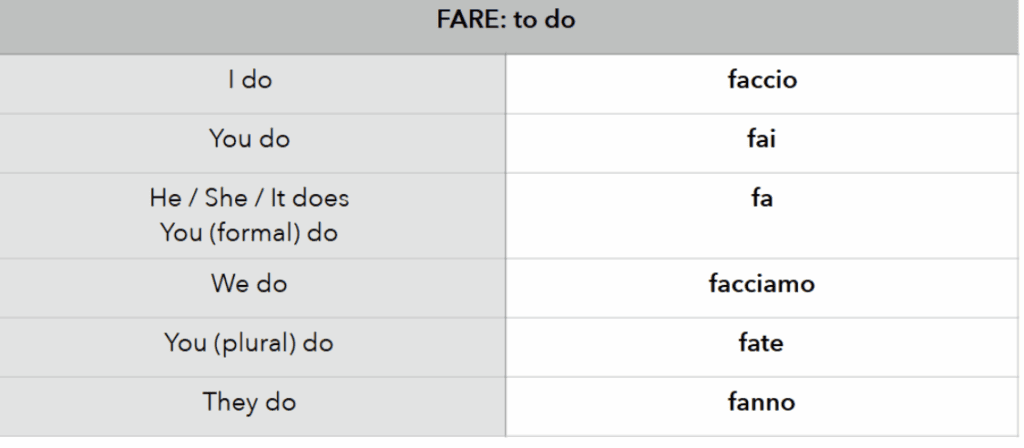
The verb fare to do is crucial here. Let’s look at its conjugation in the present tense:
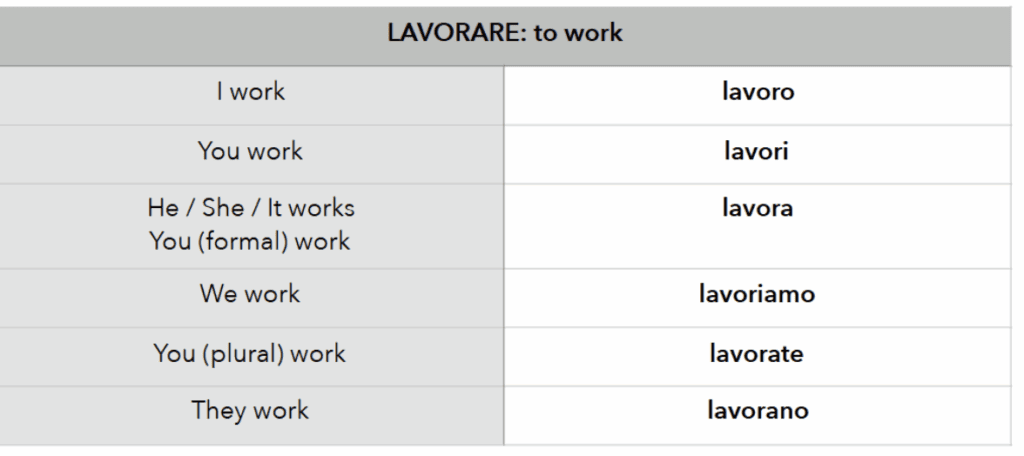
In addition, you could use the verb lavorare to work, which is fundamental for discussing what you do for a living, especially if you want to specify your workplace. To ask Where do you work? you say Dove lavori? (informal) or Dove lavora? (formal).
Let’s have a look at the present tense conjugation of the verb lavorare:
Once you know these verbs, you can express where you work or what you do for a living. For example:
- faccio il cameriere / la cameriera I am a waiter / I am a waitress
- faccio il dottore / faccio la dottoressa I am a (male) doctor / I am a (female) doctor
- lavoro in un ufficio I work in an office
- loro lavorano in un ospedale they work in a hospital
Finally, when discussing Italian jobs, you can use the verb essere to be. This is a simpler structure, translating directly to “I am a [job]”. You can use the indefinite article (a/an) or omit it:
- sono insegnante or sono un insegnante I am a teacher
Common Italian job titles
To expand your “Italian jobs” vocabulary, here’s a list of common professions:
- l’avvocato/l’avvocata lawyer
- il panettiere/la panettiera baker
- il meccanico/la meccanica mechanic
- l’architetto/l’architetta architect
- l’ingegnere/l’ingegnera engineer
- il giornalista/la giornalista journalist
- l’artista/l’artista artist
- il farmacista/la farmacista pharmacist
This list provides a good starting point for discussing various professions in Italian. Remember to pay attention to the masculine and feminine forms, as they are an important aspect of Italian grammar.
By mastering these phrases and vocabulary, you’ll be well-equipped to discuss “Italian jobs” and engage in conversations about work in Italian. This not only enhances your language skills but also provides valuable insight into Italian culture.
But would you know how to say you like your job in Italian? Or would you know how to talk about your likes in the language? If not, make sure to check the blog post we prepared on how to say ‘I like in Italian’!

2 thoughts on “Italian jobs: talking about your profession in Italian”
Hi Mark,
In the meanwhile I have learned a lot of Italian and I’m now by lesson 27. There, in the transcript of “Caffè Culturale” is mentioned the number duemilledodici (2012), but in lesson 15 we have learned that 2000 is “duemila”. Therefore 2012 mustn’t it say “duemiladodici”.
Please could you clarify me this point. Thanks.
Best regards
Irmgard
Hi Irmgard, you’re quite right – that’s a typo. We’ll get this updated as soon as possible. Apologies for the inconvenience.