
In this lesson you’ll learn to talk about rules and regulations in the past using the Präteritum of the modal verbs dürfen and müssen. By the end of the lesson you’ll know how to talk about what you were or weren’t allowed to do as a child.
CBF-ER 1.03 | Une Visite à Sainte-Agnès

In this episode Mark visits the hilltop village of Sainte-Agnès, the highest coastal town in Europe. He talks to locals and visitors to the village. As with all episodes of En Route, this will give you the perfect opportunity to practise your French and find out about another beautiful part of the Côte d’Azur.
Listen to the lesson
The audio lesson is free, as are all the main audio lessons of En Route avec Coffee Break French. Use the audio player above to listen to the lesson, or subscribe in Apple Podcasts to receive this lesson and all future lessons automatically. If you can’t see the player above, click here to access the lesson.
Accessing the Premium Version
In the full course of En Route you’ll get access to every episode as it’s released. The premium version includes additional materials which will help you move forward more effectively with your French studies:
- transcripts: read every word of French included in the conversations;
- vocabulary lists: in addition to the transcripts, we’ll provide vocabulary lists to help you understand everything that’s said;
- bonus audio materials: where an edited version of an interview is included in the main lesson, we’ll provide the full recording in the course to allow you to develop your comprehension skills further;
- exclusive video content: in addition to recording interviews in the south of France, the Coffee Break Team also filmed some video content and this video material is included in the course. Please note that these are not video versions of the interviews.
The En Route course can be accessed on the Coffee Break Academy.
Subscribe links
Subscribe on Apple Podcasts | RSS Feed | Purchase full course
31 ways to make January your best language-learning month ever!

The start of a new year is the best possible time to make a resolution to challenge yourself to become a better language learner. And this doesn’t necessarily mean hours and hours of study every day!
At Coffee Break Languages, we champion the idea of making your down-time your do-time: by using any spare moments of time you find yourself with to work on language-learning, you can make real progress. On this basis, we’ve done the hard work for you, and compiled this list of New Year language-learning mini challenges that can be completed in short bursts, on each day of January. Whether it’s your New Year’s resolution to jump into German, or to freshen up your French this coming year, this list of challenges will help you on your way to language mastery this year!
Think of this as a daily checklist – you can take your own path through these challenges, but we’d love to hear how you get on!
My daily challenge for January
Today I will…
- Listen to 1 episode of a language-learning podcast
- Learn 5 new words, complete with spelling and pronunciation
- Watch a TV episode or YouTube video in my chosen language
– Top Tip: If your chosen TV show offers subtitles, why not challenge yourself and turn on the subtitles in the language you’re learning, as opposed to the English subtitles? This will really help with your comprehension, spelling and pronunciation, as you’ll be able to both hear and see the words. - Read a paragraph in my chosen language aloud
– Top Tip: Record yourself speaking and listen back to the recording to try and identify where you can improve. - Listen to the radio in the language I’m learning for 10 minutes
- Say something to a native-speaker of the language I’m learning, or to a fellow learner
- Write my shopping list in my chosen language
- Translate my to-do list into the language I’m learning
- Introduce myself – by either speaking aloud or writing down what I would say – in the language I’m learning
- Work out how to say the current time in the language I’m learning three times during the day
- Find 5 words that I’ve partly forgotten since I learned them and learn them again
- Listen to a song written in the language I’m learning
– Top Tip: Read the lyrics of the song while you listen to it – this will help you to understand it (and of course help you to sing along!)
– Top Tip: Listen to the same song a few times so that you start to distinguish words and phrases more easily - Review 20 words and repeat them to myself out loud
- Read a recipe written in the language I’m learning (and use it, if time allows!)
- Write 2 sentences in the language I’m learning that demonstrate the last grammar point I learned
- Read a page of text in my chosen language
- Write out all the conjugations for 3 regular verbs from memory, and learn any that I get wrong
- Write out all the conjugations for 3 irregular verbs, and learn any that I get wrong
- Read a news article related to a country where the language I’m learning is spoken, either in the language I’m learning or in English
- Write a paragraph in the language I’m learning about what I’m doing for the rest of the day
- Write out a script or comic strip of a pretend conversation in the language I’m learning
- Learn 20 new words, complete with spelling and pronunciation
- Shop online for something on a website written in the language I’m learning (you don’t actually need to buy anything!)
– Top tip: Lots of international companies have equivalent websites for many different countries. Just search ‘Amazon España’, for example. - Write a short paragraph in the language I’m learning about what I did yesterday
- Learn a new fact about the culture of a country that natively speaks the language I’m learning
- Narrate my life in the language I’m learning for 5 minutes
– “I’m walking into the kitchen because I fancy a cup of tea. I can’t remember where the sugar bowl is. Ah yes, I put it through the dish-washer last night. Now I need to refill it….”
– Top tip: With this exercise you’re likely to quickly come across words that you don’t know. Write these down in English at the time, and look them up after the exercise. Try repeating the exercise later/the next day when you know the vocabulary. - Describe my surroundings for 2 minutes in the language I’m learning
– Top tip: As with the previous exercise, you’re likely to quickly come across words that you don’t know. Write these down in English at the time, and look them up after the exercise. Try repeating the exercise later, when you know all of the vocabulary. - Test myself on 40 words that I’ve learned before
- Write a poem or song (~4 lines long) in the language that I’m learning
- Read 5 pages of a book written in the language I’m learning
– Top Tip: There are lots of books available which have the foreign language and English printed side-by-side, or why not try starting out with a children’s novel? - Set myself a vocabulary test: test myself on all of the vocabulary I’ve noted down over the past month!
– Top tip: A great way to test yourself is to take a notebook and fold each page in half, from top to bottom. Then, write down all of the foreign-language words you’ve taken a note of over the past month on one side of the fold, and all of their English equivalents on the other side. Cover one side of the page and recite the translations of the words out loud, one by one. Then cover the other side of the page and translate in the opposite direction.
So, there you have it: the perfect blueprint to starting the year with a language-learning bang!
Over to you
Let us know how you’re doing in the comments! Good luck!
Dream destinations for you to practise your German speaking skills this winter

There are many winter activities on offer across the spectacular resorts in Germany, Switzerland and Austria and so many chances to practise your German speaking skills. From snowboarding to bobsledding, “fat bikes“ to swimming (yes, outdoors, in winter!), there is something for everyone in the winter playground around the Alps.
If you hit the slopes this winter, it can be a great opportunity to try the German you’ve been learning – as you buy your lift pass at the foot of the slopes, heat up with eine heiße Schokolade you order midway through your day or relax and chat with friends in a restaurant am Ende des Tages. We hope you find, as your skis are going downhill, your language skills are reaching new peaks!
With that in mind, we thought it would be helpful to give you some tips on some dream destinations to add to your bucket list, helping you practise your German speaking skills!
The thrill of the slopes
Garmisch-Partenkirchen lies on the border between Austria and Germany and is home to Germany’s highest mountain, the Zugspitze. It has more than 40 km of ski runs on offer as well as Kinderland for beginners.
If high-octane sport or entertainment is more your thing, then the same resort has a Sprungschanze or ski jump. The New Year sees the Four Hills Tournament, where adventurous winter athletes ski off the end of a 140m jump at almost 100 km/h. Auf die Plätze, fertig, los!
Walking in a winter wonderland
Do you prefer your winter sports at a more leisurely pace? The Salzkammergut in Austria provides a picture postcard setting to try Langlaufen or cross-country skiing.
While not as speedy as its more traditional downhill cousin, cross-country skiing gives participants a fantastic workout over a longer period and the opportunity to enjoy panoramic views of lakes and mountains en route.
Hopefully, you still have enough breath to carry on a conversation and practise your German skills with your fellow Langläufer as you make your way through the picturesque landscape.

Another gentle activity to try is snowshoe hiking. The large surface area of the shoes lets walkers make their way through the magical snow scenes with minimal effort. Walking and practising your German speaking skills can make the kilometres pass more quickly.
There are many guided walks and trails in the Tyrol for hikers to experience the freshest air, in untouched snow, at their own pace. Take a deep breath and enjoy!
Fast and fearless
Do you fancy trying something a bit new and different? Möchten Sie etwas anderes ausprobieren? What about “fat-bikes”? Their name refers to the wide tyres that give extra grip on icy terrain.
Not for the faint-hearted, this sport is available in Gstaad, Switzerland, alongside airboarding, where intrepid souls hurtle down pistes on a piece of equipment that’s a cross between an inflatable toboggan and a bodyboard.
If outdoor swimming in the winter months appeals to you, then there is no shortage of spas across the Alps. Can you imagine your delight at being able to practise your German speaking skills to ask for a massage? The steaming pools cater for swimmers all year round, meaning those bold enough to make the short walk outside can appreciate the Alpine views while revelling in the warmth of thermal waters.
Skating, skiing and sledging for all
The more traditional winter pursuits of Schlittschuh laufen, Schlitten fahren und Skifahren are enjoyed in towns and resorts throughout Germany, Austria and Switzerland. For example, if the Outer Alster Lake freezes in Hamburg in northern Germany, the inhabitants of the city enjoy this natural, open-air ice rink as part of the Alstereisvergnügen.
The town of Essen creates an ice rink in an old mining facility, beautifully floodlit in the soft winter sun. In Wien, die Haupstadt von Österreich, locals and tourists alike, sledge on the hill behind the Schönbrunn Palace in the city. Wouldn’t it be nice to get to know some local people as you all enjoy the winter snow together with a friendly wie geht’s? or Servus!
Downhill skiing is what comes to most of our minds when we think of winter sports and Sölden in the Tirol, near the borders with Germany, Switzerland and Italy, is a scenic spot with miles of pistes to suit all abilities of skiers and many lifts over heights up to 3000m. Vergessen Sie nicht ihren Hut!
The best of the rest

The Weissensee or White Lake, near Klagenfurt in southern Austria, sees an early morning gathering of speed skaters whizzing round the ice, making their noiseless pursuit look effortless and slick. You can hear the local people shouting words of encouragement to the speed skaters.
Some lakes in Switzerland freeze so solidly that ice hockey and curling can take place on them. One such place is the Obersee in Arosa, Switzerland, where skates can be hired throughout the winter and early spring for you to enjoy all sports on the ice in an idyllic setting.
Hiking in the winter months brings us back to where we started, Garmisch-Partenkirchen. There are trails here suitable for all levels of walkers who enjoy the spectacular backdrop as they trek in the snow on a clear, crisp day.
There are little Hütten or huts dotted around the mountains if you want to spend the night on a longer hike, talk to German-speaking walking companions and if you want to enjoy incredible views over hills and valleys the next morning. Genießen Sie den Sonnenaufgang!
At the end of the day
If all this talk of Alpine exhilaration has left you a little exhausted, will you still have energy for the part of winter sports some say they enjoy the most – the après ski? After a long day curling on a frozen lake in lovely Interlaken, bob-sledging in Berchtesgaden or paragliding over the peaks in Oberstdorf, the idea of some warming Glühwein in a cosy Weinstube might be very appealing.
Or do you live by the motto “ski hard, après-ski harder”? A party atmosphere can always be found in St Anton and Ischgl in Austria. Wherever you go and whatever you may have the chance to do this winter, wir wünschen Ihnen viel Spaß!
Sie sind dran!
Are you a winter sports enthusiast? Do you have any experience visiting Germany, Switzerland, or Austria during the winter months? Would you like to practise your German speaking skills in one of these dream destinations?
We hope that this blog post has inspired you to continue your language learning journey! If you would like to find other fun ways to learn the language, check out our blog post on German songs to add to your playlist!
New Year – New One Minute Languages!

We’re delighted to be launching five new One Minute Language courses for the new year. Starting on 1st January you can learn the basics of Czech, Slovak, Icelandic, Latvian and Hungarian with our weekly free podcast episodes.
1. Mondays: Hungarian

Hungarian is a language spoken by about 14 million people in eastern Europe. It’s the official language of course in Hungary, and it’s also spoken in parts of Romania, Slovakia and other bordering countries. One Minute Hungarian will be broadcast on Mondays for 10 weeks from 1st January.
Free podcast feed | RSS Feed | Immediate access to the video version and booklet
2. Tuesdays: Czech

Czech is a language spoken by over ten million people in central Europe. It’s the official language of course in the Czech Republic, and it’s very closely related to Slovak. In fact, Slovak speakers and Czech speakers understand one another reasonably well. Czech is one of the official languages of the European Union. One Minute Czech will be broadcast on Tuesdays for 10 weeks from 2nd January.
Free podcast feed | RSS Feed | Immediate access to the video version and booklet
3. Wednesdays: Slovak

Slovak is spoken by around five million people. It’s the official language in the Slovak Republic. Like Czech, it’s one of the official languages of the European Union. We’re producing One Minute Slovak in conjuction with Lýdia from Language Mentoring, and Lýdia explains that if you learn Slovak, speakers of most other Slavic languages will be able to understand some of what you say. One Minute Latvian will be broadcast on Wednesdays for 10 weeks from 3rd January.
Free podcast feed | RSS Feed | Immediate access to the video version and booklet
4. Thursdays: Latvian

Latvian is a language spoken by five and half million people in northern Europe. It’s the official language of course in Latvia, and it’s also spoken in parts of Russia, Sweden and Norway. One Minute Latvian will be brodcast on Thursdays for 10 weeks from 4th January.
Free podcast feed | RSS Feed | Immediate access to the video version and booklet
5. Fridays: Icelandic

We’re adding to our existing Nordic One Minute Languages this year with Icelandic, the official language of Iceland. It’s spoken by around 330,000 speakers and is a Germanic language, from the same family as Norwegian, Swedish and Danish. Icelandic is also very similar to Old Norse, the language of the famous Sagas. We’re producing One Minute Icelandic in conjunction with the lovely people at the I Heart Reykjavik blog and the show will be broadcast on Fridays for 10 weeks from 5th January.
Free podcast feed | RSS Feed | Immediate access to the video version and booklet
Can’t decide? Get them all!

Our Polyglot Pack is also available in the Coffee Break Academy, and this gives you access to all 31 of our One Minute Courses, from Arabic to Zulu, including our 5 new additions.
12 ‘Digestable’ Spanish idioms for your delectation

If you have ever heard expressions like ‘it’s not my cup of tea’ and ‘it’s raining cats and dogs’ in the United Kingdom, you know what idioms are. But have you ever thought about Spanish idioms?
It’s said that in order to find out more about the culture of a country, one need look no further than the language, or languages, spoken by the people who live there as it’s quite clear that a country’s language reflects what is most important to the people who speak it.
Bearing this in mind, today we’ll examine 12 Spanish idioms, or modismos, based on one particularly important aspect of Spanish and Hispanic culture: food.
¡Qué aproveche!
Note: the meaning of some of these idioms may vary from country to country, so watch out!
1. Ser la leche (Literally: To be the milk)
Have you ever wanted to be enthused about something in Spanish but already exhausted classic words like genial or bien? Well, next time you want to say that something or someone is really cool, you can use the idiom ser la leche.
For example: ‘Me encanta esa película, ¡es la leche!’ = ‘I love that film, it’s the best!’.
However, the catch with this expression is that it can also be used to mean the exact opposite.
For example: ‘¡Es la leche! ¿Cómo puede ser tan terco?’ = ‘He’s really something. How can he be so stubborn?’.
In this context, la leche is used to describe someone negatively. So, how do people know when it’s being used as a positive or a negative word? Well, as with many Spanish idioms, it all lies in the context and the tone of voice of the person using it, so keep an eye (or an ear) out!
2. Estar de mala leche (Literally: To be of bad milk)
The second Spanish idiom we are going to look at also uses the word leche, but this time with the verb estar. This is because this expression refers to a person’s current state, and, as we know, changeable things normally use estar. So what does estar de mala leche actually mean?
Here’s an example: ‘Hoy es mejor no hablar con Juan, está de mala leche’ = ‘It’s better not to talk to Juan today, he’s in a bad mood’.
The word uva, meaning ‘grape’ can also be used instead of leche (estar de mala uva), but has the same meaning: to be in a bad mood.
Note: the phrase ¡Qué mala leche! can be used to express sympathy, like the phrase ‘Too bad!’ in English.
For example: ‘¡Qué mala leche que no pudieron venir a la boda!’ = Too bad they couldn’t come to the wedding!
3. Ser pan comido (Literally: to be eaten bread)
If you are hoping to find literal translations of Spanish idioms in English, we are sorry to disappoint you. This one is the only one in our list that can be directly translated into English with another food-related idiom, although in the English version, it’s a different type of food. Can you think what it might be?
Well, pan comido literally means ‘eaten bread’, although this still doesn’t help us decipher the meaning of the idiom. Let’s look at an example to make it clearer:
Con todo el trabajo que he hecho, este examen va a ser pan comido’ = ‘With all the work I’ve done, this exam’s going to be a piece of cake!’.
So, ‘eaten bread’ is a Spanish version of the English idiom ‘a piece of cake’!

4. Importar un pimiento / un pepino (Literally: To matter a pepper / a cucumber)
How important is a pepper to you? And how about a cucumber? Apparently not very important, at least not in Spanish! In terms of Spanish idioms, this one is commonly used and means ‘I don’t care’ or even ‘I couldn’t care less’, if you’re really riled up!
Here it is in context: ‘A mi madre no le gusta mi novia, pero me importa un pimiento su opinión’ = ‘My Mum doesn’t like my girlfriend, but her opinion doesn’t matter to me / but I don’t care’.
5. Estar como una sopa (Literally: To be like a soup)
Among Spanish idioms, this is perhaps one of the easiest to understand from its literal meaning.
Let’s have a look at it in a sentence: Estaba lloviendo a mares y cuando la pobrecita llegó a casa, estaba como una sopa.’ = ‘It was absolutely chucking it down, and when the poor thing arrived home, she was soaked to the skin.’
So ‘estar como una sopa’ means ‘to be drenched’.
Bonus point: ‘llover a mares’ literally means ‘to rain oceans’, or as we say in English, ‘to rain cats and dogs’.
6. Cortar /partir el bacalao (Literally: To cut / to share out the cod)
Who shares the cod in your household or workplace? As with most Spanish idioms, this one doesn’t actually refer to fish. Cortar el bacalao can be translated in many ways, but the closest equivalent in English is probably ‘call the shots’. Can you think of any other translations?
Here it is in an example sentence: ‘Tengo que hablar con la jefa antes de tomar una decisión mañana porque es quien corta el bacalao en esta oficina.’ = ‘I have to speak to the boss before making a decision tomorrow because she’s the one who calls the shots in this office.
7. Ser del año de la pera (Literally: To be from the year of the pear)
At number 7 on our list of Spanish idioms, this is perhaps one of the most difficult to deduce from its literal meaning. In Spanish, if something is ‘from the year of the pear’, it means that it is old-fashioned or dated.
Let’s have a look at it in context: ‘Me encanta esta canción, pero es del año de la pera.’ = ‘I love this song, but it’s quite behind the times’.
This expression isn’t exclusively used for things such as clothing or music; it can also be used to say that someone’s views on a particular topic are outdated.
For example: ‘Armando es muy amable, pero sus ideas son del año de la pera.’ = ‘Armando is really nice, but his ideas are pretty outdated’.

8. ¡Vete a freír espárragos! (Literally: Go to fry asparagus!)
This modismo is slightly impolite, but no less useful. It can be used when you’re fed up with somebody.
For example: ‘Estoy harto de ti, ¡vete a freír espárragos!’ = ‘I’ve had enough of you, clear off!’.
9. Estar como un flan (Literally: To be like crème caramel)
If you are feeling very nervous and jittery, much like the way a flan wobbles, you can use one of the Spanish idioms that relate to food. Check the example below to understand how to use it in context:
Lorena tiene un examen muy importante mañana y está como un flan. = Lorena has a very important exam tomorrow and she is very nervous.
10. Ir al grano (Literally: To go to the grain)
This is another very useful Spanish idiom. It is used when you want to get straight to the point without wasting time on unnecessary details.
For example: No tenemos mucho tiempo, así que hay que ir al grano. = We don’t have a lot of time, so we have to get to the point.
11. Salir un churro (Literally: To get a churro)
Salir un churro is one of several funny Spanish idioms for when something turns out poorly or is of low quality. It is similar to saying “it turned out a mess” in English.
See it in context: No sé dibujar y, siempre que lo hago, me sale un churro. = I can’t draw and every time I do, I get a bad result.
12. Ponerse / Estar rojo como un tomate (To get/be red as a tomato)
This Spanish idiom is used to describe someone who is extremely embarrassed or blushing intensely. It’s similar to the English expression “to turn red as a beetroot.”
For example: Mi hijo se pone rojo como un tomate cada vez que ve a la persona que le gusta: ¡qué tierno! = My son blushes every time he sees the person he likes.
We hope you’ve enjoyed this article and are ready to have a go at using these Spanish idioms in context, even if it’s just a case of talking to yourself in Spanish! Using idiomatic phrases can help you sound more fluent.
Although the meaning of Spanish idioms in English can be quite tricky to remember – they are an invaluable tool for more advanced learners who want to take their language skills to the next level.
If you want to find more interesting and amusing aspects of the Spanish language, make sure to subscribe to the Coffee Break Spanish newsletter.
2017: A Year of Coffee Breaks

It’s been a very busy year for us here at Coffee Break. In addition to starting our fifth Coffee Break language with Mandarin Chinese in January, we launched second seasons of Coffee Break Italian and Coffee Break German, and we’ve relaunched the Coffee Break French and Spanish Masterclass, with hundreds of students working through our six-month coaching course. Our new French series, En Route avec Coffee Break French, premiered in November, and a Spanish equivalent is already in production – there will be more information about En Marcha con Coffee Break Spanish early in 2018.
Over the past year, we’re delighted to report that we’ve delivered 19.7 million free language lessons to learners around the world – that’s one lesson every 1.6 seconds! We hope that you’re continuing to enjoy your Coffee Break Moments as you learn a language with us!
We have many plans for 2018, including our new One Minute Languages courses, the Coffee Break Reading Club and we’ll be continuing to publish new content in French, Spanish, German, Italian and Chinese. We hope your New Year’s Resolutions include improving your language skills further, and we’ll be delighted to be there to help you!
12 Best French movies for French learners

Watching a film in a foreign language is a great way to improve your language skills. It does wonders for your listening and comprehension skills and is also a very enjoyable way to incorporate language learning into your free time. Tuning your ear into everyday colloquial French using the best French movies for learners will massively enhance your ability to engage with and communicate with native speakers.
If you are keen to make solid progress with your language learning, then it may be a good idea to take note of new words and phrases you come across when watching a French film. However, be careful not to get too carried away writing out the full script! Remember, watching a foreign film should be an enjoyable and relaxing experience; you will be absorbing the language without even realising it.
When it comes to choosing the best French movies to watch as a student of the language, it is important to consider not only your interests but also whether the film has a clear and continuous dialogue with the option to watch with subtitles. This is particularly important for beginners.
There is a wide range of French movies for students to choose from which can make the decision process quite overwhelming. So, we’ve done the hard work for you and selected twelve of the best French movies for learners, which are sure to grab your attention!
1. Les Choristes
Les Choristes tells the story of Pierre Morhange (Jacques Perrin), who reflects on his early years at a boarding school for boys with behavioural difficulties. The school, which is in a state of disrepair, is run by strict, old-fashioned policies instilled by the overbearing headmaster, Monsieur Rachin (François Berléand).
This soon changes when music teacher Clément Mathieu (Gérard Jugnot) arrives and introduces a school choir. To change the school’s policies, Clément encourages the boys rather than reprimanding them. This transforms the boys’ lives and leads to the discovery of Morhange’s musical talents.
The outstanding soundtrack accompanying this heartfelt story will be sure to leave you wanting more! For sure, a good suggestion to start our list of the best French movies to learn the language!
2. Les Intouchables
If you’re looking for a film that will make you both laugh and cry, then look no further than Intouchables. This award-winning comedy-drama follows the unlikely friendship between Driss (Omar Sy), a young man recently released from prison, and Philippe (François Cluzet), a wealthy quadriplegic. Despite having no intention or desire to work as Philippe’s personal carer, Driss finds himself undertaking this position and, to everyone’s surprise, excels at it despite his unconventional methods.
A beautiful friendship between two men from completely different backgrounds blossoms into an unbreakable bond. Based on an inspiring true story, this one deserves a place on our list of best French movies for learners!
3. Le Chef
Do you love la gastronomie? Well, for all the food lovers out there, Le Chef will transport you to the world of French ‘haute cuisine’. This light-hearted comedy features Jean Reno as Alexandre Lagarde, a famous chef who finds himself in trouble when his status as a Three Star chef comes under threat.
In danger of losing his reputation and beloved restaurant, Alexandre calls on the help of self-taught chef, Jacky (Michaël Youn), in an attempt to modernise his cuisine. Follow the highs and lows of the duo on their mission to get the restaurant back on track and restore Alexandre’s reputation.
For learners of all levels, this is one of the best French movies to learn the language, providing a wide range of food-related vocabulary and easy-to-follow dialogue.
4. La Famille Bélier
Louane Emera, who appeared as a semi-finalist on ‘The Voice: la plus belle voix’ in France, stars as 16-year-old Paula in La Famille Bélier. Acting as an interpreter for her two deaf parents and brother, Paula is the rock on which her family depends to run the family farm.
However, upon discovering her gift for singing, Paula’s music teacher encourages her to pursue a career in music by moving to Paris to attend a prestigious music school. Knowing that her family is heavily dependent on her, Paula faces the difficult decision of whether to remain at home, support her family, or follow her dreams.
Based on communication and the interpretation of language, this film is one of the best French movies for language learners, as it allows you to brush up on your vocabulary and learn more about popular French culture.
5. Populaire
Fifth on our list of best French movies for learners is one of those who enjoy romance, Populaire may be the film for you. Set in the late 1950s, this French romantic comedy-drama tells the story of a man, a woman, and a typewriter.
It quickly becomes apparent to insurance agent Louis Échard (Romain Duris) that his new secretary, Rose (Déborah François), can type with extraordinary speed. Keen to showcase her talent, Louis makes it his mission to help her win the title of ‘World’s Fastest Typist’ at a competition in New York. As the pair train together for the speed-typing contest, romance blossoms.
This film’s lighthearted and entertaining nature will undoubtedly lift your spirits and put a smile on your face!
6. Le fabuleux destin d’Amélie Poulain
This movie is a modern classic. If you haven’t watched it yet, this is your excuse to do so! Directed by Jean-Pierre Jeunet and starring Audrey Tautou in the titular role, the film follows Amélie, a quirky and kind-hearted young woman living in Paris.
After discovering a hidden box of childhood treasures in her apartment, Amélie decides to devote her life to secretly helping others while also pursuing her own happiness. Le fabuleux destin d’Amélie Poulain is a great choice for French learners and is an important part of our list of best French movies for discovering the language, as the dialogues are engaging and filled with useful vocabulary for everyday conversations.
7. Kirikou et la Sorcière
Kirikou et la Sorcière is a captivating animated movie that draws on African folklore to tell the story of a small but courageous boy named Kirikou. Directed by Michel Ocelot, this film follows Kirikou on his journey as he confronts the powerful sorceress Karaba, who has cursed his village. Despite his tiny size, Kirikou’s bravery, intelligence, and compassion make him a hero in the face of overwhelming odds.
This animation deserves a place among the best French movies for language learners due to its simple, slow-paced dialogue, which is particularly suitable for beginners. The clarity of the conversations allows viewers to follow along easily and absorb new vocabulary and expressions.
The combination of accessible language and cultural depth makes it a unique and enriching experience for anyone looking to improve their French skills while enjoying a lovely story!
8. Tanguy
Tanguy is a funny French comedy that explores the challenges of adulthood, independence, and family relationships. The film revolves around Tanguy (played by Éric Berger), a highly accomplished 28-year-old who still lives with his parents and shows no intention of moving out. While Tanguy enjoys the comforts of home, his parents, Edith (Sabine Azéma) and Paul (André Dussollier) are desperate to reclaim their space and freedom.
Tanguy offers a treasure trove of conversational French, particularly about family dynamics and everyday life. The humour is universal, making it easier to follow the plot even if you’re new to the language. The clear dialogue and situational context provide a great opportunity to learn vocabulary related to family, housing, and personal relationships, making it one of the best French movies for learning the language.
9. Bienvenue chez les Ch’tis
If you love comedies and want to experience regional French accents, Bienvenue chez les Ch’tis is a must-watch! This wildly successful film follows Philippe, a postal worker who gets transferred from sunny southern France to the northern town of Bergues, where the locals speak with a thick Ch’ti dialect. Expect hilarious misunderstandings as Philippe adapts to his new life and realises that the north isn’t as bad as he initially thought!
This movie is also one of the best French movies for learners because it offers excellent exposure to spoken French, humour, and cultural differences between regions. Plus, the plot is simple, making it easy to follow along.
10. Le Prénom
Le Prénom is a brilliant comedy-drama set almost entirely during a dinner party. The story unfolds when a man announces the controversial name he plans to give his unborn son, sparking a heated debate among friends and family. Deep secrets and grudges surface as the discussion escalates.
So, if you wish to enhance your listening comprehension, this is one of the best French movies for you! The dialogue is fast-paced but uses everyday French, helping learners become accustomed to authentic conversation.
11. Le Petit Nicolas
Based on the beloved French children’s book series, Le Petit Nicolas follows the mischievous adventures of a young schoolboy and his friends. Since it’s based on children’s literature, the language is clear and simple, making it ideal for beginners.
Plus, it introduces useful school-related vocabulary and expressions that are still used today.
12. L’Arnacœur
Romantic comedies don’t get much better than L’Arnacœur! Starring Romain Duris and Vanessa Paradis, the film follows a professional heartbreaker hired to sabotage relationships. But things take a turn when he’s hired to break up a seemingly perfect couple and ends up falling for the bride-to-be.
The playful dialogues, romantic tension, and formal and informal speech mix to provide a great learning opportunity.
À vous la parole !
And there you have it – a run down of some of the best French movies for language learners! More than just entertainment, these films are windows into French culture, language, and life.
Whether you’re just starting out or are a seasoned learner, incorporating films into your language journey can help you improve your vocabulary, sharpen your listening skills, and even better understand cultural nuances. So, grab some popcorn, turn on the subtitles if needed, and immerse yourself in the magic of our list of best French movies for learning.
If you’re excited to discover additional foreign-language films, be sure to look at our movie suggestions for German, Italian, and Spanish learners as well!
CBF-ER 1.02 | Menton, la Perle de la France

Mark has arrived in Menton and in this episode he sets out to rediscover the town after 25 years. In the course of this episode he talks to a number of native speakers of French including Eric, who works at the reception of the Office du Tourisme in Menton. In addition to building your understanding, this episode also introduces two useful phrases: être frais et dispos and c’est pas évident.
Listen to the lesson
The audio lesson is free, as are all the main audio lessons of En Route avec Coffee Break French. Use the audio player to listen to the lesson, or subscribe in Apple Podcasts to receive this lesson and all future lessons automatically. If you can’t see the player below, click here to access the lesson.
Accessing the Premium Version
In the full course of En Route you’ll get access to every episode as it’s released. The premium version includes additional materials which will help you move forward more effectively with your French studies:
- transcripts: read every word of French included in the conversations;
- vocabulary lists: in addition to the transcripts, we’ll provide vocabulary lists to help you understand everything that’s said;
- bonus audio materials: where an edited version of an interview is included in the main lesson, we’ll provide the full recording in the course to allow you to develop your comprehension skills further;
- exclusive video content: in addition to recording interviews in the south of France, the Coffee Break Team also filmed some video content and this video material is included in the course. Please note that these are not video versions of the interviews.
The En Route course can be accessed on the Coffee Break Academy.
Subscribe links
Subscribe on Apple Podcasts | RSS Feed | Purchase full course
8 tips to learn a new language from scratch

Have you ever dreamed of learning a language, but never had the opportunity? Perhaps your last language-learning experience was a very long time ago, but you’ve always wanted to reignite your love of languages. If so, being aware of some top tips to learn a new language can make it easier for you to pick up and achieve your language-learning goals.
To help you with that, we have developed this blog post with a list of suggestions to guide you on your language-learning journey, whether you’re using Coffee Break resources or other tools. By following these tips, you can make steady progress, stay motivated, and enjoy the process.
1. Find your favourite method
Our first suggestion in this list of tips to learn a new language is to choose the right method. There are thousands of resources available to help you learn a language, from the traditional textbooks and language exchanges to apps and, of course, the Coffee Break series of podcasts.
Sometimes, the sheer number of different resources that are out there can be quite overwhelming, as it’s impossible to try out everything before getting started. While many people prefer taking face-to-face classes, others work better at home using resources which guide their learning in a certain direction.
This allows people to soak up information without having to worry about what to learn next. Once you’ve decided which method works for you, the fun part can start: you’ll need plenty of colourful pens and notebooks to take notes while learning new vocabulary and practising your writing skills.
2. Understand the language-learning lingo
Most people first come across terms like nouns, verbs, adjectives, and adverbs when they’re learning English or their native language as a small child. Although they don’t tend to come up in everyday speech, these terms are at the very foundation of learning a second language.
The second tip to learn a new language is to know your ‘language-learning lingo.’ Even though everyone has heard of these words before, it’s a good idea to have a look over their meanings before tackling a second language:
- Nouns are “things”
- E.g. the table, the wall, or the dog
- Verbs are “doing words”
- E.g. running, jumping or getting dressed
- The infinitive form of these verbs would be ‘to run’, ‘to jump’ or ‘to get dressed’
- Adjectives are “describing words”
- E.g. blue, waving, happy or slanted
- Adverbs describe the way someone does something
- E.g. quickly, angrily, softly or sleepily
- The subject is the person/thing conducting the action of the sentence
- E.g. he, she, Sophie, the team
You’ll come across a lot more technical lingo during your language-learning journey, but this is a very good tip to learn a new language!
3. Keep a vocabulary book
No matter which new language you’re learning, you may feel overwhelmed at some point when confronted with all of the new vocabulary that comes along with it. As it takes time to learn words and even longer to retain them, our third tip to learning a new language is to keep a notebook in which you can record any new words you learn.
To take the traditional route, use a small notebook, fold each page in half lengthways, and write the English on one side and the corresponding word in the language that you’re learning on the other side. If you’re more technologically-minded, you may prefer to use a notes app to keep track of your words.
Additionally, these apps often have a search feature, so you can look up words quickly and easily, making your language learning more efficient. Spending just 5 or 10 minutes of a coffee break or a bus journey recapping words you’ve already learned goes a long way to helping you progress in your language learning!
4. Visual or audial?
Similar to tip number 1, this tip to learn a new language is all about finding the most efficient way to learn based on your personal style of learning. Many people are visual learners, meaning they need to see things written down to retain them.
These people tend to learn vocabulary best by repeatedly writing or typing the words that they’re trying to remember, for example. Visual learners can also benefit from using colours and images or even watching films.
Related topic: Film recommendations for French, German, Italian and Spanish learners
Others are audial learners and can best memorise points and words by saying and hearing the words over and over again or by listening to podcasts, for example. Try out a few different techniques to find out whether you are a visual or an audial learner. When you know what style works best for you, you’ll see your efficiency vastly improve!
5. Get your pronunciation right
The fifth tip to learn a new language is to get your pronunciation right. The alphabet of the language you’re learning may or may not be the same alphabet as English. Even if it is, be aware that the pronunciation of each word could differ from the way in which you would read it if it were a new English word. Some languages, such as Spanish, are pronounced as they’re written, but others, like French, are not.
For example, the French word “chose” is pronounced very differently from the English word “chose”, beginning with a soft “sh” sound rather than a hard “ch” sound that we hear in English. For this reason, it’s important that you hear how the words are spoken when you’re learning them.
And, of course, there are many languages which don’t use alphabets at all: some languages use characters which can prove challenging for a learner. Using listening resources as the base of your learning is also a great tip to learn a new language, as it ensures that you always learn the correct pronunciation.
It’s difficult to ‘un-train’ your ear and start using the correct pronunciation of a word once you’ve learnt it with the wrong pronunciation, so try to get it right from the start.
6. Use a dictionary app
Every language teacher will advise learners to get a dictionary to use during their studies, but lugging around a chunky book is often impractical. At Coffee Break Languages, we believe in language learning anywhere, at any time.
To enable this, our tip to learn a new language is to have a dictionary app on your phone, especially if you live in a country where your language is spoken and often need to find out the meaning of a word very quickly.
Of course, in addition to a dictionary app, it’s a good idea to have an actual dictionary at home. It should also be pointed out that, although translation apps and websites are constantly being developed and updated, they often can’t beat a good old-fashioned dictionary.
7. Build a routine around your learning
Consistency is one of the most important factors in language learning success. While it’s great to fit in practice whenever you can, building a routine makes it much easier to keep improving over time, and it’s one of the most effective tips to learn a new language.
So, our suggestion is to set aside 10-15 minutes a day. Whether it’s reviewing vocabulary, listening to a podcast, or practising pronunciation, consistent short sessions are often more effective than occasional long sessions.
To help maintain this routine, integrate language practice into your daily activities. For example, you can listen to an audio lesson during your commute, review flashcards while you’re having breakfast, or watch a short video lesson before bed. The more you make language learning a natural part of your day, the more progress you’ll see over time.
8. Be patient!
Here comes the serious stuff: learning a language to an advanced level can take a very long time and is not easy. This said, it is possible to make progress quickly, especially in the early stages.
Our final tip to learn a new language here is to constantly keep in mind the reasons for which you’re learning your language and keeping track of the progress you’ve made will help you to stay motivated, so that you can still pick up your notes or vocabulary book during a well-deserved coffee break, or in the evening after a long day’s work.
Speaking positively about your language learning to those around you and using upbeat and cheerful learning resources will also help, as will setting and achieving your goals. Here at Coffee Break Languages, we believe that everyone has the ability to learn a language, so stick at it and be patient!
Get started today!
We hope these top tips for learning a new language have inspired you to get started with another language for the first time and that they will help you to make great progress! There’s no perfect age or time to start learning a language. The best approach is to take the first step and stay committed to your journey.
At Coffee Break Languages, we believe everyone can learn a language. If you’re ready to begin, check out our courses for your chosen language at the Coffee Break Academy and start your language-learning adventure today!
CBF En Route 1-01 | En Route pour la Côte d’Azur

In episode 1, Mark sets off en route for the south of France and arrives in Nice. On the way he explains the objectives of this new series, and also takes the opportunity to talk to the French-speaking cabin crew on his flight to Nice. As the episode comes to an end Mark is heading to his final destination for this episode, the town of Menton where he lived 25 years ago.
Listen to the lesson
The audio lesson is free, as are all the main audio lessons of En Route avec Coffee Break French. Use the audio player to listen to the lesson, or subscribe in Apple Podcasts to receive this lesson and all future lessons automatically. If you can’t see the player below, click here to access the lesson.
Accessing the Premium Version
In the full course of En Route you’ll get access to every episode as it’s released. The premium version includes additional materials which will help you move forward more effectively with your French studies:
- transcripts: read every word of French included in the conversations;
- vocabulary lists: in addition to the transcripts, we’ll provide vocabulary lists to help you understand everything that’s said;
- bonus audio materials: where an edited version of an interview is included in the main lesson, we’ll provide the full recording in the course to allow you to develop your comprehension skills further;
- exclusive video content: in addition to recording interviews in the south of France, the Coffee Break Team also filmed some video content and this video material is included in the course. Please note that these are not video versions of the interviews.
The En Route course can be accessed on the Coffee Break Academy.
Subscribe links
Subscribe on Apple Podcasts | RSS Feed | Purchase full course
Black Friday Sale 2017

Update
Our Black Friday sale 2017 is now over. Thanks to everyone who has taken advantage of our special pricing, and we wish you well with your Coffee Break Language course! Want to find out if you’re among our lucky competition winners? Join us live on Facebook at 4pm UK time on Wednesday 29th!
Sale details
There’s 25% off all our courses on the Coffee Break Academy this weekend. To take advantage of this special offer you must use coupon code BF2017 at checkout.
Included in the sale are all our Coffee Break French, Spanish, German, Italian and Chinese courses. If you’d like to learn the basics of another language, try our One Minute Languages courses, or help your children or grandchildren learn a language with our High Five French and High Five Spanish courses.
And that’s not all…
How would you like to win every language course we’ve ever produced? That’s 43 courses in 25 languages, and thousands of hours of audio and video materials! Every customer purchasing a course during our Black Friday 2017 sale will automatically be entered into a prize draw and we’ll announce three lucky winners on Wednesday 29th November.
For full details of our sale and competition, please click here.
CBI 2.20 | Non ha mai provato la pizza napoletana!

In this lesson you’ll learn to use four very useful adverbs: mai (ever), già (already), appena (just) and ancora (still/yet) to talk about what you’ve just done, what you’ve already done, what you’ve never done and what you’ve not yet done. This very useful lesson builds on what you’ve learned in previous episodes, and it marks the half-way point of our course.
Huge News from Coffee Break Languages
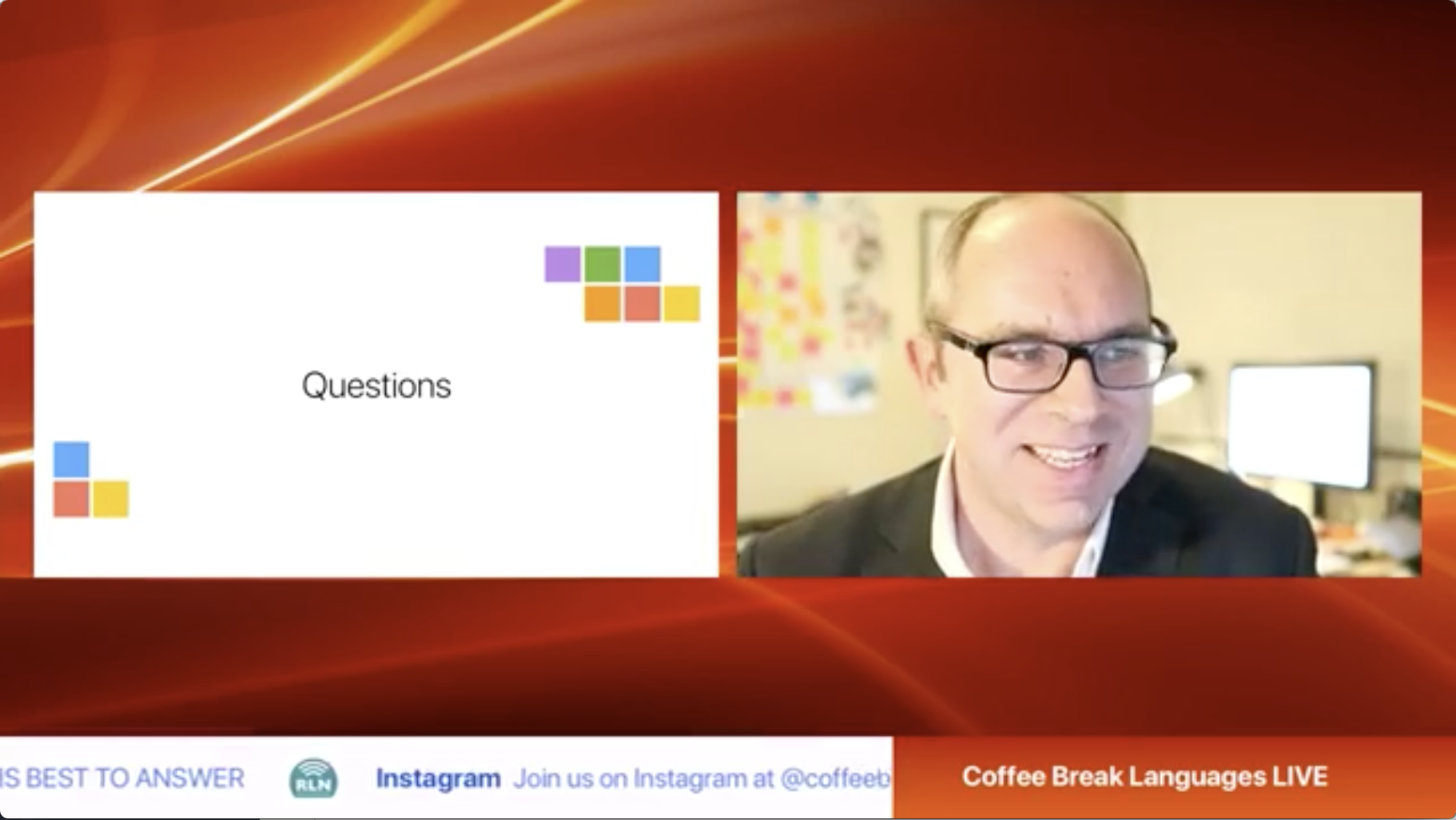
Yesterday we made some huge announcements in a live broadcast on Facebook. You can view the broadcast here, and there’s a summary of the keypoints below.
1. En Route avec Coffee Break French
You’ve learned French with Coffee Break French, and now it’s time to take your French on the road with Mark and the Coffee Break team. This first season of En Route was recorded in the south of France, in the area between Nice and Menton on the Italian border. In each episode Mark talks to people living and working in the area, so you’ll be hearing lots of different accents and speaking speeds.
The Season Preview is already available and you can find this here on the website and on the Coffee Break French podcast feed. If you’d like to sign up for the premium version of the course which includes transcripts, bonus audio and exclusive video content, you can purchase the En Route course in the Coffee Break Academy.
2. High Five French and Spanish
These courses for younger learners of French and Spanish are now fully available in our Coffee Break Academy. In High Five French, learner Emma is joined by native speaker Mathilde and children can learn along with Emma through a series of engaging video episodes, all filmed in France. Our presenters of High Five Spanish are native English speaker Sophie and her Spanish friends Marina and Miguel. High Five Spanish is set in the south of Spain and again features a series of video lessons which tell the story of Sophie learning Spanish. Both courses feature video content, audio materials, transcripts and notes for parents, activities and puzzles. Find out more about High Five French and High Five Spanish here.
3. The Coffee Break Reading Club
It’s easy to find materials in the language you’re learning on the internet, but it’s not always easy to find materials which suit your level. That’s why we’ve developed the Coffee Break Reading Club. Starting in January 2018, the Reading Club will provide weekly texts, delivered straight to your inbox. This service will be free of charge: you’ll receive a passage every week for one year. If you’d like to receive an audio version of the text along with vocabulary and an exercise/activity, you can purchase the Reading Club in the Coffee Break Academy. The Reading Club is aimed at learners who are working on or have completed Season 2 of our courses, or at a A2/B1 level in the language. It will be available in French, German, Spanish and Italian and you can find out more here.
4. New One Minute Languages
Currently our short introductory course, One Minute Languages, is available in 25 languages, from Arabic to Zulu. We’re delighted to be adding five new languages to the range, starting in December 2018. One Minute Czech, One Minute Slovak, One Minute Hungarian, One Minute Latvian and One Minute Icelandic will be published in weekly podcast episodes and a course featuring video versions of the ten lessons and a lesson guide will be available in the Coffee Break Academy. Stay tuned for more details of our launch. To find out more about One Minute Languages, click here.
5. En Marcha con Coffee Break Spanish
We decided that taking your language skills “on the road” was too good an idea to be limited to French, so we’ve started production on En Marcha con Coffee Break Spanish. Mark and the team visited the Andalucía region of Spain and recorded a series of interviews with locals. This new Spanish course will be launching in early 2018. Click here to find out more and to sign up for notifications about En Marcha.
Over to you…
Let us know what you think about our latest announcements by posting a comment!
CBF En Route 1-00 | Season Preview
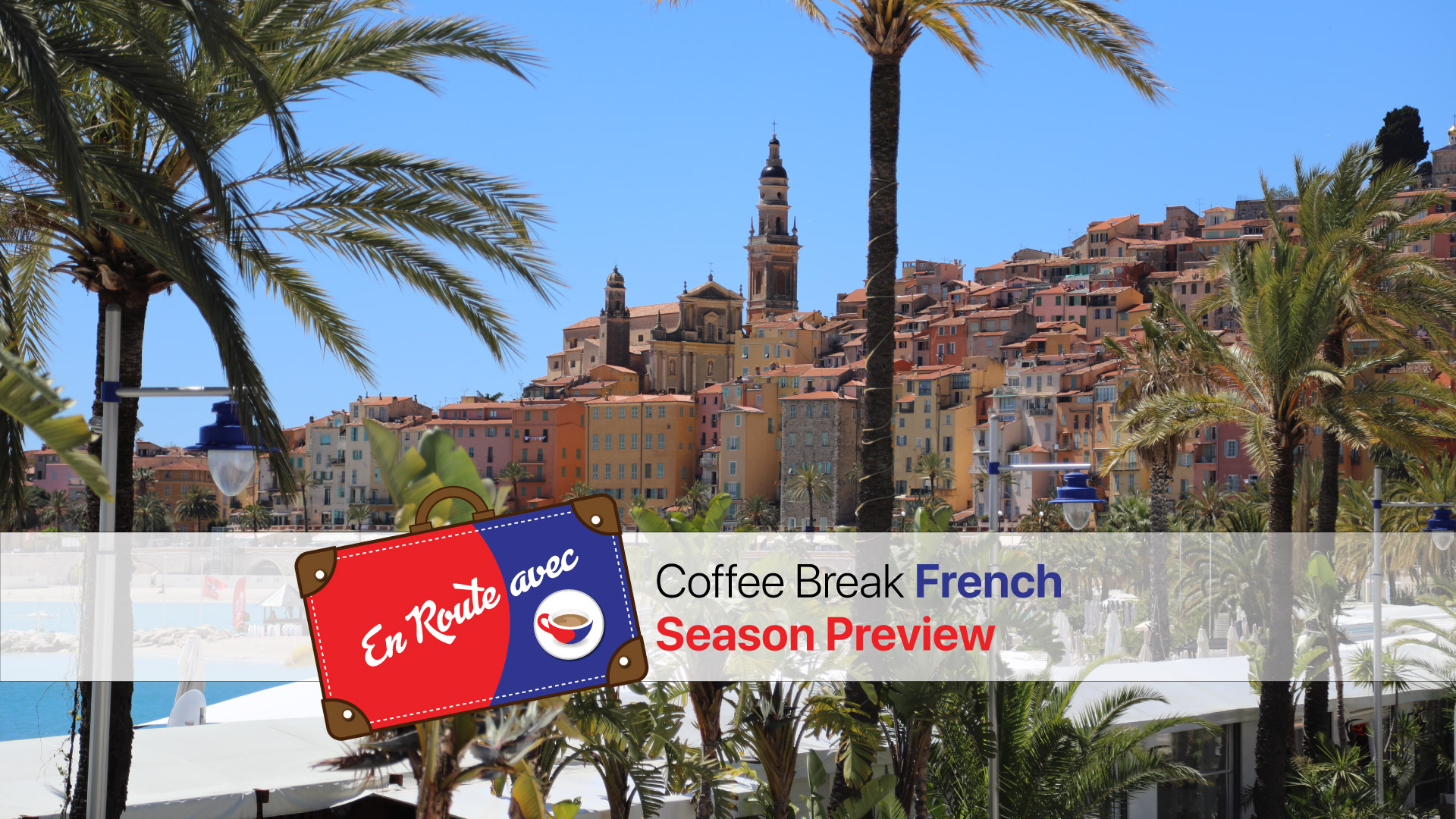
Join Mark and the Coffee Break French team “en route” in the south of France. In this season preview, Mark introduces the new show and you’ll hear excerpts from some of the many interviews we’ve carried out in the area between Nice and Menton on the beautiful Côte d’Azur. We’ll be talking to people who live or work in the area, and to people who are visiting the area. These conversations feature authentic French, with a whole range of different accents and speeds of delivery, so it’s the perfect way to improve your listening comprehension.
Listen to the lesson
The audio lesson is free, as are all the main audio lessons of En Route avec Coffee Break French. Use the audio player to listen to the lesson, or subscribe in Apple Podcasts to receive this lesson and all future lessons automatically. If you can’t see the player below, click here to access the lesson.
Accessing the Premium Version
In the full course of En Route you’ll get access to every episode as it’s released. The premium version includes additional materials which will help you move forward more effectively with your French studies:
- transcripts: read every word of French included in the conversations;
- vocabulary lists: in addition to the transcripts, we’ll provide vocabulary lists to help you understand everything that’s said;
- bonus audio materials: where an edited version of an interview is included in the main lesson, we’ll provide the full recording in the course to allow you to develop your comprehension skills further;
- exclusive video content: in addition to recording interviews in the south of France, the Coffee Break Team also filmed some video content and this video material is included in the course. Please note that these are not video versions of the interviews.
The En Route course can be accessed on the Coffee Break Academy.
Subscribe links
Subscribe on Apple Podcasts | RSS Feed | Purchase full course
CBG 2.20 | Als ich 20 war, wollte ich Astronautin werden

This lesson marks the end of the first half of our second season of Coffee Break German. Mark and Andrea take the opportunity to review the topics covered in lessons 11 to 19 with lots of new examples, helping you build your vocabulary and practise the grammar points at the same time.
CBI 2.19 | Ti è piaciuta la pastiera?

In this episode we’re looking at how you say you liked something in the past using the verb piacere. This verb is conjugated with essere and you have to be careful with how you agree the past participle. We’ll also be taking a look at how reflexive verbs work in the Perfect Tense in this lesson. Again, pay close attention to the past participles!
CBG 2.19 | Wie alt warst du, als du Deutsch lernen wolltest?
In the last lesson we looked at the Präteritum, the past tense form which is commonly used with verbs such as sein, haben and so on. In this lesson, we’ll be taking the Präteritum a little further and learn how to talk about what we wanted to do and what we were able to do in the past, using können and wollen.
Supporting the Polyglot Conference

This weekend Mark is in Reykjavík, Iceland, representing Radio Lingua as one of the official sponsors of the Polyglot Conference. This annual event brings together language enthusiasts from around the world, and features a series of presentations and workshops on language-learning, learning resources and polyglottery, the ability to speak multiple languages.
Here at Radio Lingua we’re delighted to be sponsoring the event. We’re looking forward to meeting language learners from around the world – and hopefully some of the Coffee Break community – in Iceland, and discovering this amazing part of the world. Follow Coffee Break Languages on Instagram for more updates live from Reykjavík, and to keep in touch with the team.
CBI 2.18 | A che ora sono arrivati?
So far we’ve been learning how to talk in the past by using the Perfect Tense with avere. In this lesson we’ll be learning about a specific group of verbs which use essere in the Perfect Tense. There’s something in particular we need to remember about these verbs, and all will become clear once you’ve listened to this lesson.