The Coffee Break Catch-up: 20 June 2019

Join Coffee Break Founder and CEO Mark for this week’s Coffee Break Catch-up, our weekly show in which we update you on our latest podcast episodes, blog articles and videos. There are discussions on language learning, and a round-up of some of the cultural events happening around the world.

In this edition:

  • updates on the latest episodes of Coffee Break French, Italian and Spanish, the launch of our One Minute Polish course on YouTube, and the latest Coffee Break To Go video episodes;
  • our new project, Tune for Tuesday;
  • this week’s Talking Point focuses on using music in language learning;
  • cultural news from around the world.

If you’d like to access all the links for this episode and practise your reading skills in the language you’re learning, click here to sign up for our weekly language and culture newsletter.

Music and studying: language learning using your favourite songs!

Vinyl record playing

Do you enjoy listening to music? It’s something you can do which doesn’t have to take any time out of your day – you can listen while you’re walking to work or washing the dishes. Wouldn’t it be great, then, if you could combine music and studying to help you with your language learning?

If you’ve already tried listening to songs in the language you’re learning, as good as the song may be, you may have found this a slightly demoralising experience if you’re struggling to understand what the song is about. However, understanding a language in song form can be more challenging because the pronunciation and phrasing are often altered to fit the music. 

So don’t be disheartened! Remember that even when listening to songs in English, it isn’t always easy to pick out every word. This is why songs are a great test for your listening comprehension and good for your pronunciation.

How exactly, then, can you make the most out of a song to benefit your language skills? Read on to find out our top 8 tips!

1. Just listen, with no peeking!

To combine music and studying, try listening to the song a few times without looking at the lyrics. Even if you can only pick out the odd word at first, this is a great start, as getting used to the sounds you’re hearing is good practice for your listening skills.

2. Now add the lyrics!

Look up the lyrics online (in the original language, not the English translation!) and listen to the song again while reading through them. This will help you associate the sounds you’ve heard in the song with written words you may already be familiar with, making the most of the combination of music and studying.

This stage is usually quite reassuring, as you realise that you actually do know a lot of the words being sung, making learning a language through music much easier.

3. Compare with an English translation

For many songs, you can find an English translation of the lyrics by searching online. Compare this to the original lyrics and note down any new vocabulary. 

The new words you are learning are within context and attached to a tune, often making them easier to remember! If you can’t find a translation of the lyrics, try running them through an online translator – just remember that this often can’t provide a perfect translation, but it should help to give you a rough understanding of the text.

4. Use the lyrics as a reading text

Now, to make the most of the experience of using music and studying, you can look through the original lyrics as if it were any other reading text, looking for examples of language points you have been learning about.

Try noting them down so you can remember examples of these grammar points being used in context!

5. Cultural knowledge

Look up the artist online to expand your cultural knowledge. When you get the chance to practise your language with native speakers, it is important to understand not only their language but also their culture. 

Knowledge of other cultures helps to connect with people better and gives you something interesting to talk about too!

6. Singing along for pronunciation practice

Singing along to songs is one of the best ways to improve pronunciation. Since you’re mimicking a native speaker, you’ll naturally improve your intonation and rhythm.

Plus, music repetition helps engrain phrases into your memory.

7. Enjoy your listening!

Add the song to your regular listening playlist and enjoy combining music and studying. Over time, you’ll naturally remember the lyrics, reinforcing the words and phrases. And before you know it, you’ll have improved your vocabulary and pronunciation without even realising it!

Combining music and studying can make language learning more enjoyable and effective! It immerses you in the sounds and cultural nuances of the language, complementing traditional study techniques like grammar exercises and flashcards.

If you’re excited about expanding your language skills further, you should consider exploring idiomatic expressions from other cultures. These idioms often reveal unique insights into the way different languages convey ideas and emotions. 

Would you like to get to know idioms from different languages? If so, check out our blog post that features a list of ten curious ones!

TFT: La Mer

Bonjour ! ¡Hola! Hallo! Ciao! This Friday 21st June is la Fête de la Musique – a celebration of music throughout France. To join in the festivities, we’re launching a new Coffee Break feature – ‘Tune for Tuesday’! Every week our team will select and share a song with you to introduce you to some new styles of music from around the world, while helping you develop your language skills.

Our first ‘Tune’ is a French classic, which you may recognise from its English version. The song is La Mer by Charles Trenet, who is often considered one of the greats of French popular music. This song has been translated into many languages and at the time of Trenet’s death in 2001, it was estimated that there were over 4000 different recordings of it! Have a listen to the song throughout the week – on your way to work or while making your morning coffee – and see how much you can understand by the end of the week.

Each week we will add our Tune for Tuesday to our brand-new Spotify and YouTube playlist to build up a collection of songs from all over the world and in many different languages. Scroll down to follow the playlist and keep up to date!

We’d love to hear if you enjoyed listening to La Mer in the comments below. Happy listening!

CBI Mag 1.04 | Leggiamo un po’

In this episode Francesca and Mark discuss one of Italy’s most famous authors, Italo Calvino. Calvino’s work can be read on many levels, and as a result of the type of language used, his books are very accessible for learners of Italian. In our Q&A segment, Francesca explains the difference between stare and essere.

Hast du Kinder/Geschwister? Talking about family in German – Coffee Break German To Go Episode 6

To ask “do you have children?” in German you can say hast du Kinder?, or in a more formal situation, haben Sie Kinder? You may also want to ask someone “do you have brothers and sisters?” This would be hast du Geschwister? or more formally haben Sie Geschwister? In this episode of Coffee Break German To Go, Julia asks this questions to interviewees in the streets of Berlin. You can use the answers of our interviewees to help you learn to answer this question yourself.

In the first part of the video, watch the interviews without subtitles and try to understand. In the second part of the video, we’ve provided subtitles in German at the top of the screen. You can choose to turn on subtitles in English using the Subtitles/CC button.

In our first series, Julia is in the city of Berlin, and in each episode she’ll ask passers-by one question. Of course, that one question will result in many answers, and it’s through these answers that you can practise your German and build your vocabulary.

If you’d prefer not to wait for all 10 lessons of Season 1 to be published, you can access downloadable versions of the videos along with audio versions and lesson notes / transcripts in the Coffee Break Academy:
https://coffeebreakacademy.com/p/coffee-break-german-to-go-season1/

Coffee Break German To Go is based on the popular podcast series and online course Coffee Break German. For access to the free podcasts, please click below:
https://coffeebreaklanguages.com/tag/cbg-season-1/?order=asc

To purchase our full online courses on the Coffee Break Academy, click below:
https://coffeebreakacademy.com/courses/category/German

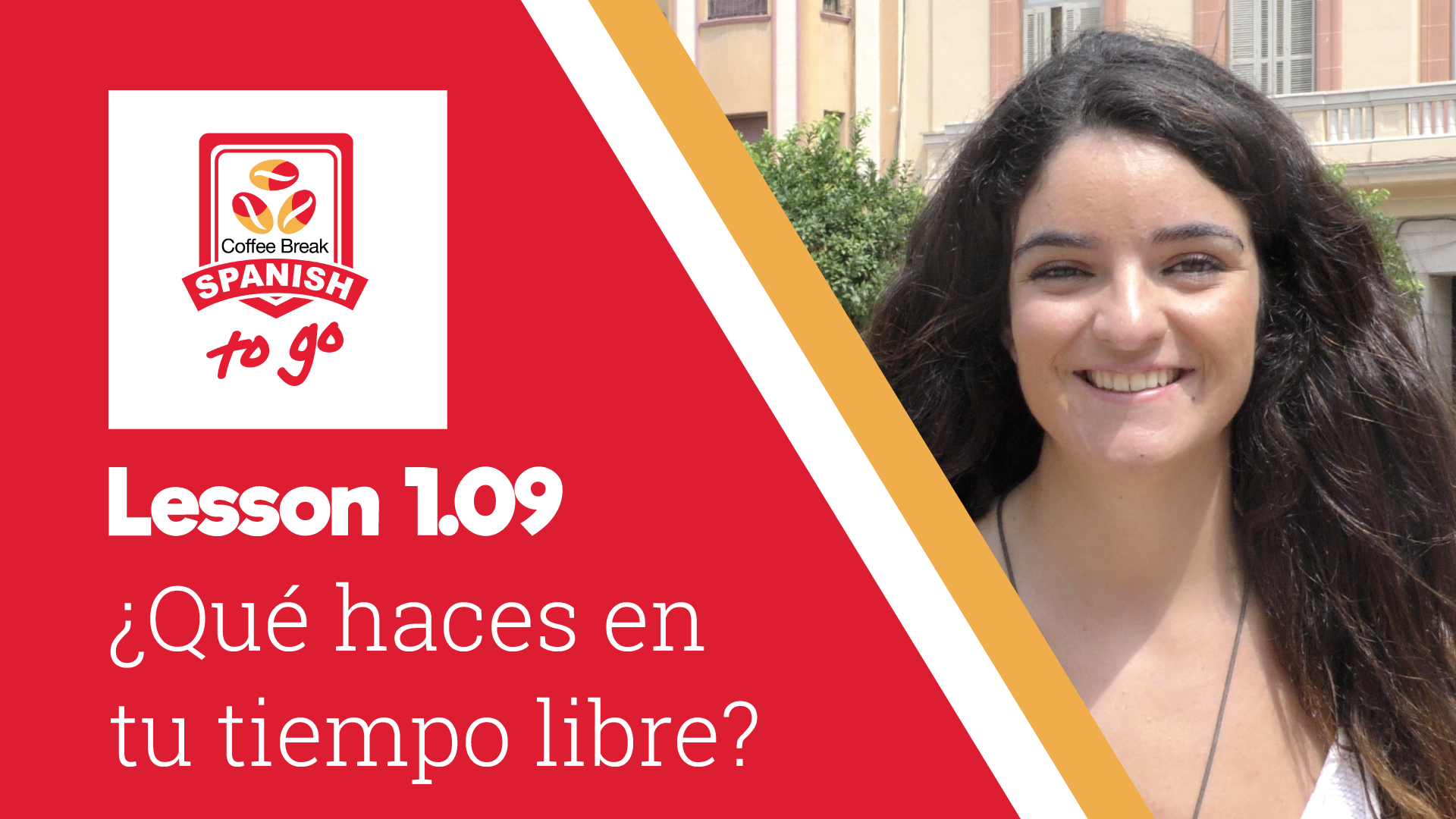
¿Qué te gusta hacer en tu tiempo libre? – Talking about free time in Spanish – Coffee Break Spanish To Go Episode 1.09

What do you like doing in your free time? In this episode of Coffee Break Spanish To Go, Marina asks the question, ¿Qué haces en tu tiempo libre? (informal) or ¿Qué hace usted en su tiempo libre? (formal). You can use the answers of our interviewees to help you learn how to talk about what you do in your free time in Spanish.

In the first part of the video, watch the interviews without subtitles and try to understand. In the second part of the video, we’ve provided subtitles in Spanish at the top of the screen. You can choose to turn on subtitles in English using the Subtitles/CC button.

In this first series of Coffee Break Spanish To Go, Marina is in the city of Málaga, in the south of Spain, and in each episode she’ll ask passers-by one question. Of course, that one question will result in many answers, and it’s through these answers that you can practise your Spanish and build your vocabulary.

Coffee Break Spanish To Go will be published every two weeks here on YouTube, and each Season will be filmed in a different part of the Spanish-speaking world.

If you’d prefer not to wait for all 10 lessons of Season 1 to be published, you can access downloadable versions of the videos along with audio versions and lesson notes / transcripts in the Coffee Break Academy.

Coffee Break Spanish To Go is based on the popular podcast series and online course Coffee Break Spanish. For access to the free podcasts, please click here.

The Coffee Break Catch-up: 13 June 2019

Join Coffee Break Founder and CEO Mark for this week’s edition of the Coffee Break Catch-up, our weekly show in which we’ll update you on all things Coffee Break Languages. There are discussions on language learning, and a roundup of some of the cultural events happening around the world.

In this edition:

  • updates on our latest episodes of the En Marcha con Coffee Break Spanish, our Coffee Break French Magazine, and the launch of One Minute Greek on our YouTube channel;
  • a sneak preview of our new project, Tune for Tuesday starting next week;
  • this week’s Talking Point focuses on language learning in schools vs learning a language in later life;
  • cultural news from around the world

If you’d like to access all the links for this episode and practise your reading skills, click here.

CBF Mag 1.03 | La Belle et la Bête

In this episode of the Coffee Break French Magazine we’re taking a trip to the movies to see one of the all time classics of French cinema, Jean Cocteau’s La Belle et la Bête. You’ll learn more about the film and about the work of Cocteau, and there’s an interesting listener’s question about how to translate “to look like” and “to feel like” into French. This series is aimed at learners who have completed at least Seasons 1 and 2 of Coffee Break French.

In each episode of this 10-lesson season for intermediate learners, you can build your vocabulary, increase your understanding of grammar and learn to use the French language in a more natural way. This series is aimed at learners who have completed at least Season 1 and Season 2 of Coffee Break French.

CBS EM 1.09 | Una Aventura Gastronómica por las Calles de Málaga

¡Es la hora del tapeo! There’s no doubt that trying delicious local delicacies is one of the best things about visiting a new place. In this penultimate episode of Series 1 of En Marcha, Mark and the team head off on a gastronomic adventure around the streets of Málaga. Led by knowledgable guides Jaimie and Susanne from the food tour company Devour Tours, we discover the secrets of Málaga’s mouth-watering offering of food and drink, as well as learning more about the concept of tapas. ¡Que aproveche!

Wann hast du Geburtstag? Talking about your birthday in German – Coffee Break German To Go

To ask “when is your birthday?” in German you can say wann hast du Geburtstag?, or in a more formal situation, wann haben Sie Geburtstag? In this episode of Coffee Break German To Go, Julia asks this questions to interviewees in the streets of Berlin. You can use the answers of our interviewees to help you learn to answer this question yourself.

In the first part of the video, watch the interviews without subtitles and try to understand. In the second part of the video, we’ve provided subtitles in German at the top of the screen. You can choose to turn on subtitles in English using the Subtitles/CC button.

In our first series, Julia is in the city of Berlin, and in each episode she’ll ask passers-by one question. Of course, that one question will result in many answers, and it’s through these answers that you can practise your German and build your vocabulary.

If you’d prefer not to wait for all 10 lessons of Season 1 to be published, you can access downloadable versions of the videos along with audio versions and lesson notes / transcripts in the Coffee Break Academy:
https://coffeebreakacademy.com/p/coffee-break-german-to-go-season1/

Coffee Break German To Go is based on the popular podcast series and online course Coffee Break German. For access to the free podcasts, please click below:
https://coffeebreaklanguages.com/tag/cbg-season-1/?order=asc

To purchase our full online courses on the Coffee Break Academy, click below:
https://coffeebreakacademy.com/courses/category/German

The Coffee Break Catch-up: 6 June 2019

Join Coffee Break Founder and CEO Mark for this week’s edition of the Coffee Break Catch-up, our weekly show in which we’ll update you on all things Coffee Break Languages. There are discussions on language learning, and a roundup of some of the cultural events happening around the world.

In this edition:

  • Updates on our latest episodes of the Coffee Break Italian Magazine, En Marcha con Coffee Break Spanish and the launch of One Minute Swedish on our YouTube channel;
  • a welcome to our new social media assistants who started this week;
  • a discussion about the origin of some words associated with tennis and how they are related to the French language;
  • cultural news from around the world

If you’d like to access all the links for this episode and practise your reading skills, click here.

Jeu, Set, Match! Essential tennis terms to add to your vocabulary!

A tennis racket with a yellow ball resting on its strings, placed on a clay court.

The French Open – les Championnats Internationaux de France de Tennis – is an annual event which takes place at the Stade Roland-Garros in Paris. Since this is the only one of the four most prestigious tournaments in tennis, which is held in a country where English is not the official language, we thought we’d take a closer look at some essential tennis terms in French.

So, if you “let” us, we’d “love” to “serve” you up this “set” of fascinating discoveries! Of course, etymology is sometimes not an exact science in that some word origins are not 100% clear. 

However, we’ve done our best to investigate the words below and we’re excited to share our findings, donc c’est parti!

1. Tennis

Let’s start with the name for “the sport of kings”. Back in 13th century France, a version of what would later become modern tennis was played in which players would hit the ball with the palm of their hand. 

This game was called jeu de paume in French. In this game, before hitting a shot across to their opponent, it is thought that players would shout tenez (from the verb tenir, meaning “to hold”), to let them know the point was about to be played. Over the years, tenez evolved into tennis, giving the sport its name.

2. Let 

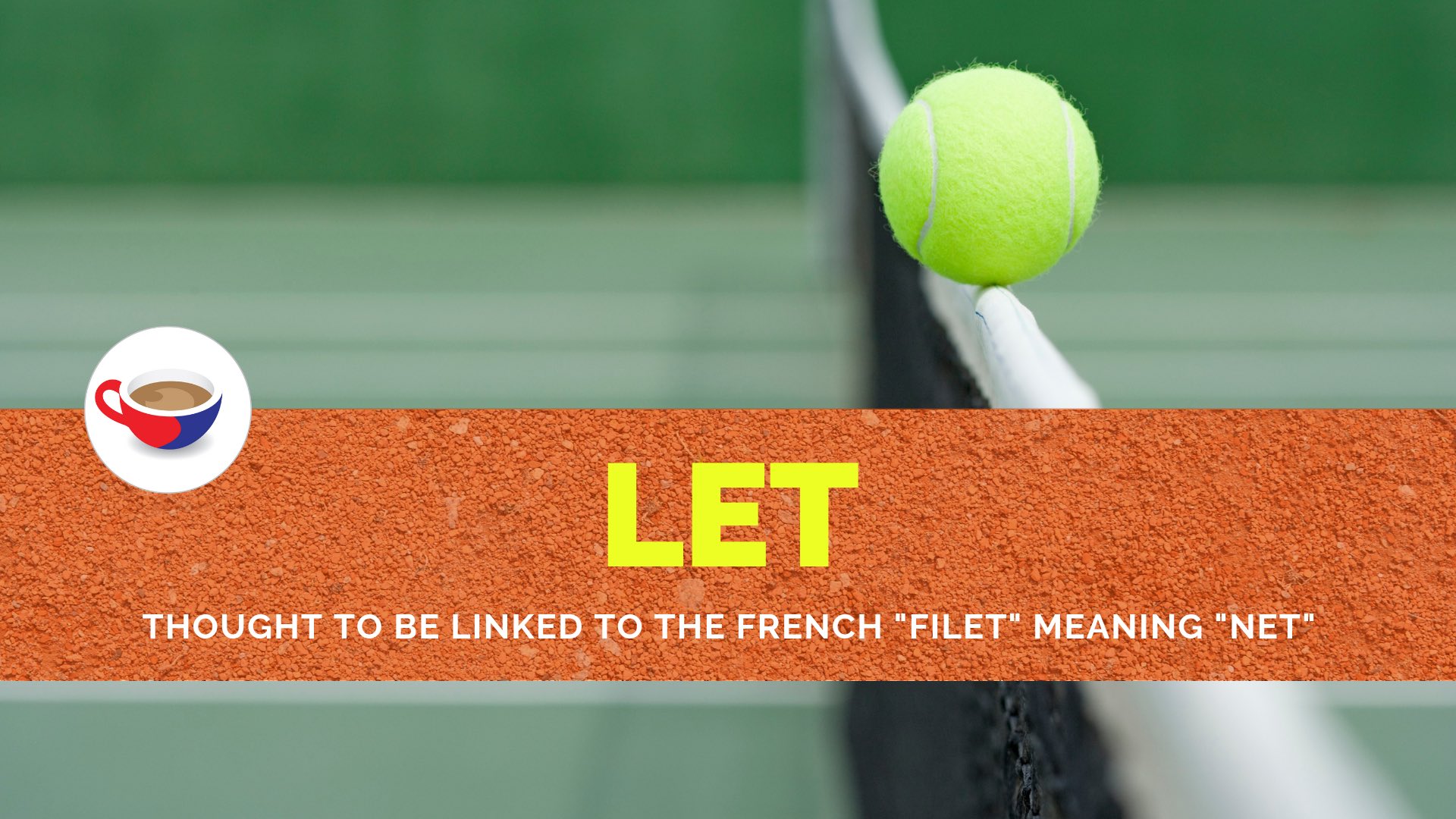
Now, let’s look at the first one of the essential tennis terms: let. This is always an exciting moment in the sport. During a player’s serve, when the ball strikes the net and topples over onto the opponent’s side of the court, the player is given the chance to retake their serve. 

This is called a let and, due to the net’s starring role in this shot, let is thought to be a shortened version of the French word for net, filet.

3. Love

Next on the list of essential tennis terms is the term we use when a player has not yet scored any points in a tennis game. In English, we say “love”, but don’t be tempted to use amour, the French equivalent! 

In French, you simply say zéro in this instance. But what is the origin of the word “love” in tennis? Believe it or not, it has something to do with the oval-like shape of the zero. Back when tennis was in its early stages in France, people thought that the zero looked like an egg, or an œuf

If we add a definite article, this becomes l’œuf, and this is said to be where “love” comes from in the English scoring system.

4. Deuce

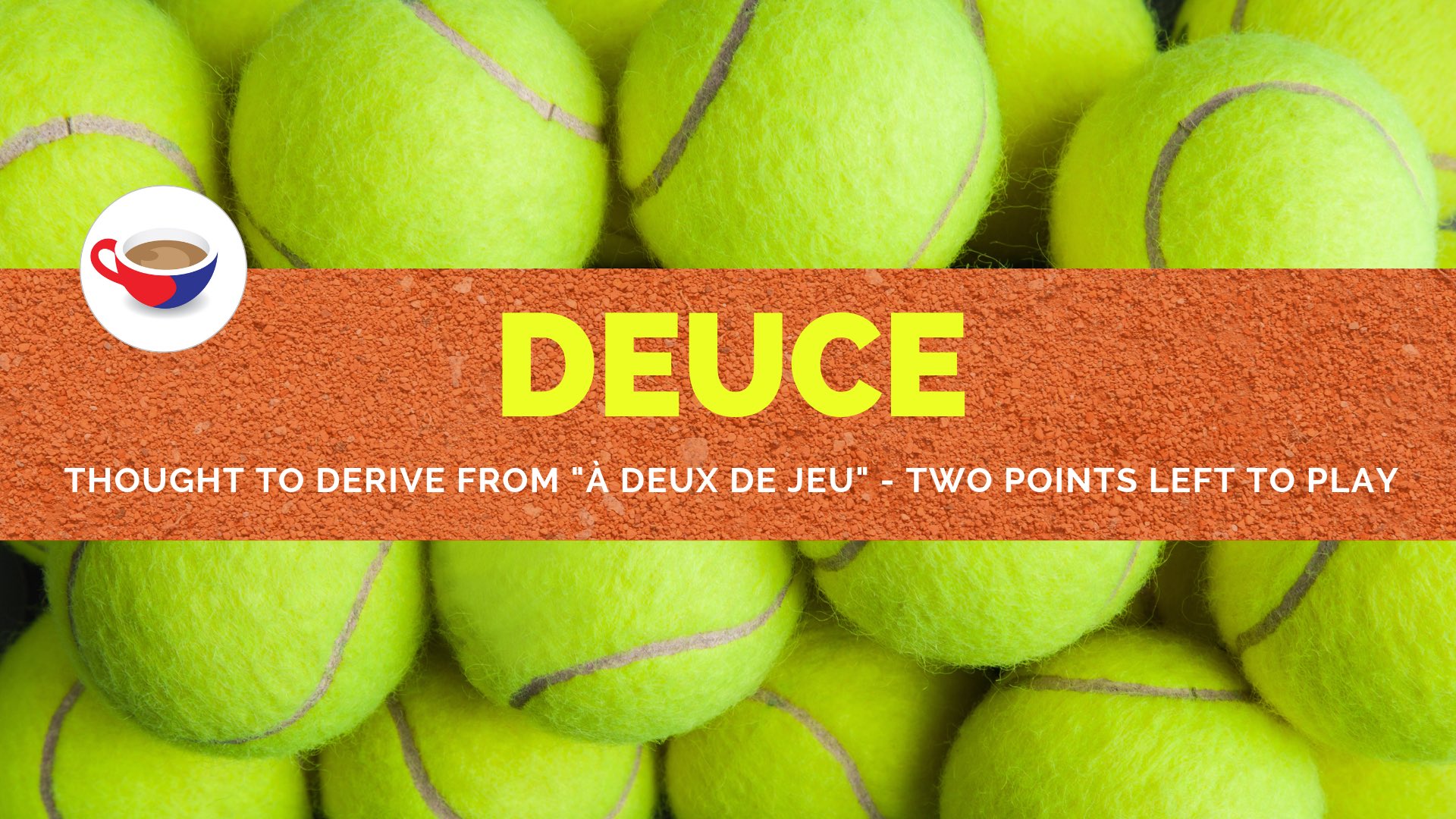
Our final word in the list of essential tennis terms is deuce, which is used when two players have 40 points each. There are a couple of theories as to the origin of the word deuce in French tennis, but one of the most likely is that it is derived from the phrase à deux de jeu, meaning “to be two points away from winning the game”. 

It’s also possible that it came from the Old French word for two – deus – now deux in Modern French. Interestingly, “deuce” is not used in French: instead when the score reaches 40-40 this is called quarante-A.

If one player then gains the advantage by winning the next point but subsequently loses the following point, the score returns to 40-40. From then on “deuce” is referred to as égalité.

Learn more tennis terms

Now you are armed and know the meaning of some very important tennis terms, but if you want to check some more useful terms watch the Walk Talk and Learn episode which Mark filmed during his visit to the Roland Garros tournament:

We hope you’ve enjoyed this quick tour of the fascinating world of tennis terminology in French. Whether you’re a seasoned tennis fan or just getting started, understanding these terms can enhance your appreciation of the game and improve your language skills.

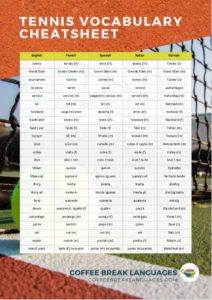
To help you even more, we’ve created a comprehensive Cheat Sheet with all these tennis terms and more. It’s a handy resource you can keep with you to reference anytime. Click the below to download your copy now:


Download the Cheat Sheet

:

¿A qué te dedicas? – Talking about your work and studies – Coffee Break Spanish To Go Episode 1.08

In this episode Marina asks the interviewees about their work and studies using the question ¿a qué te dedicas? or ¿a qué se dedica usted?, literally meaning “what do you dedicate yourself to?”

In the first part of the video, watch the interviews without subtitles and try to understand. In the second part of the video, we’ve provided subtitles in Spanish at the top of the screen. You can choose to turn on subtitles in English using the Subtitles/CC button.

In this first series of Coffee Break Spanish To Go, Marina is in the city of Málaga, in the south of Spain, and in each episode she’ll ask passers-by one question. Of course, that one question will result in many answers, and it’s through these answers that you can practise your Spanish and build your vocabulary.

Coffee Break Spanish To Go will be published every two weeks here on YouTube, and each Season will be filmed in a different part of the Spanish-speaking world.

If you’d prefer not to wait for all 10 lessons of Season 1 to be published, you can access downloadable versions of the videos along with audio versions and lesson notes / transcripts in the Coffee Break Academy.

Coffee Break Spanish To Go is based on the popular podcast series and online course Coffee Break Spanish. For access to the free podcasts, please click here.

The Coffee Break Catch-up: 30 May 2019

We have a special edition of the Coffee Break Catch-up this week which was recorded live in Milan, Italy. Join Mark and Francesca who are filming some future Coffee Break Italian content. We’ll be telling you more about this in this edition, along with our usual collection of information about the latest Coffee Break episodes and cultural events around the world.

CBF Mag 1.02 | Saint Exupéry

In Episode 2 of Season 1 of the Coffee Break French Magazine, we discuss the French author and aviator Antoine de Saint-Exupéry, author of Le Petit Prince. In the Q&A section, Mark discusses the difference between the imperfect and perfect tenses in response to Keith’s question.

In each episode of this 10-lesson season for intermediate learners, you can build your vocabulary, increase your understanding of grammar and learn to use the French language in a more natural way. This series is aimed at learners who have completed at least Season 1 and Season 2 of Coffee Break French.

CBS EM 1.08 | Málaga: Transformación Cultural

What springs to mind when you think of the city of Málaga? Until recently, it may have been the great weather and the beaches. But nowadays, the city has shaken off the dated image of sol y playa, and is establishing itself as one of Spain’s main cultural hubs. In this episode, through a series of interviews with local professionals, we hear about what led to this cultural transformation, and the opening of new museums and galleries across the city.

The Coffee Break Catch-up: 23 May 2019

Join Coffee Break Founder and CEO Mark for this week’s edition of the Coffee Break Catch-up, our weekly show in which we’ll update you on all things Coffee Break Languages. There are discussions on language learning, and a roundup of some of the cultural events happening around the world.

In this edition:

  • Updates on our latest episode of the Coffee Break Italian Magazine and our One Minute Japanese course on YouTube;
  • news of a special fund-raising project we’re running this week to support Dementia Awareness week;
  • discussion about the development of the English language and the science of etymology, the study of the origins of words;
  • cultural news from around the world.

Wie alt bist du? Talking about your age in German – Coffee Break German To Go Episode 1.04

To ask “where age are you?” in German you can say wie alt bist du?, or in a more formal situation, wie alt sind Sie? Literally this means “how old are you?” In this episode of Coffee Break German To Go, Julia asks this questions to interviewees in the streets of Berlin. You can use the answers of our interviewees to help you learn to answer this question yourself.

In the first part of the video, watch the interviews without subtitles and try to understand. In the second part of the video, we’ve provided subtitles in German at the top of the screen. You can choose to turn on subtitles in English using the Subtitles/CC button.

In our first series, Julia is in the city of Berlin, and in each episode she’ll ask passers-by one question. Of course, that one question will result in many answers, and it’s through these answers that you can practise your German and build your vocabulary.

If you’d prefer not to wait for all 10 lessons of Season 1 to be published, you can access downloadable versions of the videos along with audio versions and lesson notes / transcripts in the Coffee Break Academy:
https://coffeebreakacademy.com/p/coffee-break-german-to-go-season1/

Coffee Break German To Go is based on the popular podcast series and online course Coffee Break German. For access to the free podcasts, please click below:
https://coffeebreaklanguages.com/tag/cbg-season-1/?order=asc

To purchase our full online courses on the Coffee Break Academy, click below:
https://coffeebreakacademy.com/courses/category/German

Canadian French: An introduction to the French of Quebec

Did you know that Canadian French is spoken by more than 84% of the population of Quebec, according to data from the 2021 Census of Canada? That is true, and although many Quebecers or Québécois are bilingual in English and French (or speak another language as their mother tongue), more than 7.07 million people still speak French as their first language.

While Quebec City (la Ville de Québec) is the province’s capital, Montreal (Montréal) is its largest city. Behind Paris, Kinshasa (Republic of Congo), and Abidjan (Ivory Coast), Montreal is the fourth-largest French-speaking city in the world. So, when planning a trip to practise your French, why not consider crossing the Atlantic to discover French-speaking Canada? 

If you do, not only will you get the chance to discover the beautiful old town of Quebec and have a taste of some poutine, but you’ll also be greeted by a new accent and many differences in vocabulary from the standard French you may have been learning. Here are four aspects of Canadian French which prove that learning another dialect of a language can be a wonderfully enriching experience!

1. Je prends mon déjeuner à 8 h et mon dîner à 12 h 30

Surprised? Here’s difference number one between French in France and Canadian French:

For the French, their breakfast is le petit déjeuner, lunch is called le déjeuner and dinner is le dîner. French Canadians, however, opt for:

  • breakfast le déjeuner
  • lunch le dîner
  •   dinner le souper

So don’t be confused if you understand someone as saying they have lunch as soon as they get out of bed! Note that these words can also be heard in Belgium and Switzerland.

2. Your boyfriend is your buddy and your girlfriend is your blonde!

You may have learned that mon petit-ami means my boyfriend and ma petite-amie means my girlfriend. However, in Canadian French, your boyfriend is your chum, and your girlfriend is your blonde, regardless of her hair colour!

For example:

  • Voici mon nouveau chum. This is my new boyfriend.
  • Voici ma nouvelle blonde. This is my new girlfriend.

While the word blonde doesn’t necessarily have derogatory connotations, it is slang and should only be used in informal, conversational contexts.

3. C’est là là !

As you may already know, can be translated as there and is used in standard French in contexts such as je l’ai trouvé là I found it there. However, in informal, spoken québécois or Canadian French, this two-letter word is found at the end of many sentences, often without a translatable meaning!

It is often used for emphasis or to add more emotion to a statement. For example, if you’re getting frustrated at a person who is looking for something which is right in front of their nose, you might say regarde, c’est là là ! While the first would explain the position of the object, the second one is almost like a spoken exclamation mark, expressing the speaker’s impatience.

4. Les anglicismes

Finally, in case you’re starting to worry about having to learn a whole new language when travelling to French-speaking Canada, don’t panic – many English words are used too!

In larger cities like Montreal, French and English merge together and influence one another, sometimes referred to as franglais. Some young Québécois will even start a conversation in French ,then suddenly change into English and back into French again within a few sentences.

This means that Canadian French borrows and adapts many words from English.

Here are some of the most common ones (English / standard French / québécois French):

  • to check / vérifier / checker
  • to direct or “be the boss of” / diriger / bosser
  • cute / mignon / cute (English pronunciation)
  • anyway / de toute façon / anyway (English pronunciation)
  • a joke / une blague / une joke (English pronunciation)

Sometimes, it’s almost easier for English speakers to understand what a québécois person is saying than it is for people who speak standard French!

5. À tantôt

In québecois or Canadian French, the phrase à tantôt is a charming way to say see you later which in standard French would be à tout à l’heure. This sentence is widely used in Quebec as an informal farewell among friends and family.

Interestingly, the use of à tantôt demonstrates how Québecois French often preserves linguistic elements that have fallen out of common usage in France. Historically, tantôt was used more broadly in European French to signify a near-future time. In Quebec, it has endured as part of a living language, reflecting the province’s rich linguistic heritage.

Embracing Canadian French

Of course, the idea of travelling to a place with an unfamiliar accent and new vocabulary that you haven’t learned may seem daunting, but we hope you can see how interesting and fun it can be visiting many different countries where the language you’re learning is spoken.

Have you had any experience travelling to a country where the language you’re learning is spoken with an unfamiliar accent and vocabulary, such as Canadian French? If you would like to hear different French accents in the comfort of your home, check out the blog post we prepared with the best movies for French learners!