
The French Open – les Championnats Internationaux de France de Tennis – is an annual event which takes place at the Stade Roland-Garros in Paris. Since this is the only one of the four most prestigious tournaments in tennis, which is held in a country where English is not the official language, we thought we’d take a closer look at some essential tennis terms in French.
So, if you “let” us, we’d “love” to “serve” you up this “set” of fascinating discoveries! Of course, etymology is sometimes not an exact science in that some word origins are not 100% clear.
However, we’ve done our best to investigate the words below and we’re excited to share our findings, donc c’est parti!
1. Tennis
Let’s start with the name for “the sport of kings”. Back in 13th century France, a version of what would later become modern tennis was played in which players would hit the ball with the palm of their hand.
This game was called jeu de paume in French. In this game, before hitting a shot across to their opponent, it is thought that players would shout tenez (from the verb tenir, meaning “to hold”), to let them know the point was about to be played. Over the years, tenez evolved into tennis, giving the sport its name.

2. Let
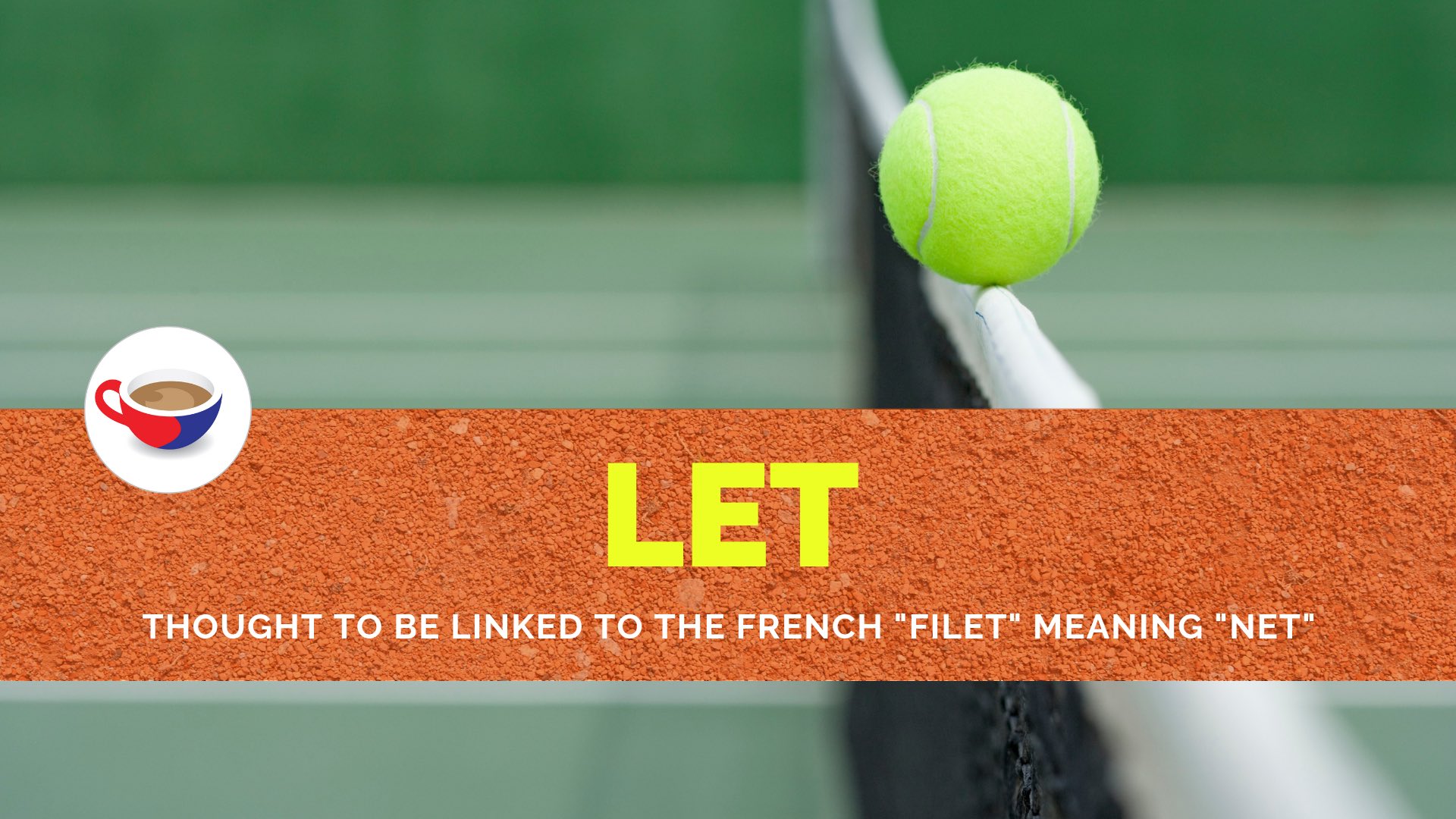
Now, let’s look at the first one of the essential tennis terms: let. This is always an exciting moment in the sport. During a player’s serve, when the ball strikes the net and topples over onto the opponent’s side of the court, the player is given the chance to retake their serve.
This is called a let and, due to the net’s starring role in this shot, let is thought to be a shortened version of the French word for net, filet.
3. Love
Next on the list of essential tennis terms is the term we use when a player has not yet scored any points in a tennis game. In English, we say “love”, but don’t be tempted to use amour, the French equivalent!
In French, you simply say zéro in this instance. But what is the origin of the word “love” in tennis? Believe it or not, it has something to do with the oval-like shape of the zero. Back when tennis was in its early stages in France, people thought that the zero looked like an egg, or an œuf.
If we add a definite article, this becomes l’œuf, and this is said to be where “love” comes from in the English scoring system.

4. Deuce
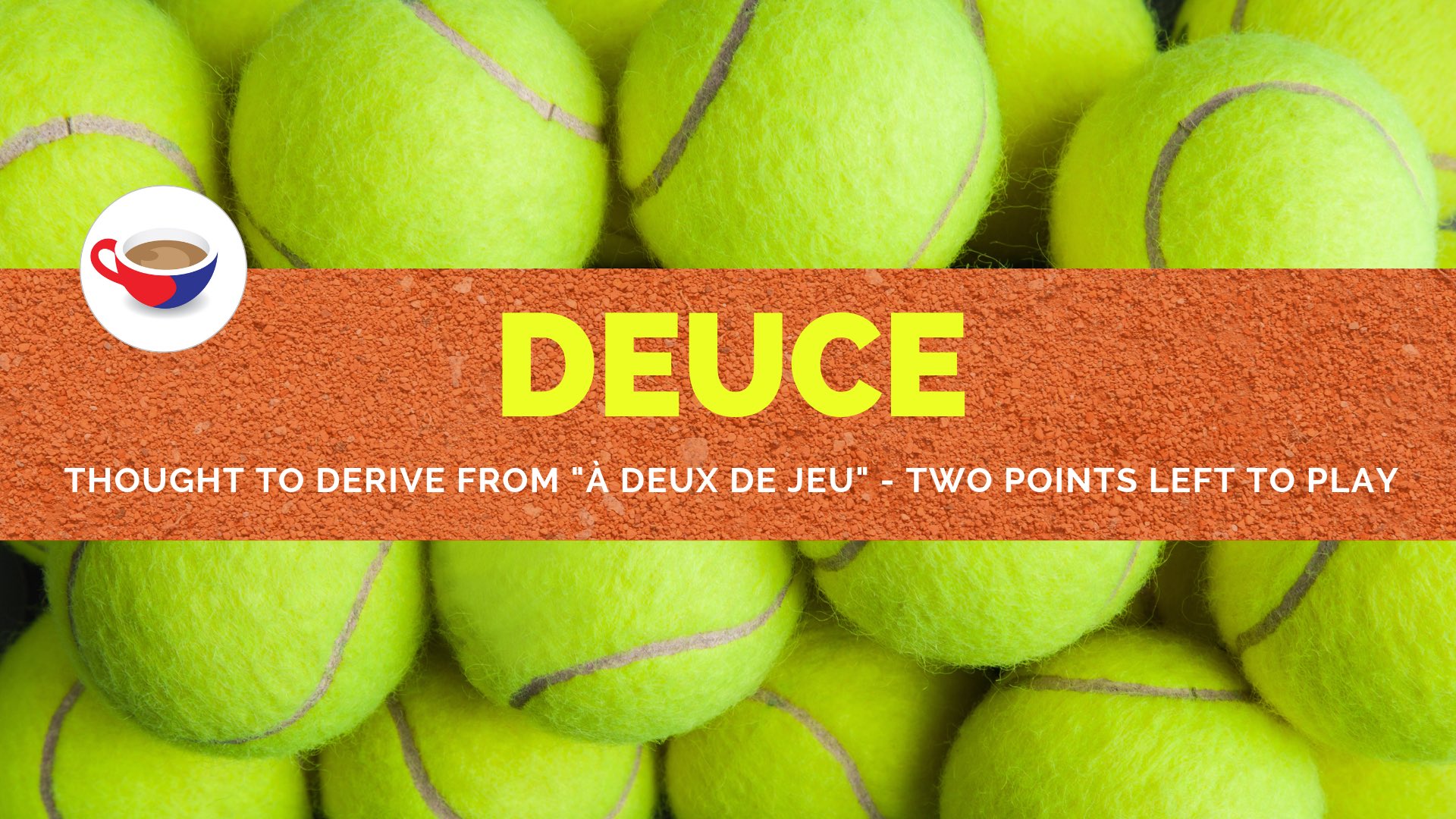
Our final word in the list of essential tennis terms is deuce, which is used when two players have 40 points each. There are a couple of theories as to the origin of the word deuce in French tennis, but one of the most likely is that it is derived from the phrase à deux de jeu, meaning “to be two points away from winning the game”.
It’s also possible that it came from the Old French word for two – deus – now deux in Modern French. Interestingly, “deuce” is not used in French: instead when the score reaches 40-40 this is called quarante-A.
If one player then gains the advantage by winning the next point but subsequently loses the following point, the score returns to 40-40. From then on “deuce” is referred to as égalité.
Learn more tennis terms
Now you are armed and know the meaning of some very important tennis terms, but if you want to check some more useful terms watch the Walk Talk and Learn episode which Mark filmed during his visit to the Roland Garros tournament:
We hope you’ve enjoyed this quick tour of the fascinating world of tennis terminology in French. Whether you’re a seasoned tennis fan or just getting started, understanding these terms can enhance your appreciation of the game and improve your language skills.
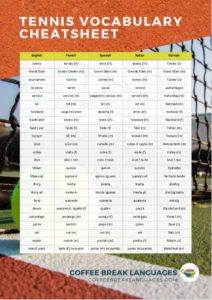
To help you even more, we’ve created a comprehensive Cheat Sheet with all these tennis terms and more. It’s a handy resource you can keep with you to reference anytime. Click the below to download your copy now:
:
2 thoughts on “Jeu, Set, Match! Essential tennis terms to add to your vocabulary!”
C’est fascinant, ces origines des mots. La thème sportif développe également notre préoccupation actuel avec l’étymologie, n’est pas ?
Cordialement
Alexander
Oui, c’est vrai, Alexander ! Merci pour votre commentaire.
L’équipe CBF