Now that we know how to talk about our hobbies, we can explore how word order can change when expressing likes and dislikes. We’ll also take this topic a step further and learn how to express preferences in Gaelic.
CBP 1.22 | Aches and pains – Vocabulary for body parts, symptoms and illnesses

In lesson 22 of our course, teacher Rafael and learner Ava are talking about aches and pains, and how to say that you’re not feeling well. We’ll be learning some parts of the body in Portuguese, how to say that we are experiencing a problem with one of these, the vocabulary for some other health problems, and some other useful phrases that you can use if you’re visiting a doctor. We’ll also be joined by Catarina in today’s Cafezinho com Catarina, in which we’ll be learning all about fado.
CBGa 1.21 | How to talk about likes and dislikes and discuss your hobbies

Susanna and Mark are back with another episode of Coffee Break Gaelic! In lesson 21, we’re learning to talk about likes and dislikes in the language. By the end of this lesson, you’ll be able to discuss your hobbies with your Gaelic-speaking friends.
CBP 1.21 | The weather – How to talk about the weather in Portuguese
Welcome back to another lesson of Coffee Break Portuguese! We’re now halfway through our 40-lesson course and in lesson 21 we are talking about the weather. We’ll be learning how to ask what the weather is like today and what it is going to be like tomorrow, how to answer these questions to describe various types of weather, and hear a weather forecast for Portugal in today’s Cafezinho com Catarina. We’ll also have a more in-depth look at one particular aspect of Portuguese grammar – the difference between the verbs ser and estar, which both translate as “to be”. Vamos lá!
What’s the difference between ‘how much’ and ‘how many’?
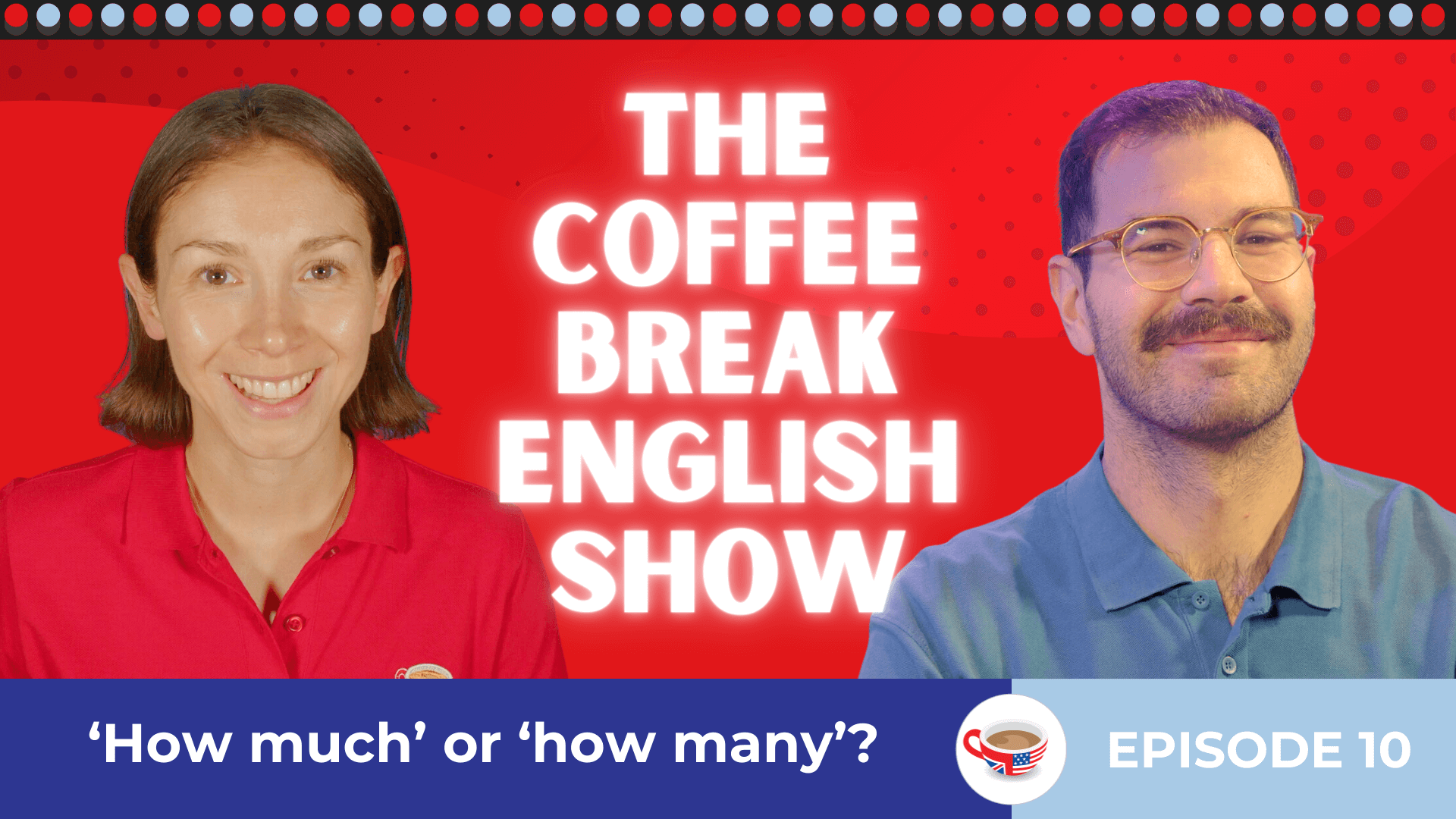
Do you know when to use how much and how many in English?
It can be confusing, but don’t worry – there are some clear rules to follow. In this episode of The Coffee Break English Show, we’ll help you understand when to use how much and how many to talk about countable and uncountable nouns.
The Coffee Break English Show is a podcast series of bite-sized, friendly conversations to help you understand some difficult topics in English. In the latest episode, Josie and Maurizio talk about when to use how much and how many and look at a few examples.
So, let’s get started! Continue reading to find out more and why not listen to the podcast episode as you go?
‘How much?’ and ‘how many?’ for questions
To decide whether to use how many? or how much? you need to know if you are asking about a countable or uncountable noun.
Use ‘how many?’ with countable nouns
We use how many in questions with countable nouns. Countable nouns are things that we can count. Let’s look at some examples:
Q: How many siblings do you have?
A: I have one sister.
Q: How many microphones are in this room?
A: There are two microphones in this room.
Q: How many cakes did you bring?
A: I brought five cakes.
In these examples, we ask questions about siblings, microphones, and cakes. These are things that we can count – one sibling, two microphones, five cakes.
Use ‘how much?’ with uncountable nouns
We use how much in questions with uncountable nouns. Uncountable nouns are things that we don’t count, and we think of as one unit, or mass. Uncountable nouns do not exist in lots of languages.
In the episode, Josie and Maurizio talk about some common uncountable nouns, including water, milk, time, information and money. Here are some examples of questions with how much and these uncountable nouns:
Q: How much water is in your water bottle?
Q: How much information do you have about the project?
Q: How much time does it take you to get to work?
A: It takes me two hours to get to work.
This question uses how much, because time is an uncountable noun. However, the answer is with a number of hours. The word time is uncountable, but the words hours, minutes, and seconds are countable.
Q: How much money do you have in your pocket?
A: I have £20 in my pocket.
Again, this question is with how much, because money is an uncountable noun. But the answer is a number, because we can count words like pounds, euros, dollars, coins, and notes.

Counting uncountable nouns
There are lots of food words that are uncountable nouns, like bread, rice, pasta, and coffee. We can count these nouns by adding a word or phrase in front of them. Let’s look at some examples:
a slice of bread
three bowls of pasta
200 grains of rice
two cups of coffee
We can also use coffee as a countable noun, to mean “a cup of coffee”. So, we can say two coffees. Maybe now is a good time to get a coffee, before we continue!
‘Not much’ and ‘a lot of’ with uncountable nouns
Is everything clear so far? We know that how much is for questions with uncountable nouns, but what happens when we answer these questions? It depends if the answer is affirmative or negative…
‘Not much’ for negative statements
When we want to answer a question with how much and an uncountable noun, we can use not much for a negative answer. Let’s look at some examples:
Q: How much ice cream do you have in your freezer?
A: I don’t have much ice cream in my freezer.
Q: How much time do you have today?
A: I don’t have much time today.
‘A lot of’ for affirmative statements
When we want to answer a question with how much and an uncountable noun, we can use a lot of for an affirmative, or positive, answer. Let’s look at some examples:
Q: How much rain is there in Scotland?
A: There is a lot of rain in Scotland.
Q: How much pizza did you eat last night?
A: I ate a lot of pizza last night.
‘Not many’ and ‘a lot of’ with uncountable nouns
What about questions with countable nouns? Well, to answer them we use not many or a lot of.
‘A lot of’ or ‘many’ for affirmative statements
When we want to answer a question with how many and a countable noun, we can give a number, as we saw earlier in the post. For example:
Q: How many siblings do you have?
A: I have one sibling.
If we don’t want to give a precise number, we can use a lot of or many for an affirmative answer. Let’s look at some examples:
Q: How many siblings do you have?
A: I have twelve siblings.
A: I have a lot of siblings.
A: I have many siblings.
Q: How many cups are on the table?
A: There are twenty cups on the table.
A: There are a lot of cups on the table.
A: There are many cups on the table.
‘Not many’ for negative statements
When we want to answer a question with how many and a countable noun, we can use not many for a negative answer. Let’s look at some examples:
Q: How many books have you read this month?
A: I have read two books this month.
A: I haven’t read many books this month.
Q: How many people did you speak to yesterday?
A: I spoke to one person yesterday.
A: I didn’t speak to many people yesterday.
It’s your turn!
Now, let’s practise! Here are four answers to questions. Try to give a possible question, using how much or how many. Some possible questions are at the end of this blog post, but don’t look until you’ve thought about your answers!
- I have five dogs.
- I don’t drink much tea during the day.
- There aren’t many people in my office.
- My brother has a lot of money.
To help you remember the rules about how much and how many, why not start a list of countable and uncountable nouns that you learn?
If you found this post interesting, make sure you listen to the full podcast episode with Josie and Maurizio on The Coffee Break English Show. Subscribe to our podcast feed and our channel on YouTube to find episodes about some other useful topics for English learners.
Plus! To get regular free English lessons in your inbox, you can sign up for our email lessons. We regularly send short (coffee-break-sized) email lessons that will help you improve your English. You will also hear from Mark, the founder of Coffee Break Languages, giving advice for language learners at any level. Sign up below!
So, keep practising how much and how many! Remember that all English learners make mistakes, but people can usually still understand you. It’s all part of the language-learning journey.
Happy Coffee Breaking!
PS. Here are some possible questions to the answers given above:
- How many dogs do you have?
- How much tea do you drink during the day?
- How many people are there in your office?
- How much money does your brother have?
Listen to the podcast
3 suffixes to expand your Spanish vocabulary

Learning new vocabulary can seem like a daunting task for any language learner.
This is why we’re going to look at some tips and tricks to help you expand your vocabulary in an easy and straightforward way, so that you can gain more confidence in your Spanish. To do this, we are going to be looking at three suffixes, or word endings.
The Coffee Break Spanish Show is a podcast series of short, informal conversations to help you understand some difficult topics in Spanish. In the latest episode, Anabel and Concha dive into vocabulary and, in particular, how to form new words from words you already know by using three suffixes.
Continue reading to find out more and why not listen to the podcast episode as you go?
1. -mente
In English, one way to create adverbs is to take an adjective and adding “-ly”. For instance, we get “quickly” from “quick” and “positively” from “positive”. And the good news is that something very similar happens in Spanish!
In order to create our adverb, we need to take an adjective (for example rápido – “quick”) and use the feminine form (rápida) to add the ending -mente. In this way, we get rápidamente, which means “quickly”. If it’s an adjective that doesn’t change in gender (for example difícil – “difficult”), we just add the suffix to it (for example difícilmente – “with difficulty”). Fácil, ¿verdad?
Now, we challenge you to give yourself 10–20 seconds to write as many Spanish adverbs ending in -mente as you can! You can find a list of some examples at the end of this article. ¡Buena suerte!
2. -dad
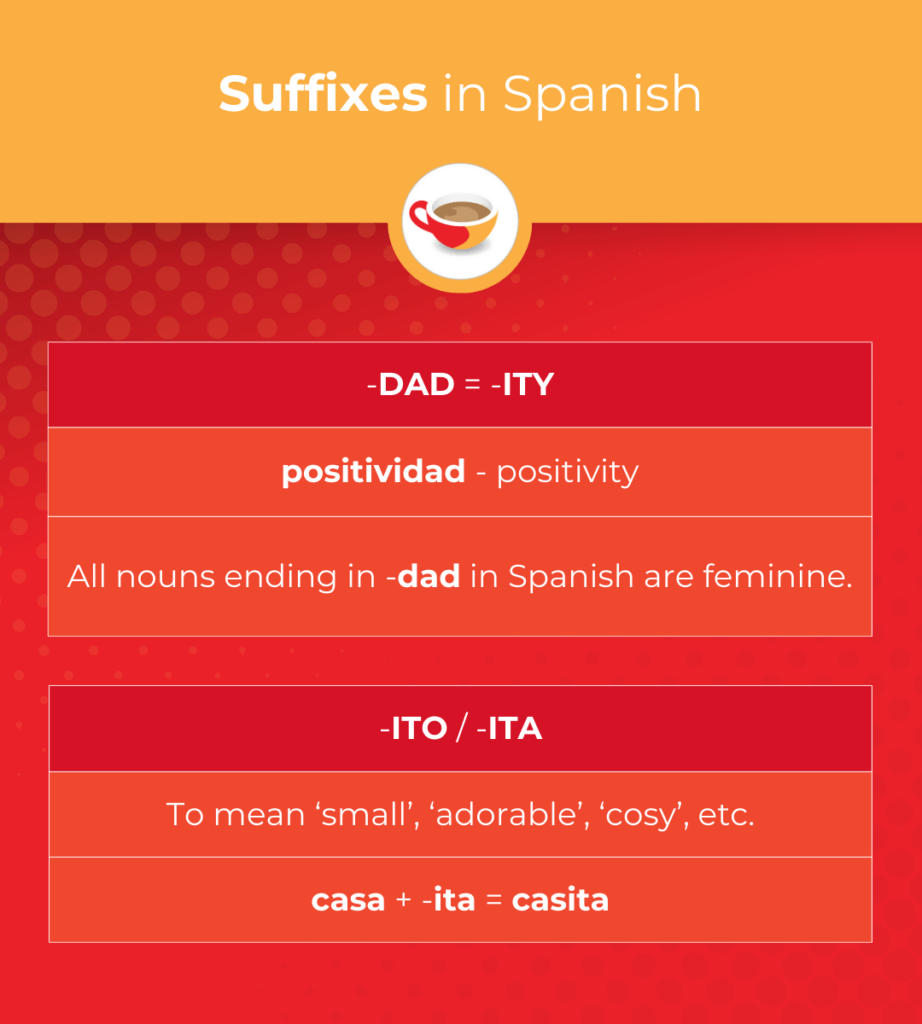
Another tip that can help us learn new vocabulary is the fact that some words ending in “-ity” in English end in -dad in Spanish. For example, “positivity” is positividad. Note the i that comes before -dad in order to help the pronunciation.
Here’s a really handy tip for you: all words ending with the suffix -dad are feminine.
Now, try coming up with as many Spanish words ending in -dad as possible in 10–20 seconds. Again, you can find some examples at the end of the article. ¡Mucho ánimo!
3. -ito/a
One of the most common suffixes in Spanish is -ito or -ita. There are a couple of things we need to know about this suffix, however.
First of all, -ito can be interchanged with -illo, -ico, -iño or -ete, depending on the Spanish-speaking area. Moreover, some speakers may prefer one over another, so it may be personal preference. All of them work in the same way, though.
The second thing we need to know about these suffixes is that they are added to the end of a noun to show it is small, or adorable, or both.
For example, if you want to say “small house”, we say casita (casa + ita), but if you want to say “cosy / homey house”, we say casita, too.
As you can see in the example, we have taken a feminine noun (casa) and added -ita. When using a masculine noun (for example libro – “book”), we use -ito. For example:
librito
small / cute book
Now, can you think of some more nouns and add this suffix to say it’s either small or adorable (or both)? Once you have taken 10–20 seconds to think of some -ito/an examples, have a look at the examples we’ve provided at the end of the article. ¡Mucha suerte!
Conclusion and answers
We hope that you feel you’ve expanded your vocabulary and have learned a few ways to continue to do so.
If you found this article interesting, make sure to listen to the full episode with Anabel and Concha on The Coffee Break Spanish Show. This is the series in which we look at a range of topics for Spanish learners, so make sure to subscribe to our podcast feed and our channel on YouTube.
Plus! To get regular free Spanish lessons in your inbox, you can sign up for our short (coffee-break-sized) email lessons that will help you improve your Spanish. You will also hear from Mark, the founder of Coffee Break Languages, giving advice for language learners at any level. Sign up below!
Happy Coffee Breaking!
PS. Here is a selection of examples using each suffix.
Adverbs using -mente:
- ligero > ligera > ligeramente (“lightly”)
- constante > constantemente (“constantly”)
- simple > simplemente (“simply”)
- alegre > alegremente (“happily”)
- triste > tristemente (“sadly”)
- afortunado > afortunada > afortunadamente (“fortunately”)
- cortés > cortésmente (“politely”)
- cálido > cálida > cálidamente (“warmly”)
Nouns ending in -dad:
- festividad (“festivity”)
- caridad (“charity”)
- natividad (“nativity”)
- negatividad (“negativity”)
- incompatibilidad (“incompatibility”)
- familiaridad (“familiarity”)
- productividad (“productivity”)
- creatividad (“creativity”)
- responsabilidad (“responsibility”)
- intencionalidad (“intentionality”)
- comunidad (“community”)
- dignidad (“dignity”)
Nouns using -ito/a:
- regalito < regalo (“gift”)
- arbolito < árbol (“tree”)
- cuadernito < cuaderno (“notebook”)
- comidita < comida (“food / meal”)
- tacita < taza (“mug”) (Here, we can also see a change of spelling in the word, just to keep the pronunciation of the th or s sound.)
- videito < video (“video”)
- ropita < ropa (“clothes”)
- manzanita < manzana (“apple”)
- poquito < poco (“a little bit”) (We change c > qu to keep the hard k sound.)
- abriguito < abrigo (“coat”) (Note the spelling change g > gu to keep the same g sound.)
- agüita > agua (“water”) (Note the spelling change to show that the u is pronounced.)
Sometimes, we add ec between the base noun and the suffix (or just c if the noun ends in -e). Some examples are:
- solecito < sol (“sun”)
- nubecita < nube (“cloud”)
- cochecito < coche (“car”)
- cafecito < café (“coffee”)
Listen to the podcast
CBGa 1.20 | End-of-unit review – The basics in Gaelic from Lessons 1–19

Let’s put everything we’ve learned so far to the test in this special episode marking the end of the first half of our Coffee Break Gaelic course! Listen to an extended conversation featuring key vocabulary covered over the past 19 lessons. We’ll be back soon with lesson 21!
A guide to German pronunciation: ‘sch’, ‘ei’, ‘ie’ and more

German pronunciation can, at times, seem daunting when you’re learning the language, but once you get the hang of some of the most common sounds and letter combinations, you’ll be speaking more confidently in no time.
The Coffee Break German Show is a podcast series of bite-sized, friendly conversations in which we demystify tricky German language topics. In the latest episode, Mark and Olivera discuss and practise the most challenging German sounds to pronounce, including the sounds created by the letter combinations sch, ei and ie, as well as others.
We will tackle these letter combinations one by one, so continue reading to find out more and why not listen to the podcast episode as you go?
How to pronounce ‘sch’
This sound is similar to “sh” in English. You can join in with Olivera and Mark in the podcast episode to practise pronouncing this sound and the others. Let’s see the combination sch in some examples. We’ve also taken the opportunity to practise some festive vocabulary, since this episode was first released during the holiday season, but the words and sounds are useful to practise all year round!
Try reading each word or phrase aloud:
der Schnee
snow
die Schokolade
chocolate
das Schlittenfahren
sledging
schon
already
schön*
beautiful
es schneit
it’s snowing
schenken
to give a present
das Geschenk
present
*Note the difference the umlaut makes in the pronunciation of schon and schön, and how they have completely different meanings.
How to pronounce ‘ei’
This is a common vowel sound in German words. The combination “ei” in English can be pronounced in different ways, such as in “height” or “eight”. However, in German ei always has the same sound, which is like “I” or “eye” in English.
Here are some examples of this letter combination. Remember to read each aloud and watch the video or listen to the podcast episode to hear Olivera and Mark pronounce them:
das Eis
ice cream
eins / zwei / drei
one / two / three
mein / dein
my / your
schreiben
to write
This word is also good practice of the sch sound.
der Wein / Glühwein
wine / mulled wine
How to pronounce ‘ie’
This vowel sound is pronounced like “ee” in English. Again, in English “ie” can be pronounced in different ways (for example in “field” and “fried”), but in German it’s always pronounced as “ee”. Let’s see ie in some example words in German:
vier
four
sieben
seven
das Lied
song
riechen
to smell
Die Plätzchen riechen gut.
The biscuits smell good.
wieder
again
Siehst du? (from sehen)
Do you see?
der Spiegel*
mirror
*Note the pronunciation of Spiegel. It begins with a sound similar to sch, but this is caused by an s at the beginning of the word, followed by the letter p. It is because it is followed by a p that it does not require sch at the start.
For a more challenging pronunciation practice, we can combine the ei and ie sounds:
mein Lied
my song
Ich rieche den Wein.
I smell the wine.
How to pronounce ‘au’
This vowel sound is like the “ou” sound in “about” in English. Examples of the au sound in German include:
der Baum
tree
das Auto
car
auf
on
das Haus
house
Ich klettere auf das Haus.
I am climbing onto the house.
der Brauch
tradition
How to pronounce ‘eu’
This vowel sound combination is pronounced “oi” or “oy”, as in “oyster” or “boy” in English. Let’s see this sound in some examples:
heute
today
die Leute
people
euch
all of you
ich freue mich auf (from sich freuen auf)
I am looking forward to
das Neujahr
the New Year
How to pronounce ‘ch’
The ch sound can have different pronunciations in different words. It is a little like the “ch” in the Scottish pronunciation of the word “loch”, as Mark demonstrates in the episode.
Let’s compare some examples of how it features in different German words. After a, o, u there is a hard h sound. For example, in:
machen
to make, to do
hoch
high
suchen
to search for
Weihnachten
Christmas
This word is also good practice of the ei sound and features the word die Nacht, meaning “night”.
After all other vowels and consonants, not listed in the examples above, the ch sound is pronounced differently, as we see in the examples below. In the episode, Mark gives some tips for pronouncing this sound. He goes to make a c sound, then brings his tongue to the top of his mouth, but then down a little before it reaches the top of his mouth, and then breathes through that. After that, he adds the y sound. Olivera suggests breathing through a very wide grin to get the ch sound correct. Remember to listen to the episode to hear Mark and Olivera discuss how to pronounce this sound, as it is difficult to describe in words.
Here are some examples of words that contain this ch sound:
lächeln
to smile
das Mädchen
girl
die Kirche
church
There are some exceptions, where the ch is pronounced like a k. Here are some examples:
der Chor
choir
die Chemie
chemistry
This can also have some regional differences in pronunciation.
der Chiemsee
the name of a Bavarian lake, sometimes known as the “Bavarian sea”
Sounding great in German!

Remember that it’s normal for language learners to have difficulties with pronunciation – the important thing, at first, is that you can be understood. However, keep practising these sounds and use them in conversations, and over time you will sound more like a native speaker.
If you found this post interesting, make sure to listen to the full episode with Mark and Olivera on The Coffee Break German Show. This is the series in which we look at a range of topics for German learners, so make sure to subscribe to our podcast feed and our channel on YouTube.
Plus! To get regular free German lessons in your inbox, you can sign up for our short (coffee-break-sized) email lessons that will help you improve your German. You will also hear from Mark, the founder of Coffee Break Languages, giving advice for language learners at any level. Sign up below!
Happy Coffee Breaking!
Listen to the podcast
CBP 1.20 | End-of-unit review – The basics in Portuguese from Lessons 1–19

We’ve reached lesson 20 of Coffee Break Portuguese, which marks the halfway point in our beginners’ course. In this episode we’re reviewing what we’ve learned throughout the first 19 lessons. We’ll be doing this by listening to a dialogue that incorporates many of the topics we’ve covered so far. We hope you enjoy seeing how much you’ve learned over the past 19 lessons and we’ll be back soon with lesson 21!
How do you know if a noun is masculine or feminine in Italian?
Is there an easy way to know the gender of a noun in Italian?
You probably already know from your experience with Italian that it is a language that has grammatical gender. Every noun in Italian is either masculine or feminine.
Over time, you get to know what gender nouns are, the more you practise and use the words, and often you simply have to memorise the gender of the noun as you’re learning the word itself. However, the good news is that there are some shortcuts that you can learn!
The Coffee Break Italian Show is a podcast series of bite-sized, friendly conversations in which we demystify tricky Italian language topics. In the latest episode, Francesca and Maurizio share some tips and tricks to help you figure out the gender of a noun in Italian.
Continue reading to find out more and why not listen to the podcast episode as you go?
How a dictionary can help you
The best way to know the gender of nouns is to look them up in a dictionary. Next to any noun you will see either (m) for masculine or (f) for feminine.
However, we don’t always carry around a dictionary and sometimes our online dictionary app might not be loading, so let’s take a look at some other ways you can work out the gender of nouns in Italian.
Nouns ending in -o & -a
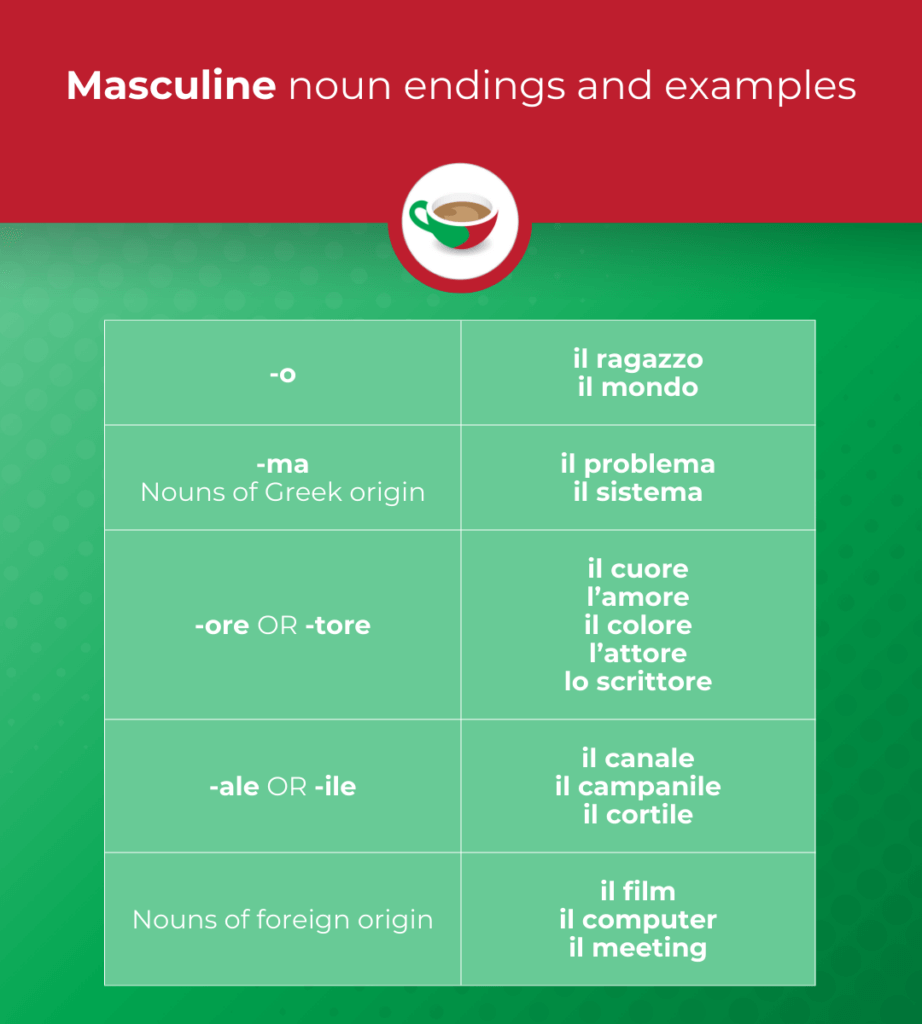
Our first rule is one that you’re likely to already be very familiar with. This is that the majority of nouns ending in -o are masculine, while the majority of those ending in –a are feminine. Let’s look at some examples:
ragazzo (m)
boy
ragazza (f)
girl
The correct articles to use with ragazzo are therefore il and un:
il ragazzo
the boy
un ragazzo
a boy
And the correct articles to use with ragazza are therefore la and una:
la ragazza
the girl
una ragazza
a girl
Some other examples are:
mondo (m)
world
natura (f)
nature
This is quite straightforward, but Francesca and Maurizio mention an exception to this rule. Let’s move onto this now.
Nouns ending in -ma
There are a number of nouns ending in -ma, which might lead you to think they are feminine because of their final -a, but they are actually masculine. These masculine nouns have a Greek origin, hence their unusual ending. For example:
problema (m)
problem
sistema (m)
system
Nouns ending in -si
There are also some nouns that end in -si and they also have a Greek origin. Usually, these nouns are feminine in Italian. Let’s see some examples:
crisi (f)
crisis
analisi (f)
analysis
tesi (f)
dissertation, thesis
Notice that the English equivalent is often a word ending in -is.
Nouns ending in -ore
You may know that there are some singular nouns in Italian ending in -e. These nouns can be either masculine or feminine. So, how can we determine their gender? For some nouns ending in -e, only the dictionary will tell you if they are masculine or feminine, but for many others the extended ending will be a useful indicator.
Let’s start with nouns ending in -ore. These are generally masculine. For example:
cuore (m)
heart
amore (m)
love
colore (m)
colour
attore (m)
(male) actor
scrittore (m)
(male) writer
Nouns ending in -trice
Pay attention to the previous two examples, attore and scrittore, which are both professions ending in -tore. When the masculine version of a profession ends in -tore, its feminine counterpart will end in -trice. For example:
attrice (f)
(female) actor
scrittrice (f)
(female) writer
Nouns ending in -ale & -ile
If a noun ends in -ale or –ile, it is most likely to be masculine. Here are some examples:
canale (m)
canal, channel
campanile (m)
bell tower
cortile (m)
backyard, courtyard
Nouns ending in -zione & -sione
If a noun ends in -zione or -sione, it is most likely to be feminine. Notice that the English equivalents of these nouns usually have the “-tion” ending. For example:
emozione (f)
emotion
stazione (f)
station
creazione (f)
creation
Nouns of foreign origin
What about nouns that are borrowed into Italian from other languages? Most of the time, these are considered masculine, especially if they end in a consonant. For example:
film (m)
film
computer (m)
computer
gossip (m)
gossip
meeting (m)
meeting
However, there are some exceptions here, as well, and some foreign nouns can be feminine. This can happen when the foreign noun is more strongly associated with its Italian equivalent and when the Italian equivalent is a feminine noun. Let’s see some examples:
call (f) / chiamata (f)
call
mail (f) / posta elettronica (f)
email
band (f) / banda (f)
band
If you’re in doubt, remember that the dictionary will always guide you in this process!

Over to you!
At the end of this episode, Francesca and Maurizio invite you to participate in a practice activity.
Can you determine the gender of the following nouns, based on what we have learned today? We’ve also taken the opportunity to practise some festive vocabulary, since this episode was first released during the holiday season!
The answers can be found at the end of the article.
- vigilia
- regalo
- decorazione
- panettone
If you found this article interesting, make sure you listen to the full podcast episode with Francesca and Maurizio on The Coffee Break Italian Show. We have many more episodes on useful topics for Italian learners, so make sure to subscribe to our podcast feed and our channel on YouTube to find others.
Plus! To get regular free Italian lessons in your inbox, you can sign up for our short (coffee-break-sized) email lessons that will help you improve your Italian. You will also hear from Mark, the founder of Coffee Break Languages, giving advice for language learners at any level. Sign up below!
Happy Coffee Breaking!
PS. Here are the answers to the challenge.
- vigilia (f) – eve, for example in vigilia di Natale (Christmas Eve)
- regalo (m) – present, gift
- decorazione (f) – decoration
- panettone (m) – traditional Italian Christmas cake
Listen to the podcast
What’s the difference between ‘à cause de’ and ‘grâce à’?
À cause de and grâce à are easy to get mixed up. This is because, depending on the context, both phrases can be translated as “because of” in English.
However, while both phrases link a cause to a consequence, they paint distinct pictures of the outcome!
We’re going to explore the subtleties of these phrases, unravelling the positive and negative nuances they bring to expressions in French.
The Coffee Break French Show is a podcast series of bite-sized, friendly conversations, in which we demystify tricky French language topics. In the latest episode, Mark and Max look into when and how to use à cause de and grâce à.
Continue reading to find out more and why not listen to the podcast episode as you go?
‘à cause de’ for negative outcomes
À cause de conveys negativity in French expressions. It translates to “because of” in English, but is exclusively reserved for situations with negative consequences. For example:
J’ai perdu une heure à cause de tes mauvais conseils.
I lost an hour because of your bad advice.
It’s a phrase that signals setbacks – attributing an undesirable result to a specific cause.
Note that à cause de ends with the preposition de. This de points to the origin or source of the negative consequence.
As always happens with the preposition de, it connects and merges with some articles. When we have de + le, it becomes du, and de + les becomes des. When preceding a vowel, de transforms into d’ for smoother pronunciation.
‘grâce à’ for positive outcomes
On the other hand, grâce à radiates positivity – signifying a favourable outcome due to a particular cause. For example:
Grâce à ton aide, j’ai réussi à monter ce meuble.
Thanks to your help, I managed to assemble this piece of furniture.
It’s a phrase that highlights the contribution of a positive factor leading to a successful or beneficial result.
Since grâce à ends with the preposition à, it also undergoes transformations. For example, à + le becomes au, and à + les transforms into aux.

Let’s practise!
Here are some sentences in English. Your challenge is to translate them into French, choosing between grâce à and à cause de. The answers are at the end of this article.
- It is because of the wind.
- It is thanks to them.
- We lost because of one mistake.
- I learned Spanish thanks to Coffee Break podcasts.
- You passed your exams because of me.
- I couldn’t travel because of the strikes.
- It is thanks to your brother that I know which gift to buy you for Christmas.
We hope that you found this post interesting. These two expressions will not only help you understand situations better, but if you can use them in your conversations you will articulate yourself more clearly.
Make sure to listen to the full episode with Mark and Max on The Coffee Break French Show. This is the series in which we look at a range of topics for French learners, so make sure to subscribe to our podcast feed and our channel on YouTube.
Plus! To get regular free French lessons in your inbox, you can sign up for our short (coffee-break-sized) email lessons that will help you improve your French. You will also hear from Mark, the founder of Coffee Break Languages, giving advice for language learners at any level. Sign up below!
Happy Coffee Breaking!
PS. Here are the answers to the challenge:
- It is because of the wind. – C’est à cause du vent.
- It is thanks to them. – C’est grâce à eux / elles.
- We lost because of one mistake. – Nous avons / On a perdu à cause d’une erreur.
- I learned Spanish thanks to Coffee Break podcasts. – J’ai appris l’espagnol grâce aux podcasts Coffee Break.
- You passed your exams because of me. – Tu as réussi tes examens grâce à moi.
- I couldn’t travel because of the strikes. – Je n’ai pas pu voyager à cause des grèves.
- It is thanks to your brother that I know which gift to buy you for Christmas. – C’est grâce à ton frère que je sais quel cadeau t’acheter pour Noël.
Listen to the podcast
How to pronounce ‘Tuesday’ and ‘Thursday’
Do you know how to say the words Tuesday and Thursday correctly in English?
These two words can be confusing when it comes to pronunciation. This is because the sounds at the beginning of the words (tu and th) can be difficult to pronounce.
There are lots of other words that contain these sounds, so if you can pronounce the words Tuesday and Thursday correctly then you will be able to pronounce many more.
The Coffee Break English Show is a podcast series of short, informal conversations to help you understand some difficult topics in English. In the latest episode, Josie and Mark talk about how to pronounce Tuesday and Thursday correctly.
Because this episode focuses on pronunciation, it’s best to watch the video or listen to the podcast episode while you read this article, to hear Josie and Mark making the sounds.
So, let’s get started and look at the words Tuesday and Thursday. Why not get a cup of coffee or tea to enjoy while you read and listen!
Tuesday
There are three different ways to pronounce the letters tu at the beginning of Tuesday. But don’t worry, they are all quite similar! The best way to understand the sounds is to watch the video, but here are the written versions to help you:
Tuesday = [chewz-day]
This is how Josie pronounces it in the episode.
Tuesday = [tee-ooz-day]
This is how Mark pronounces it in the episode.
Tuesday = [tooz-day]
This is the North American English pronunciation.
The letters ‘tu’ in the middle of a word
When the letters tu are in the middle of a word, most English speakers pronounce them as ch, like the first sound in the word cheese. Let’s look at some examples of these words:
culture
adventure
century
congratulations
nature
mature
The letters ‘tu’ at the start of a word
When the letters tu are at the start of a word, we can pronounce them as ch, like in the words above. We can also pronounce them in two other ways. Let’s look at some examples:
tune
[choon] or [tee-oon] or [toon]
tube
[choob] or [tee-oob] or [toob]
stupid
[s-choo-pid] or [stee-oo-pid] or [stoo-pid]
tutor
[choo-tor] or [tee-oo-tor] or [too-tor]
Be careful! There are lots of words that begin with tu that have a different sound. For example, in the words tunnel, turn, and turtle, the letter t is always pronounced like the letter of the alphabet T.
Thursday
Is everything clear so far? Let’s move onto the word Thursday. To make the th at the beginning of this word, we put our tongue between our teeth and blow out air. There are actually two ways to pronounce th in English.
Unvoiced ‘th’
The th sound at the beginning of Thursday is unvoiced. This means that we don’t use our voice when we make this sound.
To practise, put your hand on your neck, just under your chin, and say the sound th at the beginning of Thursday. You should not feel any vibrations or movement in your neck. Here are some other words with the unvoiced th sound:
think
three
thanks
bath
nothing
Voiced ‘th’
The th sound at the beginning of the word the is voiced. This means that we use our voice when we make this sound.
To practise, put your hand on your neck, just under your chin, and say the sound th at the beginning of the. You should feel your throat (inside your neck) moving and vibrating. Here are some other words with the voiced th sound:
this
that
although (can be pronounced voiced or unvoiced)
weather
other

It’s your turn!
Now, let’s practise! Here are three sentences. If you want, you can listen to Josie saying them in the video, and repeat them after her.
1. On Tuesday, we’re going on an adventure.
2. Let’s play a tune on Thursday.
3. There is nature and culture on Tuesday and Thursday.
If you found this post interesting, make sure you listen to the full podcast episode with Mark and Josie on The Coffee Break English Show. In this series, we talk about useful topics for English learners, so make sure to subscribe to our podcast feed and our channel on YouTube.
Plus! To get regular free English lessons in your inbox, you can sign up for our email lessons. We regularly send short (coffee-break-sized) email lessons that will help you improve your English. You will also hear from Mark, the founder of Coffee Break Languages, giving advice for language learners at any level. Sign up below!
Keep practising the sounds at the beginning of Tuesday and Thursday. We recommend that you make a list of all the words with these sounds that you find difficult to pronounce and practise them every day.
Remember that it’s ok if you don’t sound like a native speaker when you’re speaking English! It’s more important that you are confident when you’re speaking, and people can understand you.
Happy Coffee Breaking!
Listen to the podcast
A guide to making negative statements in Spanish
Making negative statements in Spanish can be challenging for learners. The negative in Spanish works differently from English which can mean it’s easy to make mistakes.
However, there are some simple rules that can help us correctly use negative structures when we are speaking in Spanish.
The Coffee Break Spanish Show is a podcast series of short, informal conversations to help you understand some difficult topics in Spanish. In the latest episode, Mark and Anabel talk about how to use negatives in Spanish.
We hope that you find this guide to negation useful and we recommend listening along to the podcast or video episode as you read!
Plus, don’t miss our free worksheet at the end to practise what you learn!
How to form a negative statement in Spanish
To turn a positive statement into a negative statement in Spanish, the first rule to know is that we use no before any verb, compound verb, or verb with its pronouns. Let’s look at some examples:
no tengo
I don’t have
no soy escocés
I am not Scottish
no lo sé
I don’t know (it)
no me desperté
I didn’t wake up
It can get a bit more challenging when we add another negative word into the sentence. This is because it creates what we call “double negation”.
In English (in most varieties), we say “I have nothing” or “I don’t have anything”, where only one negative word is possible in the sentence to negate the statement – either “nothing” or “don’t”.
This works differently in Spanish, however. In Spanish, this double negation often appears, when we have two of these negative words to create a negative statement.
Words used to negate in Spanish
We’ve already looked at no (“not”), so let’s now see some other negative words in Spanish:
nunca / jamás
never
nunca jamás
never ever
tampoco
neither
nadie
no one / nobody
ningún / ninguno / ninguna
any
nada
nothing
If we are using one of these words in a statement, we have two options in how to structure the statement:
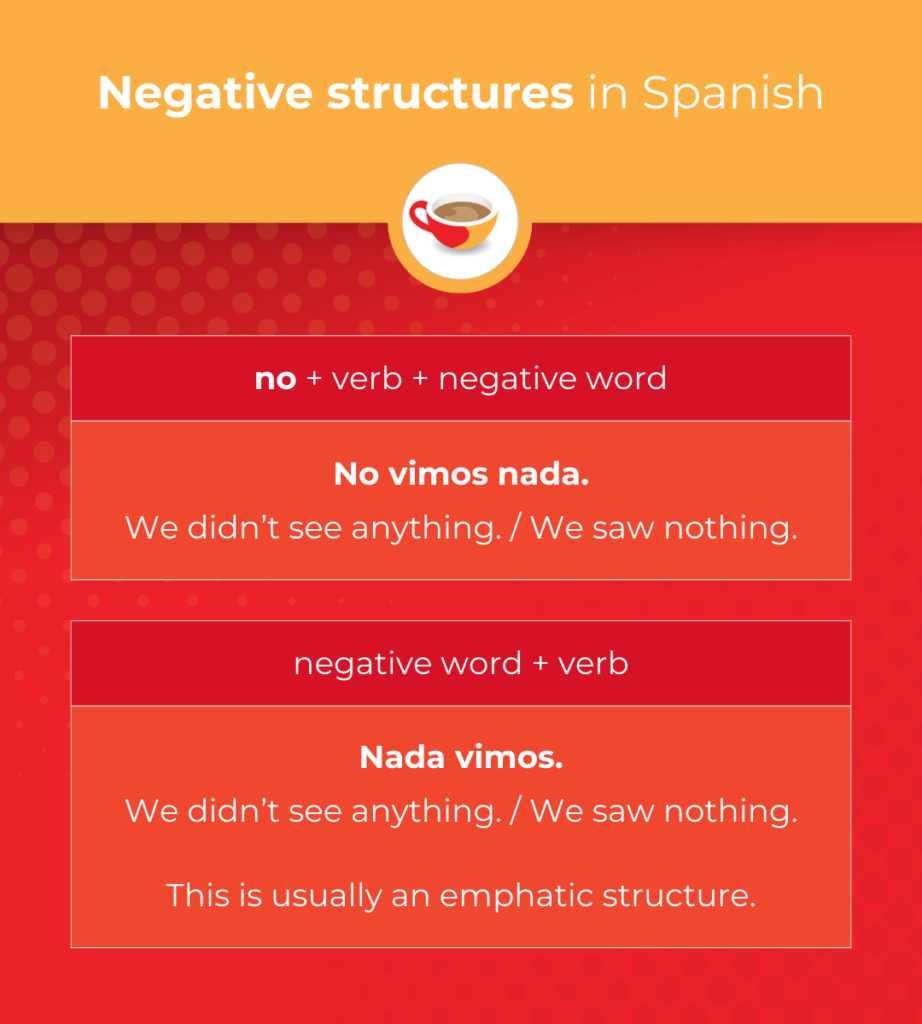
1. ‘no’ + verb + negative word
For example:
No vimos nada.
We didn’t see anything. / We saw nothing.
No me ha llamado nadie.
No one has called me.
No he desayunado tampoco.
I haven’t had breakfast either.
2. negative word + verb
For example:
Nada vimos.
We didn’t see anything. / We saw nothing.
Nadie me ha llamado.
No one has called me.
Tampoco he desayunado.
I haven’t had breakfast either.
This second construction, where the negative word comes before the verb, creates a more emphatic statement. Let’s use one of our examples in context to see this emphasis:
A: ¿Te han llamado esta tarde?
B: No me ha llamado nadie.
A: Dime la verdad. ¿Te ha llamado Juan? ¿Alberto? ¿Tal vez Clara?
B: No, nadie me ha llamado.
A: Did anyone call you this afternoon?
B: No one has called me.
A: Tell me the truth. Did Juan call you? Alberto? Maybe Clara?
B: No, no one has called me.
To summarise, in Spanish, we must have a negative word before the verb. This is why we may have double negation, in cases where a negative word such as nada or nunca goes after the verb.
A visual summary of making negative statements in Spanish
Let’s practise making negative statements in Spanish
Now it’s your turn to practise the negative in Spanish! Your challenge is to write down the two possible Spanish translations of each of the following sentences.
- I don’t know anything.
- No one buys there.
- No client has it.
You will find the answers at the end of this article, and for a little more practice download the free worksheet below to see how much you’ve learned about making negative statements in Spanish.
Make sure to listen to the full episode with Mark and Anabel on The Coffee Break Spanish Show. This is the series in which we look at a range of topics for Spanish learners, so make sure to subscribe to our podcast feed and our channel on YouTube.
Plus! To get regular free Spanish lessons in your inbox, you can sign up for our short (coffee-break-sized) email lessons that will help you improve your Spanish. You will also hear from Mark, the founder of Coffee Break Languages, giving advice for language learners at any level. Sign up below!
We hope that you now know enough about negation in Spanish to feel positive when you are using your Spanish negatives!
Happy Coffee Breaking!
PS. Here are the answers to the translation challenge.
- I don’t know anything. – No sé nada. / Nada sé.
- No one buys there. – No compra nadie allí. / Nadie compra allí.
- No client has it. – No lo tiene ningún cliente. / Ningún cliente lo tiene.
Listen to the podcast
Negation in German: ‘nein’, ‘nicht’ and ‘kein’
Making negative sentences in German does not have to be a negative experience!
If you understand how to use nein, nicht and kein then you will have no problem negating sentences in German.
The Coffee Break German Show is a podcast series of bite-sized, friendly conversations, in which we demystify tricky German language topics. In the latest episode, Mark and Thomas discuss how negation works in German using nein, nicht and kein.
Continue reading to find out more and why not listen to the podcast as you go?
Nein
Nein is used as an answer to a closed question. In all cases, it simply means “no”. For example:
– Möchtest du ein Stück Kuchen? – Nein, danke.
– Would you like a piece of cake? – No, thanks.
– Besuchen wir morgen deine Eltern? – Nein, am Freitag.
– Are we visiting your parents tomorrow? – No, on Friday.
Nicht
Nicht is used to negate different parts of a sentence, including prepositions, adverbs, adjectives and verbs. Let’s look at some examples:
Dieser Salat ist nicht frisch.
This salad is not fresh.
Wir fahren heute nicht nach Berlin.
We are not travelling to Berlin today.
The position of nicht emphasises the part of the sentence you are negating. In the sentence above the position of nicht negates the piece of information nach Berlin (“to Berlin”). It emphasises that Berlin is not the destination today.
Wir fahren nicht heute nach Berlin.
We are not travelling to Berlin today.
As the sentence is now worded, the adverb heute is negated, meaning that maybe another day they will travel to Berlin, but not today.
Das weiß ich nicht.
I don’t know that.
Ich tanze nicht.
I am not dancing.
In the examples above, the nicht is placed at the end, negating the whole sentence.
Negating with modal verbs
In German, how do you negate a sentence when you are using modal verbs? This is possibly best demonstrated with examples:
Ich kann nicht schwimmen.
I cannot swim.
Note that nicht is placed before the infinitive.
Ich möchte diese Hose nicht anziehen.
I would not like to put on these trousers.
There is further information in this sentence, but nicht is still placed before the infinitive.
Kein
Kein is used to negate nouns.
Kein can be seen as the negative of the indefinite article – the opposite of “a”. It is therefore placed before the noun it is negating. Take a look at the examples below to demonstrate its use:
Ich habe einen Hund.
I have a dog.
Ich habe keinen Hund.
I don’t have a dog. / I have no dog.
Ich habe heute Lust ins Kino zu gehen.
I want to go to the cinema today.
Ich habe heute keine Lust ins Kino zu gehen.
I don’t want to go to the cinema today.
One important point to remember when using kein is that it has to agree with the noun it is negating. This means it has to take account of the noun’s gender, whether it is plural or singular, and the case being used.
Other forms of negating
There are two other ways to negate your sentences that are worth mentioning:
nichts
nothing
niemand
nobody
For example:
Sie will heute nichts machen.
She wants to do nothing today. / She doesn’t want to do anything today.
Leider ist niemand auf die Party gekommen.
Unfortunately, nobody came to the party.
In conclusion

Once you have a good grasp of forming negative phrases and sentences in German you will be more comfortable in conversation. Of course, it is easy to make mistakes with this and it is all part of the learning process – keep practising and you will improve.
If you found this post interesting, make sure to listen to the full episode with Mark and Thomas on The Coffee Break German Show. This is the series in which we look at a range of topics for German learners, so make sure to subscribe to our podcast feed and our channel on YouTube.
Plus! To get regular free German lessons in your inbox, you can sign up for our short (coffee-break-sized) email lessons that will help you improve your German. You will also hear from Mark, the founder of Coffee Break Languages, giving advice for language learners at any level. Sign up below!
Happy Coffee Breaking!
Listen to the podcast
How to apologise and ask for permission in Italian
“I’m sorry!” – a very common phrase in any conversation, but what is the best way to say sorry in Italian?
There are many ways to say sorry, excuse yourself and ask for permission in Italian, and the one to choose will depend on the context. Not only is it useful to know what they mean, but also the subtleties of each phrase.
The Coffee Break Italian Show is a podcast series of bite-sized, friendly conversations in which we demystify tricky Italian language topics. In the latest episode, Mark and Maurizio dive into the world of Italian apologies. They explore different expressions for saying “I’m sorry” or “excuse me” politely and appropriately in various situations.
Continue reading to find out more and why not listen to the podcast as you go?
Plus, don’t miss our free worksheet at the end to practise what you learn!
How to say you’re sorry in Italian
Let’s begin with four ways to say “I’m sorry” in Italian.
1. mi dispiace
One of the most common ways to say sorry is to use the phrase mi dispiace, or its shortened version, mi spiace. It literally means “it displeases me” and it is used to apologise for something you have done.
2. scusa / scusi
Another common way to apologise is scusa or scusi (the former being used in informal contexts and the latter in formal contexts).
This phrase is also used to attract someone’s attention, for example if you want to stop someone in the street to ask for information:
Scusi, dov’è la piazza?
Excuse me, where’s the square?
You can also say scusami (informal) or mi scusi (formal) – notice the different placement of the pronoun mi in the two versions.
3. perdonami / mi perdoni
If you have done something very serious and you want to say “I’m sorry”, you should probably say perdonami (more literally “forgive me” or “pardon me”). The formal version would be mi perdoni.
In the podcast episode, Maurizio also shares something funny about the use of perdonami or mi perdoni. You can sometimes use it to introduce something that might sound harsh to your interlocutor (similar to the English “I’m sorry, but…”). For example:
Perdonami, ma non sei simpatico.
I’m sorry, but you’re not nice.
4. è colpa mia
What about taking the blame in Italian? In this case, you can say è colpa mia (“it’s my fault”). You can, of course, replace the possessive adjective and use tua, sua, nostra, vostra, loro depending on who you are blaming.
Notice the position of the possessive adjective in this expression. It is, unusually, placed after the noun. Normally in Italian possessive adjectives are placed before the noun and they are introduced by a definite article.
How to ask for permission in Italian
Again, there are a few ways to ask for permission in Italian. Let’s look at the three most common ones.
1. permesso?
When you are in a crowded place and someone wants to pass through, you might hear: è permesso?, or simply permesso? This phrase is used to ask for permission and used especially for these kinds of situations, when you want to go through or enter a room.
2. posso?
You can use the versatile phrase posso…? (“may I…?”) in many different contexts. Remember that the verb to use after this phrase must be in the infinitive. For example:
Posso fare una telefonata?
May I make a phone call?
3. chiedo scusa
In the episode, Mark tells us a story to give some background to this expression. He was recently in the process of checking out of a hotel when the receptionist had to pause to answer the phone. To apologise and explain her brief absence, she said:
Chiedo scusa, devo rispondere al telefono.
Excuse me, I have to answer the phone.
Maurizio explains that chiedo scusa is used to politely excuse yourself from a situation.
Let’s imagine you’re at a party and you’re talking to a group of people. You see someone you meant to talk to and you want to go and chat with them. In this situation you can say:
Chiedo scusa, devo andare a parlare con Antonio.
Excuse me, I need to go and speak to Antonio.
A visual summary of apologising & asking permission in Italian
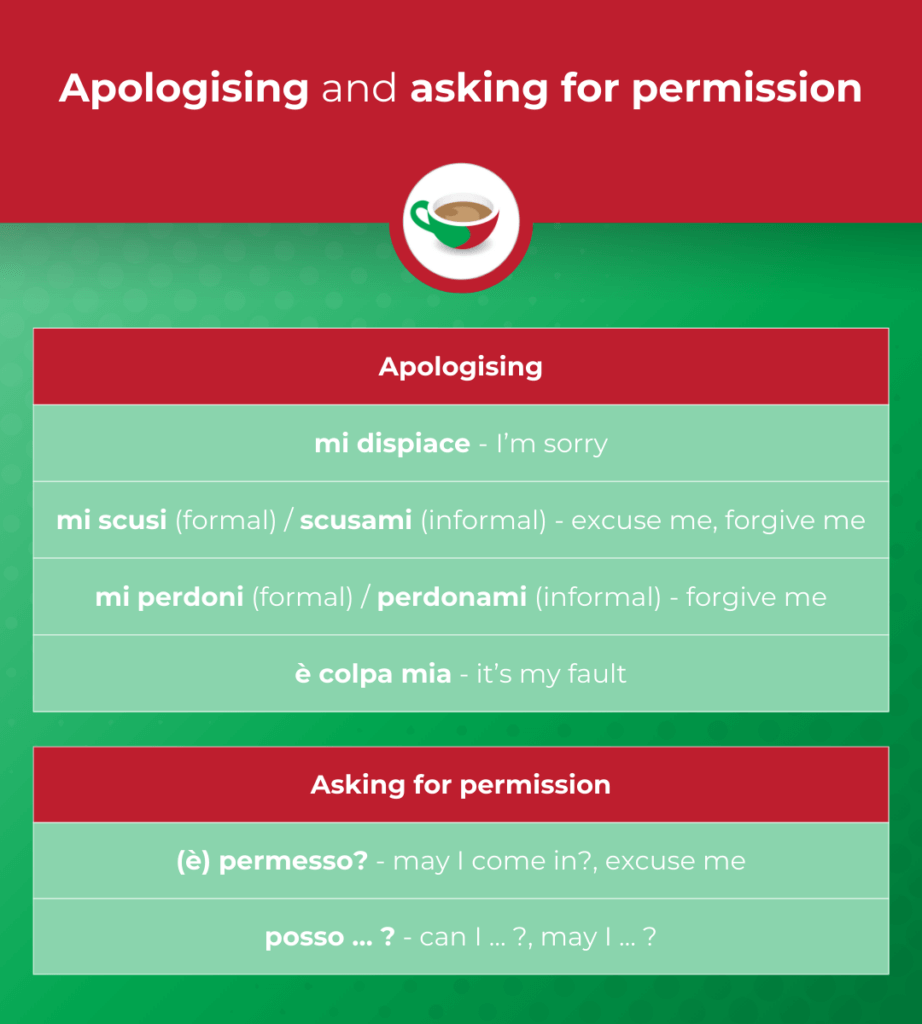
Now you can apologise in Italian!
Ecco qui! That was a glimpse into the various ways to apologise in Italian.
Remember that the Italian language is rich in nuances, and choosing the right expression can make a difference in your daily interactions. We hope this information has been helpful, and you can put it into practice in your next Italian adventures.
For a little extra practice, download the free worksheet below, and see how much you’ve learned about apologising and asking permission in Italian.
If you found this interesting, make sure you listen to the full podcast episode with Mark and Maurizio on The Coffee Break Italian Show. We will be regularly uploading more episodes for Italian learners, so make sure to subscribe to our podcast feed and our channel on YouTube to find out when the next episode is available.
Plus! To get regular free Italian lessons in your inbox, you can sign up for our short (coffee-break-sized) email lessons that will help you improve your Italian. You will also hear from Mark, the founder of Coffee Break Languages, giving advice for language learners at any level. Sign up below!
Happy Coffee Breaking!
Listen to the podcast
Which prepositions are used with cities and countries?
As a French learner, deciding which preposition to use with locations, such as cities and countries, can be frustrating. Getting to grips with why we make these choices will help us make the correct decision.
The Coffee Break French Show is a podcast series of bite-sized, friendly conversations, in which we demystify tricky French language topics. In the latest episode, Mark and Max explore the nuances of using prepositions before cities, countries, islands and continents.
We hope that you find this article useful as your roadmap to prepositions for cities and countries in French. Continue reading to find out more and why not listen to the podcast as you go?
Cities
In French, cities generally take the preposition à. For example:
Tu habites à Paris ?
Do you live in Paris?
Je veux aller à New York.
I want to go to New York.
However, there are a few points to remember. As you may know, à + le becomes au, so cities starting with Le (for example Le Caire – Cairo) require a contraction after à. For example:
J’habite au Caire.
I live in Cairo.
Je vais au Mans.
I’m going to Le Mans.
These contractions apply exclusively to cities that begin with Le. Other well-known examples are Le Cap (Cape Town) and the French port town of Le Havre.
You may have noticed something crucial from all of these examples: à can translate as “in” or “to”. There is only one option for the preposition in French, covering the idea of both being “in” and going “to” a city.
Countries
Describing countries in French involves a bit more nuance.
Feminine countries
For feminine countries (usually these can be spotted because they end in –e), the preposition en is used. These include:
en France
in / to France
en Espagne
in / to Spain
en Argentine
in / to Argentina
Masculine countries
On the other hand, masculine countries (generally those not ending in -e) typically take the preposition au. Examples include:
au Portugal
in / to Portugal
au Canada
in / to Canada
au Chili
in / to Chile
Note that some countries’ names end with an -e but they are masculine. These all use au, similar to other masculine countries. There are six of these exceptions, and they are:
le Mexique
Mexico
le Bélize
Belize
le Cambodge
Cambodia
le Mozambique
Mozambique
le Suriname
Suriname
le Zimbabwe
Zimbabwe
Countries starting with a vowel
There is another exception for countries starting with a vowel. Regardless of gender, en is used. For example:
en Uruguay
in / to Uruguay
en Afghanistan
in / to Afghanistan
Plural countries
When it comes to plural forms, gender becomes irrelevant, and the preposition aux is applied. For instance:
aux États-Unis
in / to the USA
aux Philippines
in / to the Philippines
aux Pays-Bas
in / to the Netherlands

Islands
The rule for islands is straightforward. Singular islands take à, while plural islands take aux. For instance:
à Madagascar
in / to Madagascar
aux Maldives
in / to the Maldives
Continents
Finally, continents in French take the preposition en:
en Europe
in / to Europe
en Afrique
in / to Africa
en Asie
in / to Asia
Let’s review
We hope that you now feel more confident using prepositions with place names in French.
Remember these key points and you will have a good start:
- à for cities and islands
- en for feminine countries, all countries starting with a vowel, and continents
- au for masculine countries (except those that begin with a vowel)
- aux for plural countries and islands
Remember, we all make mistakes, and French speakers will still understand you if you get this wrong. However, the more you master using prepositions with places, the more comfortable you will be and the more natural you will sound when you speak French.
If you found this post interesting, make sure to listen to the full episode with Mark and Max on The Coffee Break French Show. This is the series in which we look at a range of topics for French learners, so make sure to subscribe to our podcast feed and our channel on YouTube.
Plus! To get regular free French lessons in your inbox, you can sign up for our short (coffee-break-sized) email lessons that will help you improve your French. You will also hear from Mark, the founder of Coffee Break Languages, giving advice for language learners at any level. Sign up below!
Bonne chance et bon voyage !
Happy Coffee Breaking!
Listen to the podcast
When to use ‘a’ and ‘the’ in English
Do you know when to use a and the in English?
These little words are called articles. They can be difficult to use correctly, because they are used in different ways in different languages, and in some languages they don’t exist at all!
The Coffee Break English Show is a podcast series of bite-sized, friendly conversations to help you understand some difficult topics in English. In the latest episode, Josie and Mark talk about when to use a and the to talk about general and specific things.
So, let’s get started and look at a and the. Continue reading to find out more and why not listen to the podcast as you go?
‘A’ and ‘the’ for singular nouns
‘A’ for singular, non-specific things
We use the article a in front of singular nouns. A is an indefinite article, and we use it to describe something that is not specific, or something general. Let’s look at some examples:
I saw a dog yesterday.
= this is not a specific dog, and it’s the first time I have mentioned it
Can you give me a pen, please?
= I am not asking for a specific pen, I just need any pen available to write something
A cheetah can run very fast.
= we are not talking about one specific cheetah, we are saying that, in general, cheetahs can run fast
Watch out! If the noun begins with a vowel (a, e, i, o, u) we use an instead of a. For example:
She picked an apple from the tree.
You have to take an aeroplane to get to the USA.
‘The’ for singular, specific things
We can also use the article the in front of singular nouns. The is a definite article, and we use it to describe something specific, instead of something general. Let’s look at some examples:
I saw a dog yesterday. The dog was cute.
= the second time I mention the dog, I use the, because we know which specific dog I am talking about – it’s the dog that I saw yesterday
Did you watch the match last night?
= Mark and Josie both follow the same sport or team, so when Josie asks this, they both know which specific match she is talking about
The restaurant next to my apartment is really good.
= I am talking about a specific restaurant – I know exactly where it is
‘The’ for unique things
We also use the for things of which there is only one. These things are unique:
the sky
e.g. The sky is blue.
the Internet
e.g. I’ll look it up on the Internet.
the Earth
e.g. The Earth orbits the sun.
the sun
e.g. The sun rises in the east.
the moon
e.g. The moon is beautiful tonight.
‘A’ for jobs and professions
We use a when we talk about someone’s job. For example:
I’m a teacher.
He is a doctor.
Are you a nurse?
‘The’ or no article for plural nouns
How’s it going so far? Get some more tea or coffee if you need to! Remember, in front of plural nouns we never use a. A is only for singular nouns. For plural nouns we use the or no article at all.
No article for plural, general things
When we talk about general or non-specific things in the plural form, we don’t use an article. Here are some examples:
I love horror films.
= I love horror films in general, all horror films
Do you have pets?
= Josie doesn’t know if Mark has pets, so she can’t be specific when she asks this question
No article for uncountable, general things
Uncountable nouns are things that we don’t count individually, and which we think of as one mass. Some examples are water, rice, pasta, time and information. Let’s look at some examples:
I’m thirsty, I need to drink water.
= I don’t want some specific water, I just want any available water
I need information about the project.
= I’m not asking for some specific information, I just want to know something about the project
Pasta tastes delicious with tomato sauce.
= I am saying that all pasta tastes delicious with tomato sauce, and I am not talking about a specific pasta dish that I have eaten
‘The’ for specific things (plural and uncountable)
As we mentioned earlier, when we talk about specific, singular things, we use the article the. We also use the for specific things when they are plural or uncountable. These examples are all connected to previous examples in this blog post, so you can scroll up and compare them if you need to:
The horror films that I watched last week were very scary.
The dogs that I know are friendly.
The information that you gave me is clear.
The water that comes from my tap is delicious.
Let’s review

If you found this post interesting, make sure you listen to the full podcast episode with Mark and Josie on The Coffee Break English Show. We will release more episodes soon, about some more useful topics! Subscribe to our podcast feed and our channel on YouTube to learn when the next episode is available.
Plus! To get regular free English lessons in your inbox, you can sign up for our email lessons. We regularly send short (coffee-break-sized) email lessons that will help you improve your English. You will also hear from Mark, the founder of Coffee Break Languages, giving advice for language learners at any level. Sign up below!
So, keep practising the and a! Remember that all English learners make mistakes, but people can usually still understand you. It’s all part of the language-learning journey.
Happy Coffee Breaking!
Listen to the podcast
6 Spanish words that change meaning with ‘ser’ and ‘estar’

¿Está bueno o es bueno? Are both of these phrases correct? Do they mean the same thing?
As a Spanish learner, at times, it can be difficult to know when to use ser and when to use estar to translate “to be”. And did you know that there are some adjectives that have a different meaning depending on whether they are used with ser or estar?
The Coffee Break Spanish Show is a podcast series of short, informal conversations to help you understand some difficult topics in Spanish. In the latest episode, Mark and Concha continue to look at the verbs ser and estar, but this time discussing how the choice of verb can change the meaning of some words.
This episode is the second part of a double episode all about these two verbs, and in our previous episode we discussed how and when to use ser and estar in Spanish. So, before we start, if you haven’t already watched that episode, or read its accompanying blog article, you can find it here.
Continue reading to find out more and why not listen to the podcast as you go?
Si está todo preparado, ¡vamos a ello!
What changes with ‘ser’ and ‘estar’?
There are some adjectives in Spanish whose meaning changes a little bit when we use ser instead of estar. That is to say, although we would translate ser and estar as “to be” in English in both cases, the adjective that accompanies them changes its meaning.
As we begin this discussion, we need to keep two things in mind:
- Not all adjectives have this ser/estar change in meaning.
- For adjectives that don’t fall into this category, it’s helpful to remember the ser and estar rules that Mark and Concha taught us in the previous episode, so that you know whether to use the adjective with ser or estar.
So, what are these adjectives? One of our personal favourites is aburrido/a. Ser aburrido/a means “to be boring”, but estar aburrido/a is “to be bored”. So, be careful next time you want to say you are bored! Let’s see this in an example sentence:
La película es muy aburrida y ahora estamos aburridos.
The film is very boring and now we are bored.
However, it’s not quite as simple as equating English -ing vs -ed adjectives with ser vs estar, so let’s look at some further examples and see what happens when some other adjectives are used with ser and estar.
Abierto/a
Ser abierto/a and estar abierto/a can both be translated as “to be open”, but in two different senses. Let’s look at this in some example sentences:
estar abierto/a
to be open
La tienda está abierta hasta las once.
The store is open until eleven.
ser abierto/a
to be open / outgoing
Mi padre es muy abierto: puede hablar con todo tipo de personas.
My father is very open, he can talk to all kinds of people.
Listo/a
The adjective listo/a can carry two very different meanings, depending on whether it is used with ser or estar.
estar listo/a
to be ready
En cinco minutos estaré lista.
In five minutes, I’ll be ready.
ser listo/a
to be witty / clever
Es muy lista y por eso aprende muy rápido.
She is very smart and that is why she learns very quickly.
Bueno/a
Now, let’s turn our attention to one very commonly used adjective.
estar bueno/a
to be delicious
Esta paella está muy buena, ¿quién la ha hecho?
This paella is very tasty. Who made it?
Note that in Latin America, if we are talking about an experience such as a show, film or trip, we use estar bueno/a, too. For example:
Las vacaciones pasadas estuvieron buenas.
Our last holiday was good.
Bueno/a is used with ser in slightly different contexts.
ser bueno/a
to be good quality, to be good for you
Este ordenador es muy bueno. Tiene cinco años y aún funciona perfectamente.
This computer is very good. It’s five years old and still works perfectly.
¡Ojo! Don’t confuse the adjective bueno (“good”) with the adverb bien (“well”). While we can use bueno/a with both ser and estar, we can only use bien with estar. For example:
Estoy muy bien.
I’m very well.
Malo/a
Now for the opposite of bueno/a: malo/a.
estar malo/a
to be in bad condition
Creo que este queso está malo, huele muy fuerte.
I think this cheese is off – it smells very strong.
Estar malo/a can also mean “to be sick”.
Hugo no fue a clase porque estaba malo.
Hugo didn’t go to class because he was sick.
Like with bueno/a, in Latin America, if we are talking about an experience such as a show, film or trip, we use estar malo/a, too. For example:
No estuvo malo, ¿no creen?
It wasn’t bad, don’t you think?
Ser malo/a, on the other hand, is used in different contexts.
ser malo/a
to be bad
Espero que el tiempo mañana no sea malo.
I hope the weather tomorrow isn’t bad.
¡Ojo! Pay special attention to one difference between the adjective malo/a (“bad”) and the adverb mal (“badly / wrong”). While we can use malo/a with both ser and estar, we can only use mal with estar. For example:
Este ejercicio está mal.
This exercise is wrong.
Orgulloso/a
When orgulloso/a is used with estar, it generally has a positive connotation.
estar orgulloso/a
to be proud
Hijo, ¡qué orgullosos estamos de ti, no tienes ni idea!
Son, we are so proud of you, you have no idea!
When orgulloso/a is used with ser, however, it generally has a negative connotation, and can convey arrogance or feeling full of yourself.
ser orgulloso/a
to be prideful
¡Ay, Pepa, no seas tan orgullosa y dame un abrazo!
Oh, Pepa, don’t be so proud and give me a hug!
Reservado/a
Reservado/a can be translated as “reserved”, whether it’s used with ser or estar. However, in English we used “reserved” in two quite different contexts. In Spanish, this difference is shown through the choice of verb. Let’s look at some examples:
estar reservado/a
to be booked / reserved
Lo siento señora, esta mesa está reservada. Puede sentarse en esta otra.
Sorry ma’am, this table is reserved. You can sit at this other one.
ser reservado/a
to be discreet / reserved (in personality)
Luis es muy reservado, nunca nos cuenta nada.
Luis is very reserved, he never tells us anything.
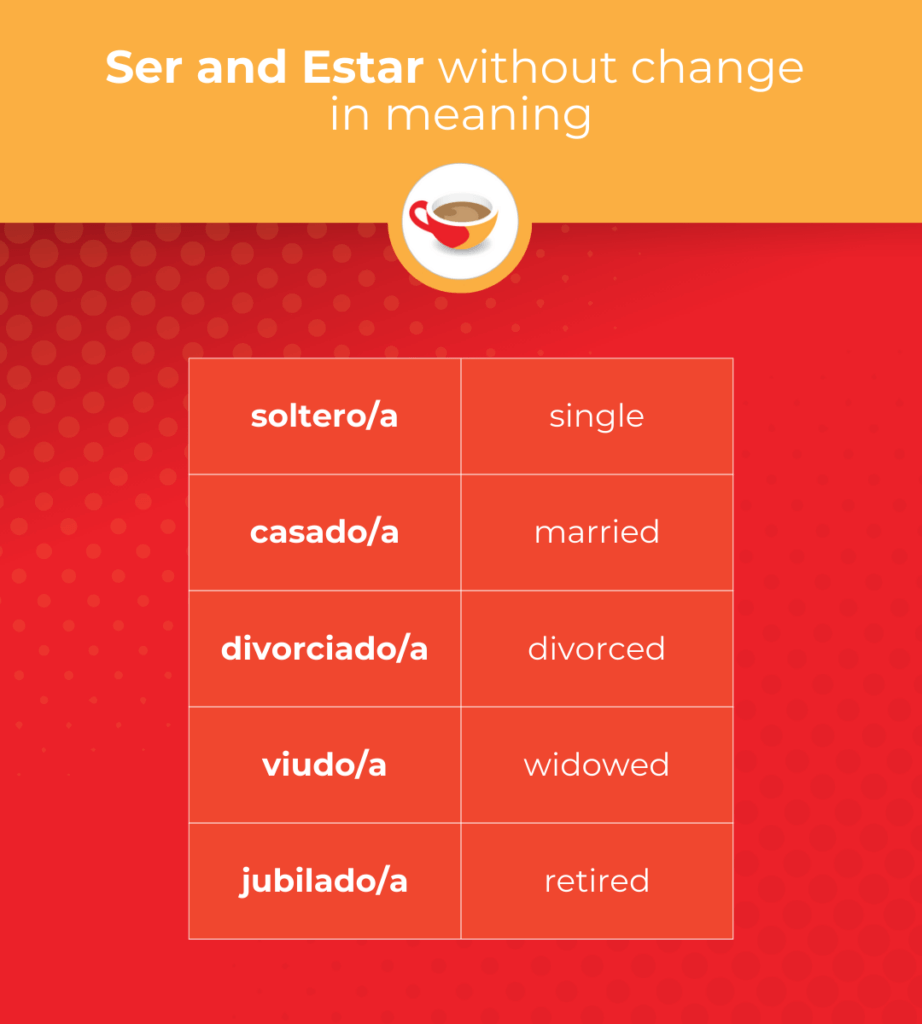
Here’s something interesting
There are some adjectives that can be equally used with ser and estar, and their meaning doesn’t change. For example:
soltero/a
single
casado/a
married
divorciado/a
divorced
viudo/a
widowed
jubilado/a
retired
In conclusion
Pay special attention to how you use ser and estar and you will be well on your way to fixing one of the most common mistakes made by Spanish learners.
We hope you found this post interesting. Make sure to listen to the full episode with Mark and Concha on The Coffee Break Spanish Show. This is the series in which we look at a range of topics for Spanish learners, so make sure to subscribe to our podcast feed and our channel on YouTube.
Plus! To get regular free Spanish lessons in your inbox, you can sign up for our short (coffee-break-sized) email lessons that will help you improve your Spanish. You will also hear from Mark, the founder of Coffee Break Languages, giving advice for language learners at any level. Sign up below!
Happy Coffee Breaking!
Listen to the podcast
CBGa 1.19 | Offering drinks in Gaelic

In this episode, we’re moving on to the topic of drinks so you can enjoy a Gaelic coffee break! You’ll learn the words for different types of drinks in Gaelic and how to ask and answer the question “what do you want?”
‘Zu’ and ‘um … zu’ constructions in German

There are various ways the infinitive form of verbs can be used in German: on their own as an infinitive, with zu, or with um … zu.
Remember that the infinitive form of a verb is the base form that you would find in a dictionary.
The Coffee Break German Show is a podcast series of bite-sized, friendly conversations, in which we demystify tricky German language topics. In the latest episode, Mark and Thomas discuss how to use the infinitive form of verbs in German sentences.
Continue reading to find out more and why not listen to the podcast as you go?
How do you use the infinitive in German?
Using the correct form of verbs in German will ensure that you are understood. There are several occasions when you would want to use the verb in the infinitive, but what are they?
There are three ways to use the infinitive form of verbs in sentences in German:
- Use the infinitive on its own
- Use zu + the infinitive
- Use um … zu + the infinitive
Let’s look at these one by one.
Infinitive verbs on their own
Let’s take the following verb as our example infinitive:
verbessern
to improve
This is the infinitive form on its own and it is the form you will see in a dictionary. It remains in this form, no matter what the tense is.
We would see the verb used in this form with auxiliary verbs, for example:
Wir werden unser Deutsch verbessern.
We will improve our German.
You also see this when the infinitive form of a verb is combined with a modal verb. They don’t require a zu clause, as they operate as auxiliary verbs combined with an infinitive. For example:
Wir müssen üben.
We have to practise.
The infinitive with ‘zu’
Sometimes when the infinitive form of the verb is in a sentence, we need zu with the infinitive. Here are some examples:
Wir vergessen jedes mal, die Fenster zu schließen.
We forget to close the windows every time.
Du hast mir versprochen, dein Zimmer aufzuräumen.
You promised me that you would tidy your room.
Er freut sich dich wieder zu sehen.
He is looking forward to seeing you again.
In the podcast episode, Thomas points out that in these sentences there is usually a comma separating the two parts of the sentence – the part containing the zu + infinitive is in a “separate clause” from the main clause.
A great way to think about this is that the sentences that need zu with the infinitive ask “what?”.
From the examples above, think about the question “what did we forget?”, “what did you promise?”, and “what is he looking forward to?”. The answer always involves “to…”, so in the above examples, the answers will be “to close the windows”, “to tidy the room”, and “to see you again”.
Sentences with ‘um … zu’
If the zu + infinitive construction answers the question “what?”, the um … zu + infinitive construction answers the question “why?” or “for what purpose?”. This construction is often translated as “in order to” in English. Let’s look at some examples:
Sie fahren nach München, um ihre Oma zu besuchen.
They are travelling to Munich to see their granny.
Ich gehe Tomaten kaufen, um einen Salat zu machen.
I am going to buy tomatoes to make a salad.
Note that there is a comma between the two parts of the sentence, just as we saw with the zu + infinitive construction.
‘Zu’ and ‘um … zu’ combined
In the episode, Thomas points out that both zu + infinitive and um … zu + infinitive can appear in one sentence. For example:
Heute lernen wir, Infinitivsätze zu benutzen, um unser Deutsch noch zu verbessern.
Today, we are learning to use infinitive sentences to improve our German.
Morgen werden wir noch mehr Infinitivsätze benutzen, um unser Deutsch noch mehr zu verbessern.
Tomorrow, we will use even more infinitive sentences to improve our German even more.
In conclusion

We hope this has helped you become more confident in knowing when to use the infinitive in your German conversations.
Don’t be afraid to make mistakes – it’s all part of the language-learning journey and the more you practise using these constructions in German, the more natural they will become.
If you found this post interesting, make sure to listen to the full episode with Mark and Thomas on The Coffee Break German Show. This is the series in which we look at a range of topics for German learners, so make sure to subscribe to our podcast feed and our channel on YouTube.
Plus! To get regular free German lessons in your inbox, you can sign up for our short (coffee-break-sized) email lessons that will help you improve your German. You will also hear from Mark, the founder of Coffee Break Languages, giving advice for language learners at any level. Sign up below!
Happy Coffee Breaking!