
¿Está bueno o es bueno? Are both of these phrases correct? Do they mean the same thing?
As a Spanish learner, at times, it can be difficult to know when to use ser and when to use estar to translate “to be”. And did you know that there are some adjectives that have a different meaning depending on whether they are used with ser or estar?
The Coffee Break Spanish Show is a podcast series of short, informal conversations to help you understand some difficult topics in Spanish. In the latest episode, Mark and Concha continue to look at the verbs ser and estar, but this time discussing how the choice of verb can change the meaning of some words.
This episode is the second part of a double episode all about these two verbs, and in our previous episode we discussed how and when to use ser and estar in Spanish. So, before we start, if you haven’t already watched that episode, or read its accompanying blog article, you can find it here.
Continue reading to find out more and why not listen to the podcast as you go?
Si está todo preparado, ¡vamos a ello!
What changes with ‘ser’ and ‘estar’?
There are some adjectives in Spanish whose meaning changes a little bit when we use ser instead of estar. That is to say, although we would translate ser and estar as “to be” in English in both cases, the adjective that accompanies them changes its meaning.
As we begin this discussion, we need to keep two things in mind:
- Not all adjectives have this ser/estar change in meaning.
- For adjectives that don’t fall into this category, it’s helpful to remember the ser and estar rules that Mark and Concha taught us in the previous episode, so that you know whether to use the adjective with ser or estar.
So, what are these adjectives? One of our personal favourites is aburrido/a. Ser aburrido/a means “to be boring”, but estar aburrido/a is “to be bored”. So, be careful next time you want to say you are bored! Let’s see this in an example sentence:
La película es muy aburrida y ahora estamos aburridos.
The film is very boring and now we are bored.
However, it’s not quite as simple as equating English -ing vs -ed adjectives with ser vs estar, so let’s look at some further examples and see what happens when some other adjectives are used with ser and estar.
Abierto/a
Ser abierto/a and estar abierto/a can both be translated as “to be open”, but in two different senses. Let’s look at this in some example sentences:
estar abierto/a
to be open
La tienda está abierta hasta las once.
The store is open until eleven.
ser abierto/a
to be open / outgoing
Mi padre es muy abierto: puede hablar con todo tipo de personas.
My father is very open, he can talk to all kinds of people.
Listo/a
The adjective listo/a can carry two very different meanings, depending on whether it is used with ser or estar.
estar listo/a
to be ready
En cinco minutos estaré lista.
In five minutes, I’ll be ready.
ser listo/a
to be witty / clever
Es muy lista y por eso aprende muy rápido.
She is very smart and that is why she learns very quickly.
Bueno/a
Now, let’s turn our attention to one very commonly used adjective.
estar bueno/a
to be delicious
Esta paella está muy buena, ¿quién la ha hecho?
This paella is very tasty. Who made it?
Note that in Latin America, if we are talking about an experience such as a show, film or trip, we use estar bueno/a, too. For example:
Las vacaciones pasadas estuvieron buenas.
Our last holiday was good.
Bueno/a is used with ser in slightly different contexts.
ser bueno/a
to be good quality, to be good for you
Este ordenador es muy bueno. Tiene cinco años y aún funciona perfectamente.
This computer is very good. It’s five years old and still works perfectly.
¡Ojo! Don’t confuse the adjective bueno (“good”) with the adverb bien (“well”). While we can use bueno/a with both ser and estar, we can only use bien with estar. For example:
Estoy muy bien.
I’m very well.
Malo/a
Now for the opposite of bueno/a: malo/a.
estar malo/a
to be in bad condition
Creo que este queso está malo, huele muy fuerte.
I think this cheese is off – it smells very strong.
Estar malo/a can also mean “to be sick”.
Hugo no fue a clase porque estaba malo.
Hugo didn’t go to class because he was sick.
Like with bueno/a, in Latin America, if we are talking about an experience such as a show, film or trip, we use estar malo/a, too. For example:
No estuvo malo, ¿no creen?
It wasn’t bad, don’t you think?
Ser malo/a, on the other hand, is used in different contexts.
ser malo/a
to be bad
Espero que el tiempo mañana no sea malo.
I hope the weather tomorrow isn’t bad.
¡Ojo! Pay special attention to one difference between the adjective malo/a (“bad”) and the adverb mal (“badly / wrong”). While we can use malo/a with both ser and estar, we can only use mal with estar. For example:
Este ejercicio está mal.
This exercise is wrong.
Orgulloso/a
When orgulloso/a is used with estar, it generally has a positive connotation.
estar orgulloso/a
to be proud
Hijo, ¡qué orgullosos estamos de ti, no tienes ni idea!
Son, we are so proud of you, you have no idea!
When orgulloso/a is used with ser, however, it generally has a negative connotation, and can convey arrogance or feeling full of yourself.
ser orgulloso/a
to be prideful
¡Ay, Pepa, no seas tan orgullosa y dame un abrazo!
Oh, Pepa, don’t be so proud and give me a hug!
Reservado/a
Reservado/a can be translated as “reserved”, whether it’s used with ser or estar. However, in English we used “reserved” in two quite different contexts. In Spanish, this difference is shown through the choice of verb. Let’s look at some examples:
estar reservado/a
to be booked / reserved
Lo siento señora, esta mesa está reservada. Puede sentarse en esta otra.
Sorry ma’am, this table is reserved. You can sit at this other one.
ser reservado/a
to be discreet / reserved (in personality)
Luis es muy reservado, nunca nos cuenta nada.
Luis is very reserved, he never tells us anything.
Here’s something interesting
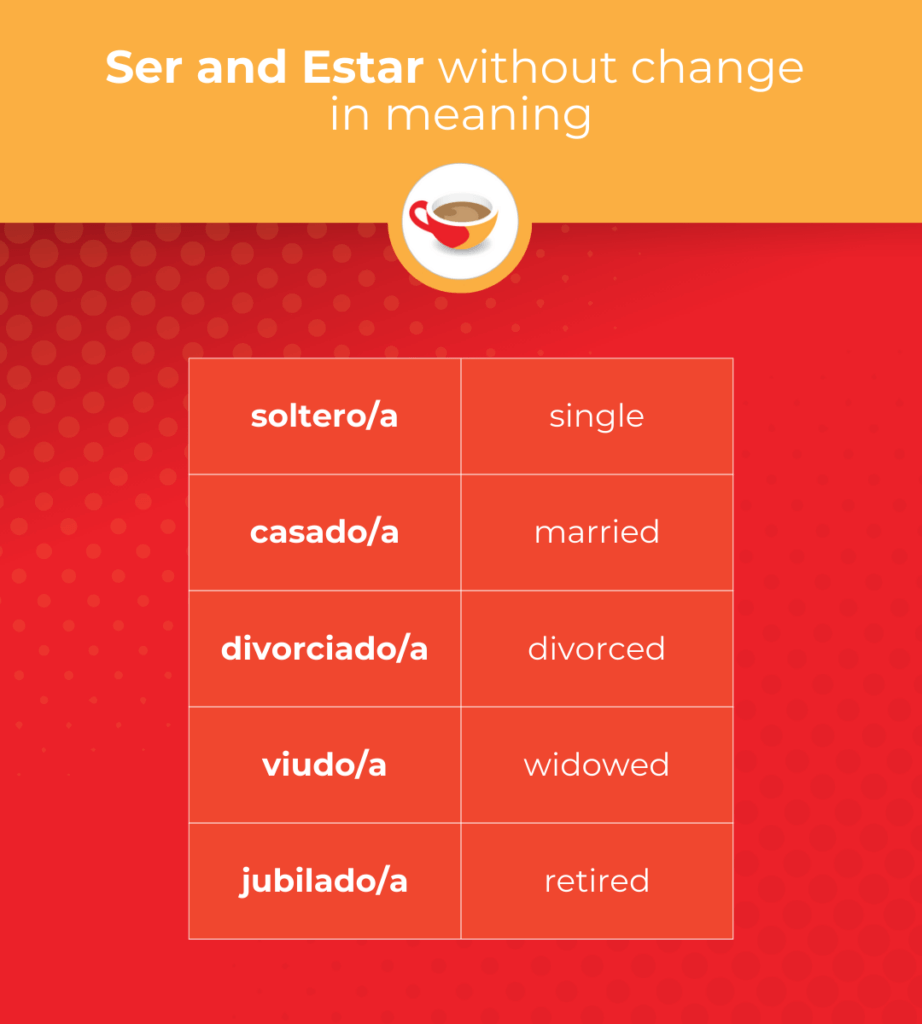
There are some adjectives that can be equally used with ser and estar, and their meaning doesn’t change. For example:
soltero/a
single
casado/a
married
divorciado/a
divorced
viudo/a
widowed
jubilado/a
retired
In conclusion
Pay special attention to how you use ser and estar and you will be well on your way to fixing one of the most common mistakes made by Spanish learners.
We hope you found this post interesting. Make sure to listen to the full episode with Mark and Concha on The Coffee Break Spanish Show. This is the series in which we look at a range of topics for Spanish learners, so make sure to subscribe to our podcast feed and our channel on YouTube.
Plus! To get regular free Spanish lessons in your inbox, you can sign up for our short (coffee-break-sized) email lessons that will help you improve your Spanish. You will also hear from Mark, the founder of Coffee Break Languages, giving advice for language learners at any level. Sign up below!
Happy Coffee Breaking!