We’re delighted to tell you more about the new course from the Radio Lingua Network. In Coffee Break German, you’ll be learning enough German to get by in a whole range of situations, for example if you’re travelling in a German-speaking country, or indeed if you just want to impress your friends or your relatives who perhaps speak German. In weekly lessons you’ll cover all the language that you need to know, and you’ll join learner Mark, being taught by native speaker Thomas.
 Thanks Mark, und herzlich Willkommen! My name is Thomas – or in German, mein Name ist Thomas. You see, German is very easy! I come from the south of Germany, from a town in Bavaria called Kempten. As Mark already explained, in Coffee Break German we’re going to cover a range of topics, so, for example, you’ll be learning to order drinks in a café, check into a hotel, ask for directions and talk about yourself so you can make friends with native speakers. The most important thing is – am wichtigsten ist – that you should not think of Coffee Break German as simply a phrase book. Yes, you’ll be learning useful words and phrases, but we will talk about these words and phrases in each lesson and you will develop an understanding of the language and how it works. This way you’ll know what you need to say – and when you need to say it. I’m looking forward to helping you with your German in our weekly lessons together.
So, as Thomas explained, it’s not just a case of learning a series of phrases which we can use in particular situations, it’s more about understanding how the language works, so you’ll be learning to manipulate the language – you’ll be learning the patterns of the language – so then you can create your own phrases and cope in many different situations. To help you with this grammatical side of things, with the patterns of the language, each lesson will include a Grammar Guru segment. Here’s Kirsten, our Grammar Guru, to tell you a little more about her role in the Coffee Break German experience.
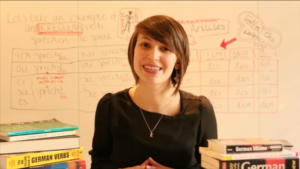 Hallo! Ich bin die Kirsten. My name is Kirsten and I’m the Coffee Break German Grammar Guru. I have to say, I’m a total grammar geek and I’m really looking forward to helping you get to grips with your German. Let’s imagine a language is like the human body. Grammar is like the skeleton – it’s what holds everything together, and without it, it would all just fall apart. Some people are a little bit scared of grammar: they think it’s just about learning lots of rules, but I like to think of these rules as patterns, and the more you get to know German, the more you’ll begin to recognise these patterns. You’re not going to have to spend ages going through these complicated grammar books. As Coffee Break German Grammar Guru, it’s my job to simplify everything for you and in each lesson I’ll be helping you get to grips with the particular patterns covered in that lesson. If you tune into my Grammar Guru sections, you’ll start to build up a really solid foundation for your German and all of these patterns will become second nature to you. I’m really looking forward to helping you with your German!
Now learning a language isn’t just about the language itself: there’s also the cultural side of things too, and German is the official language of not just Germany, but also Austria and Switzerland, and there are indeed many other parts of the world where German is spoken. To help you get to grips with these cultural aspects we’ve enlisted the services of Julia, our Cultural Correspondent, and we’ll be joined in each lesson by Julia, who will be bringing us some cultural tidbits from around the German-speaking world.
 Hallo alle zusammen! Ich heisse Julia – my name is Julia, and it’s my job to bring you some cultural insights into the German-speaking parts of the world. In each episode I’ll spend just a couple of minutes explaining an aspect of culture: the traditions we have, the food we eat, some words we use, and some of the strange, little things that make us German speakers so lovable! I’m looking forward to joining you every week and I hope that you enjoy my Cultural Correspondent segments.
We hope that you really enjoy learning German with Coffee Break German. All the information about the course will be published at coffeebreakgerman.com, and you will be able to download our free audio lessons in iTunes. We also have a premium version of the course which includes lesson notes, transcripts, exercises and additional materials which will help you get to grips with your German more quickly. Full details about the premium course and the iPad version will be provided on launch date. We’re really looking forward to launching Coffee Break German. The course goes live on Wednesday 23rd January 2013.
 We
We 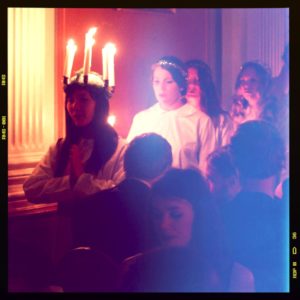 Hej! So, a few weeks back I promised more on Lussebullar (Lucia saffron buns, baked in the shape of an 8… or a curled up cat, depending on your baking skills), so here it is, my Lucia article (because I am sure you are all getting slightly tired of hearing about the snow!). Lucia is a really, really Swedish celebration which happens on the 13th December every year, and is just about impossible to avoid – not that you would want to! Shops begin selling the aforementioned lussebullar from the beginning of December, going into overdrive on the actual day itself; there are regional and nationwide contests to be crowned Lucia of the year in which the public vote; so, what’s it all about?
 Buongiorno a tutti and welcome to On Location Italian. Lessons are all finished up, exams are just around the corner and I am home for Christmas next week. It’s official, my first semester in Verona is almost over. And what a semester it has been! I am so grateful for all the amazing places I have seen, the great food I have tasted and most importantly, the fantastic people I have met. I cannot believe how close you can become to people in such a short space of time but I guess that is the nature of doing Erasmus – without your own family and friends to lean on, you form your own sort of Erasmus family to get you through.
 Hi everyone! We are now on the run up to Christmas and I am back with an article on different Christmas traditions in Germany and things that I have experienced so far during this festive period.
 Hola a todos and welcome to another of Grace’s On Location Spanish updates. With November’s rain a thing of the past, as promised, my trusty umbrella has simply been gathering dust. Now, in the middle of December, the sun still shines brightly through clear blue skies but I can confirm that, with low temperatures of 17
 Bonjour à tous et à toutes! It’s Scott here and I’d like to welcome you to this special Yuletide instalment of my On Location French blog!
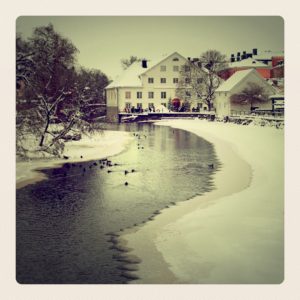 Tja! Well, I am not sure about what it is like with my fellow On Location bloggers, but here in Uppsala just about all anyone can talk about is the snow – I know I mentioned this last week, but there really is a lot! I thought it would be quite appropriate this week therefore to talk about some of the snow-related words my Swedish friends have been teaching me.
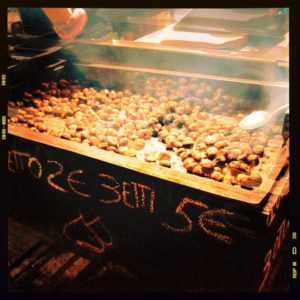
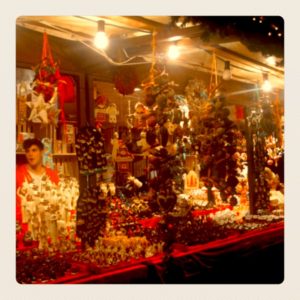 Buongiorno a tutti! It’s Nicole here, back with another On Location Italian blog post! The festive season is fast approaching and here in Verona it really is beginning to look a lot like Christmas. I have spent much of this week visiting i Mercatini di Natale (“the Christmas Markets”) which are situated just off one of the city’s main squares, Piazza delle Erbe. On one particular occasion, as I embraced the Christmas atmosphere (atomosfera natalizia) by enjoying some mulled wine (vin brulé) and roasted chestnuts (castagne), I could hear pipes being played in the background. It then dawned on me that I didn’t know the word for bagpipes in Italian. I thought that this would be a useful word for a Scotswoman to know and so I made a point of looking it up when I returned to my flat, discovering that “bagpipes” in Italian is cornamusa.
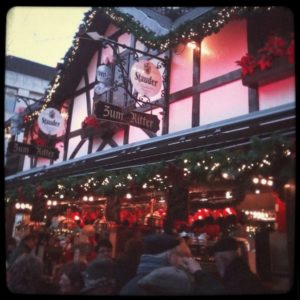 Hallo zusammen! Daniel here again for this year’s last blog post and as we have reached that time of year again, this article’s going to be based on Weihnachten – Christmas, with emphasis on food. On Thursday, I learned that the 6th December is known as ‘Nikolaustag’ (‘St. Nicholas’ Day’). This is the traditional start of the Christmas celebrations in Germany and, although not a public holiday, is still taken seriously everywhere. Children are left sweets the night before (if they’ve been good!) and I got a bag of chocolates from colleagues at work! By this point in the season, Weihnachtsmärkte (Christmas markets) have already opened up all over Germany from the big cities like Hamburg to the smaller towns like Dülmen and Herford. Some Weihnachtsmärkte even have eine Eislaufbahn – an ice rink!
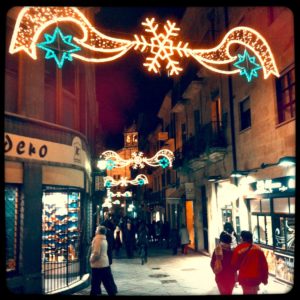 Buenos días y bienvenidos a todos to the final update from Salamanca of 2012. It’s Iain here, and I’ve been out braving the cold weather to bring you some updates of the preparations that Salamanca has been making for the festive season.
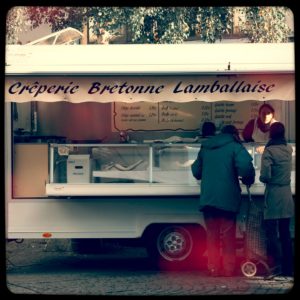 Salut tout le monde! It’s Rose here, glad to get to the end of a busy week! I’ve been kept busy doing speaking exams with my terminale(final year) pupils this week, as well as my usual classes. Unfortunately this week at school l’imprimante était en panne (the printer was broken) and it seems impossible to get it fixed! I did pick up a handy little phrase through this though. As we were gathered round trying to see what was wrong, one teacher made a suggestion then said: “mais je mets mon grain de sel“. At first I couldn’t see the link between salt and a broken printer, but I checked with another teacher later and mettre son grain de sel is an idiomatic expression for giving one’s opinion, similar to ‘that’s my two pennies/cents worth.’
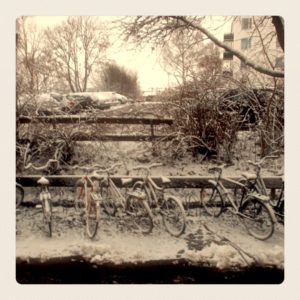 Hej! Well, it’s officially the run-up to Christmas now, and as a result suddenly huge Christmas trees are being placed all around Uppsala, lights are going up, shop windows have become explosions of red, gold and green, and everywhere you see offers on glögg (traditional Swedish mulled wine) and lussekatter (Lucia buns… more on that later!). It is almost getting too cold and icy for people to cycle – which luckily makes no difference to me, being one of maybe three students in Uppsala without a bike. It is this absence of a bike which has actually inspired this week’s article on the Swedish verbs att gå and att åka: verbs with an everyday use, but which are, at least for me, so easy to mix up!
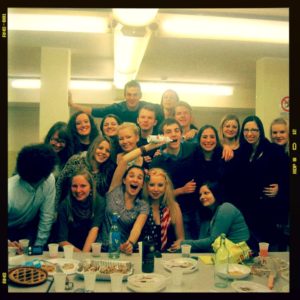 Buongiorno a tutti and welcome to this week’s On Location Italian. It’s Nicole here writing to you all once again from the Italian city of Verona. I am now into the final straight with only a few weeks left until I am home for Christmas. I have therefore decided that it is all hands on decks in terms of speaking, reading, listening and watching all things Italian before my return to bonny Scotland.
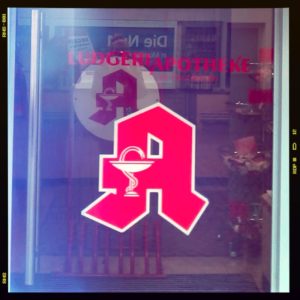 Hallo! It’s Holly here again with another blog post from Germany.
 Bienvenido a todos to Grace’s On Location Spanish Update. Here in Valencia our beachwear is slowly giving way to wooly jumpers and sensible shoes as we find ourselves in the rainy season. Although I am assured by my friend John that as we move on through December we will see the return of the dry weather. Nevertheless, I’ve been to the Corte Inglés to buy myself un paraguas (“an umbrella”) just in case.