
Join Francesca and Mark for this Chapter of Scenes from the Coffee Break Italian Café! A high school student stops at a café before class, clearly troubled and reluctant to face the day ahead. As he confides in Lorenzo, we learn he’s ready to give up, but a gentle conversation may shift his course…
Day: May 27, 2025
‘TH’ Sounds in English: How to Pronounce ‘TH’ Correctly

Making th sounds in English is a common problem that many English language learners face – but did you know that many native speakers also find th pronunciation difficult?
It really is a tricky sound to make! But many words contain th sounds in English and mastering this sound will ensure you communicate clearly and effectively.
The Coffee Break English Show is a podcast series of informal conversations to help you understand some difficult topics in English. In the latest episode, Nick and Francesca look at the difference between f and th pronunciation as well as voiced and unvoiced th sounds.
Because this episode focuses on pronunciation, it’s best to watch the video or listen to the podcast episode while you read this article, to hear Nick and Francesca making the sounds.
So let’s get started and look at th sounds in English!
‘Th’ Pronunciation in English
For many language learners, the pronunciation of th is a big challenge because this sound doesn’t exist in their language, or at least not in the same way. Today we want to demystify th pronunciation so that you feel more confident in future.
‘Th’ Vs ‘f’
The first challenge between f and th sounds is understanding how to make them.
The big difference is the position of the tongue!
F sounds are made by putting the top teeth on the bottom lip and blowing air through the gap. The tongue stays in the mouth. 🦷
Th sounds are made by putting the tongue between the top and bottom teeth and blowing air around the tongue. You should be able to see the tongue if you look in a mirror! 😛
Another good way to practise this sound is to put a pencil, or your finger, in front of your lips and make sure you touch the pencil with your tongue when you make the th sounds. You will find some fun sentences to do this at the end of this blog! 👅✏️
Spelling Rules
Now let’s look at when to use each one. If you are looking at a dictionary post of a word, you will see the spelling and the phonemic transcription. Understanding phonemic symbols can help you with your pronunciation because written English does not always help you understand how to say words in English.
The good news is, for the difference between /f/ and /θ/, we can trust the spelling!
f = /f/
/f/ is almost always spelt with one or two f’s. It is never spelt th. This spelling rule really helps to know when to make each sound. We sometimes see /f/ spelt with gh (laugh, enough, etc.) or ph (photo, phone, physics, etc.)
th = /θ/
/θ/ is always spelt with th. There are no exceptions to this rule! 🥳
TH – voiced or unvoiced?
Now we come to a small problem with th pronunciation. There are two ways to pronounce th in English. One is voiced 🗣️ and the other is unvoiced 🔇.
We can see a clear difference between voiced and unvoiced sounds with the letters f and v. To make an f sound, you put your top teeth on your bottom lip and blow air. To make a v sound, you do the same, but you vibrate your voice box. You can feel this happening if you put your finger on the front of your throat and make the v sound. For this, try making the sound of a Formula One car! 🏎️
We can apply the same rule between /f/ and /v/ to th sounds. For the voiced th sound, the tongue remains between the teeth, but now we are vibrating the voice box. The symbol for this sound is /ð/.
Th = /θ/ (unvoiced) e.g. theatre, bath, truth 🔇
Th = /ð/ (voiced) e.g the, then, breathe 🗣️
If you would like more practice with th pronunciation, check out how to pronounce ‘Tuesday’ and ‘Thursday’ in episode 9 from the first season of the Coffee Break Show!
Spelling Rules
The difference between f and th is quite easy to see in spelling. Unfortunately, it is not so easy with the difference between the th sounds /θ/ and /ð/. There are some general rules we can follow but we have to be careful for exceptions.
Both /θ/ and /ð/ can appear at the beginning of words but /ð/ is more common.
Many determiners begin with a /ð/ sound: the, this, that, these, those.
The numbers three, thirteen, thirty and thousand all have a /θ/ sound.
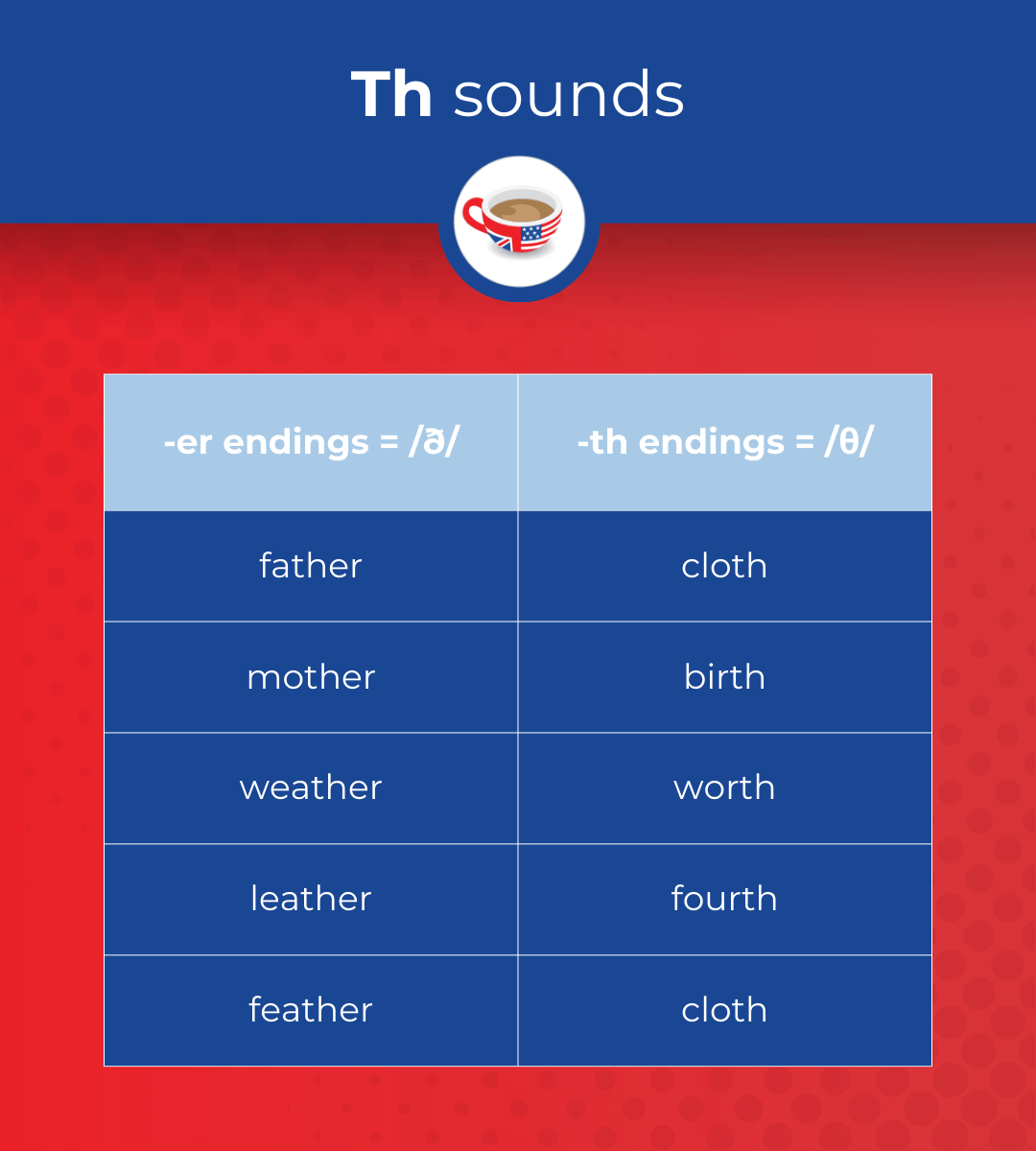
Generally, when th is at the end of the word, we say /θ/ (unvoiced).
When th is in the middle of the word we normally say /ð/ (voiced). But there are many exceptions to this rule so be careful! The best thing to do is learn the patterns where these rules do apply.
Let’s have a look at some examples:

Let’s review
So the fundamental difference between f and th in English is that /f/ needs the top lip on the bottom teeth, and /θ/ needs the tongue between the teeth, and /ð/ is the same but has a vibrating quality. As always, the best way to perfect these rules is to practise using the words and learning when to follow each rule. Now try saying the words in the visual below out loud! 🗣️

It’s your turn!
Try saying these tongue twisters out loud to practise pronouncing these sounds correctly! Try this in front of a mirror and check you can see your tongue when making those th sounds. If you want, you can listen to Nick and Francesca saying them in the video, and repeat them after them.
👅🌪️
There are Thirty-three thick silk threads.
👅🌪️🌪️
Three thousand thick feathers float down the river.
👅🌪️🌪️🌪️
I thought a thought, but the thought I thought wasn’t the thought that I’d thought that I’d thought.
If you found this post interesting, make sure you listen to the full podcast episode with Nick and Francesca on The Coffee Break English Show. In this series, we talk about useful topics for English learners, so make sure to subscribe to our podcast feed and our channel on YouTube.
Plus, don’t miss your free worksheet – perfect for extra practice after the lesson! When you sign up, you’ll also receive our short coffee break-sized email lessons, delivered straight to your inbox every week, to help you build your English skills. 💪 You’ll even hear from Mark, the founder of Coffee Break Languages, who shares regular tips and motivation for learners of all levels. Sign up below! 👇
Try to practise the th sounds often at home! The more you practice, the more confident you will become. We recommend you make a list of the words with these sounds that you find difficult and practise saying them until you feel more confident making th sounds.
Remember that it’s ok not to sound exactly like a native speaker! The important thing is that you feel confident and comfortable when speaking and people can understand you.
Happy Coffee Breaking!