
Join Francesca and Mark for this Chapter of Scenes from the Coffee Break Italian Café! In this episode, a familiar face comes to the bar with an unusually cheerful spirit! He shares his new idea: renting out his city apartment as a charming summer B&B. It sounds like a great deal could be worked out with the bar.
Day: May 20, 2025
Future Tenses in English: Making Future Plans

Do you know the different ways to talk about future plans in English? Talking about your plans can be a little confusing as we don’t always use future tenses in English like we do in the present and past. Instead, we have different phrases we use to express specific ideas.
In this episode, Nick and Anabel look at will, be going to and the present continuous to see how we can express different ideas about our future plans in English.
The Coffee Break English Show is a podcast series of informal conversations to help you understand some difficult topics in English. In the latest episode, we discuss different ways to use future tenses in English to express future plans.
Continue reading to find out more and why not listen to the podcast as you go?
Let’s get started with will!
Future Tense Verbs – Will
Let’s look at will first. One of the most common meanings of will is to express spontaneous decisions. We can consider a spontaneous decision as the birth of our plan, it has just been decided and is still new. To create this form, we use will, plus the bare infinitive (without to).
If we are hungry, we might say “I’ll go and buy a sandwich”. If it is cold we might say “I will put on a jumper”. It is something I decide to do in the moment.
Examples in positive, negatives and question form:
✅ I will buy a new phone.
❌ I won’t buy a new phone.
❓ Will you buy a new phone?
Remember the contraction of will involves the subject and the last two letters of the verb will, with an apostrophe (‘ll). You may even hear this contraction with a noun but this is almost always only when we speak.
I’ll
you’ll
he’ll
she’ll
it’ll
we’ll
they’ll
Nick’ll
Anabel’ll (ok, this one is very difficult to pronounce!)
Future Tense Verbs – Be going to
We use be going to to describe the next stage of our plan. This is a decision which we have made in the past and we are now thinking about. We are now planning the details and it is our personal intention. We use the bare infinitive after be going to.
If I am talking about the weekend, I can say “I’m going to see my friends.” This means that the plan is being organised but maybe some details are not finalised.
Examples in positive, negatives and question form:
✅ I am going to buy a new phone.
❌ I am not going to buy a new phone.
❓ Are you going to you buy a new phone?
Future Tense Verbs – Present Continuous
When we have finalised the important details and our plan is complete, we can use the present continuous. This shows that our plan is fixed and the details are confirmed. We use present continuous for fixed plans.
Examples in positive, negatives and question form:
✅ I am buying a new phone.
❌ I am not buying a new phone.
❓ Are you buying a new phone?
Let’s review the future tenses in English
So let’s go over the different ways to use future tenses in English to express future plans.
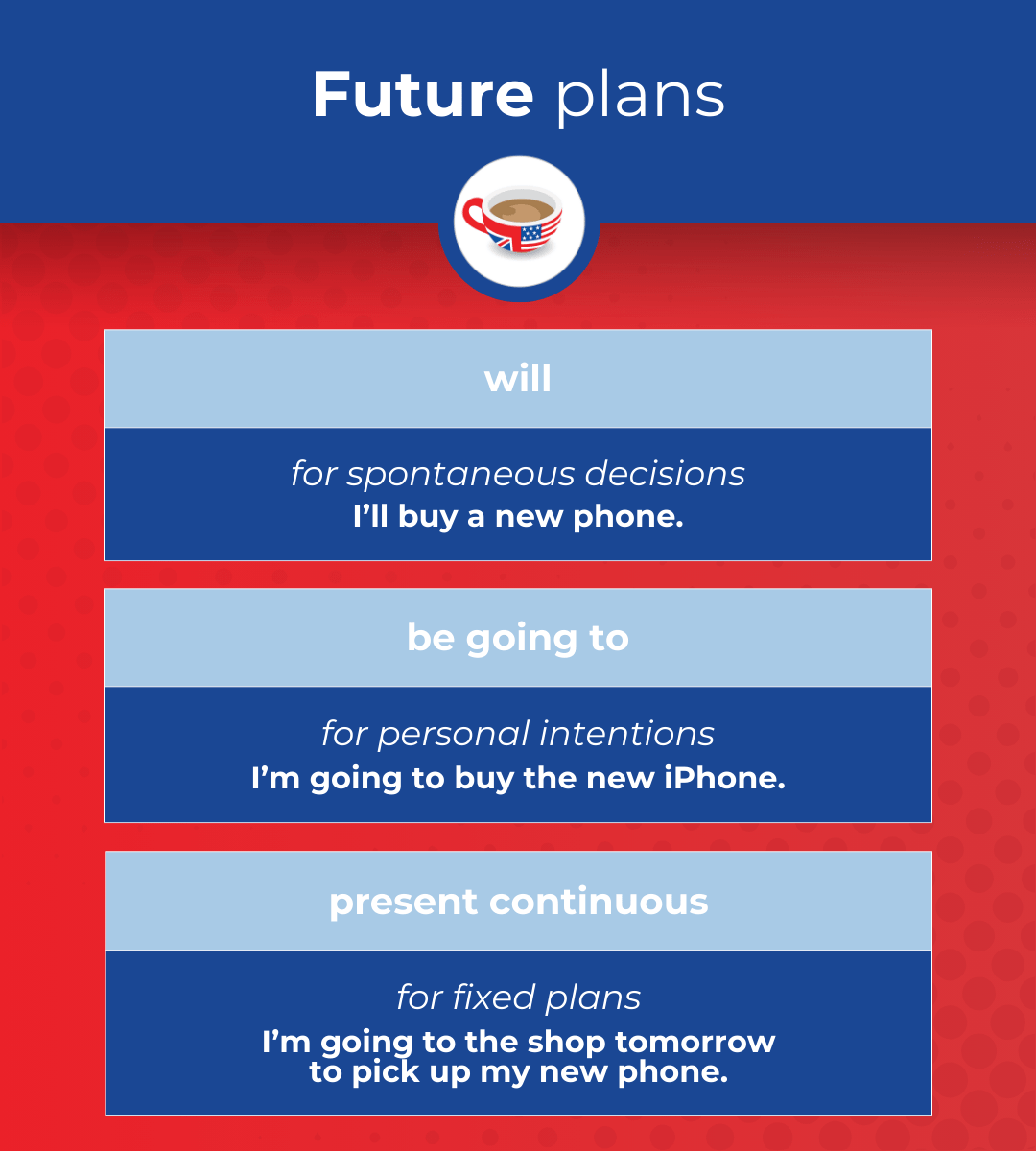
First, we start with will to express a new plan. We make a spontaneous decision.
Then we use be going to when we have already made the decision and we now have a personal intention.
And finally we used present continuous to show we have finalised the details and we have a fixed plan.
Remember! The present continuous and be going to are very similar and express slightly different ideas but can often be used in the same context with little difference in meaning. Don’t worry if sometimes you’re not sure which one to use, it probably means you can use both! If you feel you need more practice with future tenses in English, we take a look at other ways to use be going to and will in Episode 5 of Season 3.
It’s your turn!
Now, let’s practise using the future tenses in English to talk about future plans! Look at the prompts and think about which future form would be best to use. The answers are at the end of the blog post but don’t look until you’ve thought about your answers!
- It’s cold! (put on my jumper) …
- I am busy tonight. (meet my friends in town) …
- I’m on my summer holiday! Tomorrow (swim in the sea and sunbathe) …
If you found this post interesting, make sure you listen to the full podcast episode with Nick and Anabel on The Coffee Break English Show. We will release more episodes soon, about some more useful topics! Subscribe to our podcast feed and our channel on YouTube to learn when the next episode is available.
Plus, don’t miss your free worksheet – perfect for extra practice after the lesson! When you sign up, you’ll also receive our short coffee break-sized email lessons, delivered straight to your inbox every week, to help you build your English skills. 💪 You’ll even hear from Mark, the founder of Coffee Break Languages, who shares regular tips and motivation for learners of all levels. Sign up below! 👇
So, start trying to use different future tenses in English to be specific about your future plans when you can! Remember that when you learn new grammar, it will help you to express yourself as well as improving your understanding when listening to others. It’s all part of the language-learning journey. Are you going to try using these three future forms in your speech? Good luck!
Happy Coffee Breaking!
Here are some possible answers to the questions given above:
- It’s cold! I’ll put on my jumper.
- I am busy tonight. I’m meeting my friends in town.
- I’m on my summer holiday! Tomorrow I’m going to swim in the sea and sunbathe.