
In lesson 17 of Coffee Break Portuguese we’re taking what we learned in our previous lesson a stage further and continuing with the topic of shopping. This time, we’re at the market, and we’re applying some of the same language to a new context, as well as learning lots of new words for the food items you might find there and how to express quantities in Portuguese. We’ll also be joined by Catarina in today’s Cafezinho com Catarina, in which she tells us about a famous market in Lisbon.
Month: November 2023
How to say ‘can’ in Italian: potere, sapere, riuscire
Did you know that the English verb “can” can be translated into Italian in three different ways? Each of the three verbs brings its own twist to the concept of “can” – creating a painter’s palette of nuanced expressions!
The Coffee Break Italian Show is a podcast series of bite-sized, friendly conversations in which we demystify tricky Italian language topics. In the latest episode, Francesca and Mark guide us through this topic to understand these three verbs and discover how they transform the simple idea of “can”. They discuss the different uses of the three verbs and also their irregular conjugations.
Continue reading to find out more, and why not listen to the podcast as you go!
sapere
sapere – present tense:
so
sai
sa
sappiamo
sapete
sanno
This verb is used to talk about our abilities and skills that you have acquired. The idea is that there has been a learning process that has allowed you to know how to do something. Here are some examples to clarify this point:
Luca sa suonare il violino.
Luca can / knows how to play the violin.
So giocare a golf.
I can / know how to play golf.
I miei amici non sanno cucinare.
My friends can’t / don’t know how to cook.
potere
potere – present tense:
posso
puoi
può
possiamo
potete
possono
You should use this verb when you have the possibility of doing something or the permission to do something. As Francesca explains, the idea is that other people or some external factors affect your ability to do something. Let’s look at some examples:
Questa sera Anna può uscire perché non lavora.
Tonight, Anna can go out because she is not working.
Non posso mangiare i crostacei.
I can’t eat shellfish.
Notice the difference if we decide to use sapere for this last sentence:
Non so mangiare i crostacei.
I can’t eat shellfish (because I don’t know how to clean them, for example, rather than because of an allergy).
Potere is also a verb of politeness and it is used to make requests. For example:
Puoi prestarmi il motorino, per favore?
Can you lend me your moped, please?
riuscire
riuscire – present tense:
riesco
riesci
riesce
riusciamo
riuscite
riescono
Our last verb for today is riuscire, which conveys the idea of succeeding in doing something or managing to do something. It indicates that the person has made an effort to do something. For example, we would say:
riuscire a fare qualcosa
to manage to do something
As you can see there, when using this verb, it is important to remember that it is followed by a + an infinitive. Here are some examples:
Non riesco a trovare le chiavi.
I can’t find my keys (because I left them somewhere).
Luisa riesce sempre a sorprendermi.
Luisa always succeeds in surprising me.
Nuances of ‘sapere’, ‘potere’ & ‘riuscire’
We can see the nuances of these three verbs in Italian by changing the verb in this example:
Riesci ad aprire questa bottiglia?
Can you manage to open this bottle?
Puoi aprire questa bottiglia?
Can you / Are you allowed to open this bottle? (Maybe you’ve been saving it for some time for a specific occasion.)
Sai aprire questa bottiglia?
Can you / Do you know how to open this bottle? (Maybe it’s tricky to open because there is a specific way of opening it.)

A little test… Can you do it?
Here’s a final test to check if you have understood the difference between sapere, potere and riuscire! Can you identify the subtle difference in meaning between each sentence below? Think about what the context may be in each situation, then scroll down to the end of the article to find the answers.
- Non so guidare il camper.
- Non posso guidare il camper.
- Non riesco a guidare il camper.
Eccoci alla fine!
The next time you’re in Italy or engaging in an Italian conversation, remember these three useful verbs. They will not only enrich your language skills but also open doors to a better understanding of the nuances of the Italian language.
If you found this post interesting, make sure to listen to the full episode with Mark and Maurizio on The Coffee Break Italian Show. This is the series in which we look at a range of topics for Italian learners, so make sure to subscribe to our podcast feed or our channel on YouTube.
Plus! To get regular free Italian lessons in your inbox, you can sign up for our short (coffee-break-sized) email lessons that will help you improve your Italian. You will also hear from Mark, the founder of Coffee Break Languages, giving advice for language learners at any level. Sign up below!
Happy Coffee Breaking!
PS. Here are the answers to our test:
- Non so guidare il camper. I can’t / I don’t know how to drive the camper van. (I have never learned how to drive one.)
- Non posso guidare il camper. I can’t / I’m not allowed to drive the camper van. (I don’t have permission to do so, perhaps I don’t have the right licence or insurance policy to do so.)
- Non riesco a guidare il camper. I can’t / I’m not able to drive the camper van. (No matter how hard I try – perhaps it feels too big).
Listen to the podcast
Useful expressions with ‘avoir’
Which French expressions do you know that use the verb avoir? There are many to choose from! While avoir translates into English as “to have”, its use goes beyond possession and ownership, extending to sensations, emotions and age.
The Coffee Break French Show is a podcast series of bite-sized, friendly conversations in which we demystify tricky French language topics. In the latest episode, Mark and Max chat about the verb avoir and look at some common expressions in which avoir is used differently from “to have” in English.
French’s linguistic quirks make it fascinating and, at times, tricky for learners, so using avoir correctly is an important learning point.
Continue reading to find out more and why not listen to the podcast as you go?
Common expressions that use ‘avoir’
Let’s look at how avoir can be combined with various nouns to take on a variety of meanings that may not necessarily relate to possession or ownership.
Age
avoir _ ans
to be _ years old
In French, your age is something you “have”. For example:
J’ai 30 ans.
I am 30 years old.
To be hungry or thirsty
avoir faim
to be hungry
avoir soif
to be thirsty
When you’re hungry or thirsty, in French this is expressed as “having” the feeling of “hunger” or “thirst”. For example:
J’ai faim.
I am hungry.
J’ai soif.
I am thirsty.
To be hot or cold
avoir chaud
to be hot
avoir froid
to be cold
French speakers also use avoir to express temperature sensations. For example:
J’ai chaud.
I am hot.
J’ai froid.
I am cold.
To be right or wrong
avoir raison
to be right
avoir tort
to be wrong
In French, you don’t say that “you are right or wrong”. Instead, “you have reason or wrong”. Here’s an example:
Je pense qu’il a raison.
I think he is right.
To be scared
avoir peur de
to be afraid of, to be scared of
When it comes to fear, we also express this using avoir in French. Let’s look at an example:
J’ai peur des araignées.
I am afraid of spiders.
To be sleepy
avoir sommeil
to be sleepy
When you’re feeling sleepy, you don’t say that “you are sleepy” in French, rather, “you have sleepiness”.
J’ai sommeil ce soir.
I’m sleepy tonight.
To need something
avoir besoin de
to need
To express that you need something in French, we literally say that “you have need of” whatever it is. For example:
J’ai besoin de deux kilos de pommes.
I need two kilograms of apples.
To want or feel like something
avoir envie de
to want, to feel like
We can also express a desire or craving for something using an avoir expression in French. Note that avoir envie de can be followed either by a verb (in the infinitive form) or a noun. Here’s an example:
Tu as envie de manger une tarte aux pommes ?
Do you feel like eating an apple pie?

A little challenge
Let’s see if you can remember some of these expressions we’ve talked about. Here are three sentences for you to translate into French, using avoir expressions:
- My mother is always right.
- I needed five more minutes.
- It’s 3 am and I am not sleepy.
Once you have your answers, scroll down to the bottom of the page to see how you got on.
In conclusion
As we’ve seen, the use of avoir in French very often cannot be translated into English as “to have”. Combined with different nouns, its meaning can range from sensations, to emotions and even age.
While these nuances may initially leave learners a little perplexed, don’t worry, you’ll get used to them. Ultimately, they add depth and character to the language, so the next time you encounter avoir, enjoy the thought that this little word can be used for expressing such a wide range of human experiences!
If you found this post interesting, make sure to listen to the full episode with Mark and Max on The Coffee Break French Show. This is the series in which we look at a range of topics for French learners, so make sure to subscribe to our podcast feed and our channel on YouTube.
Plus! To get regular free French lessons in your inbox, you can sign up for our short (coffee-break-sized) email lessons that will help you improve your French. You will also hear from Mark, the founder of Coffee Break Languages, giving advice for language learners at any level. Sign up below!
Happy Coffee Breaking!
PS. Here are the answers to the challenge:
- My mother is always right. Ma mère a toujours raison.
- I needed five more minutes. J’avais besoin de cinq minutes de plus.
- It’s 3 am and I am not sleepy. Il est trois heures du matin et je n’ai pas sommeil.
Listen to the podcast
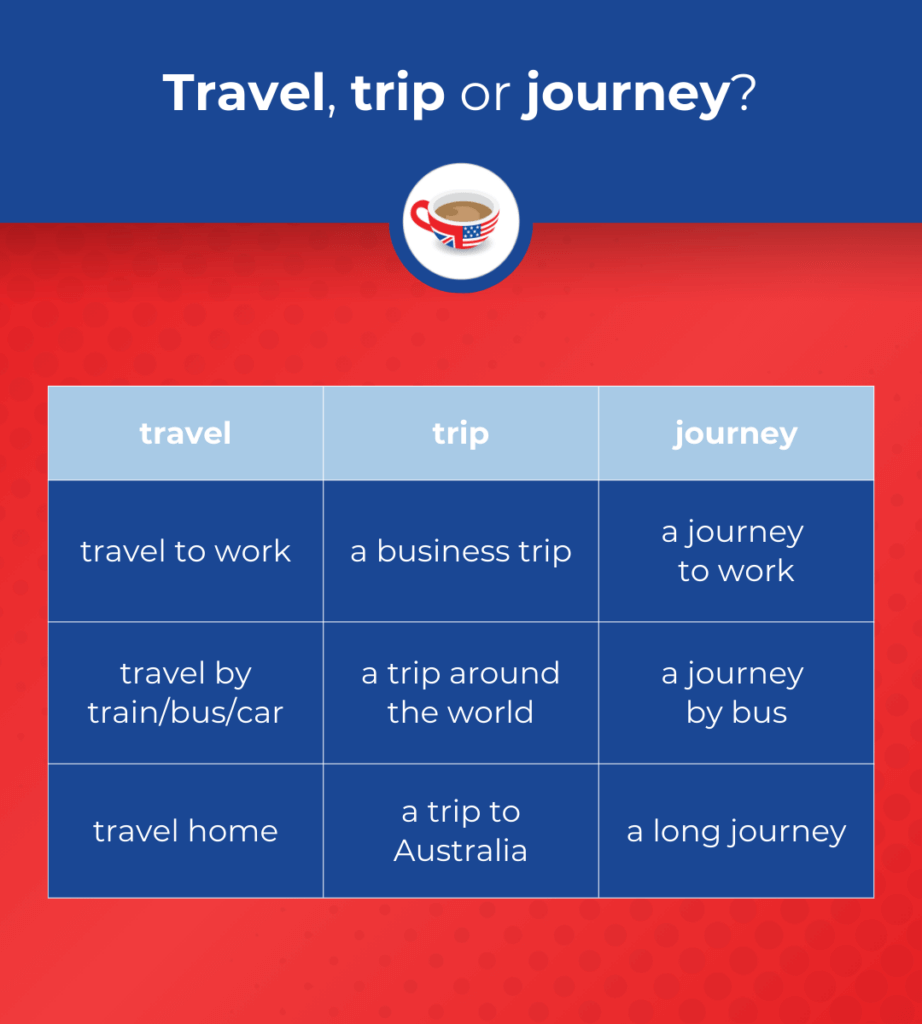
When do I use ‘travel’, ‘trip’ and ‘journey’?
Do you know the difference between the words travel, trip and journey? They all have similar meanings, so it’s easy to confuse them!
The Coffee Break English Show is a podcast series of bite-sized, friendly conversations to help you understand some difficult topics in English. In the latest episode, Mark and Josie talk about when to use travel, trip and journey correctly.
Continue reading to find out more and why not listen to the podcast as you go?
So, let’s get started and look at the words travel, trip and journey.
Travel
Travel is a verb. It describes the action of going to a place.
Here are some examples using travel:
They travelled to London by train.
I’m going to travel to Australia this summer.
Top tip: we can often replace travel with go.
Travel is usually a verb, but not always. The word travels describes the action of visiting different places, and we can replace it with adventures. We use travels in the expressions go on your travels and be off on your travels. For example:
Now that my daughter has finished high school, she’s off on her travels.
When are you going on your travels in Europe?
Journey
Journey is a noun. It describes the action of travelling from one place to another place. For example:
Mark’s journey to work takes 20 minutes.
I am exhausted after my long bus journey.
Have a safe journey home!
Trip
Like journey, trip is also a noun. It describes the process of travelling to a place, doing things in that place, and travelling back home again. We use trip in the expressions take a trip and go on a trip. For example:
She’s going on a business trip to Thailand.
We’re taking a trip to Greece this summer.
Let’s practise!
Now, let’s practise! Here are five sentences. Complete the spaces with travel, trip, or journey. The answers are at the end of this blog post, but don’t look until you’ve thought about the answers!
- I ___ to work by train.
- It was a really long car ___.
- I’d love to go on a ___ around the world.
- How long will the ___ to Rome take?
- My brother is on a work ___ this week.
Happy Coffee Breaking!
If you found this post interesting, make sure you listen to the full podcast episode with Mark and Josie on The Coffee Break English Show. We will release more episodes soon, about some more useful topics! Subscribe to our podcast feed and our channel on YouTube to learn when the next episode is available.
Plus! To get regular free English lessons in your inbox, you can sign up for our email lessons. We regularly send short (coffee-break-sized) email lessons that will help you improve your English. You will also hear from Mark, the founder of Coffee Break Languages, giving advice for language learners at any level. Sign up below!
So, keep practising when to use travel, trip, and journey! Remember that all English learners make mistakes, but people can usually still understand you. It’s all part of the language-learning journey.
Happy Coffee Breaking!
PS. Here are the answers to the questions:
- I travel to work by train.
- It was a really long car journey.
- I’d love to go on a trip around the world.
- How long will the journey to Rome take?
- My brother is on a work trip this week.
Listen to the podcast
How to use ‘me gusta’ in Spanish
Me gusta el español may be one of the first sentences we learn when we start studying Spanish. However, gustar can be a tricky verb to use!
In fact, “how do you say that you like something?” is one of the questions we get asked the most by our Coffee Break Spanish community. That’s why in the latest episode of The Coffee Break Spanish Show Mark and Concha are chatting about how the structure me gusta works and teaching us how to use it in different tenses and situations.
The Coffee Break Spanish Show is a podcast series of bite-sized, friendly conversations in which we demystify tricky Spanish language topics, and we hope that after listening to the episode and reading this article you’ll be confident using the verb gustar in many different situations.
Continue reading to find out more and why not listen to the podcast as you go?
Me gusta
Verbs like gustar (used to talk about liking things) or encantar (used to talk about loving things) are back-to-front verbs when we compare the structure to English. Let’s take an example:
Me gusta el café.
I like coffee.
Yes, this means “I like coffee”, but its literal meaning is “to me (me) it pleases (gusta) the coffee (el café)”. Or, in other words, “coffee pleases me” = me gusta el café.
Understanding this structure is key to using the verb properly, because the verb is conjugated according to what is pleasing to us or what we like.
That might sound a bit obscure, so here are three examples where we can see how it is used in different situations:
me gusta + singular noun
e.g. Me gusta la manzana.
I like the apple.
me gustan + plural noun
e.g. Me gustan las tazas.
I like the mugs.
me gusta + verb (infinitive)
e.g. Me gusta estudiar español.
I like studying Spanish.
As you can see in the second structure, when we have a plural noun (tazas – “mugs”), instead of using me gusta (gustar in the third person singular form) we use me gustan (in the third person plural form). Remember that in Spanish we are saying “something pleases me”. When that something is a plural noun (as is the case with tazas), we are therefore saying “they please” (gustan), rather then “it pleases” (gusta).

‘Gustar’ in different tenses
Now, let’s take this a stage further and try using gustar in different tenses. How would you say the following sentences in Spanish?
I have liked them a lot.
I liked them a lot.
You will like them.
You are going to like them.
Think about them for as long as you need to, then check the answers below:
I have liked them a lot.
Here, we are using the perfect tense:
Me han gustado mucho.
I liked them a lot.
Now, we are using the preterite tense.
Me gustaron mucho.
You will like them.
Using the future tense, this would be:
Te gustarán mucho.
You are going to like them.
Here, we use the structure ir a + infinitive, and here we have two possible options. In the first option, the pronoun (te) goes before the van a gustar structure. In the second option, the pronoun goes after and is attached to the infinitive. Both are correct and there’s no difference in meaning:
Te van a gustar mucho. / Van a gustarte mucho.

How to say “I like you”
We have seen how to use gustar in different tenses and structures, so now, can you guess how “I like you” is expressed in Spanish?
Since we are literally saying “you please me”, this would be me gustas (tú), where the verb is conjugated according to the subject, tú. Remember that the subject pronoun is optional, as usual in Spanish.
To ask somebody “do you like me?”, you would say ¿te gusto?, literally meaning “do I please you?”
Note that using gustar in this way suggests liking someone in a romantic way.
“I like you” – with friends
If you want to say you like someone, but not in a romantic way, we use caer bien in Spanish. ¡Ojo! Caer is an irregular verb in some tenses. Let’s look at some examples:
La novia de mi hermano me cae bien.
I like my brother’s girlfriend
(literally, “my brother’s girlfriend falls well to me”).
Los vecinos no me cayeron bien.
I didn’t like the neighbours.

Translation challenge
Let’s put what we’ve learned to the test. How would you say the following sentence in Spanish? Try translating it using gustar first, then using caer bien, and think about how the meaning changes with each verb. You can find the answers at the end of this article. Here’s your translation challenge:
At the beginning I didn’t like you, but now I like you very much.
Conclusion and answers
If you found this post interesting, make sure to listen to the full episode with Mark and Concha on The Coffee Break Spanish Show. This is the series in which we look at a range of topics for Spanish learners, so make sure to subscribe to our podcast feed and our channel on YouTube.
Plus! To get regular free Spanish lessons in your inbox, you can sign up for our short (coffee-break-sized) email lessons that will help you improve your Spanish. You will also hear from Mark, the founder of Coffee Break Languages, giving advice for language learners at any level. Sign up below!
Happy Coffee Breaking!
PS. Here are the translations of the sentence:
Using caer bien:
Al principio no me caíste bien, pero ahora me caes muy bien.
You would use this when talking to a friend or an acquaintance.
Using gustar:
Al principio no me gustabas, pero ahora me gustas mucho.
You would use this when talking to somebody you are romantically interested in.
Listen to the podcast
Everything you need to know about the German umlaut
As you may already know, the umlaut in German is the two small dots that can be used above the letters a, o and u. But when and why do we use an umlaut? And how does the umlaut change the sound of the letter?
The Coffee Break German Show is a podcast series of bite-sized, friendly conversations in which we demystify tricky German language topics. In the latest episode, Mark and Thomas look at exactly how to pronounce letters with an umlaut and they chat about its different uses.
Continue reading to find out more and why not listen to the podcast as you go?
How did umlauts evolve?
It is said the umlaut came about through laziness! Thomas describes them as “vowel harmonies”. Basically, words that had an a, o or u alongside the letter i were difficult to pronounce and over time these letter combinations became ä, ö and ü.
One example of such an evolution in spelling is in the word for “goose”, Gansi > Gänse.
Pronunciation
There are three letters that can be written with the umlaut in German. Let’s tackle them one by one.
‘a’ with an umlaut: ä
Let’s take a look at the ä sound. It is pronounced like the e sound in the English word “egg”. Though beware – different accents in English pronounce such words differently! Here are some examples of the umlaut in action:
Äpfel
apples
Hände
hands
ähnlich
similar
Käfer
bug, beetle
Of course, there are often exceptions to a rule. The ä sound in the following words has a slightly different pronunciation. To perfect these words, listen carefully to Thomas in the episode and really focus on the pronunciation.
Käse
cheese
Mädchen
girl
Allgäu
an area in Germany
Mäuse
mice
A little note about that last example: it is quite common in German to have a word of only one syllable in the singular, for example Maus (“mouse”), which adds an umlaut in the plural, as well as the -e at the end, in this case becoming Mäuse (“mice”).
‘o’ with an umlaut: ö
Now, let’s look at the sound created by ö. It can be pronounced as a short sound. You can hear these examples in the episode:
öffnen
to open
können
to be able to
In some words, the ö sound is longer. This can be heard in:
Öl
oil
schön
beautiful
‘u’ with an umlaut: ü
Next, we’ll look at ü, which you can pronounce by making an “ee” sound in English, but then pursing your lips. Thomas gives a great demonstration of this in the episode. Here are some examples of words containing ü:
fünf
five
Müll
rubbish
Tür
door
üben
to practise
übertrieben
over the top
Note that in the first two examples above the ü has a short sound, but in the last three it has a longer sound.
By the way, the last word is one that Thomas used at the start of the episode to describe how excited he was about this topic!
What else do we need to know about umlauts?
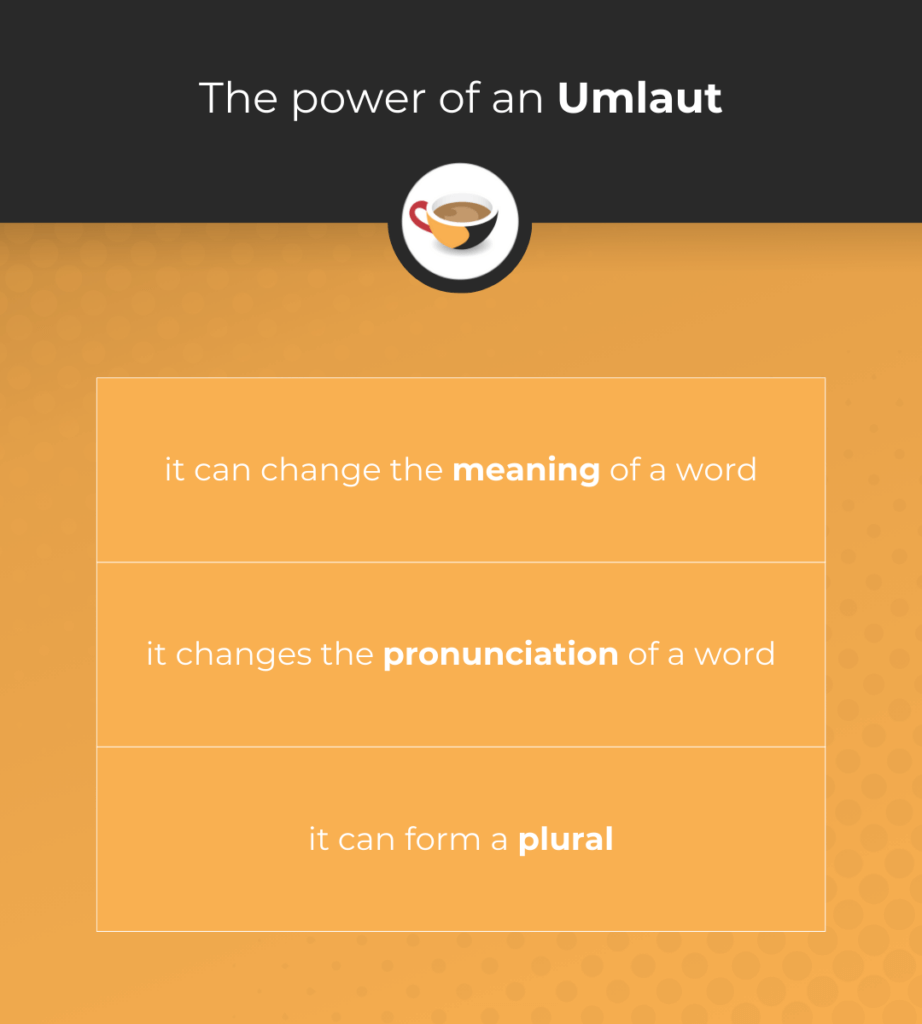
It is essential to take note that where an umlaut is found can make a difference not only to the sound of a word, but its meaning, too.
One example is that the word schon means “already”, but schön means “beautiful”. It is only the addition of the umlaut that distinguishes the two words from one another, yet it changes the meaning significantly.
Adding an umlaut can create a plural noun
As we’ve seen, adding an umlaut is often how the plural of a noun is formed, particularly for single-syllable nouns. Here are some more examples:
Maus > Mäuse
mouse > mice
Haus > Häuser
house > houses
Hand > Hände
hand > hands
Zug > Züge
train > trains
Adding an umlaut to form the comparative
When changing an adjective into the comparative form, an umlaut is often added to create that form. For example:
groß > größer
big > bigger
arm > ärmer
poor > poorer
It is often the case that one-syllable adjectives form the comparative by adding an umlaut (similar to one-syllable nouns). Obviously, the comparative adds the –er ending as well as adding the umlaut.
Umlauts in conjugated verbs
Often, when a verb is conjugated in the present tense, an umlaut is added. Thomas mentions the verb that was the focus of a previous episode in this series, fahren. Previously, we looked at when to use fahren and when to use gehen to translate “to go”, but now let’s see how different parts of the verb are spelled differently, involving an umlaut:
ich fahre
du fährst
er/sie/es fährt
wir fahren
ihr fahrt
Sie/sie fahren
A visual summary
We hope that you now know how and when to use an umlaut in German. If you’re unsure of how to type letters with umlauts on your keyboard, scroll down to take a look at our tips.
If you found this post interesting, make sure to listen to the full episode with Mark and Thomas on The Coffee Break German Show. This is the series in which we look at a range of topics for German learners, so make sure to subscribe to our podcast feed or our channel on YouTube.
Plus! To get regular free German lessons in your inbox, you can sign up for our short (coffee-break-sized) email lessons that will help you improve your German. You will also hear from Mark, the founder of Coffee Break Languages, giving advice for language learners at any level. Sign up below!
Remember to bookmark this article so that you can refer back to it for help with the pronunciation and uses of the umlaut. We’ll be back soon with another interesting German language topic.
Happy Coffee Breaking!
How to type an umlaut on your keyboard
Finally, here is our guide on how to type an umlaut when you are writing on a keyboard or phone.
This, of course, depends on which operating system you use. As Thomas says, if you have a German keyboard, it’s easy as there is an umlaut key on the keyboard.
If you are using a Mac:
- Hold down the option/alt key + u, which gives the umlaut.
- Then release the keys and type the letter over which you want the umlaut (a, o or u).
If you are using a PC, it’s a little more complicated. Different systems have their own shortcuts, but there is one fail-safe option:
- Hold down the Windows key + r to open the Run dialog box, then type in “charmap” and press enter. The character map box should appear.
- Double click on the character you want to copy so that it appears in the text box.
- Click on “copy” to copy the character, then you can paste it anywhere with the ctrl + v shortcut.
With most smartphones, hold down the letter to which you want to add the umlaut and options will appear. Scroll or swipe along to select the one you want to use.
If you are unable to use any of these options, you can write the letter e after the a, o or u. This option will give the same sound as using an umlaut so it will be understood by readers.