Coffee Break Language Podcasts Now Downloaded Over 3 Million Times Monthly

For Immediate Release
Glasgow, UK – 2 July 2019

Three Million Free Language Lessons Delivered Monthly by Glasgow-based Podcast Company

Radio Lingua Ltd announced today that the total number of monthly downloads of the Coffee Break French, Spanish, Italian, German and Chinese podcasts has now surpassed three million. Language learners around the world are improving their language skills through these 20-minute, “coffee break”-length podcasts. In each episode, listeners learn the language in a fun and entertaining way, with the help of the experienced teachers and native speakers who host the podcasts.

Hosted by Acast, the hugely popular Coffee Break podcasts have been downloaded over 250 million times since launching in 2006. They are listened to in 196 countries, with 41% of listeners in the United States and 12% in the UK. The total number of downloads over the 30-day period 28 May 2019 until 26 June 2019 was 3,056,588. Every minute of the past 30 days, over 70 learners have started learning a language with an episode of Coffee Break.

The Coffee Break language podcasts have consistently been rated top education podcasts on Apple Podcasts and are among the most popular education podcasts on Spotify. Coffee Break Spanish has won a European Award for Languages and the European Podcast Award, and Coffee Break Italian was voted Smartest Podcast in the 2017 British Podcast Awards.

The team at Radio Lingua believe that language-learning can be done by anyone, any time and anywhere. Founder and CEO of Radio Lingua, Mark Pentleton, said: “it’s no longer a case of having to go out to a conversation class on a cold Tuesday evening in November: you can learn a language where and when it suits you.” Each episode of the podcast aims to feel like a coffee break with a friend, where the friend happens to speak the language and can help you learn.

According to Mark, “podcasting is the perfect medium for language-learning: you can listen as many times as you want, and pause the recording to build your comprehension. By using podcasts as a starting point, you can take advantage of your downtime and do something useful while you’re driving to work, walking the dog or at the gym.” In addition to the podcasts, Radio Lingua also offers a range of online courses and regularly publishes learning materials on social media. A weekly live video show on YouTube, the Coffee Break Catch-up, helps to keep the Coffee Break community up to date with the latest lessons and episodes.

Sophie Herdman, UK content director for Acast, said: “Having the Coffee Break podcasts as part of the Acast family is something we’re really proud of. As anyone who has heard the shows knows, they educate and inform in a really fun way, as well as helping listeners to develop an understanding of other cultures. We’ve been so pleased to see the shows’ fantastic growth over the last few years and we look forward to seeing them continue to inspire language learners around the world.”

Coffee Break Spanish was a ground-breaking podcast, the first of its kind on iTunes when it launched in October 2006. Since then, the team has gone on to produce podcasts in French, German, Italian and Mandarin Chinese. In total, over 600 episodes have been released across the languages. Further languages are planned for future release.

Coffee Break podcasts are available via Apple Podcasts, Spotify, Acast or any other podcast app. New episodes are uploaded regularly and lesson notes and additional materials are available at radiolingua.com.

About Radio Lingua

Radio Lingua Ltd (https://coffeebreaklanguages.com) has been delivering languages education since 2006. Based in Glasgow, Scotland, Radio Lingua produces Coffee Break courses in French, Spanish, German, Italian and Mandarin Chinese, and other short courses in over 30 languages. Working in conjunction with experienced teachers and native speakers, the small core team of 10 employees are dedicated to helping language learners around the world develop a passion for language learning.


Download the full Press Release:
190701-PressRelease-RadioLingua-3MillionMonthly

Coming soon: the Coffee Break German Magazine

Coming in August 2019, the Coffee Break German Magazine will help you build your understanding of intermediate German. In each episode of the Coffee Break German Magazine you’ll pick up new vocabulary, hear further examples of grammar points you already know, and learn new grammar through the discussions in each episode with teacher Andrea and learner Mark. Listen to the preview episode below.

We also need your help! In each episode of the Magazine we’ll be including a question from a listener. To send us your question, click here and record a voice message. We’d love to include a question in every episode of the Magazine, so please send us your questions about the German language! The video below will help to explain how to send us your question.

The Coffee Break German Magazine will launch in August, and in order to receive the first episode as soon as it’s available, just make sure you stay subscribed to Coffee Break German on your favourite podcast app. Don’t forget to follow Coffee Break German on Facebook where we post language activities, cultural points and review materials to help you practise your French. Remember – a few minutes a day can help you build your confidence in the language. Access the Coffee Break German Facebook page here.

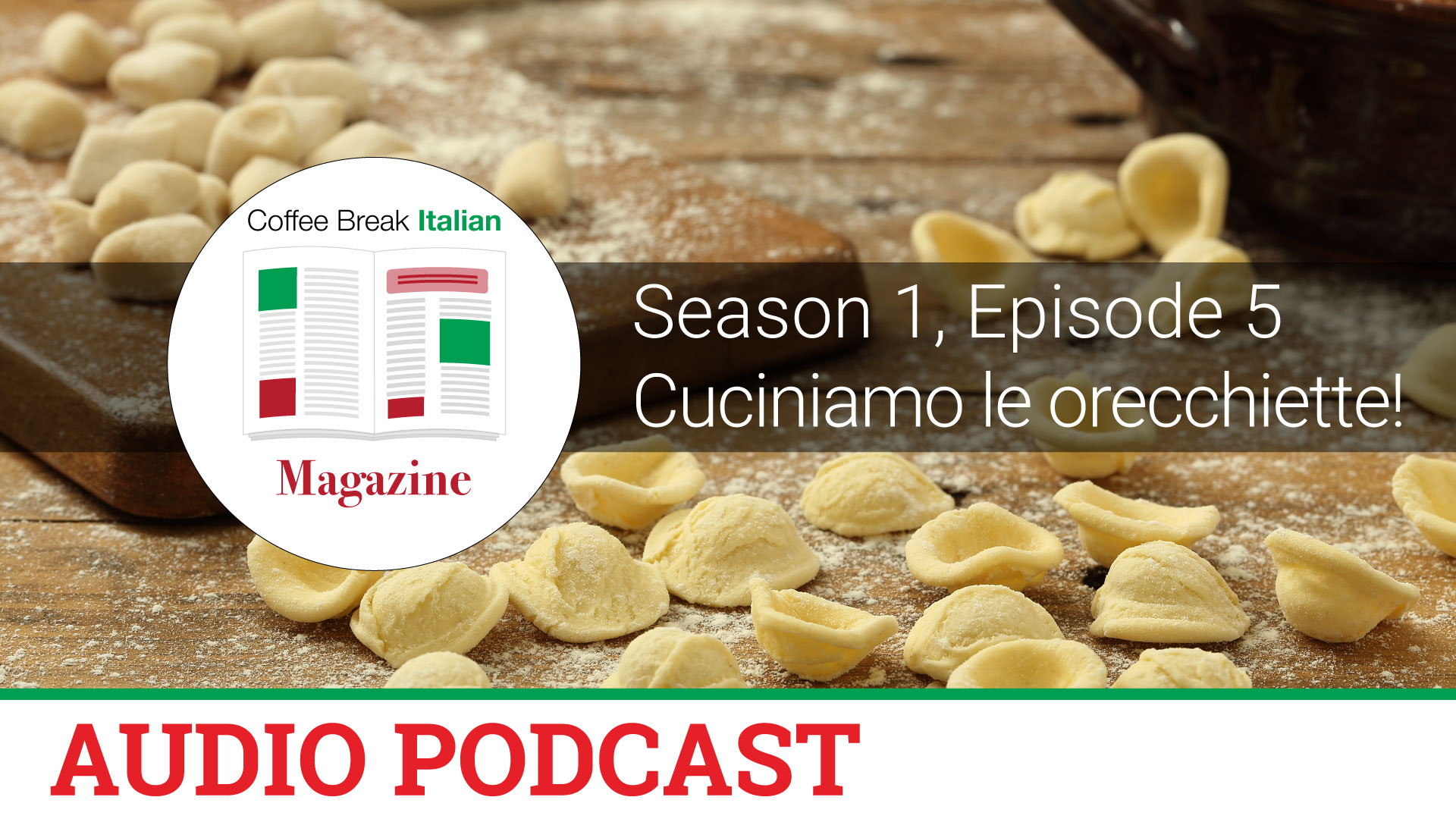
CBI Mag 1.05 | Cuciniamo le Orecchiette

We’re heading to the kitchen for this episode and learning about the popular pasta dish, le orecchiette. Mark and Francesca also discuss their recent trip to Milan and Stresa to film some content for the forthcoming Coffee Break Italian To Go video series. There’s also an explanation of how to translate “some” into Italian, based on a listener’s question. After this episode we’re taking a break and we’ll be back with the next episode of the Coffee Break Italian Magazine in August.

Was machst du beruflich? Talking about your job in German – Coffee Break German To Go Episode 7

To ask “what do you do for a living?” in German you can say was machst du beruflich?, or in a more formal situation, was machen Sie beruflich? In this episode of Coffee Break German To Go, Julia asks this questions to interviewees in the streets of Berlin. You can use the answers of our interviewees to help you learn to answer this question yourself.

In the first part of the video, watch the interviews without subtitles and try to understand. In the second part of the video, we’ve provided subtitles in German at the top of the screen. You can choose to turn on subtitles in English using the Subtitles/CC button.

In our first series, Julia is in the city of Berlin, and in each episode she’ll ask passers-by one question. Of course, that one question will result in many answers, and it’s through these answers that you can practise your German and build your vocabulary.

If you’d prefer not to wait for all 10 lessons of Season 1 to be published, you can access downloadable versions of the videos along with audio versions and lesson notes / transcripts in the Coffee Break Academy.

Coffee Break German To Go is based on the popular podcast series and online course Coffee Break German. For access to the free podcasts, click here.

The Coffee Break Catch-up: 27 June 2019

Join Coffee Break Founder and CEO Mark for this week’s Coffee Break Catch-up, our weekly show in which we update you on our latest podcast episodes, blog articles and videos. There are discussions on language learning, and a round-up of some of the cultural events happening around the world.

In this edition:

  • updates on the latest episodes of Coffee Break French, Italian and Spanish, the launch of our One Minute Turkish course on YouTube, and the latest Coffee Break To Go and Walk, Talk and Learn videos;
  • our plans for the summer break and the content you can look forward to over the next few weeks;
  • this week’s Talking Point focuses on how to keep your language practice going after your class ends, or while you’re on vacation;
  • cultural news from around the world.

If you’d like to access all the links for this episode and practise your reading skills in the language you’re learning, click here to sign up for our weekly language and culture newsletter.

Using “ne … plus que” in French – Walk, Talk and Learn French Episode 004

You may be familiar with ne … plus meaning “no longer”, and ne … que meaning “only”, but what about ne … plus que? Do you know what this means? It’s a really useful phrase and in this episode of Walk, Talk and Learn, you’l learn to use it in a variety of situations.

Make sure you subscribe to Coffee Break Languages on YouTube to be notified when we post new videos!

The Coffee Break Catch-up: 20 June 2019

Join Coffee Break Founder and CEO Mark for this week’s Coffee Break Catch-up, our weekly show in which we update you on our latest podcast episodes, blog articles and videos. There are discussions on language learning, and a round-up of some of the cultural events happening around the world.

In this edition:

  • updates on the latest episodes of Coffee Break French, Italian and Spanish, the launch of our One Minute Polish course on YouTube, and the latest Coffee Break To Go video episodes;
  • our new project, Tune for Tuesday;
  • this week’s Talking Point focuses on using music in language learning;
  • cultural news from around the world.

If you’d like to access all the links for this episode and practise your reading skills in the language you’re learning, click here to sign up for our weekly language and culture newsletter.

CBI Mag 1.04 | Leggiamo un po’

In this episode Francesca and Mark discuss one of Italy’s most famous authors, Italo Calvino. Calvino’s work can be read on many levels, and as a result of the type of language used, his books are very accessible for learners of Italian. In our Q&A segment, Francesca explains the difference between stare and essere.

¿Qué te gusta hacer en tu tiempo libre? – Talking about free time in Spanish – Coffee Break Spanish To Go Episode 1.09

What do you like doing in your free time? In this episode of Coffee Break Spanish To Go, Marina asks the question, ¿Qué haces en tu tiempo libre? (informal) or ¿Qué hace usted en su tiempo libre? (formal). You can use the answers of our interviewees to help you learn how to talk about what you do in your free time in Spanish.

In the first part of the video, watch the interviews without subtitles and try to understand. In the second part of the video, we’ve provided subtitles in Spanish at the top of the screen. You can choose to turn on subtitles in English using the Subtitles/CC button.

In this first series of Coffee Break Spanish To Go, Marina is in the city of Málaga, in the south of Spain, and in each episode she’ll ask passers-by one question. Of course, that one question will result in many answers, and it’s through these answers that you can practise your Spanish and build your vocabulary.

Coffee Break Spanish To Go will be published every two weeks here on YouTube, and each Season will be filmed in a different part of the Spanish-speaking world.

If you’d prefer not to wait for all 10 lessons of Season 1 to be published, you can access downloadable versions of the videos along with audio versions and lesson notes / transcripts in the Coffee Break Academy.

Coffee Break Spanish To Go is based on the popular podcast series and online course Coffee Break Spanish. For access to the free podcasts, please click here.

The Coffee Break Catch-up: 13 June 2019

Join Coffee Break Founder and CEO Mark for this week’s edition of the Coffee Break Catch-up, our weekly show in which we’ll update you on all things Coffee Break Languages. There are discussions on language learning, and a roundup of some of the cultural events happening around the world.

In this edition:

  • updates on our latest episodes of the En Marcha con Coffee Break Spanish, our Coffee Break French Magazine, and the launch of One Minute Greek on our YouTube channel;
  • a sneak preview of our new project, Tune for Tuesday starting next week;
  • this week’s Talking Point focuses on language learning in schools vs learning a language in later life;
  • cultural news from around the world

If you’d like to access all the links for this episode and practise your reading skills, click here.

CBF Mag 1.03 | La Belle et la Bête

In this episode of the Coffee Break French Magazine we’re taking a trip to the movies to see one of the all time classics of French cinema, Jean Cocteau’s La Belle et la Bête. You’ll learn more about the film and about the work of Cocteau, and there’s an interesting listener’s question about how to translate “to look like” and “to feel like” into French. This series is aimed at learners who have completed at least Seasons 1 and 2 of Coffee Break French.

In each episode of this 10-lesson season for intermediate learners, you can build your vocabulary, increase your understanding of grammar and learn to use the French language in a more natural way. This series is aimed at learners who have completed at least Season 1 and Season 2 of Coffee Break French.

Wann hast du Geburtstag? Talking about your birthday in German – Coffee Break German To Go

To ask “when is your birthday?” in German you can say wann hast du Geburtstag?, or in a more formal situation, wann haben Sie Geburtstag? In this episode of Coffee Break German To Go, Julia asks this questions to interviewees in the streets of Berlin. You can use the answers of our interviewees to help you learn to answer this question yourself.

In the first part of the video, watch the interviews without subtitles and try to understand. In the second part of the video, we’ve provided subtitles in German at the top of the screen. You can choose to turn on subtitles in English using the Subtitles/CC button.

In our first series, Julia is in the city of Berlin, and in each episode she’ll ask passers-by one question. Of course, that one question will result in many answers, and it’s through these answers that you can practise your German and build your vocabulary.

If you’d prefer not to wait for all 10 lessons of Season 1 to be published, you can access downloadable versions of the videos along with audio versions and lesson notes / transcripts in the Coffee Break Academy:
https://coffeebreakacademy.com/p/coffee-break-german-to-go-season1/

Coffee Break German To Go is based on the popular podcast series and online course Coffee Break German. For access to the free podcasts, please click below:
https://coffeebreaklanguages.com/tag/cbg-season-1/?order=asc

To purchase our full online courses on the Coffee Break Academy, click below:
https://coffeebreakacademy.com/courses/category/German

The Coffee Break Catch-up: 6 June 2019

Join Coffee Break Founder and CEO Mark for this week’s edition of the Coffee Break Catch-up, our weekly show in which we’ll update you on all things Coffee Break Languages. There are discussions on language learning, and a roundup of some of the cultural events happening around the world.

In this edition:

  • Updates on our latest episodes of the Coffee Break Italian Magazine, En Marcha con Coffee Break Spanish and the launch of One Minute Swedish on our YouTube channel;
  • a welcome to our new social media assistants who started this week;
  • a discussion about the origin of some words associated with tennis and how they are related to the French language;
  • cultural news from around the world

If you’d like to access all the links for this episode and practise your reading skills, click here.

¿A qué te dedicas? – Talking about your work and studies – Coffee Break Spanish To Go Episode 1.08

In this episode Marina asks the interviewees about their work and studies using the question ¿a qué te dedicas? or ¿a qué se dedica usted?, literally meaning “what do you dedicate yourself to?”

In the first part of the video, watch the interviews without subtitles and try to understand. In the second part of the video, we’ve provided subtitles in Spanish at the top of the screen. You can choose to turn on subtitles in English using the Subtitles/CC button.

In this first series of Coffee Break Spanish To Go, Marina is in the city of Málaga, in the south of Spain, and in each episode she’ll ask passers-by one question. Of course, that one question will result in many answers, and it’s through these answers that you can practise your Spanish and build your vocabulary.

Coffee Break Spanish To Go will be published every two weeks here on YouTube, and each Season will be filmed in a different part of the Spanish-speaking world.

If you’d prefer not to wait for all 10 lessons of Season 1 to be published, you can access downloadable versions of the videos along with audio versions and lesson notes / transcripts in the Coffee Break Academy.

Coffee Break Spanish To Go is based on the popular podcast series and online course Coffee Break Spanish. For access to the free podcasts, please click here.

The Coffee Break Catch-up: 30 May 2019

We have a special edition of the Coffee Break Catch-up this week which was recorded live in Milan, Italy. Join Mark and Francesca who are filming some future Coffee Break Italian content. We’ll be telling you more about this in this edition, along with our usual collection of information about the latest Coffee Break episodes and cultural events around the world.

CBF Mag 1.02 | Saint Exupéry

In Episode 2 of Season 1 of the Coffee Break French Magazine, we discuss the French author and aviator Antoine de Saint-Exupéry, author of Le Petit Prince. In the Q&A section, Mark discusses the difference between the imperfect and perfect tenses in response to Keith’s question.

In each episode of this 10-lesson season for intermediate learners, you can build your vocabulary, increase your understanding of grammar and learn to use the French language in a more natural way. This series is aimed at learners who have completed at least Season 1 and Season 2 of Coffee Break French.

CBS EM 1.08 | Málaga: Transformación Cultural

What springs to mind when you think of the city of Málaga? Until recently, it may have been the great weather and the beaches. But nowadays, the city has shaken off the dated image of sol y playa, and is establishing itself as one of Spain’s main cultural hubs. In this episode, through a series of interviews with local professionals, we hear about what led to this cultural transformation, and the opening of new museums and galleries across the city.

Wie alt bist du? Talking about your age in German – Coffee Break German To Go Episode 1.04

To ask “where age are you?” in German you can say wie alt bist du?, or in a more formal situation, wie alt sind Sie? Literally this means “how old are you?” In this episode of Coffee Break German To Go, Julia asks this questions to interviewees in the streets of Berlin. You can use the answers of our interviewees to help you learn to answer this question yourself.

In the first part of the video, watch the interviews without subtitles and try to understand. In the second part of the video, we’ve provided subtitles in German at the top of the screen. You can choose to turn on subtitles in English using the Subtitles/CC button.

In our first series, Julia is in the city of Berlin, and in each episode she’ll ask passers-by one question. Of course, that one question will result in many answers, and it’s through these answers that you can practise your German and build your vocabulary.

If you’d prefer not to wait for all 10 lessons of Season 1 to be published, you can access downloadable versions of the videos along with audio versions and lesson notes / transcripts in the Coffee Break Academy:
https://coffeebreakacademy.com/p/coffee-break-german-to-go-season1/

Coffee Break German To Go is based on the popular podcast series and online course Coffee Break German. For access to the free podcasts, please click below:
https://coffeebreaklanguages.com/tag/cbg-season-1/?order=asc

To purchase our full online courses on the Coffee Break Academy, click below:
https://coffeebreakacademy.com/courses/category/German

CBI Mag 1.02 | Il Gargano – la Perla della Puglia

In this episode we’re heading south to the region of Puglia and, more specifically, to the area known as Il Gargano. Known for its crystalline waters and golden beaches, there is much to see and do in Il Gargano. Find out more in the episode. Francesca and Mark also have some advice on how to learn vocabulary, based on Tricia’s question. The episode concludes with a scioglilingua – a tongue twister – which will help you practise the ‘gl’ sound in Italian.