Let’s face it. Everybody loves the sound of the Italian language. That’s why we at Coffee Break Languages have decided to bring you 10 beautiful Italian words that sound great (and are really useful).
After all, there is a charming melodic aspect to it that is absolutely undeniable. How can we resist its postalveolar affricates, its dental fricatives and, most of all, its sensual “r’s”?
Keep reading to find some unique Italian words to add to your vocabulary!
1. Dai!
You may be familiar with this one if you’ve overheard Italians talking to each other. It has nothing to do with the verb dare – meaning “to give” – and it cannot be easily translated. Dai can be used to encourage someone to do or not to do something, much in the same way English speakers say “go on” or “come on”. It can also convey a sense of astonishment, meaning “are you serious?” or “really?”.
It’s definitely one of the unique Italian words, with several possible meanings, which can only be understood from the context. Did one of your Italian friends say Non ce la faccio to you? Just reply back with dai! Is someone doing something to annoy you? Tell them to stop with dai! Did you just hear the latest gossip and you cannot believe it? Express your surprise with dai!
2. Abbiocco
Have you ever eaten so much that you were unable to move and the only thing you wanted to do was take a nap? If so, then you know what l’abbiocco is. It is the drowsiness you feel after a hearty meal: a feeling with which Italians are rather familiar. There is also a verb to describe this feeling: abbioccarsi.
A translation in English might be “food coma”, but this is a much more dramatic term than abbiocco. This one deserves a place in the list of beautiful Italian words because of its sound.
The double “b” and double “c” convey perfectly the idea of being full and sleepy after a Sunday roast or a big bowl of pasta. Italians love this food-induced state and usually use it to relax and take a break from the everyday rush, enjoying the abbiocco as much as they can!
3. Mozzafiato

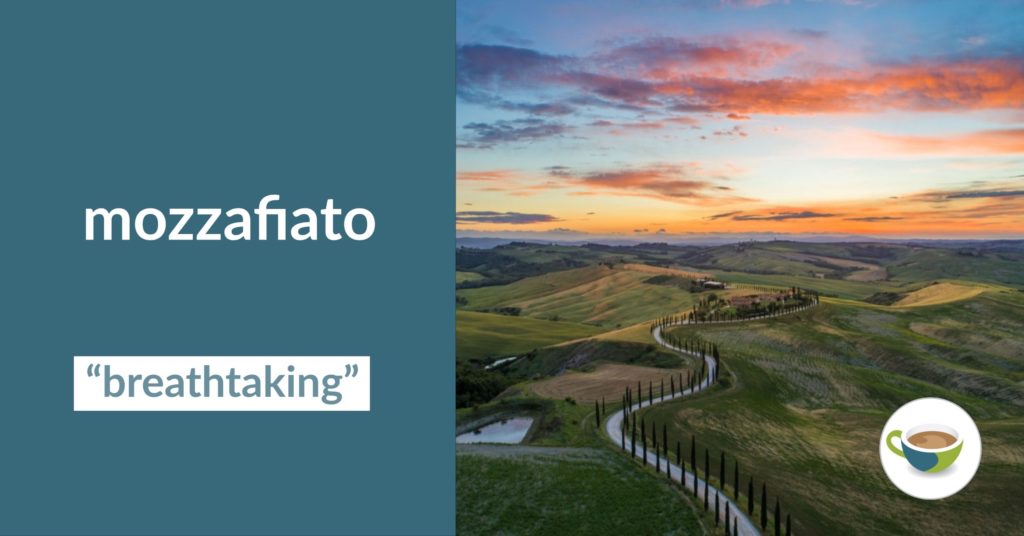
This word comes from mozzare, meaning ‘to cut off’, and fiato, meaning ‘breath’. A view, a piece of art, a show, a journey and even a person can be mozzafiato. It means that something is so strikingly beautiful that it makes us stop breathing, just as the word suggests.
It can be translated in English as “breathtaking” or “riveting”. However, the image of cutting off one’s air feels more sudden and extreme than the simple act of “taking”, and somehow, more appropriate for a country like Italy, where “breath-chopping” beauty can be seen everywhere..
That is why it definitely deserves a place amongst beautiful Italian words!
4. Invasato
If you are thinking that this word means being stuck in a vase, you’re not quite in the right area. L’invasato is someone who experiences strong feelings, such as uncontrollable emotions or passions – so strong that they take over their minds! This is one of the beautiful Italian words that comes from the Middle Ages, when people believed that demons invaded and possessed the bodies of certain individuals.
That’s why today, invasato means someone who is being taken over by fear, jealousy or anger, as well as by creativity, enthusiasm or passion.
5. Menefreghismo
When you hear an Italian say me ne frego, it means that they could not care less about something. From this expression, we get the term menefreghismo which stands for a thoughtless indifference towards what is happening outside of one’s personal space. It is the kind of attitude we usually have during our summer holidays when enjoying the sun and the heat is our most important priority.
If, on one hand, il menefreghismo could be a good quality, on the other, the term is not always considered to be positive. Sometimes it is used to address the callousness or the selfishness of an uninterested friend. So, be aware of the context if you are called a menefreghista!
6. Crepitio
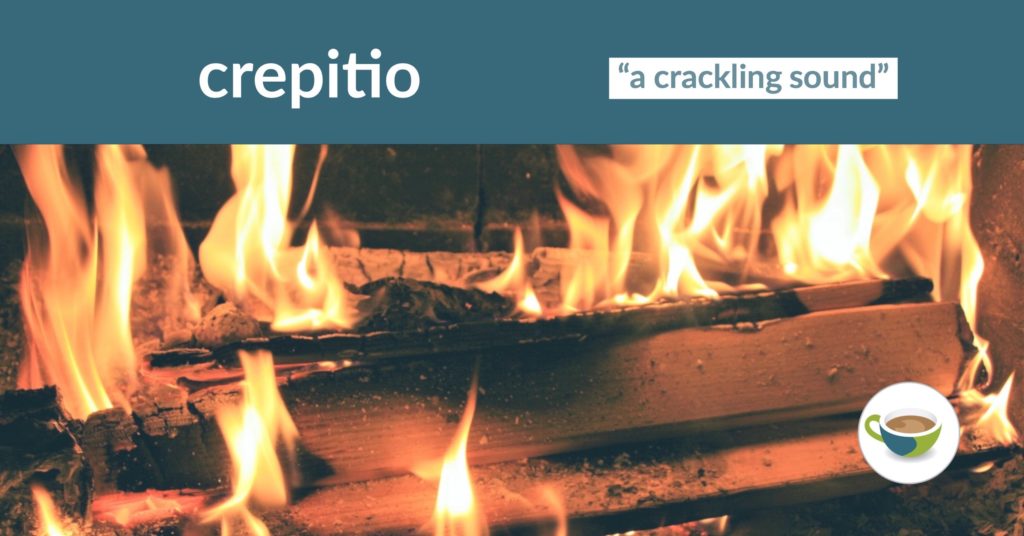
The rustling of leaves, the crackling of fire, the pattering of rain. There is one of beautiful Italian words that can describe these sounds: il crepitio. Try to pronounce this word and repeat it several times. Doesn’t it emulate the burning of logs in the fireplace or the tapping of raindrops on the window?
You can also use the verb crepitare to describe the making of these pleasing and relaxing sounds. It is a very evocative word that, despite its harsh “kr” phoneme, can bring back memories of outdoor naps, cosy nights-in and autumn afternoons.
7. Struggimento
How would you describe that feeling of yearning and torment that you experience when you argue with your significant other? Italians call it lo struggimento, a combination of gut-churning misery and desire, usually associated with one’s love life.
It is not necessarily a negative feeling; many poets – like Dante Alighieri, Petrarch and Giacomo Leopardi – found inspiration in their struggimento, another of beautiful Italian words.
Repeat this word in your head. Savour the harsh sound of its consonants. Now, can you understand what we are talking about here?
8. Boh!
In the list of interesting Italian words, this short expression deserves a spot. Well, you may not even notice it in a conversation, but it is a key expression of current Italian. Boh means “who knows?” or simply “I don’t know” and it is always accompanied by a dramatic shrug of the shoulders and a furrowed brow.
A non-native speaker should pay attention to the context, where boh! appears, though it’s quite easy to deduce its meaning since it usually appears in response to something.
Boh is an onomatopoeic expression that conveys doubt, indifference or unwillingness to talk about something. Similar expressions are bah and mah, both of which convey an idea of uncertainty.
Is that clear enough? Don’t answer boh! (or maybe do…)
9. Sfizio
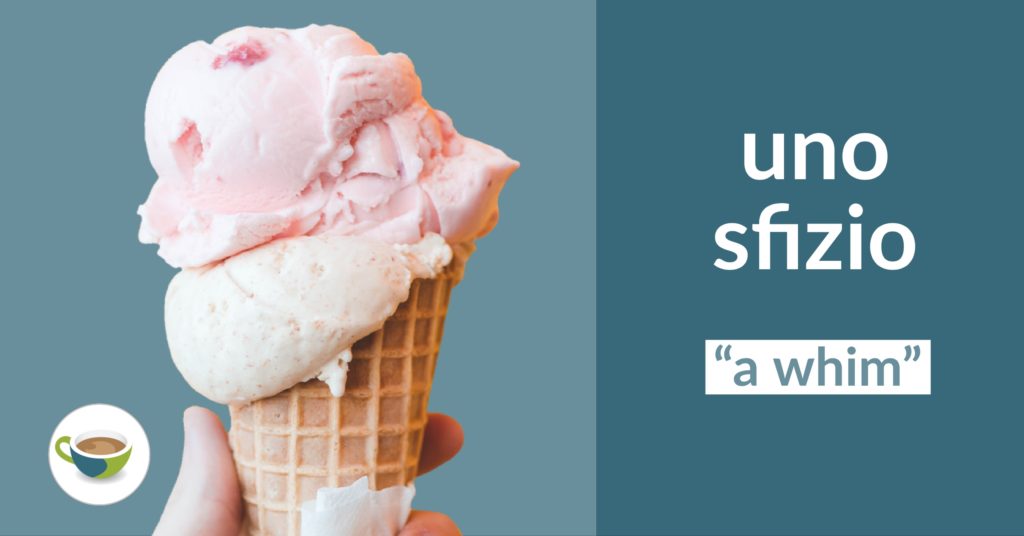
If you are a big shopper, you may know what we are talking about here. Do you know when you feel the urge to buy something you shouldn’t buy, but you buy it anyway? That’s what Italians call uno sfizio, meaning a whim or fancy.
Having gelato after dinner or bagging that pizza-shaped hat are actions that Italians would describe as togliersi lo sfizio, meaning “to satisfy one’s whim”. But, it’s not simply that! There is always a fun side to it, something between being ashamed and feeling right about it, enjoying it.
Sfizio: the tongue sizzles and fizzles. It sounds great and is definitely one of the most beautiful Italian words (especially if involves food)!
10. Procione
This may not be the most useful word, but it feels great on your tongue. It is a wonderful combination of the harsh “pr” sound and the sweet “tʃ” phoneme. Also, the fact that procione is the name of a cute animal made us include this word in our list.
We’re talking about a nocturnal animal, best known in North America, that is usually portrayed in movies and TV series as stealing food from a wheelie bin. Can you guess it? It’s a racoon. Although this mammal is not very common in Italy, its name sounds incredibly cute in Italian.
There is also another name for the racoon in Italian: l’orsetto lavatore (the washing little bear). We hope that you’ve enjoyed reading our article about beautiful Italian words.
Learning a language is a challenge, but it can be an enjoyable challenge. Try to find the words that please your ears and repeat them; they will help you improve your pronunciation. Languages are meant to be spoken, so remember to savour their sounds!
Why not see some of these beautiful Italian words in use? Check out our list of Italian movies for learners right now!