In this lesson we’ll be putting what we’ve previously learned about counting in Mandarin into practise by learning the days of the week, the months of the year, and how to tell the time. All of these topics are based around the numbers, so you’ll quickly learn this new vocabulary and how to put it to use.
CBI 2.11 | I pantaloni blu sono molto eleganti!
In this episode of Coffee Break Italian you’ll be learning about Italian adjectives and how they agree in gender and number with the noun they describe. You’ll learn about Four-Ending, Two-Ending and Invariable adjectives, and how to change the adjectives so that they “agree” with the noun. Join Mark as he goes clothes shopping in Milano (!) and build your vocabulary in the process.
CBC 1.14 | Wǒ yào yí gè shuāngrénjiān – Hotels in Mandarin
One of the great things about learning any language is the fact that you begin to see that many constructions can be reused in different contexts. With the help of some new vocabulary in this lesson for talking about hotel rooms, reservations and room keys, you’ll see that you can use the structures you’ve already learned in this new context. You’ll learn to say you have a reservation (or that you don’t have a reservation!) and to specify the type of room you would like. By the time you’ve completed this lesson you will be able to check into a hotel in China – in Chinese!
CBG 2.10 | Review episode
In this episode of Coffee Break German you’ll be amazed when you realise how far you’ve come, as you review everything you have learned so far in Season 2. Andrea and Mark talk about the topic from this unit such as cases and adjective agreements, adverbs, using denn and weil and making sure your perfect tense really is perfect! After listening to this lesson you will be an expert on all the language points covered so far.
Announcing En Route avec Coffee Break French
In this special edition of Coffee Break French, Mark announces the new series in which you can join the Coffee Break French team, “en route”. Listen to a sneak preview of some of the many interviews with native speakers and learn more about the forthcoming series. This episode is the first of two special announcements from Coffee Break French. Stay tuned for the next announcement, coming soon.
Use the audio player to listen to the lesson, or subscribe in iTunes to receive this lesson and all future lessons automatically. If you can’t see the player below, click here to access the lesson.
CBI 2.10 | Esci stasera? Vengo anch’io!

In this lesson you’ll learn to conjugate and use three very common -ire verbs which are irregular: venire (to come), uscire (to go out) and dire (to say/tell). Pay particular attention to the spelling changes which happen in these verbs!
CBC 1.13 | Wǒ nǚpéngyou yào yì bēi bái pútaojiǔ – Ordering drinks in Chinese
In this lesson you’ll put the language learned in previous lessons into practice with a restaurant dialogue and you’ll also learn to order beer and wine in Mandarin. You’ll need to be very careful when ordering báijiǔ which literally means something like “white wine”, but is definitely not the “white wine” you would expect!
CBG 2.09 | Ich lerne Deutsch, weil ich Deutsch eine schöne Sprache finde
If you’ve been following our Coffee Break German lessons you can now use denn to give a reason – ausgezeichnet! However, there is another word which also means “because”, and that’s weil, and this word brings with it some challenges regarding word order. In this lesson you’ll master weil and you’ll learn how to use it in a sentence and cope with the word order changes. As usual there will be lots of examples and you can work through the lesson and understand everything.
Coffee Break French News – Live Q&A

Coffee Break French host Mark did a live Q&A broadcast on Facebook last night in which he answered listeners’ questions and made some exciting announcements about future Coffee Break French projects. Watch the broadcast below. Please note we had some technical problems at the beginning of the broadcast, but you can skip ahead to 2:30 and start watching there.
Questions featured in this episode
- How can I build reading skills in French with newspapers and online publications?
- Is it possible to print the lesson notes two pages at a time?
- Is there a way to slow down the French in the podcasts?
- Do you have any resources for younger learners of French?
- Is there anything which bridges the gap between Season 3 and Season 4?
- Can I use an app to listen to Coffee Break French?
- Is Coffee Break French Season 5 coming soon?
A new series is on its way
Mark announced that we’re getting ready to launch a new series of Coffee Break French which we’re calling En Route avec Coffee Break French. In this new series, listeners will join Mark as he travels around French-speaking parts of the world, talking to locals and visitors alike and learning about life in the local area. Each episode will feature a series of interviews and listeners can build their comprehension skills with authentic conversations with French speakers. The En Route avec Coffee Break French podcast will launch in July 2017 and the premium materials will feature extra audio content, video materials and transcripts of all the conversations.
The Masterclass returns
We’ve been moving the Coffee Break French Masterclass into our new Academy and we’ll be relaunching the Masterclass on 1st July 2017. This is a six-month course which offers regular lessons spread over six modules, helping intermediate learners build their understanding and develop key skills in aspects of French grammar. It is aimed at learners who have completed Season 2 or who are working on Season 3. The new Masterclass will be open for registration in June and the course will begin on July 1. The “class of July 2017” will enjoy audio, video and text materials and will be able to contribute to discussions and post their “homework” in a private discussion area. We’ll be running a series of webinars introducing the Masterclass over the month of June and will post more information about these shortly.
CBI 2.09 | Sai che vado a Londra domani?
In this lesson we’ll be taking a look at four common irregular verbs which end in -ere: bere (to drink), tenere (to hold/keep), sapere (to know) and conoscere (also to know). You’ll also learn the difference between the two verbs which can be translated as “to know” and when to use them.
CBC 1.12 | Wǒ yào hǎixiān chǎofàn – Ordering food in Mandarin
It’s time to learn how to order food in a Chinese restaurant using Mandarin. You’ll learn various words and phrases to help you get a table, ask for a menu in English and if you’re struggling with chopsticks you can ask for a knife and fork. You’ll also learn to talk about typical food – everything from egg fried rice to chicken chow mein!
CBG 2.08 | Ich habe großen Hunger, denn ich habe heute noch nichts gegessen
In this lesson of Coffee Break German you’ll learn how to give a reason – without having to worry about word order! This lesson introduces the word “denn” and you’ll be delighted to know that it does not change the word order of your sentence.
CBI 2.08 | Hai bisogno di aiuto?
In this episode you’ll learn to use avere and essere, two of the most important Italian verbs. In addition to the normal uses you’ll also learn to use the verbs in a number of idiomatic expressions. By the end of this lesson you’ll be a master of “being” and “having” in Italian!
CBC 1.11 | Qǐng gěi wǒ yì bēi lǚchá – Ordering drinks in Chinese

In this lesson you’ll learn to order drinks in a Chinese café or tea house. In addition to building your vocabulary for common drinks in Mandarin, you’ll also learn the structures used to ask for things. You’ll quickly find how easy it is to reuse these structures in other situations, and before long you’ll be ready to order a cup of jasmine tea, a mineral water and lots more!
CBG 2.07 | Wir sind nach Berlin geflogen
We’ve dealt with the Perfect Tense using the verb haben, but there are some verbs which need to use sein as the auxiliary verb when forming the Perfect. In this lesson you’ll learn which verbs take sein, and how to say where you went, when you woke up, when you were born and how you travelled. It’s all about a change of place or state…
CBI 2.07 | Faccio colazione, e poi vado alla spiaggia perché fa bello!
This lesson focuses on two very important irregular verbs, andare (“to go”) and fare which means “to do” or “to make”, but is used in many other expressions. You’ll learn to conjugate these verbs and through a series of dialogues between Mark, Francesca and Isla, you’ll practise using the verbs, helping you to consolidate what you’ve learned.
Coffee Break Italian wins British Podcast Award
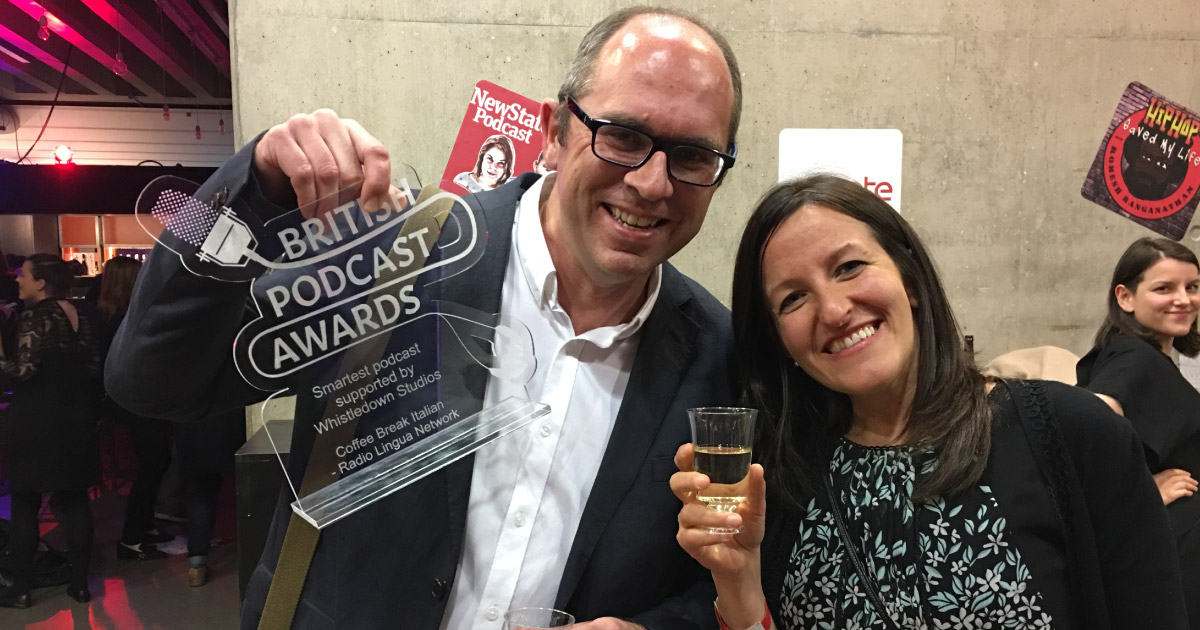
The British Podcast Awards took place last night in King’s Cross, London, and Coffee Break Italian was named Smartest Podcast 2017. Mark and Francesca were there to collect the award on behalf of the whole Coffee Break team.
The jury was made up of more than 50 independent judges from across the audio and media industry including representatives from The Observer, the Financial Times, New Statesman and The Sunday Times in addition to radio producers, film critics and journalists. Commenting on Coffee Break Italian, the judges said:
The gold goes to a completely new and novel use of the medium of podcasting with an approach that was light, funny and enjoyable which truly makes listeners more smart and informed, beyond their next dinner party.
Other winners included Mark Kermode and Simon Mayo’s Film Review podcast from the BBC, audioBoom’s Hip Hop Saved My Life with Romesh Ranganathan and The Inquiry from BBC Current Affairs for BBC World Service.
Special thanks to Olly Richards from I Will Teach You a Language who joined the Coffee Break team and helped us film a special episode of Coffee Break Conversations.
CBG 2.06 | Was hast du gestern gemacht?
In this lesson of Coffee Break German you’ll be starting to learn to talk in the past using the Perfect Tense. This tense is formed by using a part of the auxiliary verb haben (to have) and the past participle. Andrea will explain everything you need to know, and you’ll soon be saying what you did, what you cooked, what you ate and what you played yesterday, last week and 100 years ago!
CBC 1.10 | Review episode
In this lesson you’ll see how much you’ve learned in the first unit of the course. You’ll listen to a conversation in which Mark and Crystal play two characters who meet each other at a conference in Beijing university. You’ll be amazed at how much you understand, and there’s also some new vocabulary in this lesson too.
CBI 2.06 | Cosa facciamo stasera?
In this lesson you’ll consolidate what you already know about regular -are, -ere and -ire verbs and you’ll also review reflexive verbs. One of the most common uses of the present tense is in making arrangements, and in the dialogues of the lesson you’ll learn to make arrangements, identifying what you’re doing, when you’re doing it and where you’re meeting your Italian-speaking friends.