
It’s time to take a detailed look at a topic which, on the surface, can seem straightforward, but when you get into it in more detail it can get a bit more complicated. We’re talking about adverbs: words which “describe” a verb, or which give more information as how quickly, effectively, badly etc., you’re doing whatever it is you’re doing! We’ll look at the Italian equivalent of adding “-ly” to an adjective, but we’ll also consider other types of adverbs, and we’ll look at those tricky adverbs like molto. Are you 100% sure when to use molto and when to use molti/molte/molta? By the end of this lesson you’ll be confident with all kinds of Italian adverbs!
CBG 2.29 | Fährst du in die Schweiz, oder fährst du in der Schweiz?

Coffee Break German Season 2 is all about helping you “tighten up” your German, and this episode addresses one of the trickiest aspects of German for learners. You’re already familiar with prepositions, and you’re already familiar with the accusative and dative case, but did you know that there is a group of prepositions which can take the accusative OR the dative, depending on the situation? By the end of this lesson all will become clear and you’ll be able to make the correct decision every time with the help of Andrea and Mark.
CBF-ER 1.09 | Prochain Arrêt : Monaco

In this episode of En Route avec Coffee Break French, Mark heads to the Principality of Monaco where he attends the Changing of the Guard, meets Riviera blogger Kevin Hin, and experiences the ePrix, a version of the Grand Prix for electronic racing cars. As usual, you’ll be learning about the area while improving your French through the interviews and language study provided in the lesson.
To find out more about the French Riviera visit Kevin’s blog at french-riviera-blog.com.
Listen to the lesson
The audio lesson is free, as are all the main audio lessons of En Route avec Coffee Break French. Use the audio player above to listen to the lesson, or subscribe in Apple Podcasts to receive this lesson and all future lessons automatically. If you can’t see the player above, click here to access the lesson.
Accessing the Premium Version
In the full course of En Route you’ll get access to every episode as it’s released. The premium version includes additional materials which will help you move forward more effectively with your French studies:
- transcripts: read every word of French included in the conversations;
- vocabulary lists: in addition to the transcripts, we’ll provide vocabulary lists to help you understand everything that’s said;
- bonus audio materials: where an edited version of an interview is included in the main lesson, we’ll provide the full recording in the course to allow you to develop your comprehension skills further;
- exclusive video content: in addition to recording interviews in the south of France, the Coffee Break Team also filmed some video content and this video material is included in the course. Please note that these are not video versions of the interviews.
The En Route course can be accessed on the Coffee Break Academy.
Subscribe links
Subscribe on Apple Podcasts | RSS Feed | Purchase full course
CBC 1.26 | Talking about why you’re visiting China

In this episode of Coffee Break Chinese you’ll learn to increase your range of expression to deal with conversations when visiting China and explaining why you’re there, how long you’re there for, and how long you’ve been learning Chinese.
CBI 2.28 | Dopo aver fatto colazione, vado al lavoro

In this episode of Coffee Break Italian we’re looking at two constructions which will help you increase your range of expression easily and effectively. You’ll learn to use prima di + infinitive and dopo + past infinitive with both avere and essere verbs. Once you’ve mastered these expressions you’ll be able to talk about “before doing something” and “after doing something”, and understand the nuances of each of these expressions in their Italian translations.
CBG 2.28 | Deutschschüler sind Leute, die Deutsch lernen

Coffee Break German is the course which teaches you German. Andrea is the teacher who helps Mark learn. You are the student who is learning along with Mark, and this is the lesson in which you’ll learn all about relative pronouns in German! We’ll learn how to use relative pronouns to combine two clauses together and how relative pronouns work with different genders and cases. All will become clear!
CBG 2.27 | Wir sollten wirklich nach Zürich fahren

In this lesson we’re dealing with what, on the surface, seems like a tricky topic: the use of the verb sollen. We’ll learn to use the verb in the Present and Präteritum, and we’ll learn about the subtle differences of using each tense. Sollen is used to say what someone “should do”, or “ought to do”, and the key question involves whether or not you’re being given advice, a suggestion is being made, or indeed you’ve already been given orders by someone else (e.g. doctor, teacher, parent, etc.) to do it! Complicated stuff, but we’ll help you sort it all out!
CBI 2.27 | Fra 10 minuti dobbiamo essere da tuo zio!

We’re back with the second instalment of our two-part preposition marathon. In this episode you’ll learn all you need to know about the prepositions di, da, con, per and tra/fra. Once again, there are some crucial nuances with certain prepositions which can completely change the meaning, so listen carefully in this lesson! As usual, Francesca and Mark provide plenty of examples to help, and Isla puts what she learns to the test with a translation challenge. By the time you’ve completed this lesson you’ll be a preposition pro!
CBF-ER 1.08 | De Sospel à Gorbio
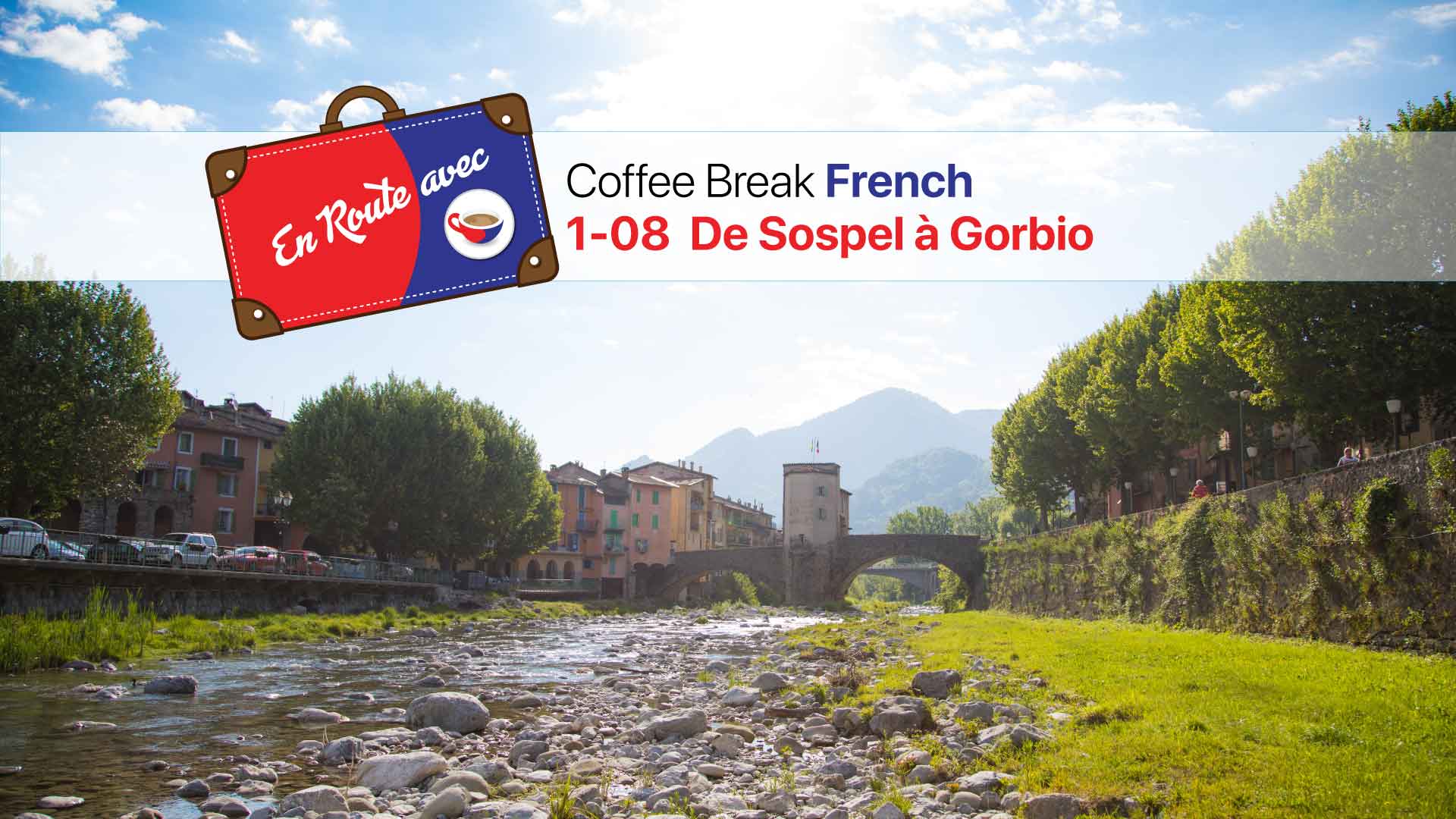
Welcome to our “frogs and dogs” episode of En Route avec Coffee Break French. In this episode Mark starts in the village of Sospel which straddles the Bévéra river and is a popular destination for walkers and cyclists. He then travels on to the village of Gorbio and has a coffee break with photographer Jilly Bennett whose passion is for photographing the life – and dogs – of the village. As usual, the episode is full of fascinating insights into the local area, and plenty of French to help you practise your listening skills.

To find out more about Jilly and her work, please visit her website.
Listen to the lesson
The audio lesson is free, as are all the main audio lessons of En Route avec Coffee Break French. Use the audio player above to listen to the lesson, or subscribe in Apple Podcasts to receive this lesson and all future lessons automatically. If you can’t see the player above, click here to access the lesson.
Accessing the Premium Version
In the full course of En Route you’ll get access to every episode as it’s released. The premium version includes additional materials which will help you move forward more effectively with your French studies:
- transcripts: read every word of French included in the conversations;
- vocabulary lists: in addition to the transcripts, we’ll provide vocabulary lists to help you understand everything that’s said;
- bonus audio materials: where an edited version of an interview is included in the main lesson, we’ll provide the full recording in the course to allow you to develop your comprehension skills further;
- exclusive video content: in addition to recording interviews in the south of France, the Coffee Break Team also filmed some video content and this video material is included in the course. Please note that these are not video versions of the interviews.
The En Route course can be accessed on the Coffee Break Academy.
Subscribe links
Subscribe on Apple Podcasts | RSS Feed | Purchase full course
CBC 1.25 | Dealing with emergencies in Chinese

In this episode you’ll learn to deal with emergencies in Chinese. Needless to say, we hope you never have to use this language, but it’s useful to know nonetheless! You’ll learn to talk about losing wallets, reporting stolen passports and asking for help in various situations. You’ll be ready for all eventualities by the time you’ve listened to this episode!
CBI 2.26 | Preferisci andare in palestra o a teatro?
This is the first of our two-part preposition marathon! In this episode you’ll learn all you need to know about the prepositions a, in and su. Using prepositions in Italian can be quite tricky, particularly because they don’t work the same way as in English. There’s also the fact that, when combined with the definite articles, the prepositions take on different forms. Through this lesson about (su) prepositions, you’ll learn to (a) use the prepositions in (in) the correct way!
Listen to the episode
The audio lesson is free, as are all the main audio lessons of Coffee Break Italian. Use the audio player above to listen to the lesson, or subscribe in iTunes to receive this lesson and all future lessons automatically. If you can’t see the player above, click here to access the lesson.
CBC 1.24 | Making phone calls and using the Internet in Chinese
In this lesson you’ll learn the words and phrases needed to make phone calls and use the internet in Mandarin Chinese.
CBG 2.26 | Kommst du jeden Dienstag mit dem Fahrrad zur Deutschklassen?
In this lesson we’re tackling a tricky subject for learners of German: word order. In particular we’re looking at where adverbs come “inside the Verbklammer”. For this we’ll be introducing you to a new concept: “Tekamolo”. All will become clear in this lesson.
CBF-ER 1.07 | Nissa La Bella

Our destination for episode 7 of En Route avec Coffee Break French is “Nice the beautiful”, as the city is referred to in the unofficial anthem which is in the local dialect, Niçard. In this episode Mark visits Nice, takes a ride on a vélotaxi and has a Coffee Break with a friend from Scotland who now lives and works in the area.
Listen to the lesson
The audio lesson is free, as are all the main audio lessons of En Route avec Coffee Break French. Use the audio player above to listen to the lesson, or subscribe in Apple Podcasts to receive this lesson and all future lessons automatically. If you can’t see the player above, click here to access the lesson.
Accessing the Premium Version
In the full course of En Route you’ll get access to every episode as it’s released. The premium version includes additional materials which will help you move forward more effectively with your French studies:
- transcripts: read every word of French included in the conversations;
- vocabulary lists: in addition to the transcripts, we’ll provide vocabulary lists to help you understand everything that’s said;
- bonus audio materials: where an edited version of an interview is included in the main lesson, we’ll provide the full recording in the course to allow you to develop your comprehension skills further;
- exclusive video content: in addition to recording interviews in the south of France, the Coffee Break Team also filmed some video content and this video material is included in the course. Please note that these are not video versions of the interviews.
The En Route course can be accessed on the Coffee Break Academy.
Subscribe links
Subscribe on Apple Podcasts | RSS Feed | Purchase full course
How to say “Cheers” in Irish … and much more!

Here at Coffee Break Languages we want to help share our love of languages with a worldwide community of language learners, and that’s why we’re celebrating St Patrick’s Day by making our course in Irish Gaelic available for free on YouTube. In this course you’ll learn to introduce yourself, make conversation with other Irish speakers, and crucially learn to say “cheers” as you toast your friends on Lá fhéile Pádraig, St Patrick’s Day.
So how do you say “Cheers”?
“Cheers” in Irish is sláinte which is pronounced a bit like “slawn-che”. Sláinte means “health”, and if you’re feeling brave, you can say sláinte is táinte (“slawn-che iss toin-che”), meaning “health and wealth”. “Cheers” is one of the words included in lesson 10 of our course. Also included in lesson 10 is “I love you”, which you may also need this St Patrick’s Day weekend!
What is Irish Gaelic?
Irish Gaelic is spoken by around 75,000 people in the Republic of Ireland and in Northern Ireland and it’s also an official language of the European Union. In the Republic of Ireland, Irish enjoys official status and the Irish words for a number of public titles and organisations have been adopted into Irish English, e.g. Garda (police), Dail (parliament), and Taoiseach (Prime Minister).
Irish is a member of the Celtic language group which includes Scots Gaelic, Welsh, Breton, Cornish and Manx. It’s closely related to Scots Gaelic and Manx, and an Irish speaker may understand a fair amount of written Scots Gaelic or Manx, though there is more variation in the spoken language, making it less mutually intelligible.
One important thing: make sure you know how to pronounce the word Gaelic properly: for Irish Gaelic, “Gael-” rhymes with the English word “sail”, while for Scottish Gaelic, “Gael-” rhymes with the English word “shall”!
What’s One Minute Irish?
Our One Minute Languages courses feature ten lessons and cover the absolute basics of the language. You’ll learn basic greetings and useful words, numbers 1-10, asking people “how are you?” and answering the question yourself and you’ll learn to say that you can speak a little Irish. You can access the full 10-lesson course in the video playlist below, or head over to our YouTube channel.
How do you say “Happy St Patrick’s Day” in Irish?
One final thing: since we’re making this course available for free to celebrate St Patrick’s Day, it’s only right that you learn how to say “Happy St Patrick’s Day” in Irish! Here’s a list of useful expressions:
- Lá fhéile Pádraig sona dhuit! – Happy St Patrick’s Day to you (singular)
- Lá fhéile Pádraig sona dhaoibh! – Happy St Patrick’s Day to you (plural)
- Beannachtaí na Féile Pádraig dhuit! – St Patrick’s Day blessings to you (singular)
- Beannachtaí na Féile Pádraig oraibh! – St Patrick’s Day blessings to you (plural)
We hope you enjoy learning some Irish with One Minute Languages. There will be more free courses on YouTube soon!
CBI 2.25 | Chi è quella persona che lavora in biblioteca?

In this episode you’ll learn everything you need to know about asking questions in Italian. We’ll cover come, dove, quando, chi, perché, quale, quali, quanto/a/e/i and, of course, che, che cosa and cosa! By the time you’ve completed this lesson you’ll be able to satisfy your curiosity in Italian by asking any question.
CBG 2.25 | Ich habe mich sehr gut entspannt
It’s time to look at reflexive verbs in the past. In this lesson you’ll learn to say what you enjoyed, what you complained about and what you looked forward to, and much more besides! Julia is back with a cultural correspondent segment on an area in Italy where German is spoken, Südtirol.
CBF-ER 1.06 | Les Villes Frontalières
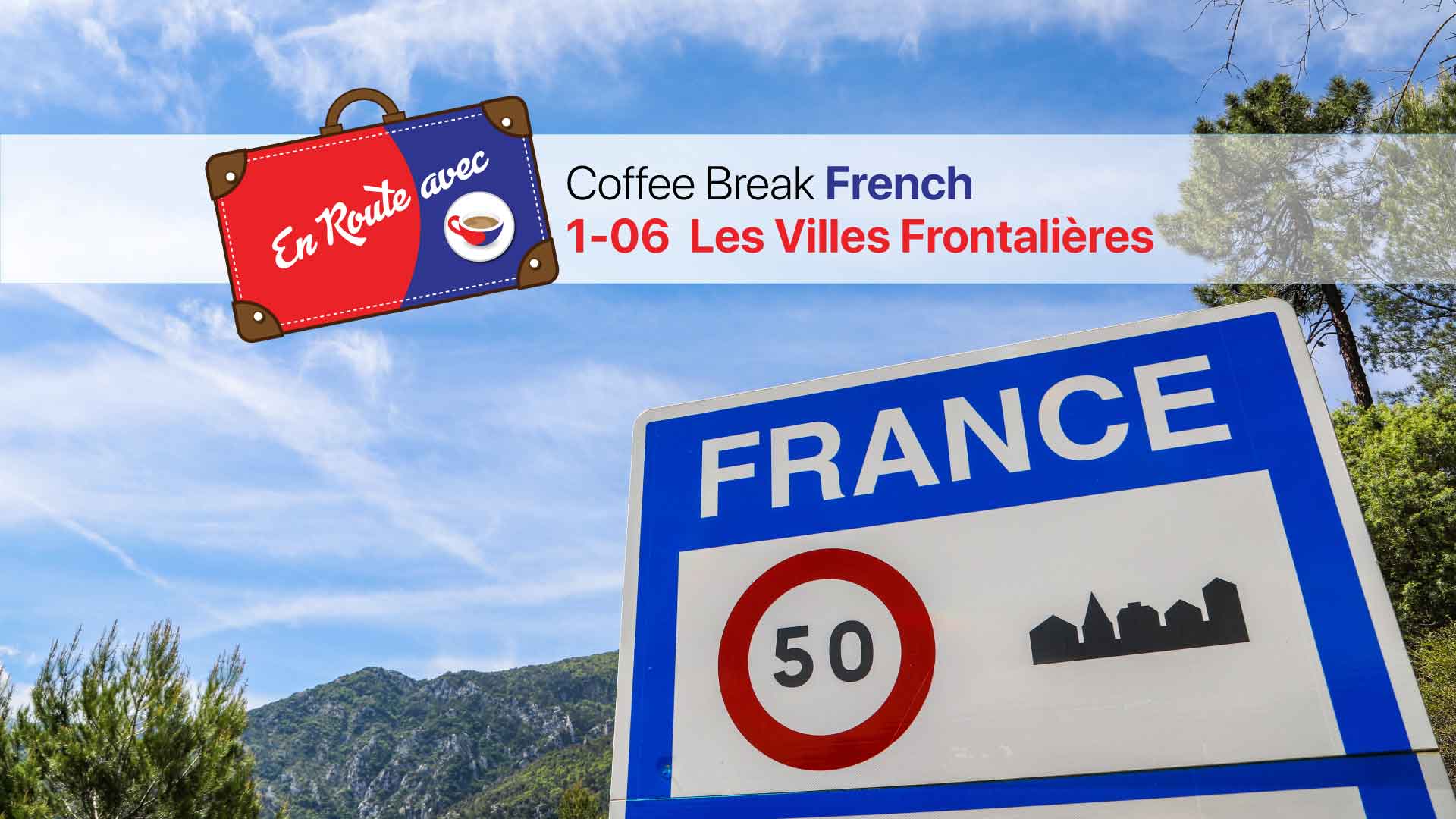
In this episode we’re investigating an interesting aspect of life in this part of France: what it’s like to live and work in a border town. Mark travels north to the town of Breil-sur-Roya, and to do so he has to cross the border between France and Italy a number of times. Through the conversations featured in this extended audio episode you’ll learn about life in les villes frontalières.
Listen to the lesson
The audio lesson is free, as are all the main audio lessons of En Route avec Coffee Break French. Use the audio player above to listen to the lesson, or subscribe in Apple Podcasts to receive this lesson and all future lessons automatically. If you can’t see the player above, click here to access the lesson.
Accessing the Premium Version
In the full course of En Route you’ll get access to every episode as it’s released. The premium version includes additional materials which will help you move forward more effectively with your French studies:
- transcripts: read every word of French included in the conversations;
- vocabulary lists: in addition to the transcripts, we’ll provide vocabulary lists to help you understand everything that’s said;
- bonus audio materials: where an edited version of an interview is included in the main lesson, we’ll provide the full recording in the course to allow you to develop your comprehension skills further;
- exclusive video content: in addition to recording interviews in the south of France, the Coffee Break Team also filmed some video content and this video material is included in the course. Please note that these are not video versions of the interviews.
The En Route course can be accessed on the Coffee Break Academy.
Subscribe links
Subscribe on Apple Podcasts | RSS Feed | Purchase full course
CBI 2.24 | Chi va a Roma perde la poltrona

In this lesson we’re focusing on combining the Perfect and the Imperfect which together allow us to tell stories in the past. You’ll consolidate what you already know about each of the tenses and you’ll recognise certain words and expressions which trigger the Perfect or the Imperfect. Francesca also has some mystery Italian personalities for us to identify in the Caffè Culturale.
CBC 1.23 | A visit to the pharmacy in Chinese
In this episode of Coffee Break Chinese we’re taking the topic of illnesses and ailments a stage further with a visit to the pharmacy where you’ll learn to describe your symptoms and understand the advice given to you by the pharmacist.
