In this dialogue chapter we finally get to hear the voice of a familiar character and, at long last, Yvette meets her father properly. We also witness Max and James’ reunion as they discuss the recent events. Throughout this dialogue chapter we hear many examples of informal, spoken French. Some interesting words and expressions to listen out for include: voir venir quelqu’un, épauler and c’est … tout craché.
CBSw 1.39 | Grattis på födelsedagen!

Welcome to the second last lesson of this series of Coffee Break Swedish! As we are nearing the end of this season we are looking at more colloquial Swedish and what typical smalltalk may sound like. We do so in the setting of Lovisa’s sister Linnea’s birthday party. Låt oss börja!
CBG 3.11 | The genitive with prepositions | Laut Aussagen es Fanclubs, wird Mark P. Pianist

In this lesson, we’re continuing with a topic which had been avoided up until Season 3 of Coffee Break German – the genitive! While it is possible to avoid using the genitive, when used correctly, it makes you sound like a true native speaker. Join hosts Mark and Andrea as they explore some prepositions with the genitive: wegen, infolge, gemäß, dank, außerhalb/innerhalb, and anstelle. Listen out for some interesting vocabulary along the way as well as a special news broadcast where we hear more genitive prepositions in context.
CBE 3.02 Extra | Visiting Australia

In the extra episode of Coffee Break English, our hosts Josie and Mark talk about their experiences visiting Australia.
CBI 3.11 | Introduction to the imperative | Anno nuovo, vita nuova!

In this week’s lesson of Coffee Break Italian Season 3 we’re looking at the following forms of the imperative: tu and voi forms; the negative imperative; irregular forms; and the imperative with pronouns. We also hear a dialogue between two colleagues, Carlo and Michela, who are back at work after their Christmas holidays.
CBE 3.02 | Dreamtime | Language focus: the present perfect tense
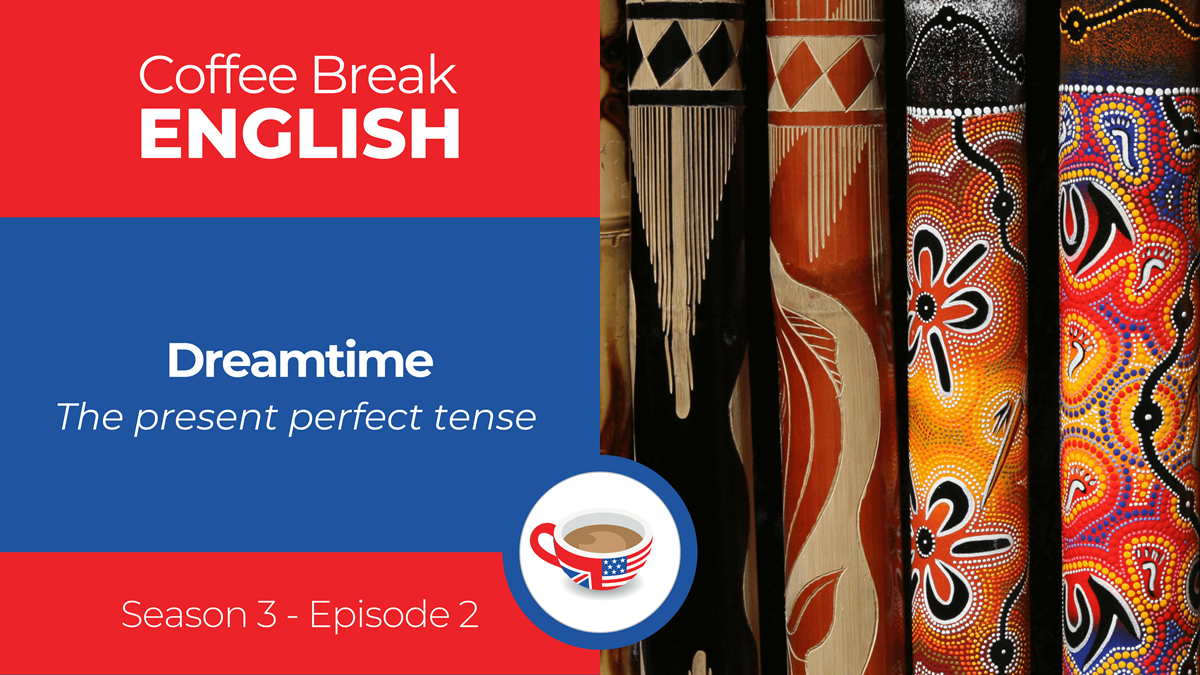
In this episode, we hear from Matthew in Australia. He talks about an important part of indigenous Australian culture, and we focus on when to use the present perfect tense for unfinished actions.
CBE 3.01 Extra | A Comparatives Quiz
In this season of Coffee Break English we’re bringing you an extra episode related to the content covered in our main episode on a Tuesday. In today’s extra episode, Josie and Mark are asking each other some quiz questions. Listen out for the comparatives!
CBE 3.01 | The Cheeseburger | Language focus: comparatives

In this episode, we hear from Kate in the USA. She tells us about the history of the cheeseburger, one of the world’s most popular foods. We also focus on the comparative adjectives.
Chapitre 38 – La seule chose qui comptait vraiment c’était Max !
In this chapter we’re in the police station, as James, Claire and Yvette give their witness statements and go through all the evidence they have against Roger. We revisit some interesting words and expressions that we’ve seen in previous chapters, such as: tenir la route, boucler and sévir. And, as always, we encounter some new interesting words and expressions like témoigner and être partant/e pour faire quelque chose.

CBG 3.10 | Review episode

We’ve reached Lesson 10 so it’s time to review everything we’ve learned so far in Season 3 of Coffee Break German! Throughout this lesson we’ll be reviewing the topics which Mark and Andrea covered in Lessons 1 – 9, from the Perfect and Imperfect Tense to the Genitive, Connectors and more. There are some exercises along the way, giving you the chance to put your knowledge to the test!
CBI 3.10 | Review of all pronouns | Caro diario…

We have reached Lesson 10 of Coffee Break Italian Season 3! In this review lesson we look at all of the pronouns covered in Lessons 1 -9: subject pronouns, reflexive pronouns, direct and indirect object pronouns and combined pronouns. We also hear from Silvia, a young girl who has written a journal entry all about a boy in her class, Tommaso, whom she likes. Some interesting phrases to listen out for include una volta per tutte and avere una cotta per. Pronti?
Chapitre 37 – J’ai eu la trouille de ma vie !
In this dialogue chapter, we hear the voices of James, Claire and Yvette. We join them on their way back from Louise’s and just when they start to relax, an unfamiliar four-by-four with tinted windows pulls up outside their hotel. Throughout this chapter we hear lots of informal, spoken language. Colloquial words & expressions we come across include: prendre un pot, taper dans l’œil quelqu’un and la trouille.
CBSw 1.37 | Följ med till kassan
In this lesson, Mark and Catriona are continuing their travels in Sweden and Lovisa brings them to the town of Askersund, just south of Örebro. We take a look at three separate conversations in three different settings as we explore Askersund. We also introduce some new words and phrases and look at different ways native speakers use the language. Låt oss börja!
CBG 3.09 | The Infinitive with um zu | Was soll ich tun, um durchs Land zu reisen?

In this lesson of Coffee Break German our hosts, Mark and Andrea, look at the infinitive structure with um zu which allows us to say “in order to”. We then hear this structure in the context of a conversation between characters Mike and Sandra who discuss Mike’s upcoming trip through Switzerland.
CBI 3.09 | Disjunctive pronouns | Amicizia e musica

In this lesson, Coffee Break Italian hosts, Mark and Francesca, introduce the last remaining category of personal pronouns to be discussed in this series: disjunctive pronouns. We then listen to a dialogue centred around the use of disjunctive pronouns. In the previous episodes, direct, indirect and combined pronouns were looked at quite extensively and you can refer to Episode 8 if you wish to have a brief overview.
Chapitre 36 – Il leva le poing en signe de victoire
In this chapter of La Vérité éclate toujours we discover the identity of the armed men and women who burst into the hospital. Finally, everyone is reunited and all that’s left to do is to go and see Max and tell him about everything that has happened. Some interesting constructions to look out for in this chapter: en déduire que and se devoir de.
CBSw 1.36 | Vad finns det att göra och se här?
In Lesson 36 of Coffee Break Swedish Mark and his wife continue their travels in Örebro and we join them on a trip to the tourist office where they find out which tourist attractions they can visit. We revisit some vocabulary we haven’t used in a while and take a closer look at some subtleties within the language. Låt oss börja!
CBG 3.08 | Connectors | Ohne zu meckern

This lesson of Coffee Break German is about “connectors”. These are words that join clauses or phrases in a sentence. Join Mark and Andrea as they look at a variety of different connectors and see how they function in a sentence while learning their meanings. We also have the chance to see connectors in the context of a mother and daughter talking about a pyjama party in our dialogue.
CBI 3.08 | Combined pronouns | Una macchina nuova di zecca

Welcome back to Coffee Break Italian Season 3! In this lesson, Mark and Francesca bring together direct and indirect object pronouns, and discuss what happens when both pronouns are used in one sentence at the same time. Before looking at this new grammar point, we remind ourselves what direct and indirect objects are and then listen to a dialogue centred around the use of combined pronouns.