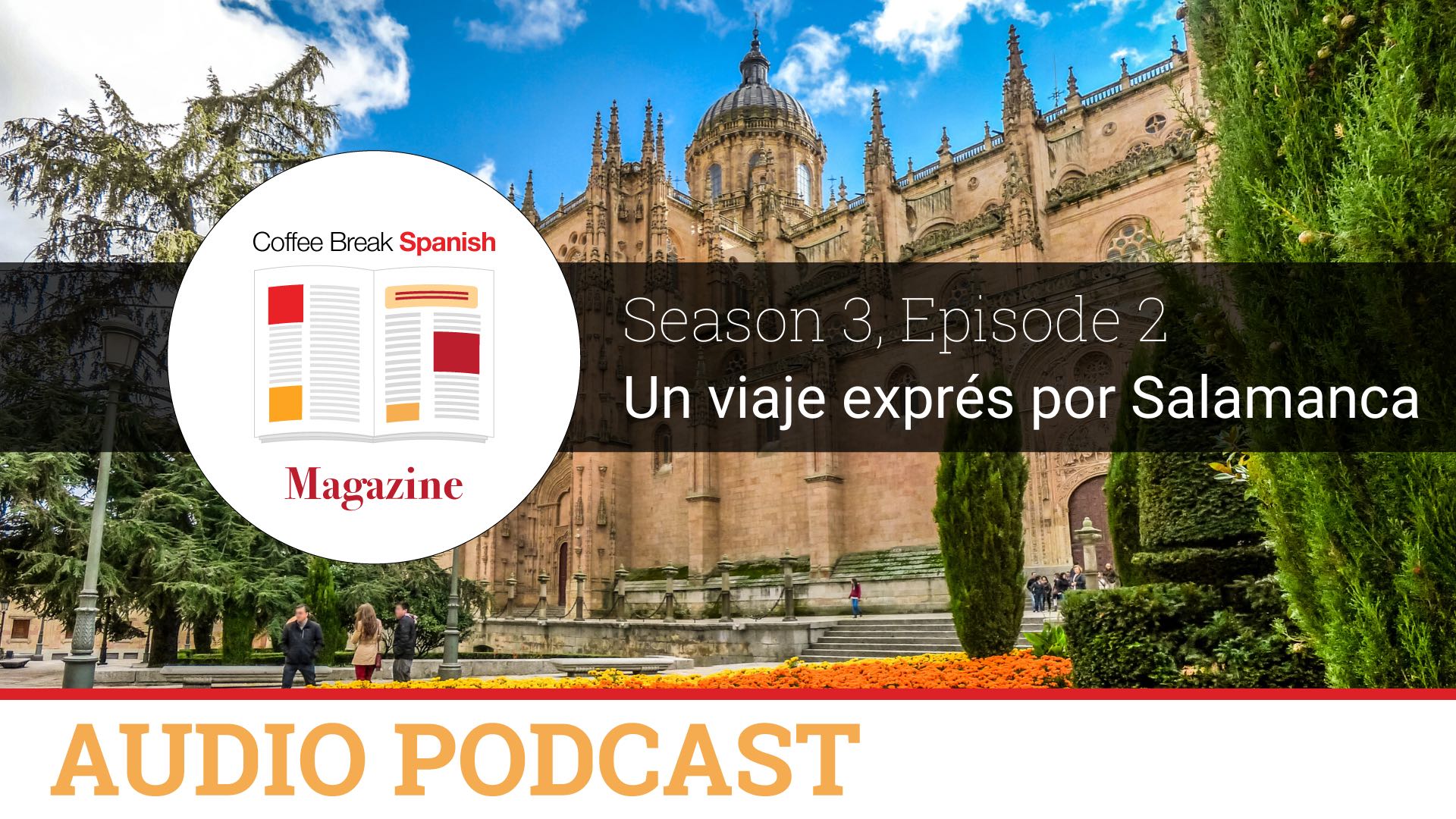
In this episode of the Coffee Break Spanish Magazine we’ll be investigating an astronaut and a dragon eating ice cream on the façade of a 17th Century cathedral. There’s only one city in the Spanish-speaking world where you can see such a thing, and that is Salamanca. Join Mark, Fernanda and Anabel for a quick trip to this jewel in the crown of Castilla y León. In our grammar section we’ll be answering listener Hanne’s question about using the subjunctive after the word cuando.
Day: November 29, 2019
8 German songs for learners

Listening to songs when learning German is an effective and enjoyable way to practise your language skills. German songs can help improve your listening comprehension and your pronunciation and, on top of this, music is catchy! This means that the new words, phrases and structures that you hear within a song may be easier to remember and reuse in your own speaking or writing.
Thousands and thousands of songs exist throughout the German-speaking world – where do you start with finding ones to listen to which will help you practise your German? In this article, we’ve done the hard work for you!
Read on to discover 8 German songs we recommend to help your learning.
1. Griechischer Wein – Udo Jürgens, 1974
As mentioned before, using music to learn a new language is an interesting and fun way to practise your skills. So, without further ado, let’s talk about our first suggestion on this list of German songs for learners: Griechischer Wein, by Udo Jürgens.
He was an Austrian-Swiss singer and composer who is partly remembered for winning the Eurovision Song Contest for Austria in 1966 with the song Merci, chérie. Many consider him to have played a large role in expanding German-language pop music by bringing in influences from other genres, such as French chanson.
Griechischer Wein is one of his most popular songs and versions in a number of different languages have since been recorded, including Bing Crosby’s version which he recorded during one of his last sessions, titled Come Share the Wine.
LINK: Lyrics
2. Ein bißchen Frieden – Nicole, 1982
If you are a Eurovision fan, perhaps you’ll remember Germany’s winning song from 1982, Ein bißchen Frieden, performed by 17-year-old school student, Nicole. In 2005, the European Broadcasting Union announced Ein bißchen Frieden as one of the 14 most popular Eurovision songs ever, according to the results of their Internet poll.
The song was written by Ralph Siegel and Bernd Meinunger and its success led to the recording of versions of it in many different languages. The English version, A Little Peace, reached Number 1 in the UK Charts.
Listen out for similes in this song’s first verse, as they are great examples of phrases of comparison in German. Just consider “wie eine Blume” or “wie ein Feuer” and you can spot the common construction introduced by the adverb “wie”. Another grammatical feature to look out for is the recurrence of embedded clauses beginning with the word “dass”.
LINK: Lyrics
99 Luftballons – Nena, 1983
In our look at German songs, this one is very popular and we’re sure may have heard the 80s hit 99 Red Balloons, which reached Number 1 in the UK and the US Charts, but have you tried listening to its original version in German? It was released in 1983 by German band, Nena, who were together between 1981 and 1987.
The band is very important to German musical culture, as it was part of the forming of the German New Wave scene (Neue Deutsche Welle). 99 Luftballons was a huge success across Europe, leading to the writing of the English version the year after.
Unfortunately, Nena never managed to match the success of 99 Luftballons and the band broke up after the release of its fourth, final and least successful album in 1986. They reunited in 2017 for a public performance of their debut single, Nur geträumt, to mark the 40th anniversary of the band’s first appearance on stage.
The lyrics to 99 Luftballons tell the story of the release of 99 balloons. These are mistaken for UFOs and the reactions of different nations result in a destructive war breaking out. The lyrics to 99 Red Balloons aren’t an exact translation but carry the same anti-war message.
Like many German songs, this one contains several interesting language points that you may recognise. For instance, it demonstrates the differences in building the plural form of nouns. For example, the words “Kriegsminister” and “Düsenjäger” remain in the same form when made plural.
On the other hand, the nouns “Luftballons” and “Jahre” change in their plural form. Something else to note is the omission of the personal pronoun in sentences like “Hab’ nen Luftballon gefunden”. This song is also good practice for your numbers in German! Before you look at the lyrics, see if you can count how many times you hear her sing “neunundneunzig” (“ninety-nine”).
LINK: Lyrics
4. Mensch – Herbert Grönemeyer, 2002
When talking about German songs, we could not leave out the title track of Germany’s best-selling album of all time. Mensch sold over 3 million copies in Germany and thanks to this success and the popularity of his fifth album, 4630 Bochum (1984), Herbert Grönemeyer is often considered one of the most successful German artists.
One prominent language feature of this song is the frequent use of the conjunction “und”. In German, this word is often added to form sentences with multiple dependent clauses. Also, listen out for examples of compound words, such as “Sonnenzeit” or “ozeanblau”.
LINK: Lyrics
5. Der perfekte Moment… wird heut verpennt – Max Raabe, 2017
The fifth recommendation in this article about German songs comes from an artist with a very interesting musical style. Max Raabe founded his Berlin-based Palast Orchester with fellow students in the mid-1980s while studying opera in Berlin.
Together, Raabe and Palast Orchester perform covers of cabaret songs from the Weimar period as well as original songs that merge 1920s and 30s melodies with modern lyrics. As well as this, they have recorded some covers of modern pop songs in a 1920-30s style, including Britney Spears’ Oops!… I Did It Again!
The title track of their most recent album, Der perfekte Moment… wird heut verpennt, is among the list of good German songs for learners as it allows you to practise your listening comprehension, where Raabe sings in nice, clear German. As you’re listening, it is particularly interesting to take a look at all the idioms the song contains.
Most of them are used to describe that the singer will not do anything today, for example, “Heut’ mach’ ich gar nichts/Keinen Finger krumm”. “Was ich heut’ besorgen kann” is especially interesting, because it is a play on the original saying “Was ich heut’ kann besorgen, verschieb’ ich nicht auf morgen”.
LINK: Lyrics
6. Sowieso – Mark Forster, 2016
The sixth recommendation in our list of German songs is Sowieso by Mark Forster. This track is an upbeat song that talks about embracing life’s uncertainties. Mark Forster, a well-known figure in the German pop music scene, released this song in 2016, and it quickly became a hit.
Sowieso is perfect for German learners because the lyrics are clear and easy to follow, making it a great choice for practising listening comprehension. As you listen, pay attention to phrases like “Egal, was kommt, es wird gut, sowieso” and other interesting expressions.
LINK: Lyrics
7. Barfuß am Klavier – AnnenMayKantereit, 2013
Released in 2013, this song by the German rock band AnnenMayKantereit is a beautiful ballad. The band’s distinctive sound is characterised by the deep voice of the lead singer Henning May, which adds a unique touch to their music.
Barfuß am Klavier is part of this German songs list due to its poetic lyrics, offering listeners a glimpse into the band’s heartfelt storytelling.
LINK: Lyrics
8. Auseinandergehen ist schwer – Wanda, 2014
The last on our list of German songs is “Auseinandergehen ist schwer” by the Austrian band Wanda. The band is known for their catchy melodies and honest lyrics.
The song is sung in clear German, making it an excellent choice for learners who want to practise their listening skills and expand their vocabulary relating to relationships and emotions.
LINK: Lyrics
We hope this article has given you a useful introduction to just a tiny proportion of the huge variety of German songs which are out there. In our special Tune for Tuesday – German playlist you can find some more examples to learn the language with some catchy rimes. Don’t forget to save it.
If you want to get access to more interesting content like this, make sure to subscribe to our Coffee Break German newsletter!