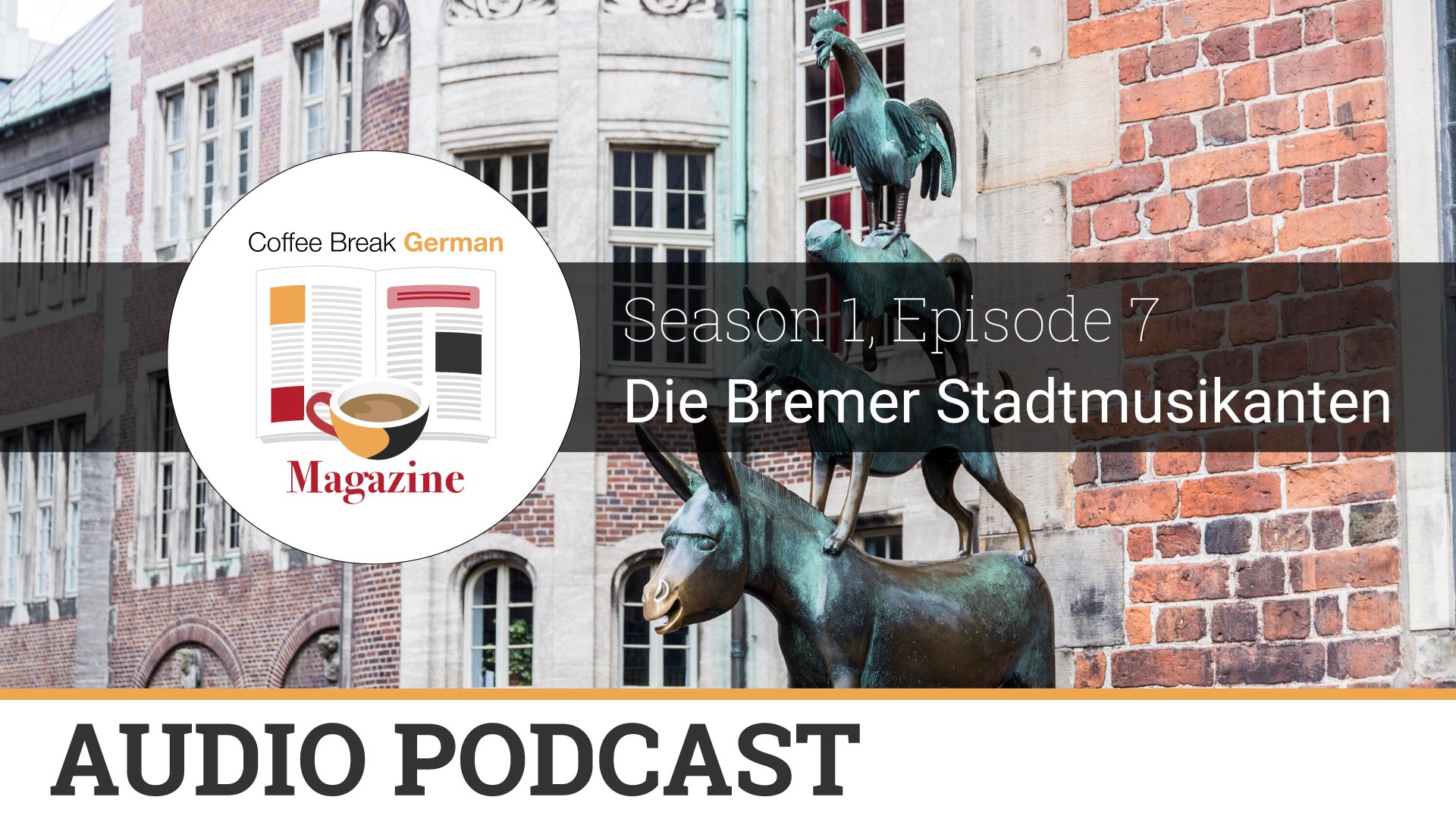
Have you heard the one about the donkey, the dog, the cat and the rooster? In this episode of the Coffee Break German Magazine we’re finding out about the famous Town Musicians of Bremen. First published in Grimms’ Fairy Tales in 1819, Die Bremer Stadmusikanten has become a key part of the cultural legacy of the German-speaking world. We’ll also hear from listener Nick who wants to know more about the small but versatile word doch, and Olivera is back with another long German word.
Day: November 22, 2019
8 Spanish Songs For Learners

Any learner wanting to have more contact with the language that they are learning should try to listen to music. That is why we ask you “do you know any songs for learning Spanish”?
There are so many different songs available that it might be hard to find a playlist at a beginner level for the Spanish-speaking world. But, don’t worry! In this article, we’ve done the hard work for you and selected 8 songs in Spanish specifically for that purpose!
1. ¡Y viva España! – Manolo Escobar, 1973
The first music on our list of Spanish songs for learners was actually written by a Belgian composer and Belgian lyricist, Leo Caerts and Leo Rozenstraten. It started out as Eviva España, a song about holidaying in Spain, imitating the Spanish pasodoble musical style (the name given to a style of Spanish dance and music often played during bullfights).
It seems that the meaning behind “Eviva” in the title is unknown, but when the song was translated into Spanish, this became “Y viva”. Manolo Escobar’s 1973 recording of the Spanish version of the song was extremely successful.
Escobar was a very well-known singer, actor and performer of Andalusian copla, a style of Spanish popular song. He began his career in a band with four of his brothers, called Manolo Escobar y sus guitarras.
There are many interesting language points to listen out for in this song. Don’t worry if there are some words you don’t recognise, as there are a few unusual pieces of vocabulary, for example, “fandanguillos y alegrías” are styles of Spanish music and dance.
Listen out for the many different verb tenses used in the lyrics, including the line which uses both the present perfect and the future tense, “España siempre ha sido y será…” (“Spain has always been and always will be…”). And, of course, you may quickly notice the repeated Spanish subjunctive in the chorus “Que viva España” (“Long live Spain”), as this is expressing a desire that something will happen
LINKS: Lyrics | English translation
2. La Puerta de Alcalá – Ana Belén & Víctor Manuel, 1986
If you have ever visited Madrid, it is likely that the title of this next song will conjure up images of Madrid’s famous monument of the same name. Inaugurated in 1769, La Puerta de Alcalá is often associated with similar Roman arches such as the Arc de Triomphe and the Brandenburg Gate.
Over 200 years later, La Puerta de Alcalá, the song, was written by Bernardo Fuster, Luis Mendo, Miguel Ángel Campos and Francisco Villar, to be performed by Ana Belén and Víctor Manuel. These two Spanish singers were married in 1972 and are often considered symbols of the Spanish Transition to Democracy, with many of their songs expressing strong social and political opinions.
Their recording of La Puerta de Alcalá stayed at Number 1 in the Spanish charts for seven weeks and it remains an important song for many Madrileños because of its link with the monument. In our list of songs for learning Spanish, this one has interesting lyrics as it contains several more complex phrases, and each verse of the song refers to a different socio-political event that has affected Madrid and its famous monument.
Amongst the many language points to look out for within the lyrics, listen out for the refrain “Ahí está, la Puerta de Alcalá” (“There it is, La Puerta de Alcalá”). You can remember this line as a good example of when to use ser or estar in Spanish to describe the position of something.
LINKS: Lyrics | English translation
3. En el muelle de San Blás – Maná, 1997
Our next song comes from a Mexican pop-rock group formed in 1986, whose name, Maná, comes from the Polynesian term for supernatural energy. They have won 4 Grammy Awards and are extremely popular throughout Latin America and further afield.
Their song En el muelle de San Blás tells the story of Rebeca Méndez Jiménez, who is said to have waited at the pier of San Blás, on the Pacific coast of Mexico, for 41 years for her husband to return from a fishing trip. It is thought that he tragically got caught in a storm out at sea and never returned. One day, she was noticed by Fher Olvera, the lead singer of Maná, who listened to her story and decided to write the song.
The lyrics are a good challenge for your Spanish comprehension, so we recommend reading them as you listen to the song another time so that you can fully understand the story being told. They also contain many examples of the preterite and the imperfect tenses in Spanish.
LINKS: Lyrics | English translation
4. Color esperanza – Diego Torres, 2001
Born in Buenos Aires, Diego Torres is a singer, songwriter, actor and musician who is well-known throughout Latin America, the United States and Spain. He is also known for being the son of famous Argentinian film actress, Lolita Torres. His uplifting song, Color esperanza, focuses on hope. In 2003, Torres gave a special performance of it in order to welcome Pope John Paul II to Cuatro Vientos Airport in Madrid.
Torres sings quite clearly and the lyrics aren’t too complex and, of course, contain many examples of language points you have been learning about. For example, note the interesting phrase in the chorus, “Saber que se puede, querer que se pueda”, which can be used to compare the use of the indicative and the subjunctive.
This would be a good example to memorise, to help you remember the structures “saber que + infinitive” and “querer que + subjunctive”. For sure music that deserves to be on the list of songs for learning Spanish!
LINKS: Lyrics | English translation
5. El mismo sol – Alvaro Soler, 2015
The fifth tune on our suggestion of songs for learning Spanish was one of the hits of the summer of 2015 in Spain and across Europe. El mismo sol is the debut single of Spanish-German singer, Alvaro Soler. Following the success of the song, there are now various recordings of it. Soler collaborated with Jennifer Lopez to create a version with the addition of her vocals, and a version in Spanglish, El Mismo Sol (Under The Same Sun), with some lyrics in English.
The lyrics to this positive, upbeat song focus on the idea of a united world where “no hay fronteras” (“there are no borders”) and where “todos estamos bajo el mismo sol” (“we are all under the same sun”). And also, luckily for us, they are sung nicely and clearly!
We recommend reading the lyrics and trying to find some useful examples of the language points you have been studying. For example, note the double subjunctive in the first line of the chorus, “Yo quiero que este sea el mundo que conteste”.
We’d also like to take a moment to admire Soler’s impressive number of languages. It is said that he speaks Catalan, Spanish, German, English, Italian, French and Japanese!
LINKS: Lyrics | English translation
6. Todo se transforma – Jorge Drexler, 2015
Jorge Drexler’s “Todo se transforma” released 14 years ago, is a timeless classic that talks about the interconnectedness of all things. As the Uruguayan artist says:
Nada es más simple
No hay otra norma
Nada se pierde
Todo se transforma
Nothing is simpler
There is no other rule
Nothing is lost
Everything transforms
The song lyrics are an excellent resource for learners looking to expand their vocabulary. The way Drexler plays with words and ideas offers a unique opportunity to understand deeper, more abstract concepts in Spanish.
LINKS: Lyrics | English translation
6. Cuando te mueras – Jósean Log, 2020
Jósean Log’s “Cuando te mueras” is a very emotional song that brings to light themes of ageing and companionship. Its lyrics are a great example of Spanish songs with subjunctive, a crucial aspect of grammar.
Although the song’s theme might be intense, it offers a profound learning experience, illustrating the depth of Spanish linguistic and emotional expression.
LINKS: Lyrics | English translation
7. Te guardo – Silvana Estrada, 2022
Released in 2022, this song stands out as a captivating piece that blends traditional Mexican folk elements with contemporary influences. The lyrics are poetic and talk about personal experiences and universal emotions.
The release of “Te guardo” in 2022 marked another milestone in Silvana Estrada’s career. As a rising star in the Latin music scene, Estrada continues to enchant listeners with her unique sound and storytelling, solidifying her place as a significant voice in contemporary music.
LINKS: Lyrics | English translation
8. Si no estás – Íñigo Quintero, 2024
If you are an active user on TikTok you might have come across this trendy song. The lyrics of “Si no estás” are poetic and relatable, painting a vivid picture of the void left by a loved one’s absence.
Lines like El tiempo pasa lento sin tu sonrisa Time passes slowly without your smile and Mis días son oscuros si no estás My days are dark if you’re not here showcase the artist’s ability to express complex emotions with simplicity and grace.
LINKS: Lyrics | English translation
We hope this article has given you a useful introduction to just a tiny proportion of the huge variety of Spanish-language music which is out there, across the whole Spanish-speaking world.
Two of the songs we have chosen, La Puerta de Alcalá and En el muelle de San Blás, are already included in our Tune for Tuesday on our Spotify playlist.
Now, how about understanding more about how you can use songs to improve your language learning? Check our blog post on the subject and make the most of your journey!