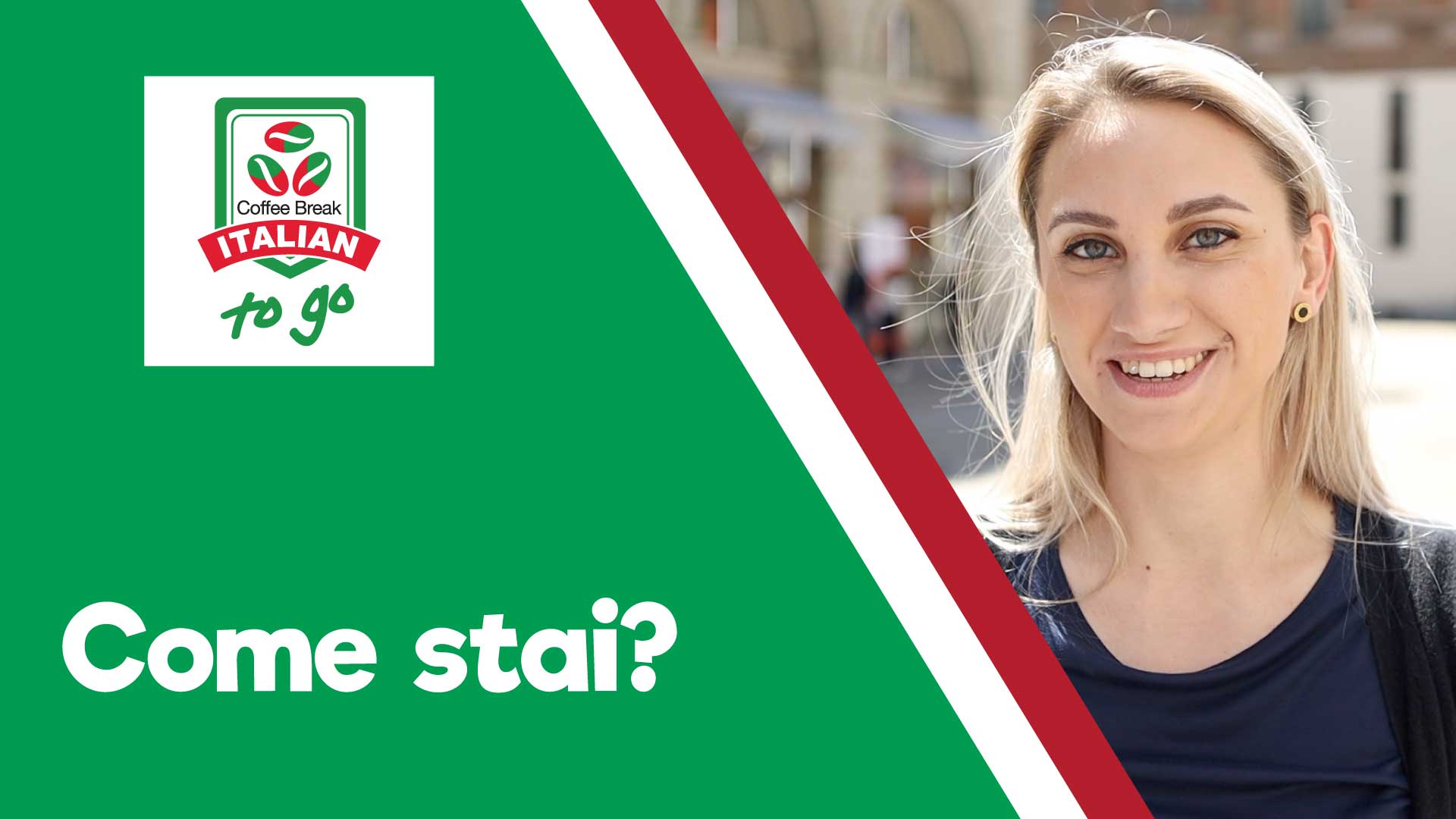
Come stai? / Come sta? – “How are you?” – Coffee Break Italian To Go Episode 1

To ask “how are you?” in Italian you can say come stai?, or in a more formal situation, come sta? In this episode of Coffee Break Italian To Go, Francesca asks this question to passers-by in the streets of Milan. You can use the answers of our interviewees to help you learn to introduce yourself in Italian.

In the first part of the video, watch the interviews without subtitles and try to understand. In the second part of the video, we’ve provided subtitles in Italian at the top of the screen. You can choose to turn on subtitles in English using the Subtitles/CC button.

In this first series of Coffee Break Italian To Go, Francesca is in the town of Milan, in the north of Italy, and in each episode she’ll ask passers-by one question. Of course, that one question will result in many answers, and it’s through these answers that you can practise your Italian and build your vocabulary.

Coffee Break Italian To Go will be published every two weeks here on YouTube, and each Season will be filmed in a different part of the Italian-speaking world.

If you’d prefer not to wait for all 10 lessons of Season 1 to be published, you can access downloadable versions of the videos along with audio versions and lesson notes / transcripts in the Coffee Break Academy.

Coffee Break Italian To Go is based on the popular podcast series and online course Coffee Break Italian. For access to the free podcasts, please click here.

To purchase our full online courses on the Coffee Break Academy, click here.

TFT: C’est écrit

Do you already know any songs by Francis Cabrel? The iconic sound of his acoustic guitar in his songs such as Petite Marie, La corrida and Je l’aime à mourir has made them well-loved by many across the French-speaking world, and he is generally considered to have been an extremely influential figure in the development of popular music in France. After winning a competition for French singer-songwriters in 1974, at the age of 21, he released his first album, Les murs de poussière in 1977. His music is usually described as folk, occasionally with blues and country influences. As today’s Tune for Tuesday, we’ve chosen his beautiful 1989 single, C’est écrit.

If you’re a Coffee Break French learner, listen out for the many examples of different verbs in the future tense within the lyrics. We hope they will also help you to remember some irregular future stems: listen out for “Elle te fera changer…” and “Elle voudra que…” and note the irregular stems of faire and vouloir. To help you, we recommend reading the lyrics as you listen to the song another time. You can find them online by clicking here. Or, if you’d like to hear the song played more slowly, we recommend watching the YouTube video below and selecting a slower playback speed by clicking on the settings symbol.

We hope you enjoy listening to C’est écrit and would love to hear what you think of it, or of any other Francis Cabrel songs that you know, in the comments.

Unser Tag in Potsdam – Coffee Break German Travels with Julia and Mark

Join Coffee Break German Cultural Correspondent Julia and learner Mark for a trip to the beautiful town of Potsdam where Julia grew up. Mark puts his German into practice with Julia’s help and together they visit various parts of Potsdam including the Russische Kolonie Alexandrowka, the Holländisches Viertel, and Park Sanssouci.

We’ve provided English captions for the whole video, and all German used in the video has both German and English subtitles. Click on the Subtitles/Closed Captions (CC) button.