
Today, we are looking at a single German word that many learners come across early in their studies: ziehen. You might have seen it on doors, where it means “to pull.”
However, this verb is one of those versatile ones in German and it has multiple meanings depending on the context. Let’s explore some of these diverse uses.
The Coffee Break German Show is a video and audio podcast series of short discussions, in which we explore interesting German language topics. Join Mark and Thomas in our latest episode for a thorough look at this interesting German verb.
Keep reading to find out more, and we’d recommend listening to the podcast episode as you read. Plus, don’t miss our free worksheet at the end to practise what you learn!
What does the verb ‘ziehen’ mean?
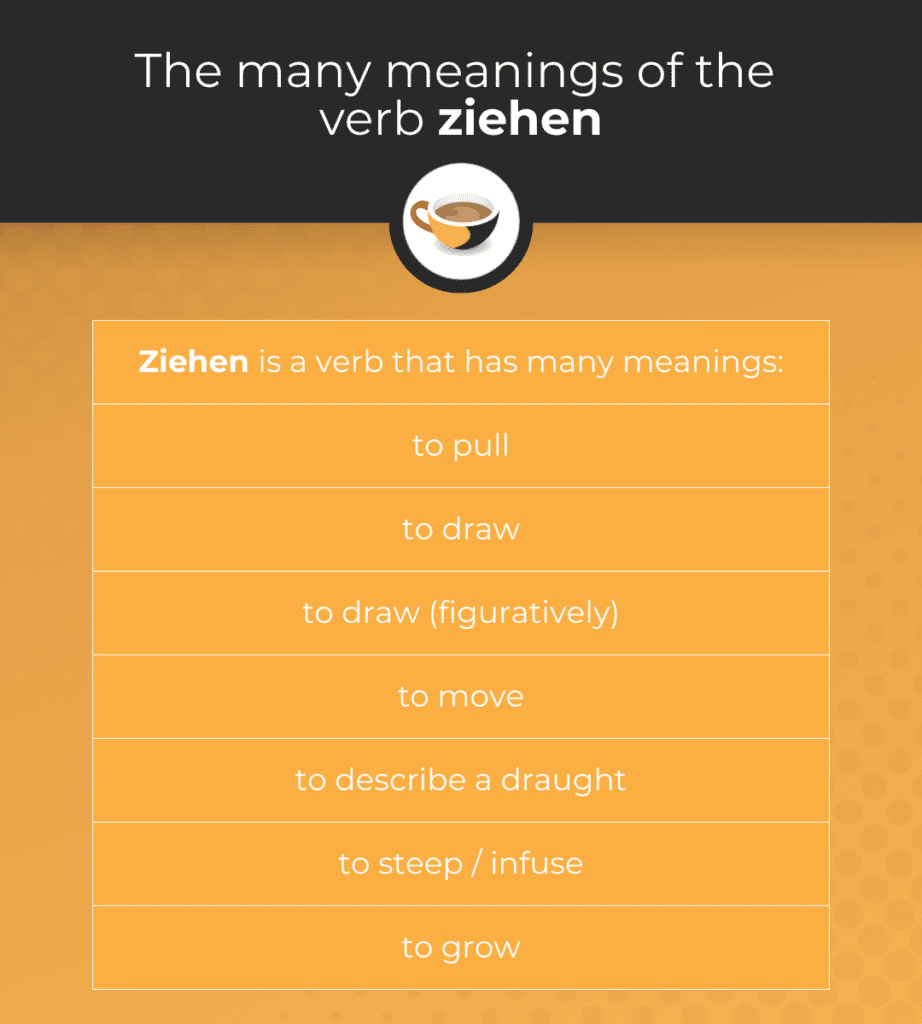
We may be familiar with ziehen meaning “to pull”. However, as you’ll see below, it has many different meanings in addition to this.
The core meaning: “to pull”
At its core, it often means “to pull”. This is a straightforward translation that appears in many everyday situations. For example:
Der Hund zieht an der Leine.
The dog pulls on the leash.
Bitte zieh nicht an mir.
Please don’t pull (on) me.
This second example uses the imperative in German and both sentences here show use of the preposition an with the verb ziehen.
Another meaning: “to draw”
A closely-related meaning of this verb is “to draw”, as in drawing a card or drawing conclusions:
Zieh eine Karte.
Draw a card.
Er hat die richtigen Schlüsse gezogen.
He has drawn the right conclusions.
Sometimes, it implies a figurative pull or attraction:
Im Sommer zieht es uns ans Meer.
In summer, we are drawn to the sea.
Es hat keinen Sinn, wir müssen hier einen Schlussstrich ziehen.
It makes no sense, we need to draw a line here.
Further meanings: moving and more
Ziehen also means “to move” in the context of changing residences. For instance:
Wir werden nächstes Jahr nach Japan ziehen.
We will move to Japan next year.
Another common use relates to draughts or wind:
Es zieht, bitte mach das Fenster zu.
There’s a draught, please close the window.
When making tea, the verb also describes the steeping process:
Der Tee muss 5 Minuten ziehen.
The tea needs to steep for 5 minutes.
In a gardening context, it refers to growing plants:
Er zieht die Gurken in seinem Treibhaus.
He grows cucumbers in his greenhouse.
Lastly, let’s see the verb in a practical, everyday situation:
Er zieht den Koffer in das Haus.
He pulls the suitcase into the house.
Time to practise!
Now, it’s time to put everything you’ve learned to the test. Try translating the following sentences into German. You can find the answers at the end of this blog article.
- He pulls his suit out of the wardrobe.
- We are moving to Spain next year.
If you found this interesting, make sure to watch or listen to the full episode with Thomas and Mark on The Coffee Break German Show. To keep up to date with new Coffee Break German episodes and lessons, subscribe to our YouTube channel or our podcast feed, wherever you get your podcasts.
What’s more, you can sign up to receive regular, free German lessons straight to your inbox. Look out for the sign-up box and we hope that you enjoy your first mini lesson.
The verb ziehen is a fantastic example of how German verbs can be incredibly flexible. From pulling and drawing to moving and growing, the verb covers a wide range of actions and scenarios. Understanding its various uses can significantly enhance your comprehension and fluency in German. Keep an eye out for this versatile verb in your reading and listening, and you’ll soon master its many contexts.
In the meantime, happy Coffee Breaking!
PS. Here are the answers to the translation challenge:
- Er zieht seinen Anzug aus dem Kleiderschrank.
- Nächstes Jahr ziehen wir nach Spanien. / Wir ziehen nächstes Jahr nach Spanien.