
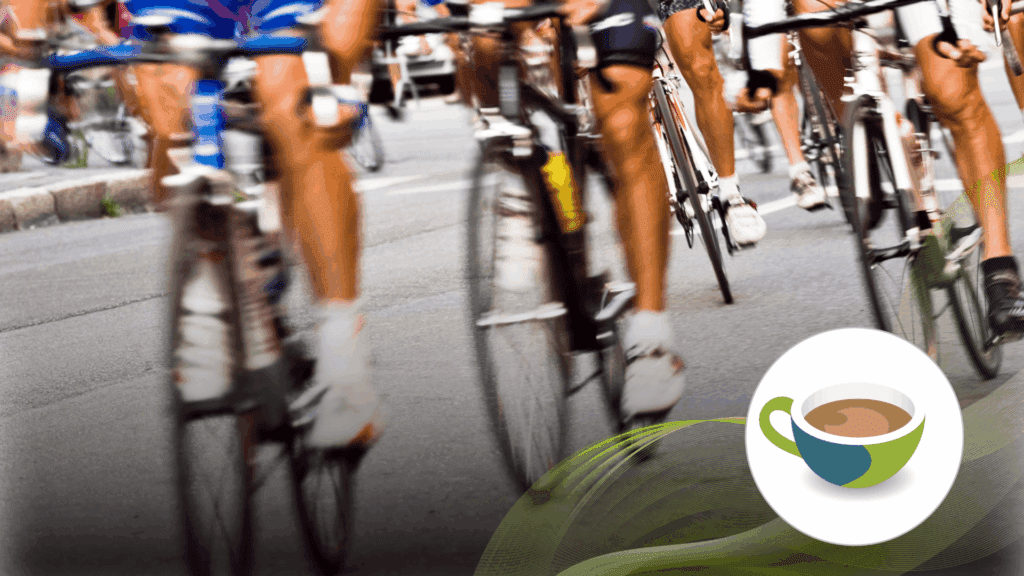
Every year, France plays host to one of the largest annual sporting events in the world: Le Tour de France. For 23 days, competitors cycle 2000 miles through 21 different stages, covering mountain ranges and coastal villages. With all of its twists, turns, rapid sprints and gruelling ascents, the event can serve as a powerful source of inspiration and motivation to learn a new skill. In this case, that skill could be a new language.
Whether you’re just starting out or you’re close to reaching your goals, learning a language is a lot like competing in a challenging race: you need the motivation to learn and the perseverance to overcome challenges. So, get on your bike and come along for the ride with us!
Motivation to learn: your prologue to success
It’s day one. You’re lined up at the start of the race and can’t wait to get going. Though your nerves are threatening to take over, you set your sights on your end goal as you wait for the sound of the starting pistol.
When you first start learning a language, it can feel a lot like the opening stage of the Tour de France, which is called the prologue. At this initial stage of learning a new language, it’s likely that you’ll feel that you’re advancing quickly with all of the new vocabulary you’re using each day. After all, this initial enthusiasm provides the perfect motivation to learn and sets the foundation for future success.
The most helpful thing you can do for yourself at this stage is to find a method or technique for learning a language which you enjoy. Whether it’s listening to podcasts, using apps, writing out colourful notes or going to language ‘tandems’ (pardon the pun!), you’ll be much more likely to reach that final ‘Champs-Elysées’ stage if you enjoy what you’re doing.
Building consistency: the flat stages of language learning
You are still filled with excitement and passion for the challenge you’ve taken on, but the further you advance, the more you realise how much is ahead of you. From here on, there’s no room for freewheeling.
After the initial rush of the prologue, language learning often moves into a steady, consistent phase. So far, you’ve been learning colours, numbers and days of the week, but to be able to advance further, it’s time to move up a gear and tackle grammar and more complicated learning points.
This is when it’s crucial to find the motivation to learn through practising your skills consistently. Make sure to keep enjoying what you’re doing and try to immerse yourself in the language as much as possible, as this helps maintain your motivation to learn. Try listening to the radio in your new language every day, watch TV shows with subtitles or attend evening classes to keep your ear tuned to the sounds of the language.
Think of this moment of your language learning path as the flat stages of the Tour, where the race is less dramatic, but no less essential to reaching the finish line.
Overcoming challenges: the mountain stages
Uh oh… You’ve hit the dreaded ‘wall’ and everything feels like an uphill climb that might never end. You’re at the back of the group; other people keep whizzing past you, and you can’t help but compare your progress to theirs. Make sure not to backpedal, you can do this!
Inevitably, every language learner faces obstacles. Anyone who has spent time learning a language will undoubtedly be familiar with ‘the wall’. This is when things start to feel more challenging than in the earlier stages.
As learning a new language isn’t something that can be done overnight, it’s only natural that there will be peaks, troughs and the odd plateau along the way. That is why this part of the journey is comparable to the mountainous stretches of the Tour, where every climb tests a cyclist’s endurance.
So, if you find yourself in a language-learning rut, why not try different activities and introduce some variety to your learning? Try something creative, like using sticky notes or flashcards to help you memorise vocabulary.
Changing your regular routine will stop things from becoming monotonous and will reinvigorate you, providing the motivation to learn and to get you to the next stage! Most importantly, as the saying goes, “if you fall off your bike, the best thing to do is get back on and keep pedalling”.
Confidence boost: time trial to the finish
The end is in sight, and it’s time to get your head down and perhaps even switch up a gear. Perhaps you are reminded of why you decided to take on this challenge in the first place, which gives a sudden burst of motivation. Although there are still some mountains to climb, your confidence is coming back and you’re racing along the route towards the finish line.
One of the biggest obstacles in any major challenge is the fear of making mistakes. In language learning, the most important thing to do at this stage is to think about how far you’ve come. When you have the opportunity to put what you’ve learned into practice, don’t be embarrassed; just go for it.
There’s an Italian expression, sbagliando s’impara, which means that it’s only by making mistakes that you actually learn. Once you have this breakthrough moment and realise that nobody will laugh if you get a word wrong, there will be no stopping you!
This is also the stage where you begin to feel comfortable in the language, and you’ll experience a renewed sense of motivation to learn. At this stage, your confidence grows, so enjoy the feeling of ‘freewheeling’ as you put your language learning into practice.
Celebrating achievements: the Champs-Elysées of language learning
Bravo ! You’ve won the yellow jersey! After countless ups, and just as many downs, you can be proud to say that you’ve accomplished what you set out to do at the beginning.
At this stage, it’s important to remember that reaching this level doesn’t necessarily mean that you will be mistaken for a native speaker, or that you won’t muddle up a verb conjugation now and again. What it does mean is that you can deal with a variety of different situations in the language you’re learning and that you are no longer afraid of making mistakes!
Your motivation to learn has carried you through challenges, and now you’re ready to celebrate your success. Bear in mind that language learning is a lifelong journey, not a race, and there is so much to enjoy en route. With some of the skills you’ve already picked up, you’ll be ready for the Giro d’Italia or the Vuelta d’España next!
Embracing the open road: what’s next?
Of course, it’s not just about the language: just as the cyclists who have completed the Tour de France will have built their stamina, developed their fitness, and hugely increased their mental focus, you will also have acquired a whole range of additional skills and attributes that go along with learning a language.
Whether it is developing confidence, boosting your memory, becoming more creative, widening your cultural awareness, or even making new friends, these benefits can fuel your motivation to learn!
So, which language are you going to learn next? No matter where you are on your language-learning path, remember that the motivation to learn comes from the whole journey!
1 thought on “Inspiration and motivation to learn a new language from the Tour de France”
This was great! Suggestions from the Academy team always seem to come when I’m feeling frustrated about my progress. “S’bagliando s’impara.”