
Navigating a new place can be challenging, but knowing how to ask for and understand directions in French makes it much easier. In this article, we’ll cover essential vocabulary and phrases to help you find your way around French-speaking areas.
Whether you’re looking for a restaurant or the nearest bank, these phrases will come in handy.
Key locations
Before we dive into directions in French, it’s important to familiarize yourself with some common places you might need to find:
- le restaurant the restaurant
- le musée the museum
- le marché the market
- le supermarché the supermarket
- la banque the bank
- la cathédrale the cathedral
- la piscine the swimming pool
- la place the square
- l’office de tourisme the tourist office
- l’église the church

Asking for Directions
When you need to ask for directions in French, it’s important to be polite and clear. Here are some essential phrases and how to use them in different contexts:
Où est … ?
This is the simplest and most direct way to ask where something is. For example:
- Où est le restaurant ? Where is the restaurant?
Où est la banque, s’il vous plaît ?
Adding “s’il vous plaît” (please) makes your request more polite. It’s a good habit to include this in your questions, especially when asking strangers for help. For instance:
- Où est la cathédrale, s’il vous plaît ? Where is the cathedral, please?
Où se trouve la banque, s’il vous plaît ?
This phrase is a bit more formal and can be used interchangeably with “Où est la banque, s’il vous plaît ?” It implies that you’re asking for the specific location of the bank. Examples include:
- Où se trouve l’office de tourisme, s’il vous plaît ? Where can I find the tourist office, please?
La banque, s’il vous plaît ?
This is a very concise way to ask for directions in French, often used when you want to quickly grab someone’s attention or when you’re in a hurry. It’s less formal and might be followed by a more detailed question or statement. For example:
- Le supermarché, s’il vous plaît ? The supermarket, please?
Giving directions in French
Once you’ve asked for directions, understanding the response is crucial. And if any French speaker comes to you and asks you about a direction. Here are some phrases you might find useful:
- allez tout droit go straight ahead
- tournez à gauche turn left
- tournez à droite turn right
- et puis and then
Would you like to learn the pronunciation of these phrases to ask and give directions in French? In episode 13 of Season 1 of the Coffee Break French podcast, you can learn how these phrases and more are pronounced in French. Listen to it now:
Proximity Questions
When asking for directions in French, it’s often helpful to know how close or far a location is from your current position. Here are some useful phrases to help you determine proximity:
C’est près d’ici ?
This phrase is a simple and direct way to ask if a location is close to where you are. It’s informal and commonly used in casual conversations. For example:
- Le musée, c’est près d’ici ? Is the museum near here?
Est-ce que c’est près d’ici ? (more formal)
This is a more formal way to ask if something is nearby. It’s useful in more polite or formal contexts, such as when speaking with someone you don’t know well. For example:
- Est-ce que la banque est près d’ici ? Is the bank near here?
C’est loin d’ici ?
This phrase helps you find out if a location is far from your current position. It’s straightforward and informal, suitable for everyday use. For example:
- La cathédrale, c’est loin d’ici ? Is the cathedral far from here?
Est-ce que c’est loin d’ici ? (more formal)
This is a more formal way to ask if something is far away. It’s polite and can be used in more formal situations. For example:
- Est-ce que l’office de tourisme est loin d’ici ? Is the tourist office far from here?
Example dialogue
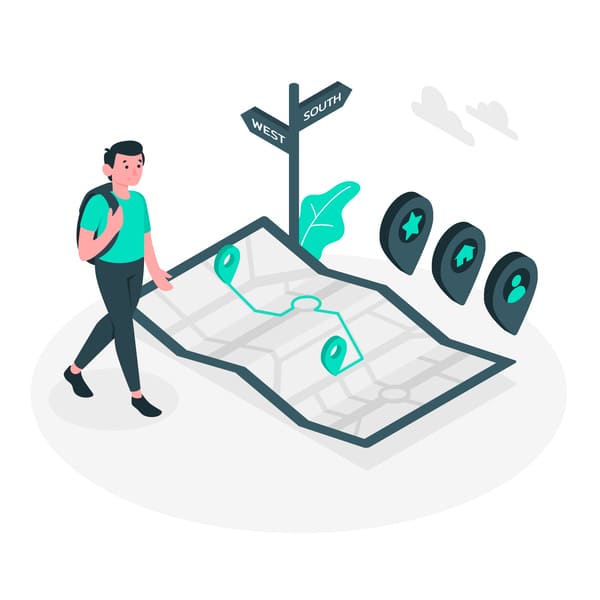
To give you a practical example of how to ask for directions in French, here’s a dialogue that incorporates the vocabulary and phrases seen above:
You: Bonjour, où est la banque, s’il vous plaît ?
Local: Bonjour ! Allez tout droit, puis tournez à gauche. La banque est à côté de la cathédrale.
You: Merci beaucoup ! Est-ce que c’est près d’ici ?
Local: Oui, c’est très près d’ici, à environ cinq minutes à pied.
Translation:
You: Hello, where is the bank, please?
Local: Hello! Go straight ahead, then turn left. The bank is next to the cathedral.
You: Thank you very much! Is it near here?
Local: Yes, it’s very close, about a five-minute walk.
Mastering directions in French is a valuable skill that enhances your travel experiences and daily interactions in French-speaking areas. By learning key locations and essential phrases, you’ll be well-equipped to ask for and understand directions with ease. Remember to practice regularly and don’t hesitate to ask locals for help—they’re usually more than willing to assist!
Do you want to keep improving your French skills and learn how to talk about what is there in your town? Then check the article we prepared to help you with this!
17 thoughts on “Asking and giving directions in French”
You are excellent. I love listening to the both of you and also the short segments are perfect.
Just Excellent pair of Anna and Mark. Don’t ever break up your company.
I enjoy the lesson so much and it’s so easy to understand because of your correct speed.
PLEASE keep up the superb Work. I am sure other listener also agree with me.
My grand daughter is only 11 month old and I would like to teach her FRENCH through your lessons and Anna is the wright student to teach her in her innocent Baby voice., and so is Mark too. You are great. My hat off to you.
merci! amateur learning french, finding the lessons very helpful.
J’adore vos podcasts. Merci beaucoup.
I’m traveling to France in a few weeks and these podcasts are really helping me to brush up on my high school French from over forty years ago!!
I am enjoying the French lessons so much, and I loved learning the words to a French Christmas carol in Lesson 10! I am wondering what the phrase is that Mark says at the very end of Lesson 13–I have heard him say it before–it sounds a little like “A tous est a toute” but I can’t quite figure out what he is saying.
This is the only French lessons that I literally listen to all day between telephone calls, I can’t wait to get onto it first thing in the morning and when I am finished work for the day I have it on my MP3 player. keep it up and thankyou so much
I agree Mark and Anna – J-adore tu et vous. These (free) lessons really are helping me w/the pronounciation which is the hardest. My native language is Spanish and I speak English fluently for 30 years so I can make out the French when reading.
The lessons are fun and I replay them over and over. Thanks so much, I will tell all my friends about your CBF! Merci Beaucoup, muchas gracias, thanks a lot! A plu tard, and vive le vent, Anna.
Merci beaucoup pour votre lessons superb. Merci beaucoup Mark et Anna pour aider les nouveau francophonies! J’adore votre accents aussi.
j’ecoute ces lessons tous les jous. C’est tres bien pour les femmes et hommes qui sont tres occupe’.
GOOD!
I never thought I would understand or speak French, and now I am! Bc of ur wonderful coffee break French! Lesson by lesson, I am actually getting it! Merci beaucoup Marc et Anna!
This is by far the best podcast I have found for learning French. I am amazed at how much I’ve learned in just 17 lessons. I feel I can go to France on holiday now and at least converse a little. Thank you for these great lessons. I have recommended them to friends and they also love them!
merci…you are the best.
Someone has a really creepy obsession with an “innocent baby voice”. Saying it once, cool. Saying it twice, O.K.. Saying it in every comment… creepy as heck.
Tres bien. Merci beacoup Marc et Anna
Is it: il est tres occupe (with an grave accent over the e in tres)
elle est tres occupee ( again with a grave accent over the e in tres and an acute accent over the first e in occupee
ils sont tres occupes (again with the grave accent)
and elles sont tres occupees (again with the grave accent and the accute accent)? I have tried putting the accents in but I just can’t.
this lessons are really helping me out understanding and speaking french. merci beaucoup!