Knowing how to react in a Spanish conversation can significantly enhance your fluency and make you sound more like a native speaker. Therefore, using Spanish filler words to react in a conversation is key.
That’s why we didn’t want to finish this season of The Coffee Break Spanish Show without bringing you some tips on how to perform better in your speaking in Spanish. In this article, we’ll explore common reactions and filler words in Spanish that will help you sound natural and confident in your conversations. ¡Qué ganas!
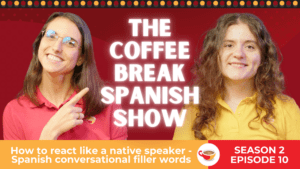
The Coffee Break Spanish Show is a series of short, informal podcast episodes, in which we discuss tricky but useful topics for Spanish learners. In the latest episode, Anabel and Concha introduce some of the main Spanish filler words, teaching you how to properly use them in a real conversation and sound more like a native speaker.
Listen along to the audio episode, or watch the video version, while you read this article. Once you reach the end, don’t miss your free worksheet which you can download to put what you’ve learned to the test. ¡Empecemos!
Common Spanish filler words to react in a conversation
Now we are going to look at some of the main Spanish filler words, which will help us navigate any conversation in the language like a native speaker! We have included filler words in Spanish more focused on how to react to news and also some other phrases or Spanish filler words that will show you are engaged in the conversation. ¡Empezamos!
¿En serio?
This phrase is perfect for expressing surprise, whether it’s after hearing good or bad news. It’s similar to the English “really?”. An example of this use in a conversation is:
A: Me voy dos meses a Tailandia.
A: I’m going to Thailand for two months.
B: ¿En serio? ¡Qué bien!
B: Really? That’s great!
¡Qué rollo!
Use this phrase to show that you find something boring or bothersome. It is similar to the English “how boring!” and “what a pain!”. In this phrase, we can find the word rollo, which means “roll” or, in slang, “boring’.
Let’s see how to use this one taking the same example about a trip to Thailand. This time, let’s imagine that speaker A doesn’t like travelling.
A: Me voy dos meses a Tailandia.
A: I’m going to Thailand for two months.
B: ¿En serio? ¡Qué rollo!
B: Really? What a pain!
Now we can also see how ¿en serio? can be used to react to negative news. Listen to the audio episode or watch the video to notice the difference in intonation when using this reaction filler after good and bad news. The difference is subtle, so you may want to listen to it several times.
¡Qué pena!
Another one of our Spanish filler words (another phrase in this case) is ¡qué pena!. Similar to English, this phrase expresses condolences about a situation – it’s like saying “what a shame!”. Also, in the following example you can see it’s possible to use multiple filler words in the same sentence to convey more nuanced reactions.
A: No podemos ir de vacaciones.
A: We can’t go on holiday.
B: ¡Oh, no! ¿En serio? ¡Qué pena!
B: Oh, no! Really? What a shame!
¡Qué me dices!
This phrase is used to show surprise, whether good or bad, and can be interchangeable with ¿en serio?, or you use one after the other to emphasise your surprised reaction.
It’s important to differentiate it from ¿qué me dices? (“what are you telling me?”), which is an actual question where the speaker wants you to repeat what you said. In a conversation, the intonation shows the difference between them. It may be good to listen to or watch the episode to get a better grasp of this.
A: Mis amigos me prepararon un viaje sorpresa y nos fuimos una semana a Francia.
A: My friends organised a surprise trip for me and we went to France for a week.
B: ¡Qué me dices! ¡Qué guay!
B: Really? How cool!
¡No me digas!
Similar to ¡qué me dices! and ¿en serio?, we have ¡no me digas!. It literally means “don’t tell me”, but in some contexts it’s simply used to express surprise. For example:
A: Me voy a casar el mes que viene.
A: I’m going to get married next month.
B: ¡No me digas! ¿En serio? ¡Qué bien!
B: No way! Really? So cool!
¡Qué lío!
Use this to express that a situation is complex or a mess. For instance:
A: Pensaba que tenía que hacer una presentación el lunes, pero me dijo mi jefe que era el martes. Llega el lunes y me dicen que tenía que hacerla ese día. ¡Y no me había preparado nada!
A: I thought I had to do a presentation on Monday, but my boss told me that it was on Tuesday. Monday arrived and I was told that I had to do it that very same day. And I didn’t have anything ready!
B: ¡Qué me dices! ¿En serio?
B: Really? Are you joking?
A: Sí, sí. Y resulta que el tema de la presentación era otro del que me habían dicho.
A: Yes. And it seems that the topic of the presentation was different from what I was told.
B: ¡No me digas! ¡Qué lío!
B: No way! What a mess!
Ya / sí
One of the most versatile filler words in Spanish is ya. It is incredibly useful to show that you are following the conversation. It’s simple but effective. Instead of ya, or along with it, we can also use sí or ajá. These three filler words in Spanish will show you are engaged in the conversation.
A continuación, we have transcribed the conversation between Anabel and Concha from this episode of The Coffee Break Spanish Show, but we’d recommend listening to it in the video or audio episode, too, to hear how it sounds in a real conversation.
Anabel: ¿Qué vas a hacer este fin de semana?
Anabel: What are you going to do this weekend?
Concha: Este fin de semana, Anabel, me voy a París.
Concha: Anabel, this weekend I’m going to Paris.
Anabel: Ah, ¡qué bien!
Anabel: Ah, how cool!
Concha: Sí, voy a París para ver a mi amiga, que vive allí.
Concha: Yes, I’m going to Paris to see my friend, who lives there.
Anabel: Ajá, sí.
Anabel: (simply showing attention to the conversation)
Concha: Y vamos a visitar muchos museos.
Concha: And we are going to visit many museums.
Anabel: Ay, ¡qué bien!
Anabel: Oh, how cool!
Concha: Sí, pero creo que va a llover.
Concha: Yes, but I think it’s going to rain.
Anabel: Ah, ¡qué mal!
Anabel: Oh, no. How bad!
Concha: Sí… no, no. Espero que no llueva.
Concha: Yes, I know… I hope it won’t rain.
Anabel: Oh, lo siento.
Anabel: Aw, I’m sorry.
Summary of some common Spanish filler words to react in a conversation

Learning how to react like a native speaker in a Spanish conversation involves mastering various Spanish filler words. By using expressions like ¿En serio?, ¡Qué rollo!, ¡Qué pena!, ¡Qué me dices!, ¡Qué lío!, and the versatile ya, you’ll not only sound more natural but you will also enhance your conversational skills. So, practise these reactions and see how they transform your Spanish interactions!
If sounding more natural and more like a native speaker is one of your main goals, then make sure you check out another episode of The Coffee Break Spanish Show, which is all about how to sound more natural in Spanish in restaurants and shops. Or, if you’d like to find out how to ask for the bill like a native speaker, you can find a video all about this here. ¡No te lo pierdas!
¡Eso es todo por este episodio! We hope that you have enjoyed this episode about Spanish filler words and how to use them to react in a conversation, and we also hope you enjoyed this season of The Coffee Break Spanish Show. If you found this article useful, why not listen to the full episode with Anabel and Concha on The Coffee Break Spanish Show? For more episodes for Spanish learners, make sure to subscribe to our podcast feed and our channel on YouTube.
As well as this, you can sign up to receive regular, free email lessons to help you improve your Spanish. You will also receive language-learning tips and tricks from Mark, the founder of Coffee Break Languages. Just look out for the sign-up box!
Muchísimo ánimo, and, as always,
Happy Coffee Breaking!