When talking about events in the past in German, we often have to make the choice between using the perfect tense and the imperfect tense, also known as the preterite (Präteritum).
While both tenses are grammatically correct in most situations, there’s a clear favourite in spoken German: the perfect tense. However, there are some verbs that German speakers tend to use almost exclusively in the imperfect tense, even in casual conversation.
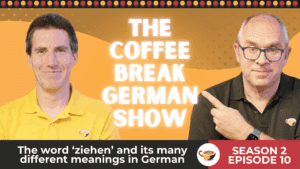
The Coffee Break German Show is a podcast series of bite-sized, friendly conversations in which we chat through interesting German language topics. In the latest episode, Mark and Thomas talk about how to sound more like a native speaker by using particular past tenses when speaking in German. Join them as they go through a list of verbs that are usually used in the imperfect (rather than the perfect) when talking about the past in German.
Continue reading to find out more and why not listen to the podcast as you go? Plus, don’t miss our free worksheet at the end to practise what you learn!
‘sein’ (to be) in the imperfect tense
First up, we have sein (“to be”), which becomes ich war in the ich form. Let’s see an example of sein in the imperfect tense.
Gestern war sie im Museum und hat sich die neue Ausstellung angeschaut.
Yesterday she was at the museum and checked out the new exhibition.
Here, war, the imperfect tense, is used in the first part, while the perfect tense, hat … angeschaut, is used in the second part. This mixture of tenses is very common in German since the choice often depends more on the verb than on the context of the situation, especially in spoken German.
‘haben’ (to have) in the imperfect tense
Next, let’s talk about haben (“to have”), which becomes ich hatte in the ich form. Here’s an example:
Wir hatten leider kein gutes Wetter und haben die meiste Zeit im Hotel verbracht.
Unfortunately, we didn’t have good weather and spent most of the time in the hotel.
Again, the imperfect tense, wir hatten, is used here because the perfect tense alternative, wir haben gehabt, would sound almost unnecessarily complicated and long to a native speaker.
‘wissen’ (to know) in the imperfect tense
Then, there’s wissen (“to know”), which becomes ich wusste in the ich form. For example:
Ich wusste nicht, was ich machen sollte.
I didn’t know what I should have done.
Using wusste sounds much more natural in the imperfect than the perfect tense form of the verb.
Modal verbs in the imperfect tense
Let’s not forget about modal verbs. Modal verbs like müssen and können are often used in the imperfect tense in German to express necessity, ability, or desire in the past.
wollen > wollten
können > konnten
müssen > mussten
dürfen > durften
mögen > mochten
sollen > sollten
Have a look at the following examples:
Du musstest nur den Knopf drücken.
You only had to press the button.
Sie konnten gestern nicht kommen, obwohl sie wollten.
They couldn’t come yesterday, even though they wanted to.
‘es gab’ (there was/were)
Moving on to expressions such as es gab (“there was/were”), es gibt is commonly used to say “there is” or “there are”. In the past in German this is always seen in the imperfect. For example:
Wir haben gestern meine Freunde besucht und es gab Kuchen.
Yesterday, we visited my friends and there was cake.
‘etwas ging/lief’ (something went)
And finally, we have etwas ging/lief (“something went”). Es geht and es läuft are also expressions used frequently in German. However, in the past, the imperfect is the past tense of choice. Take a look at these examples:
Der Vortrag ging viel zu lang.
The lecture went on for way too long.
Das Training lief sehr gut.
Training went really well.
Das Interview lief sehr gut.
The interview went very well.
Verbs such as ging and lief are commonly used in the imperfect tense to describe how something unfolded in the past.
A visual summary of when to use the imperfect in German

So, the next time you find yourself recounting past events in German, we hope that everything you’ve learned here comes in useful.
If you found this interesting, make sure to listen to the full episode with Thomas and Mark on The Coffee Break German Show where they talk more about past tenses in German. We will regularly be uploading more episodes for German learners, so make sure to subscribe to our podcast feed and our channel on YouTube to find out when the next episode is available.
Plus! To get regular, free German lessons in your inbox, you can sign up for our short (coffee-break-sized) email lessons that will help you improve your German. You will also hear from Mark, the founder of Coffee Break Languages, giving advice for language learners at any level. Sign up below, and we hope that you enjoy the first lesson that arrives in your inbox.
Happy Coffee Breaking!